Blog

  • Day 3: Paris, Part 1

    Day 3: Paris, Part 1

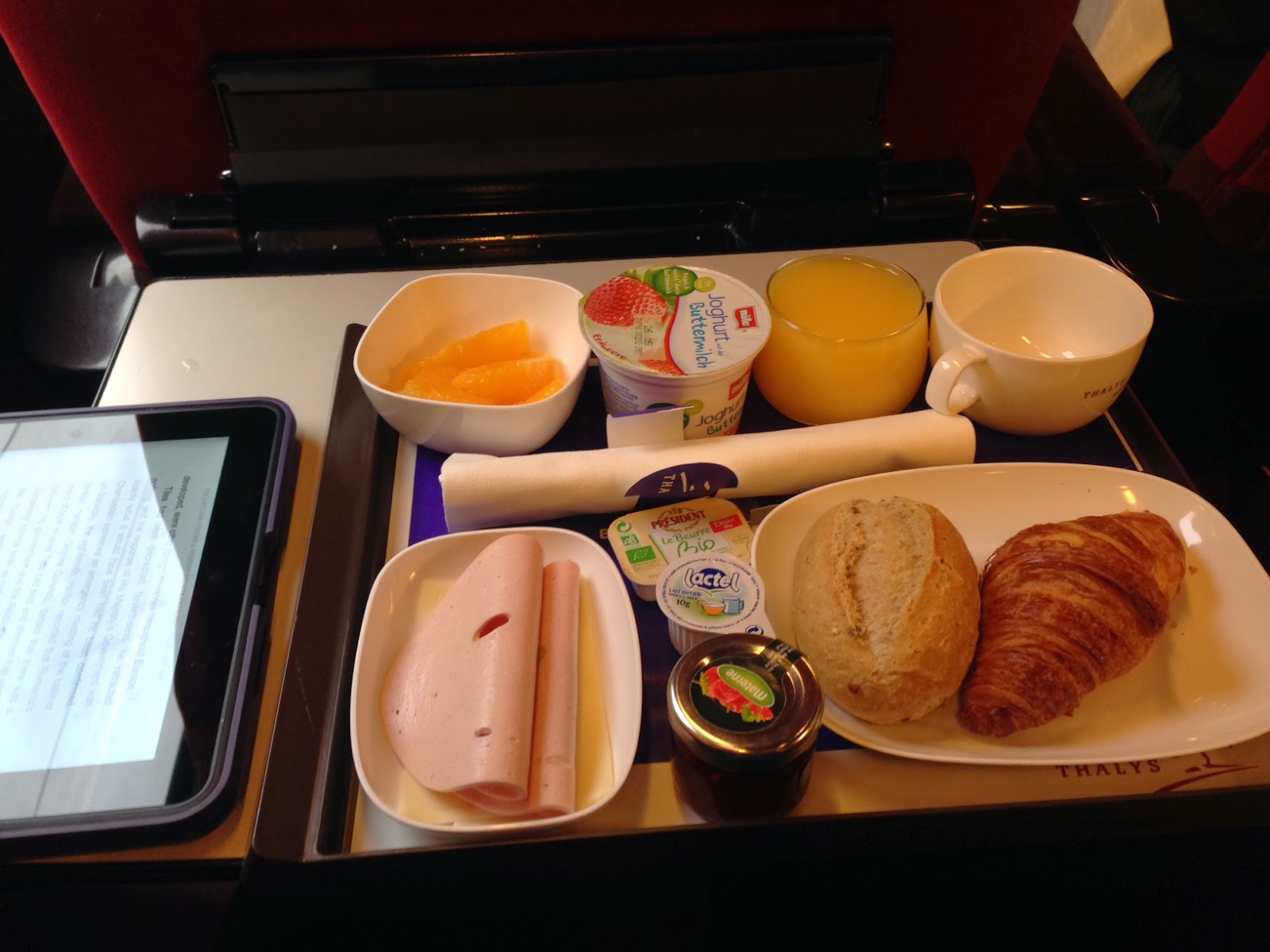
    We left Cologne early, had a 6:44am train ride to Paris. Dan bought these tickets a long time ago, early enough to get great rates on first class, so we had a nice ride. It came with breakfast, which was nothing fancy but decent and appreciated since it kept us from having to deal with that before we left. First class also came with free WiFi which we definitely took advantage of.

    We got to Paris about 10am. We have rented an apartment for our 6 night stay here through AirBnB. (Google it if you don’t know what that is yet. We used it for all of our lodging this trip, except of course for the hotel in Cologne because that was arranged through Dan’s work.) Our host had sent us step-by-step instructions on how to get here from the train station we arrived in, which included two transfers on the Metro, Paris’s subway/rail system. There was a little confusion once we got here about who was supposed to be giving us the keys – the owner is in Spain this week on business – but it got worked out and we were up in the 6th floor walk-up flat by 11am. We unpacked, figured out how the place worked, and rested for a bit before heading out about Noon.

    Our agenda for the day was intentionally planned to not do too much other than walk around. Tomorrow we go to Normandy; Monday we’ll buy a 4day museum pass that has to be used consecutively, so today was about that stuff we could do for free and just get a feel for where we were and what was where. There was only one sight we would actually go into and it was open until 10pm so we weren’t in any hurry. And it’s a good thing we weren’t.

    There’s one thing that several of our friends who have been here before all warned us about: don’t over plan your day, it takes longer to get places than you think, because you’ll stop constantly to look at things, take an odd turn to check something out, etc; you need to build in time for general meandering.

    We weren’t 3 blocks outside of our apartment when we stumbled upon this great Saturday morning farmers market (that’s what we would call it at home) but it was oh so much more. We decided to take advantage of it and do some grocery shopping and then take it back to the apartment, and then get on with our day. We made it back to the apartment finally 90 minutes later!, armed with 1/2 a dozen eggs, 3 kinds of cheese, 3 kinds of sausage, fresh hot paella which we had for lunch, 4 heirloom tomatoes (each a different color), a quart of strawberries, and a 9″ strawberry tart (that we cut into for dessert this evening).

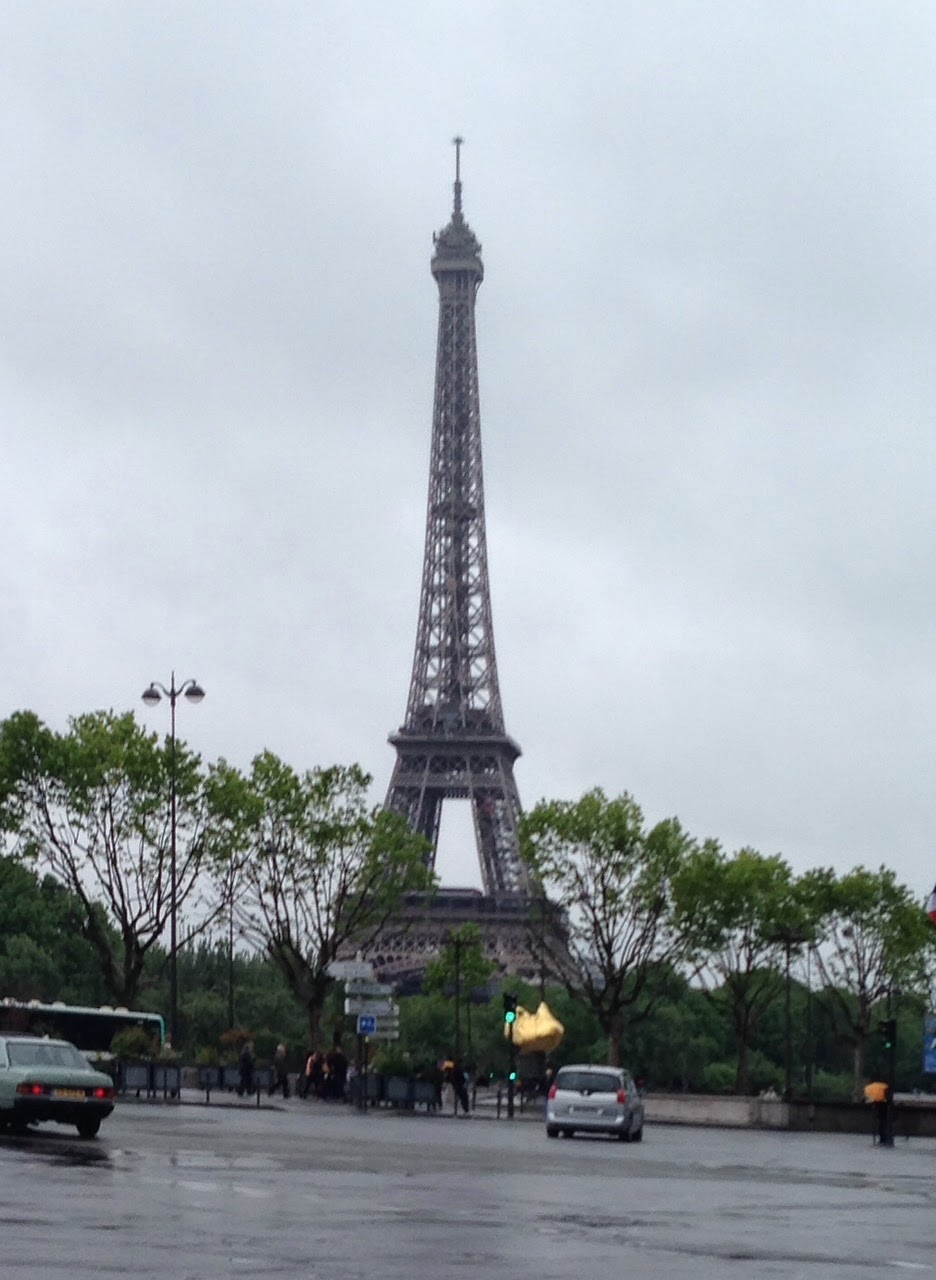
    So it was close to 2pm before we headed out again. I wanted to make sure we could find the place we’re meeting the tour for Normandy tomorrow morning, so we headed in that direction but took the scenic route. I think it’s appropriate that this is the first official picture we took in Paris, our first sighting of the Eiffel Tower.

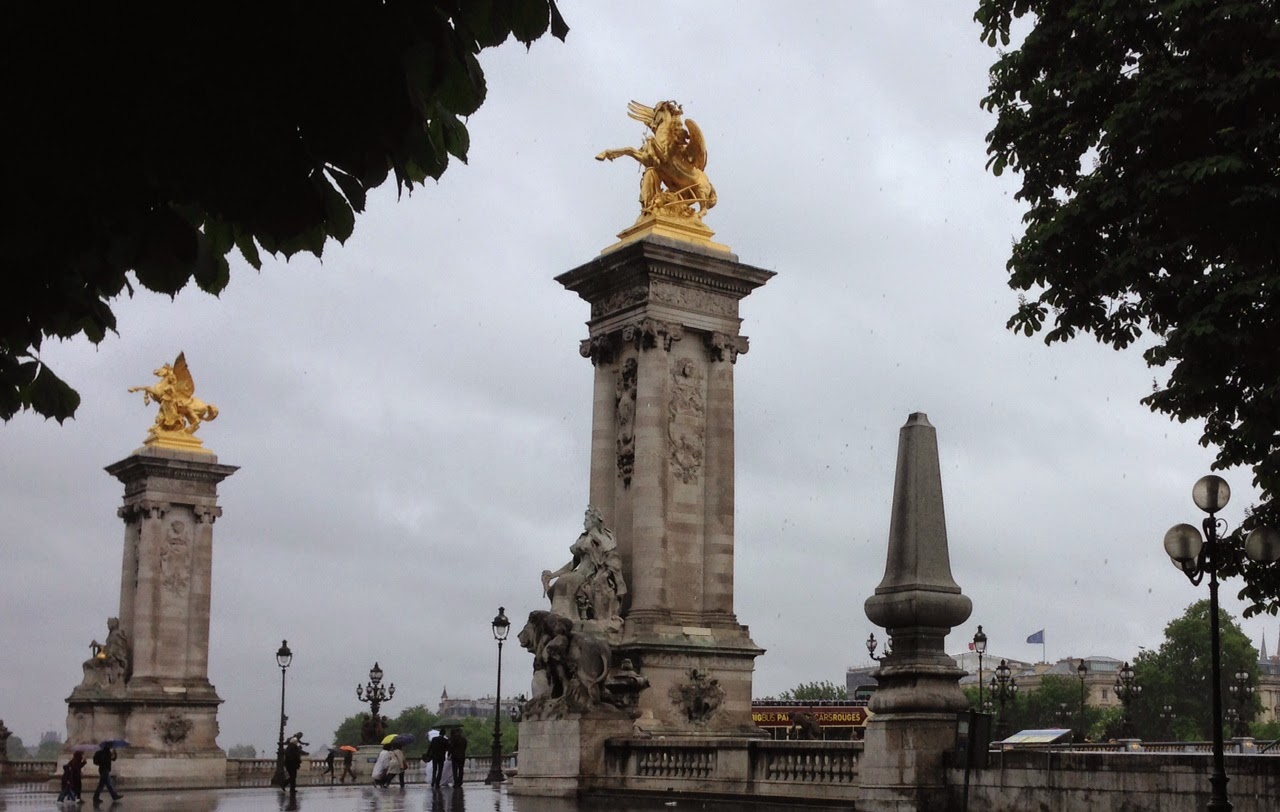
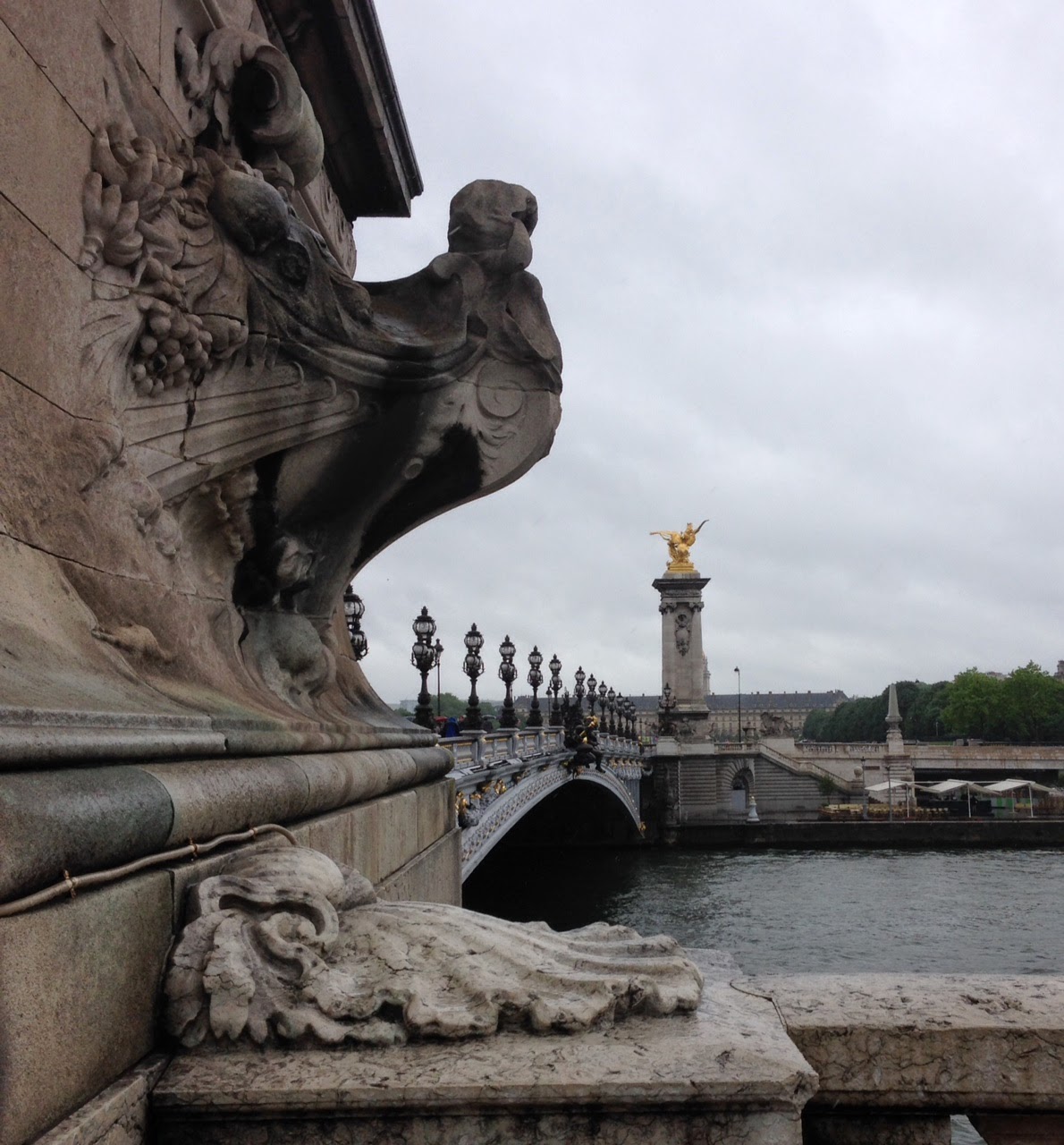
    We just happened to look to our right as we were crossing the street and there it was. We decided to walk along the Seine and came across the Pont Alexandre III bridge, generally considered to be the most ornate bridge in Paris. We were familiar with this bridge only because on our trip to Amsterdam last year we’d seen a replica of it (although not as well done of course).


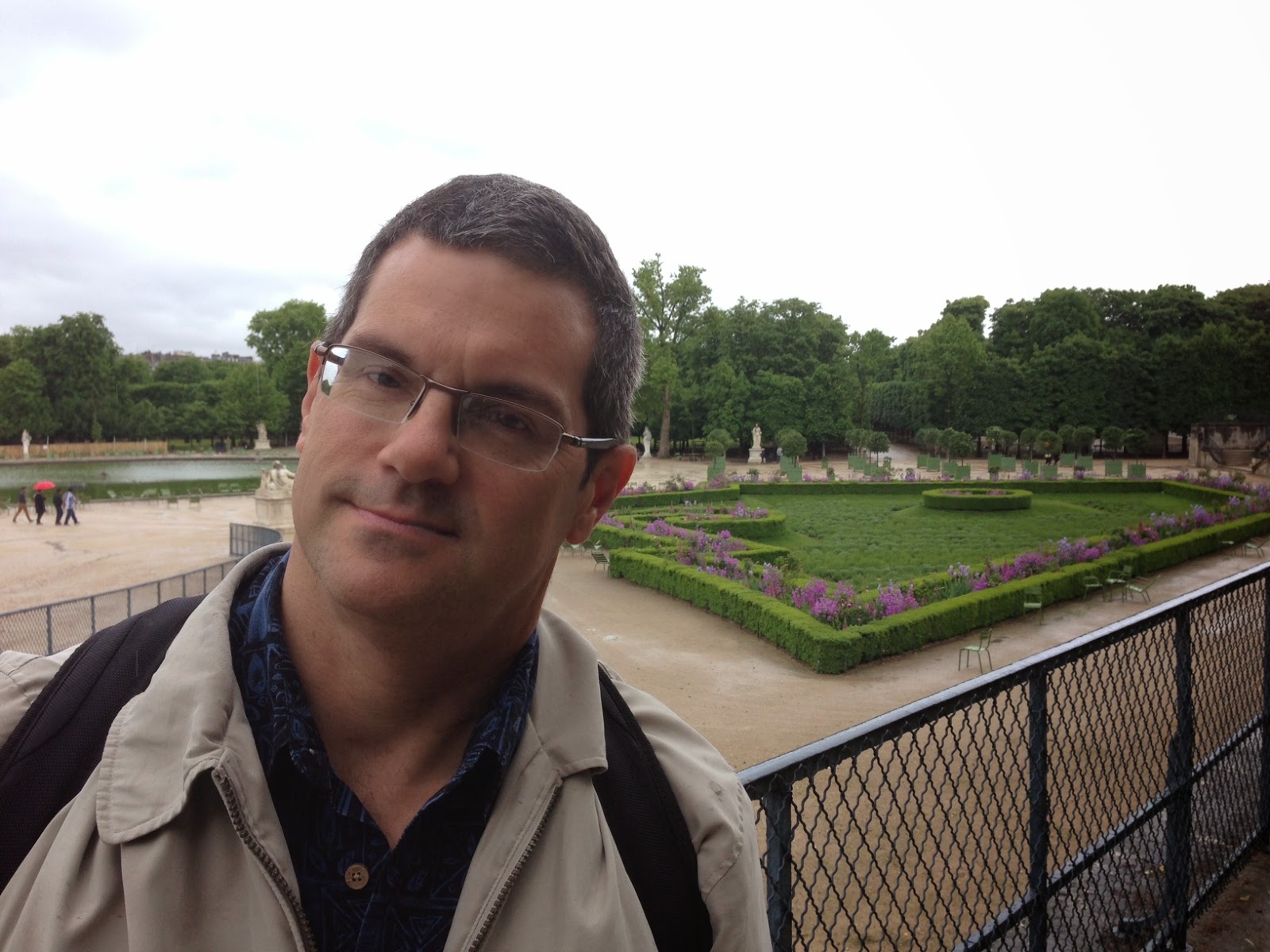
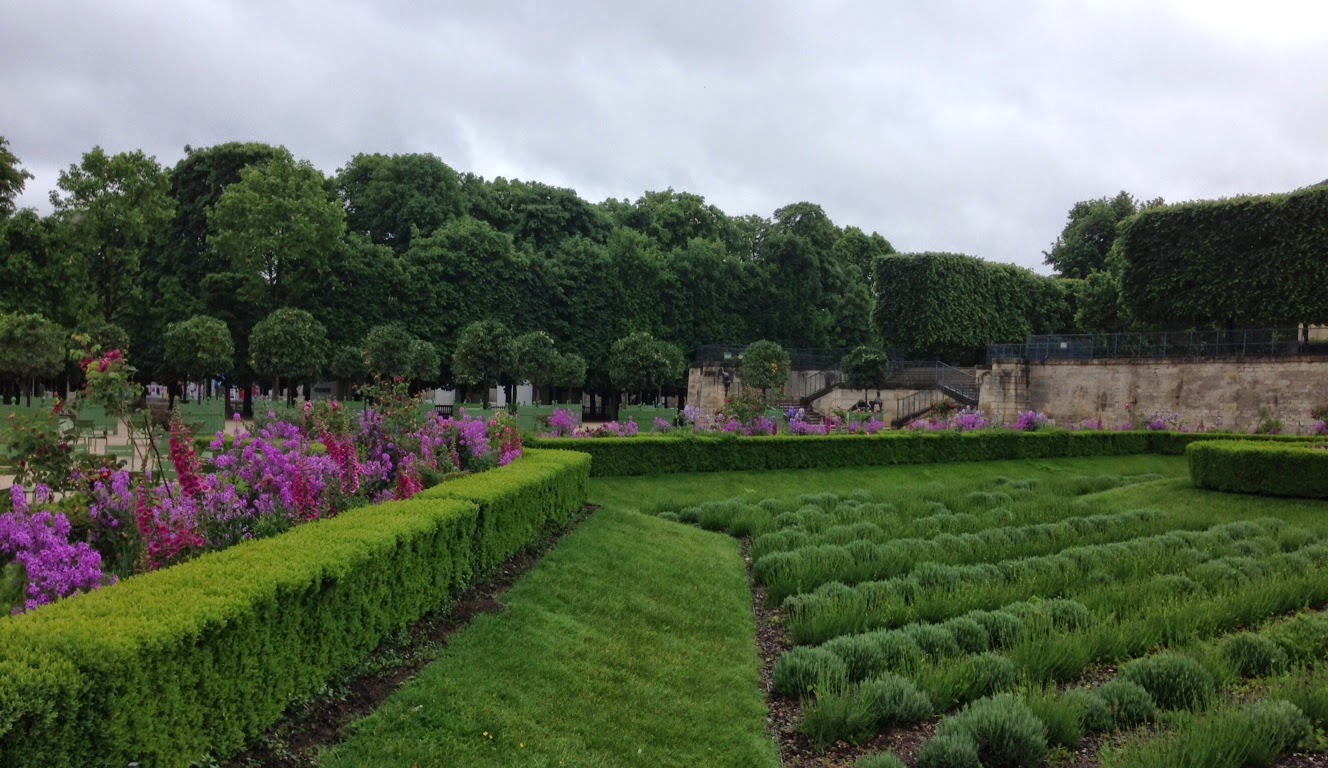
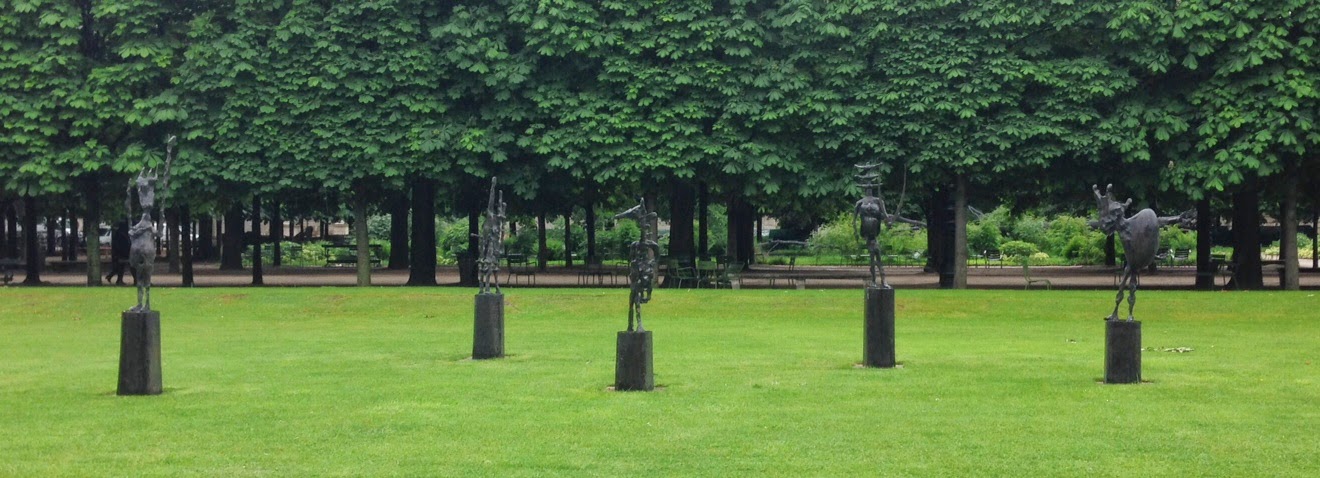
    We kept going and stumbled into the Jardin Des Tuileries – Tuileries Gardens – which is this really amazing park along the river next to the Louvre that’s full of gardens and sculptures. We’d barely been truly out in Paris 30 minutes and had seen such a small sliver of stuff, but Dan was already remarking about how impressive it is that the city has put so much art into public spaces and how much it adds to the beauty and personality of the city. He’s hard to impress and Paris got him early! The next few pictures are some shots he took from this park.


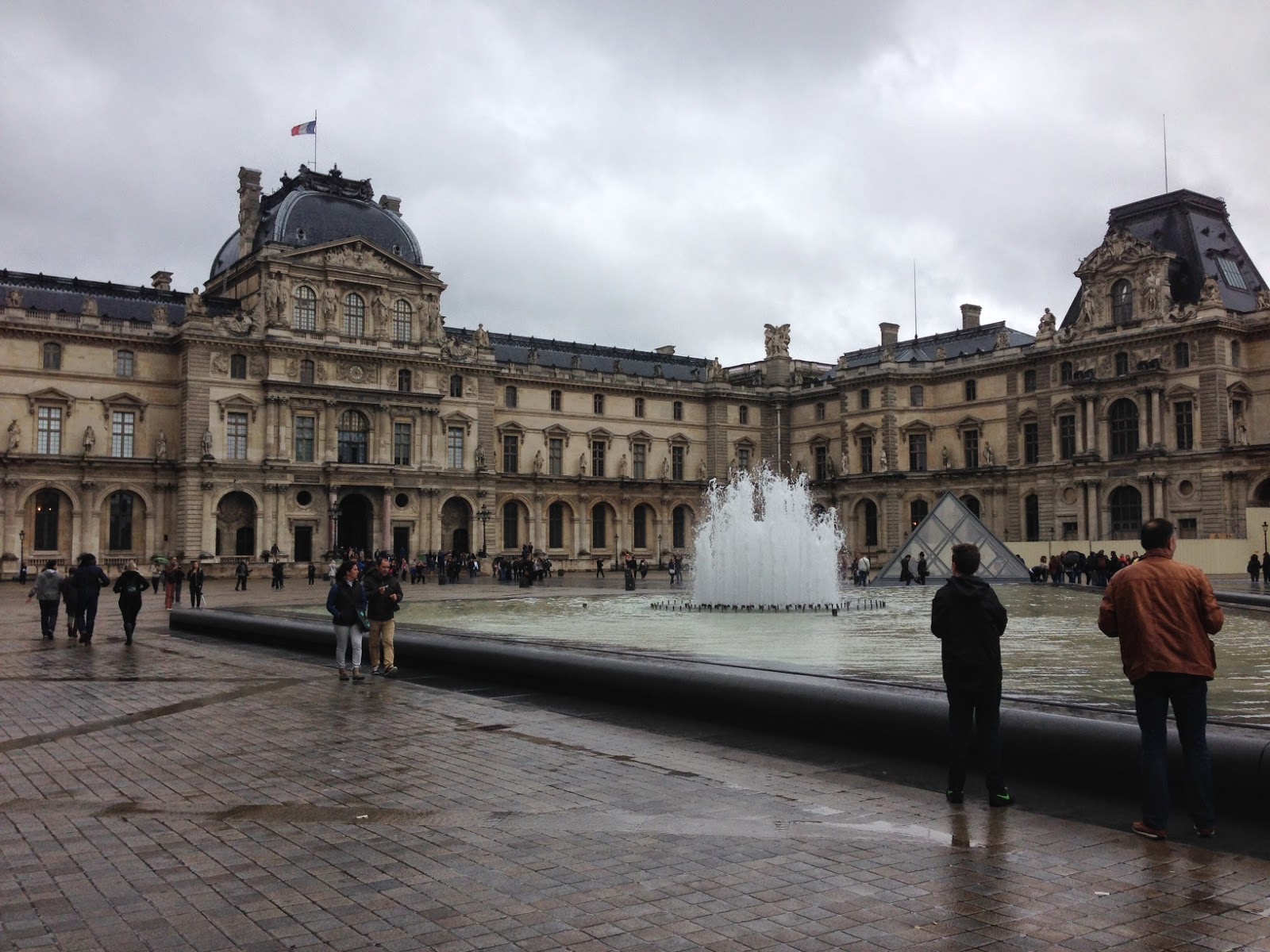
    In the bottom left of the above photo you see a of piece of the first building we’d come across in awhile. It was massive and beautifully designed. Dan said “I wonder what that is?” I said “I think it’s the Louvre.” And it was. We got out of the park, found our meeting place for tomorrow morning which is essentially across the street from the Louvre, and continued our meandering. We are planning on going to the Louvre on Wednesday – a morning and evening shift, actually! – but couldn’t resist getting a peak since we were walking right by it. This is what we saw.

    As you’re walking in from the street you’re in this huge open area where lines form for tickets, etc. But there are windows into the museum on either side – Dan called them teasers – and that they were. This was the view from one of them and we were suitably impressed. Never seen anything like it; it’s absolutely stunning. So we continue through this covered area into the courtyard – where the gawdawful glass pyramids are; really, what were they thinking? – but the rest of the building is amazing. I wasn’t prepared for the size. I’ve seen pictures of it a million times but they just don’t do it justice. Here’s another that won’t. Pay attention to the small people at the entrance and you’ll get an idea of scale.

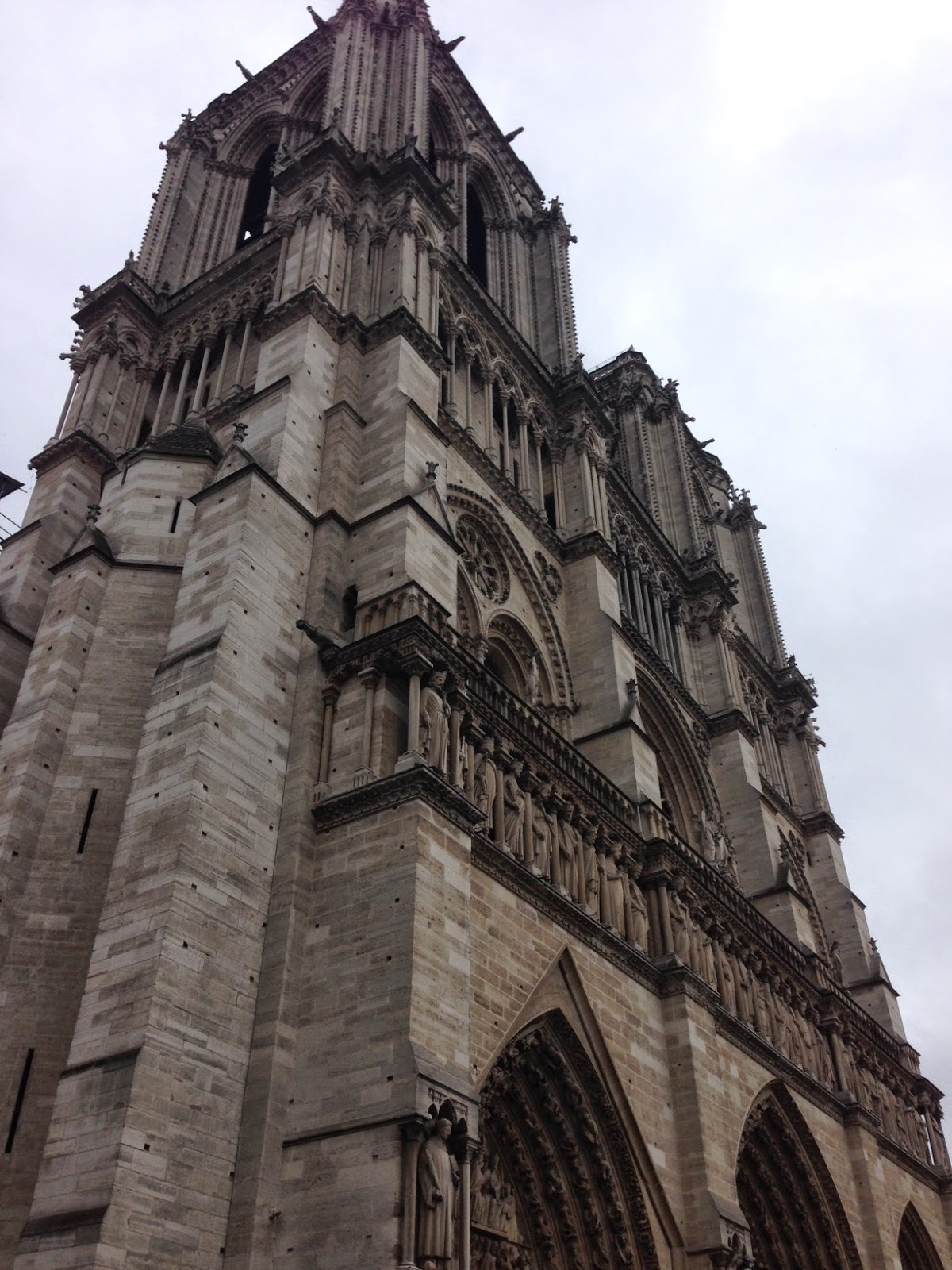
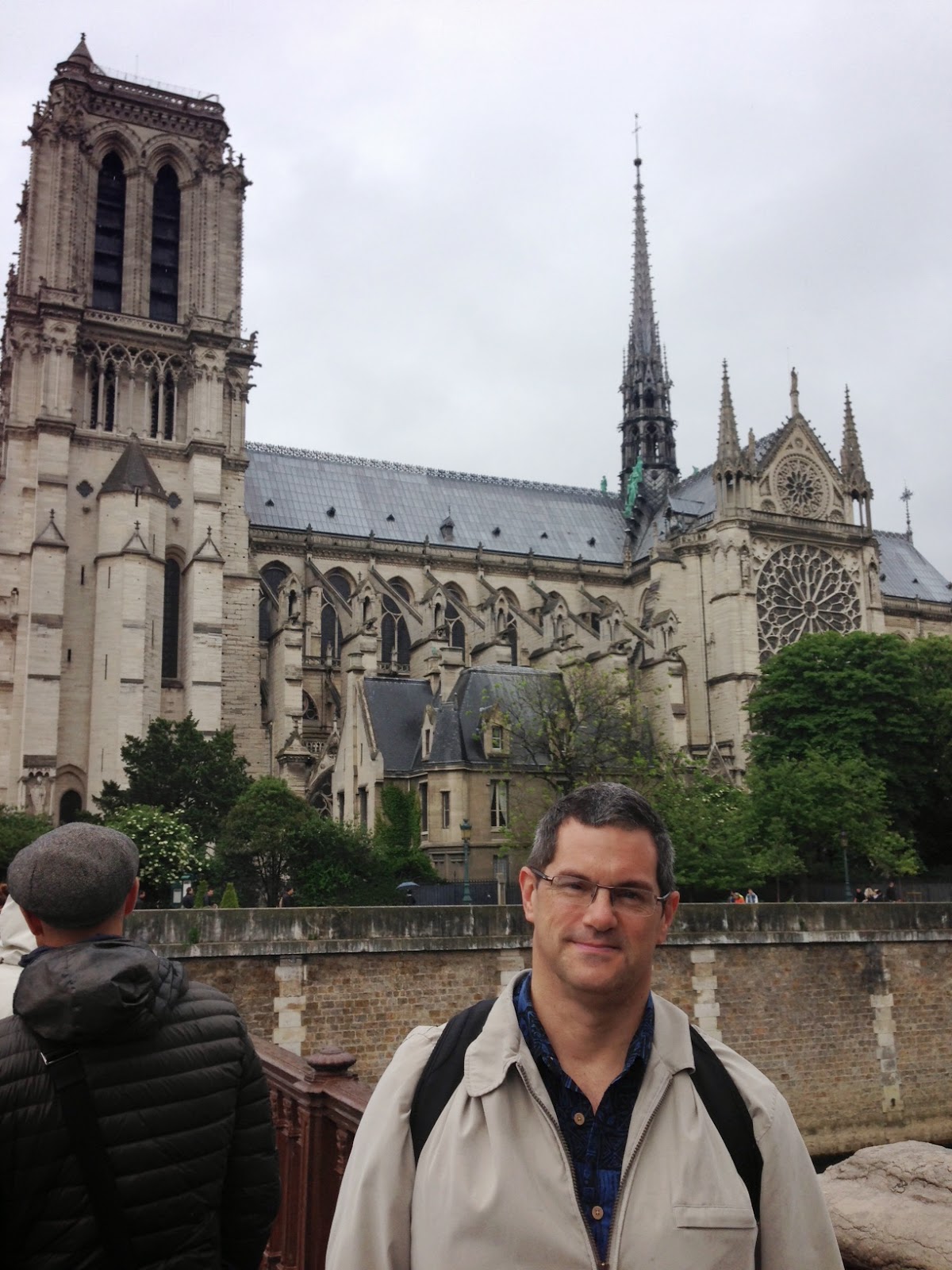
    Next we were headed to the Latin Quarter, one of the two neighborhoods we were going to explore today. We passed Notre Dame on the way and couldn’t resist a couple of photos there, either.


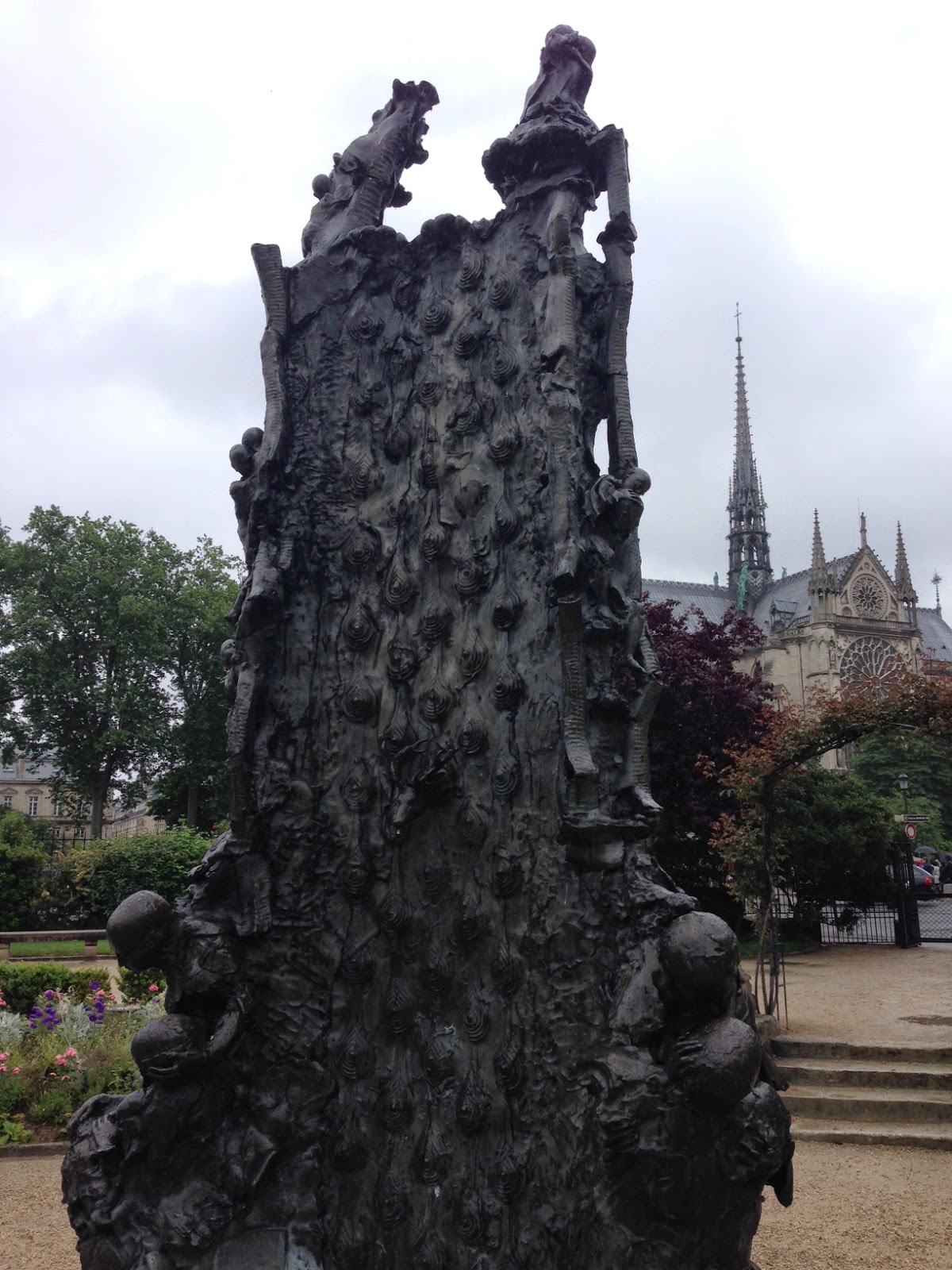
    This was a creepy looking sculpture Dan liked in one of the many parks we came across today. I believe this was just across the river from Notre Dame.

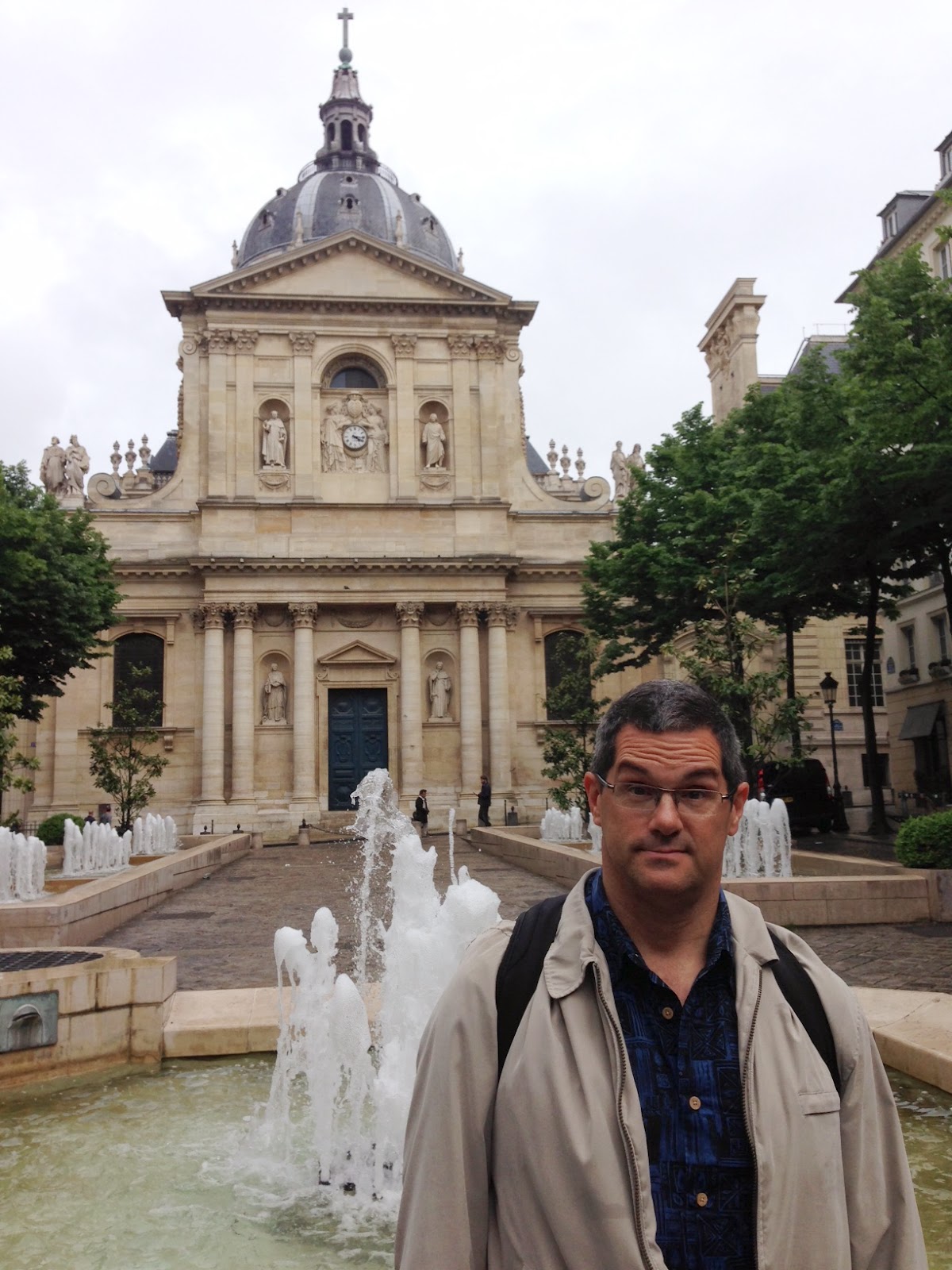
    We continued meandering the Latin Quarter and really enjoyed the neighborhood. It got less touristy, lots of narrow streets with interesting shops and restaurants. Eventually we came across a tree-lined avenue – we saw many of those – and came across this. We just thought it was pretty, then quickly figured out it was the Sorbonne, a Paris university.
    My goofy expression is a result of Dan saying “open your eyes!” I swear they’re always open but they often look closed in pictures. He takes 5 shots and maybe one of them will have them open.
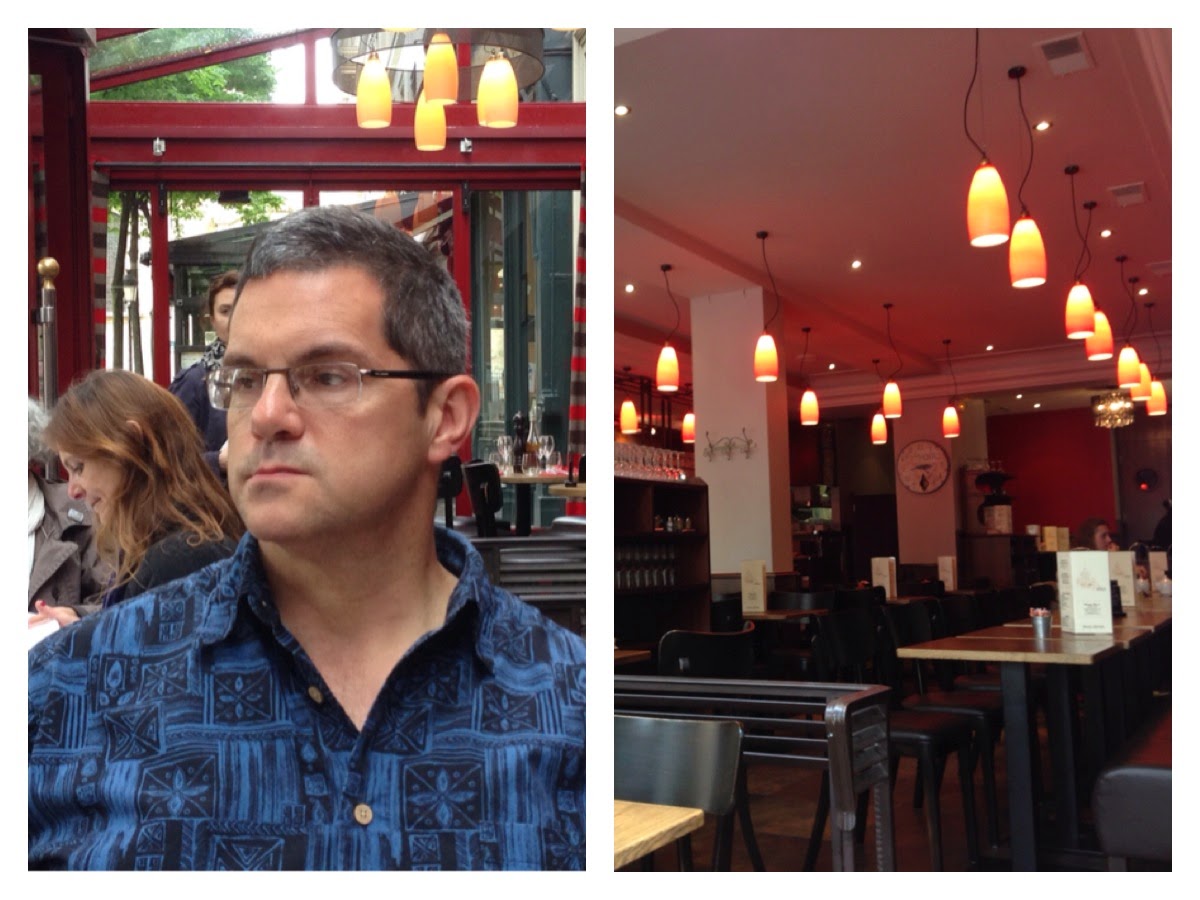
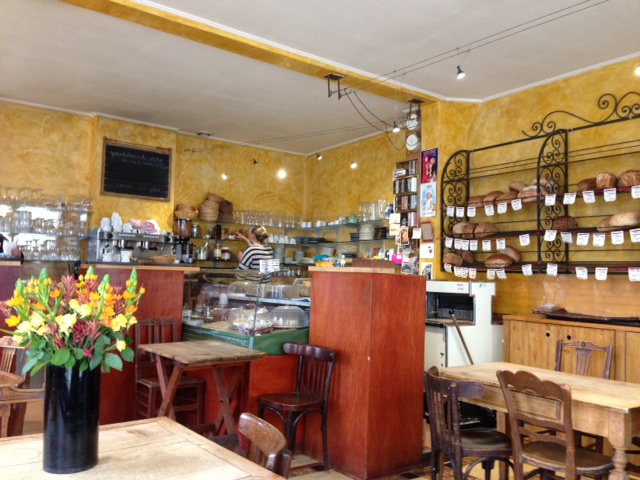
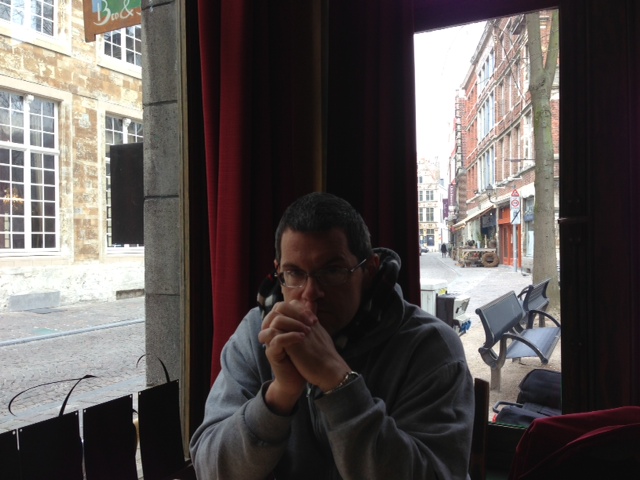
    There was a nice cafe directly to the right of where I’m standing above, and we stopped there for a coffee break. Or in Dan’s case, tea. He captures me without me knowing it. I didn’t see this until I got back to the apartment!
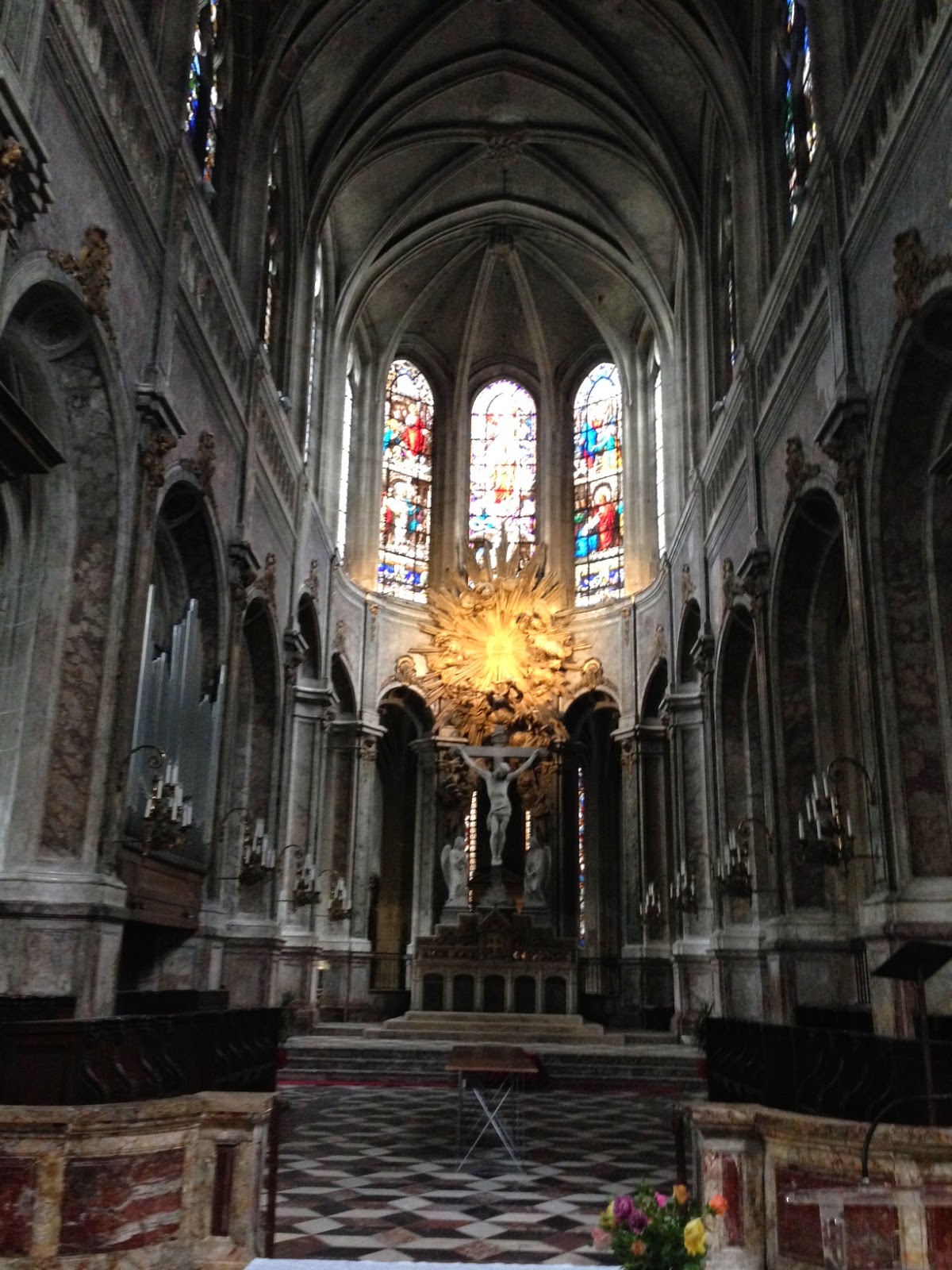
    We went by the Pantheon after this but there is serious renovation going on so we didn’t take any photos. Then we headed to the 2nd neighborhood for the day, Montmartre. We decided to walk because that’s just our preference unless time is an issue and it wasn’t. It was 3 miles north of where we were so it took a little over an hour. We saw a lots of stuff along the way, thoroughly enjoying just being there. One of our random turns down an alley took us into this church where some organ playing was happening, so we stopped in and listened to that for a few minutes. Dan has never met a church he didn’t want to take a photo of.
    It’s the Church of Saint-Merri and is about 600 years old.
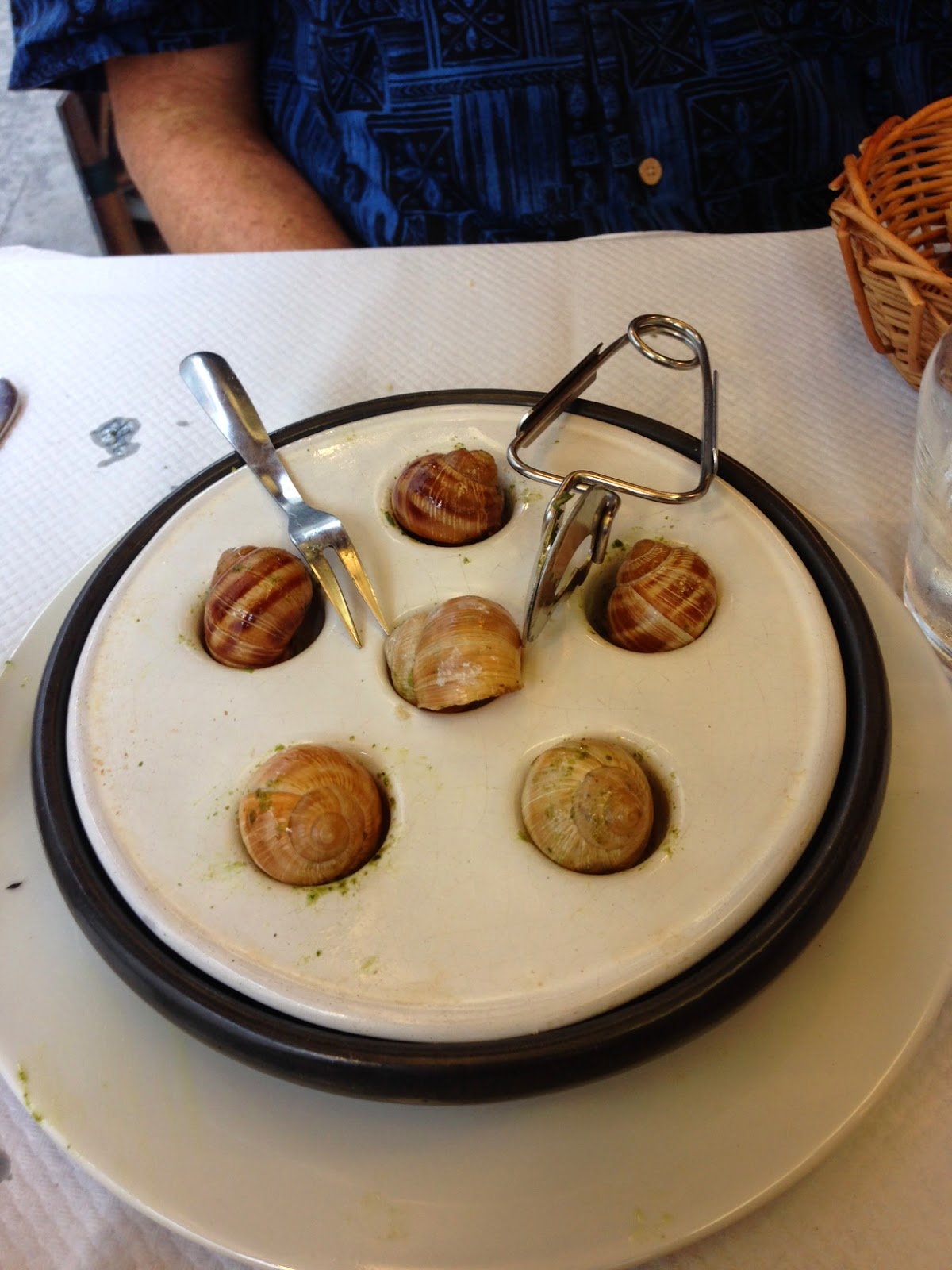
    We eventually got to Montmartre, which has a personality all its own for sure, some of it kinda wild and trashy, but we found a nice quiet French restaurant on one of the side streets that turned out to be pretty good. When in Rome and all that, we had escargot for our appetizer and they were excellent.
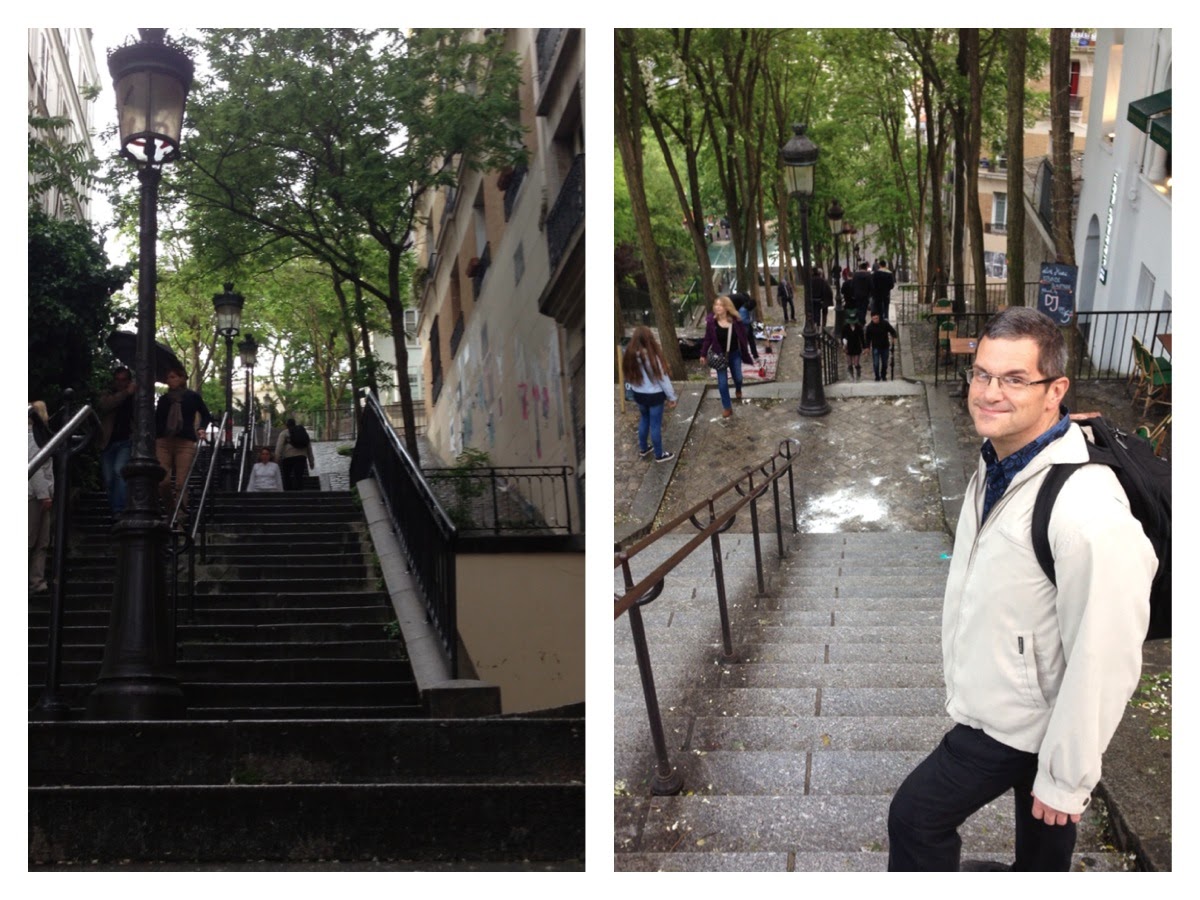
    From there we made our way up – way up – to the Basilica of the Sacre-Coeur. The steps made it easier. This is me going up – if you look close enough – and coming down.
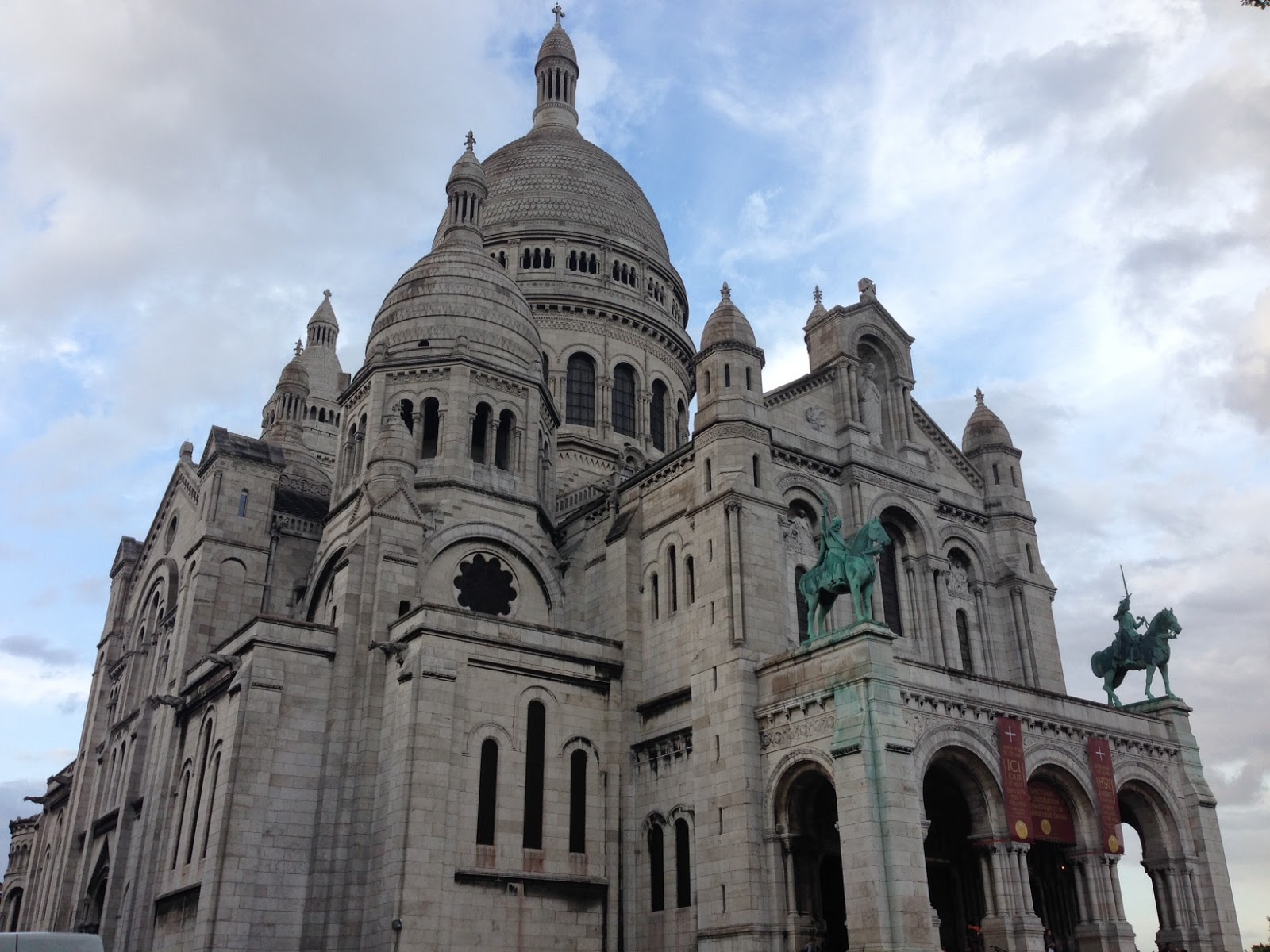
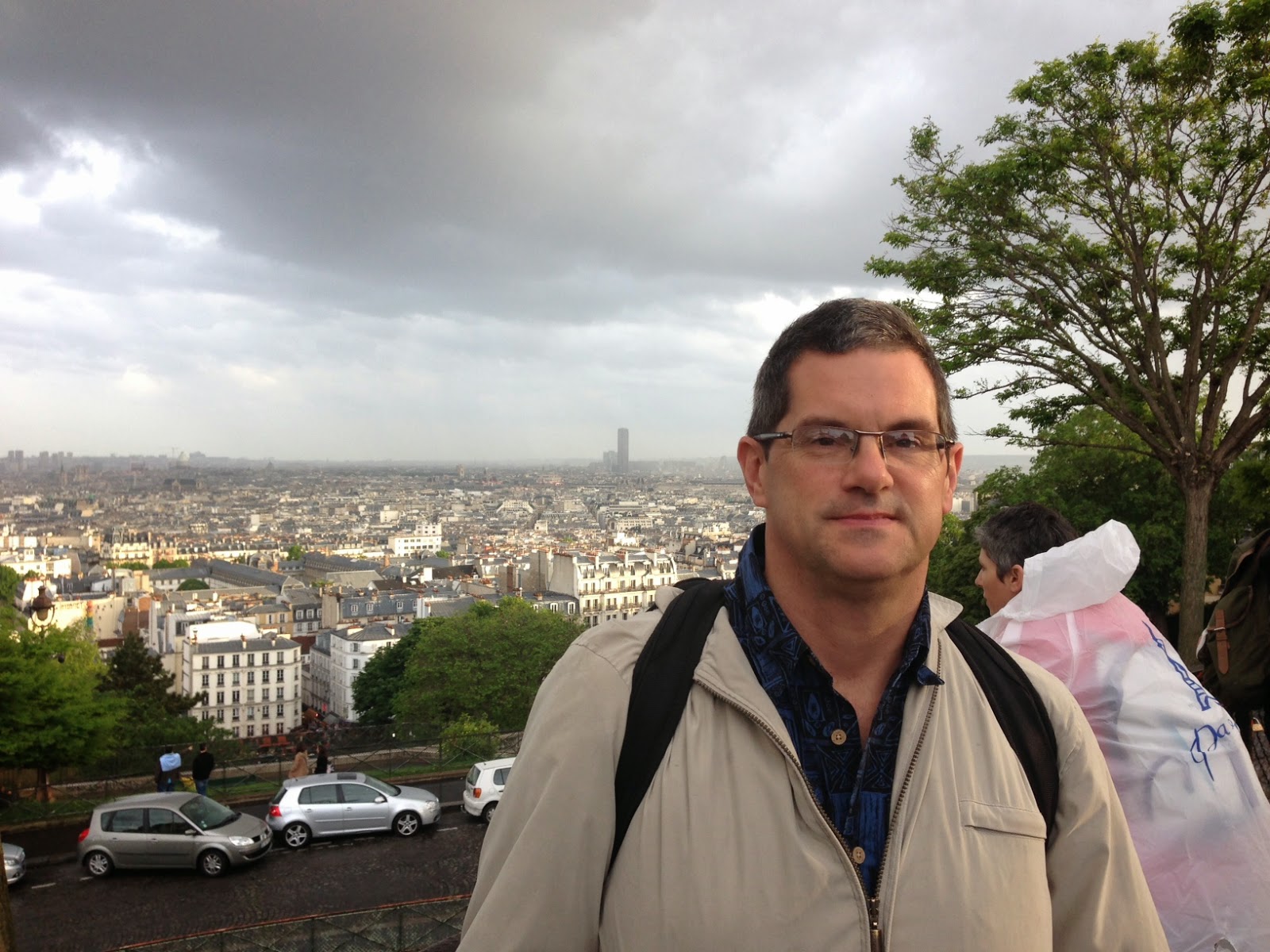
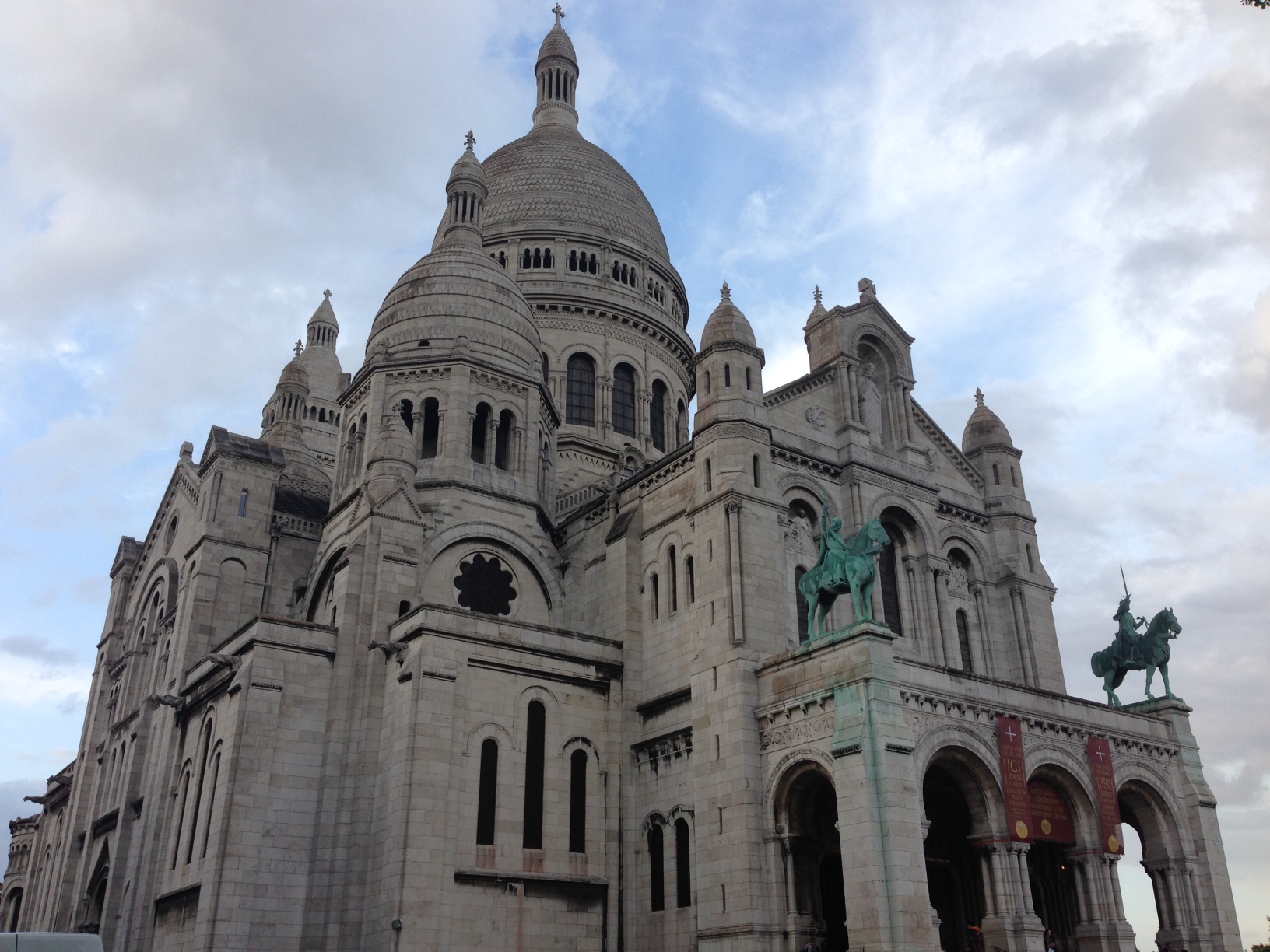
     But it was worth the climb. Here’s what you saw once you got there.
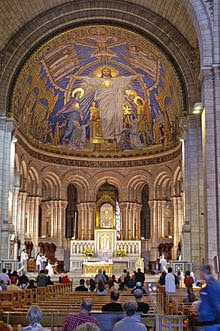
    The Basilica of the Sacred Heart is located on the summit of the butte Montmartre, and is the highest point in the city. Construction started in 1875 but it wasn’t completed until 1914. You weren’t allowed to take pictures inside; it was of course stunning. I lost count of the number of side chapels, but it was easily eight. The main front altar was of course the most beautiful; I stole this off the internet. It’s poor quality but you’ll get the idea.
    And below is what you saw looking back at the city. I was bummed that the Eiffel Tower was to the right of those trees and completely hidden by them.
    We took the metro back to the apartment. Funny: when we first got on the metro this morning, we’d commented how smart they were designed, because there was a little map above with all the stops, lit (or not) in such a way where you could tell immediately if you were on the right train. I believe NYC is similar. Dan said “we’ll have to make sure we do that each time.” So we did. And – Oops! Quickly figured out we were going in the wrong direction. The train didn’t stop long and was already moving so we had to wait a stop and turn around and go back. Dan realized he had read the Google instructions backwards (easiest way to explain that) and that’s what got us turned around. It didn’t take much time at all to get back on track. We were back at the apartment by about 9pm.
    It was a full day. Didn’t “do” much but we felt like we saw A Lot. I also lost count of the number of times one of us said “I can’t believe we’re here.”
    Tomorrow is Normandy. It is the thing I’ve been looking the most forward to.
  • Day 2: Bonn

    Day 2: Bonn

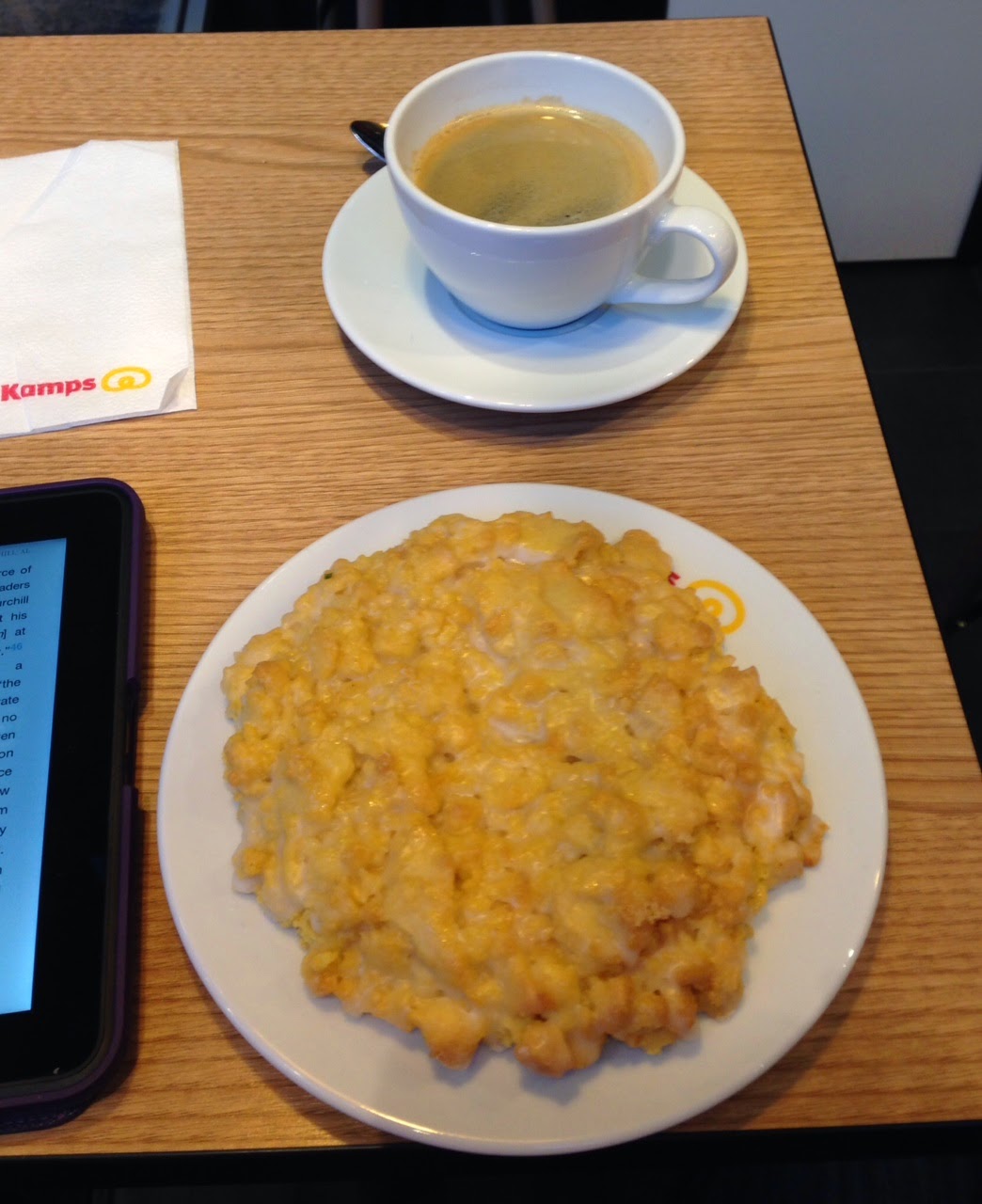
    Dan slept much better last night, 7 hours; I slept about 6 hours and woke up naturally around 6am. So for now I’d say we’re pretty adjusted to the time change. We left early so he could catch a train to Monheim for work. His train left just before 7am. I took one about 30 minutes later to Bonn. In the mean time, I repeated yesterday and got coffee and a bite to eat at Kamps with my Churchill book.

    That lovely thing is called a strueselthaler. Probably the closest thing we have in taste at home is coffee cake, minus the cinnamon. Texture probably a little more like a scone. It was a little sweeter than I generally like that early in the morning, but it was very good, and it didn’t give me the sugar crash I typically get after eating something like that at home.

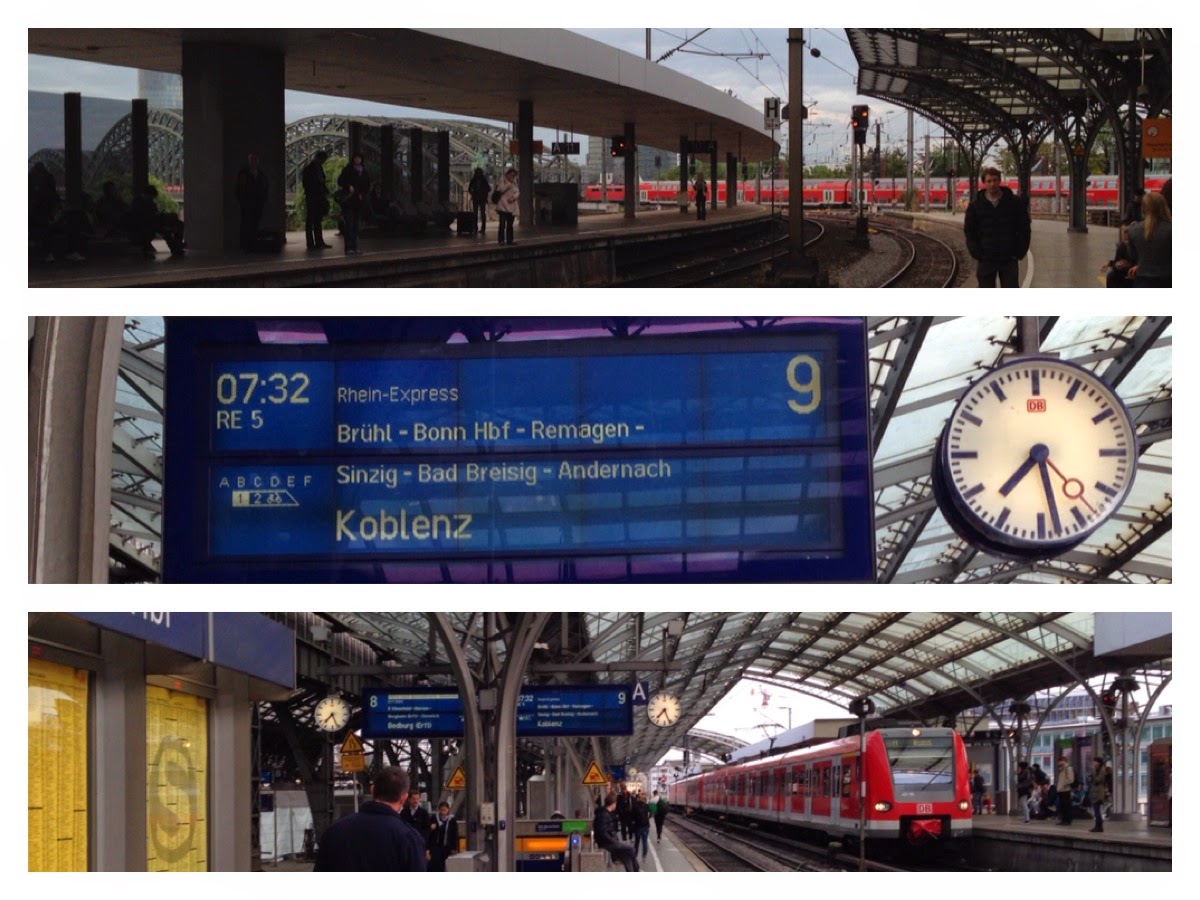
    Left and right views from where I was waiting for my train on the platform, with a closeup of the sign showing my train info. I do love the train culture in Europe, just like I loved the subways in NYC. It would be very easy to not own a car, and I don’t miss not having one while I’m here at all. In fact I prefer it.

    I decided to spend the day in Bonn at somewhat the last minute. Originally I thought I would go there or Dusseldorf on this second day, then decided to spend it in Cologne still. I changed my mind Wednesday night while Dan and I were having dinner here. He has work colleagues from Monheim who live in Bonn and commute and really like it as a place to live. Monheim is about 30 minutes north of Cologne by car; Bonn is about 30 minutes south. I also learned that Bonn was the capital of West Germany during the time when it was it’s own country, separate from East Germany. Somehow I thought that Berlin was the capitol of both – why else have the weird little piece of democratic Germany in the middle of a communist state? That’s what the Berlin Wall kept apart. It was years before I learned that wasn’t actually the West Germany border – just a piece of Berlin carved out. All of that has always been a mystery to me so I thought maybe I’d learn something.

    And I did. I got to Bonn about 8:15am, and since nothing opens until 10am I had plenty of time to just walk check out the scenery. It immediately reminded me of Mainz, my first European city last year, and also Koblenz, where we spent 2 days last year. And they are all similar; all 3:

    • Were established during the Roman Empire, something BC;
    • Are along the Rhine River
    • Are small-ish, with populations 300k or less, with quaint centrums that are very pedestrian friendly
    • Have a small town feel but have everything you need
    • All very different from say Cologne and Frankfurt, which definitely have big city vibes

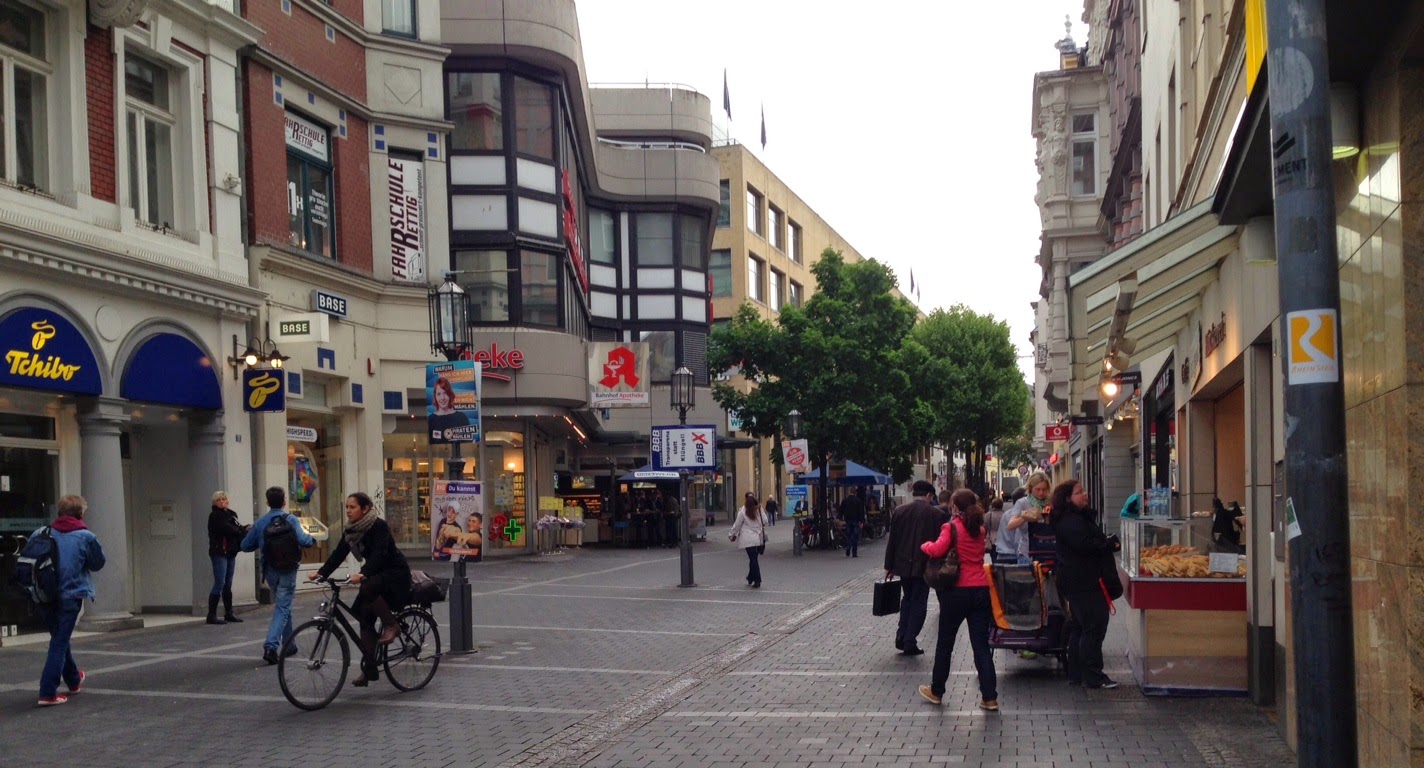
    Much of the centrum is this classic European urban design – pedestrians and bikes OK, but no cars. We love that.

    Flower vendors on the street


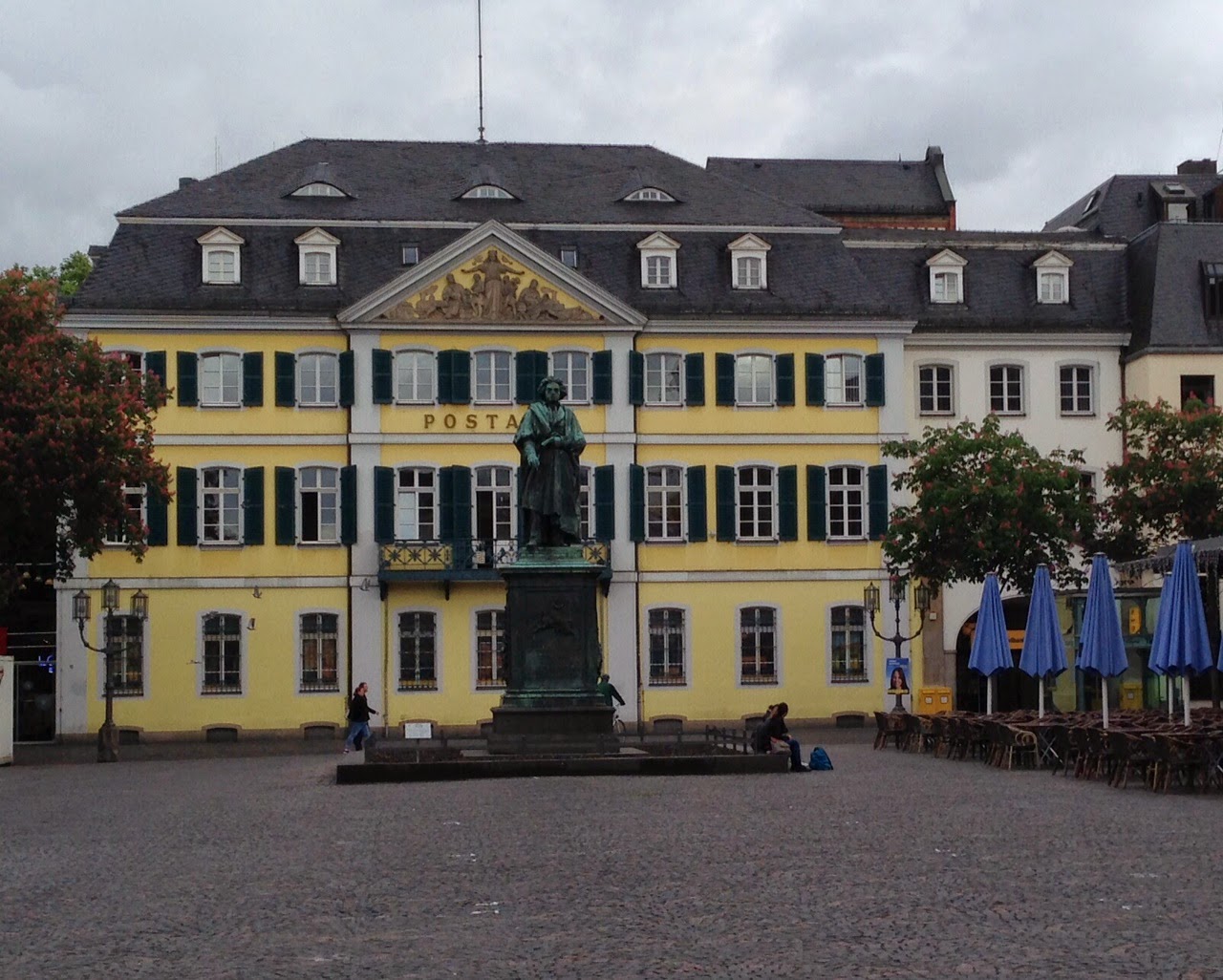
    This square across from the church reminded me a lot of the one in Mainz across from its cathedral. This building is the Kunstmuseum. Art. I passed :) The guy of the statue? Beethoven More on that later.


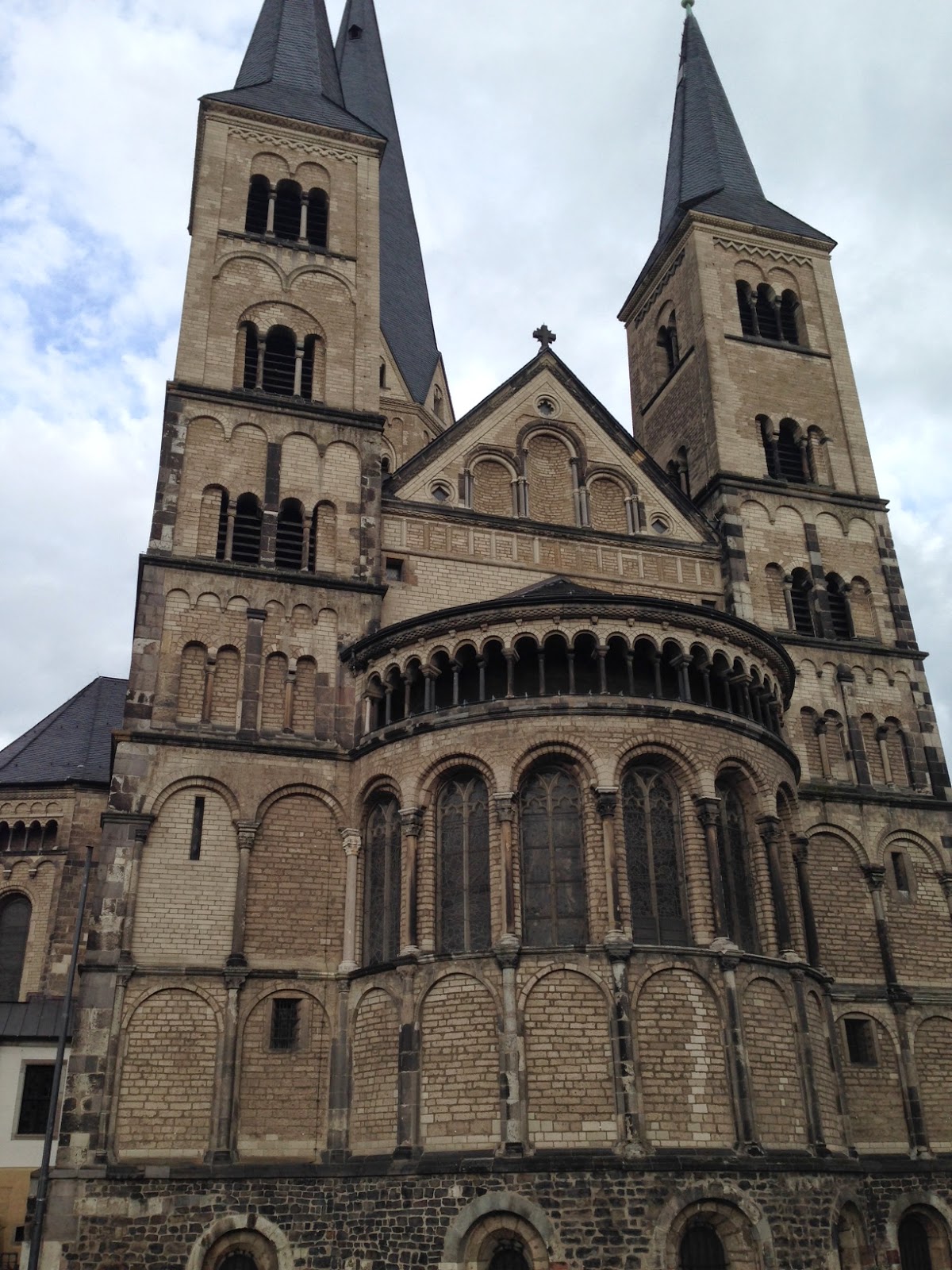
    This church is called Bonn Minster, and is about 800 years old. It was beautiful inside but too dark to take good pictures. I did my daily morning quiet time there; yesterday I’d done that in the Cologne cathedral.


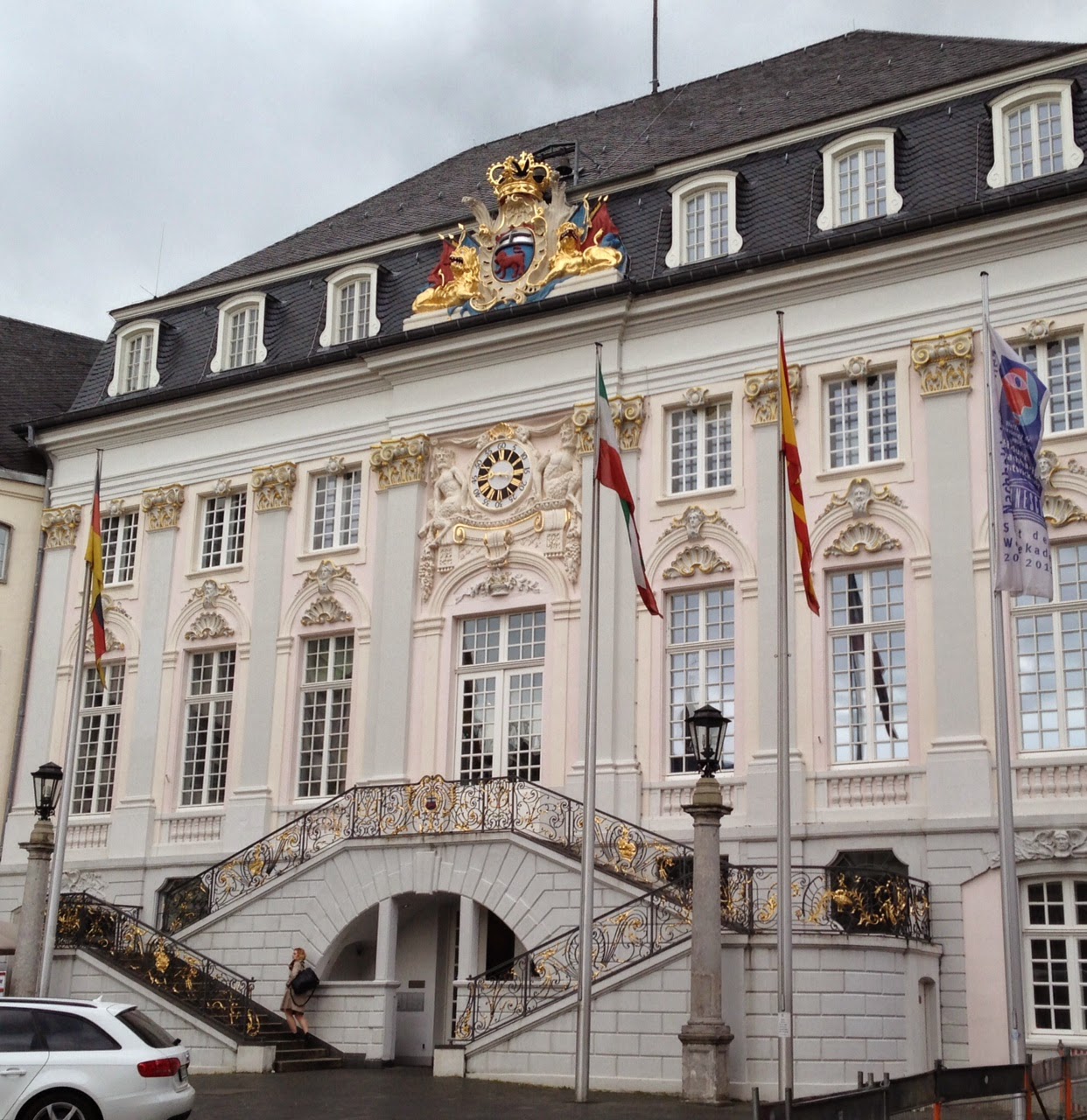
    This lovely building is Altes Rathaus – Old Town Hall. It was built during the 1700’s and was a city administration building until it was badly damaged in WWII. It became a place for official ceremonies again when Bonn became the federal capital in 1949. Charles de Gaulle and JFK have been welcomed on those steps.

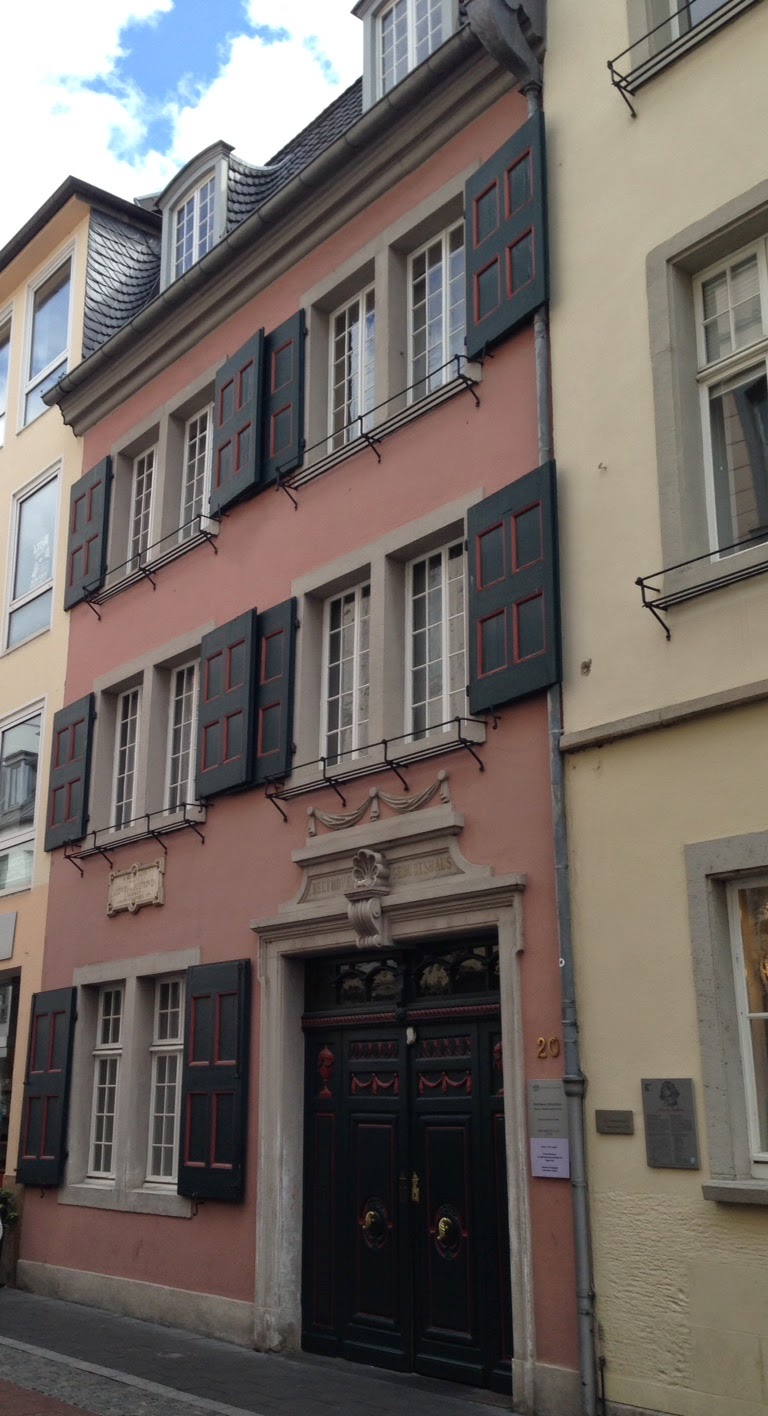
    Ludwig von Beethoven was born in Bonn in 1770. His family lived in the small house shown below until he was 4 years old, then moved to several other places in Bonn over the years. He left Bonn at 22 to study with Joseph Haydn in Vienna, and and spent the rest of his life there. He died at 56. By the late 1800’s, his birthplace was about to be demolished until a group of artists banded together to preserve it as a historical monument. The Beethoven-Haus Society has maintained it as a commemorative museum since 1889; it houses the world’s largest Beethoven collection.

    I walked past it the first time. If you’re not paying attention (clearly I wasn’t) it’s easy to miss.

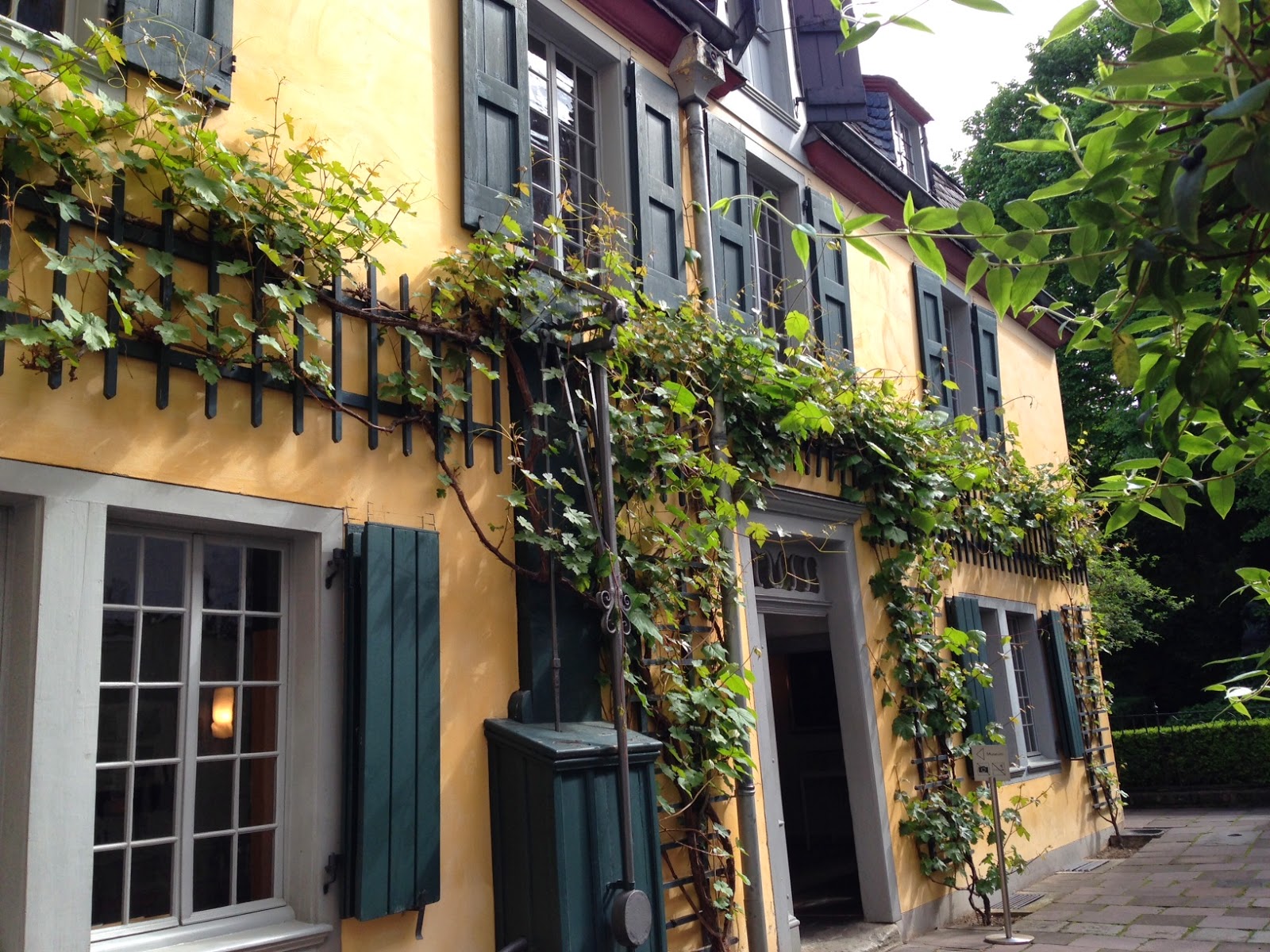
    This This is the “back house” that’s behind the one above, where he was born, and where the primary collection was.What I love about being in places like this is imagining was it was like to live in it during the late 1700’s. You weren’t allowed to take pictures and frankly it was a pretty simple home; I just appreciate what spending time in it makes me think about. Oh, and all the Beethoven stuff – I was pretty whatever about that, but anyone who was a big fan would have enjoyed it. The violin he played, lots of original manuscripts with notes in the margins, paintings of important people in his life. There was an electronic archives in the building across this courtyard where you could search your hearts content for any tidbit you were interested in.

    And in the category of “it’s a small world”: When I was on the train bridge yesterday, I was asked to take a photo by a woman who appeared to be chaperoning a group of teenagers.  I ran into that same group in the Beethoven house today. And now you’ve got that song in your head. You’re welcome.

    I was only there about 45 minutes. It was enough. I headed to the only other stop I really wanted to make in Bonn, a place on their “museum mile”, and it was about 2 miles from where I was. So a nice walk. The weather was schizo – I traded sunglasses for umbrella several times throughout the day. But when it was nice it was beautiful, so I didn’t mind the walk.

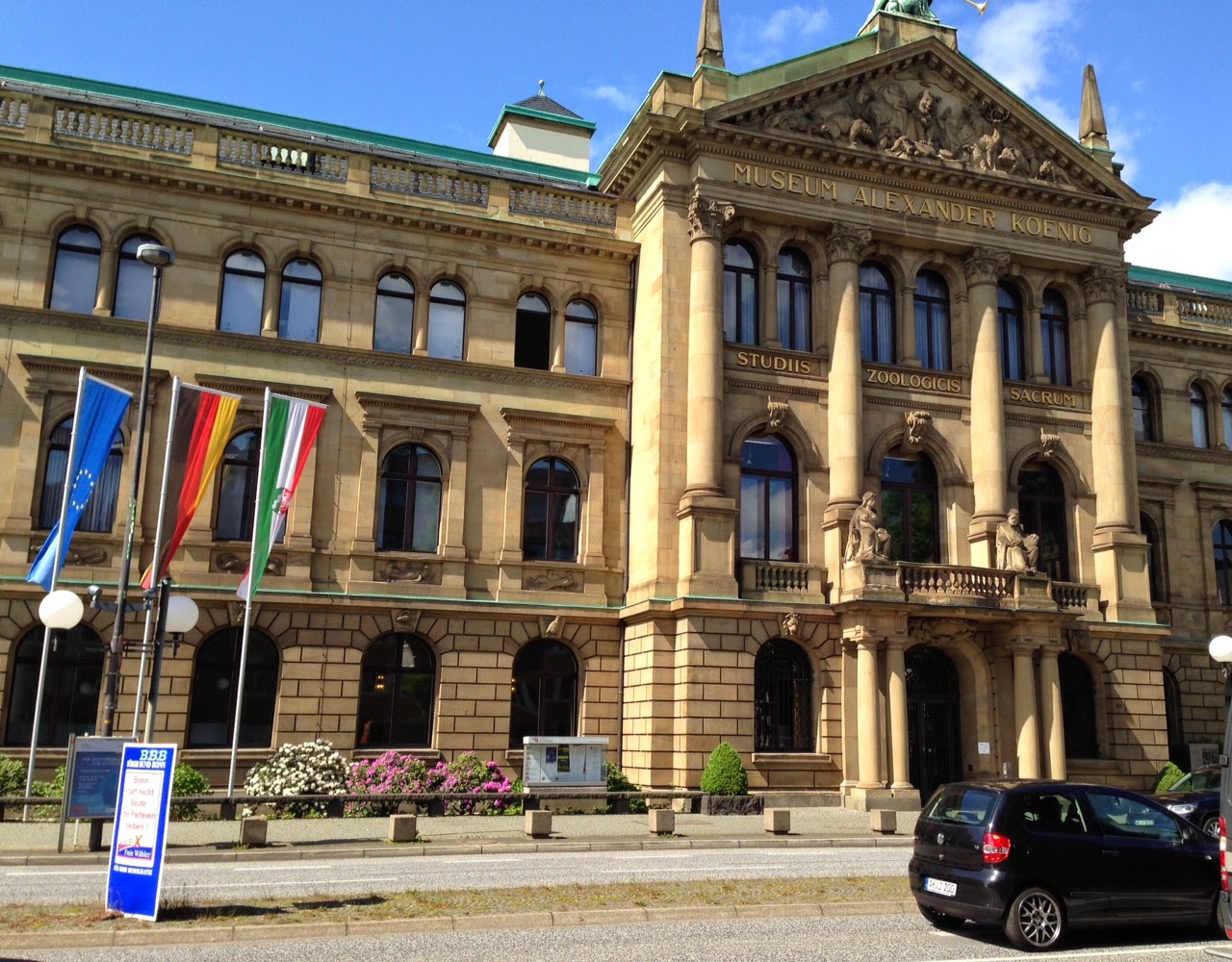
    This was not the museum I was headed to, but it was the parliamentary building when Bonn was the federal capital. It’s now a museum of natural history.

    The German National Museum of Contemporary History was #1 on TripAdvisor’s “things go do in Bonn” list, and if it was the only thing I did I would have been very satisfied. I was disappointed that Dan wasn’t with me; this was his kind of museum and he would have really liked it. I was also glad he wasn’t with me!, because he has much more bandwidth for this stuff than I do and it would have been hard to get him out. There was A LOT of information delivered in a wonderful mix of media. Only maybe 10% of it was in English, I read/listened to about 75% of that and I was still there over 2 hours. But my head was full and legs were tired so it was time to go!

    The very first thing you see when you walk into the exhibit is an American Army Jeep. The Jeep led the way when the Americans came into Germany in 1945 and came to symbolize the Allied occupation. The first room of the exhibit also contained a memorial of the Holocaust done solely in black and white pictures in this small black steel room. The description on the outside was very clear: Germans after the war didn’t want to talk about what happened. They felt “complicit” and couldn’t face it. It was their children – coming to age during the 60’s – that reached back a generation and brought it all out into the open. Between this museum and the one yesterday, I’m starting to understand a different sort of survivor’s guilt the war generation of Germans experienced. I thought their use of the word “complicit” was profound – it acknowledges the incredible amount of looking the other way that had to be done while Jews were being driven from their businesses and homes. What’s the line? All it takes for evil to succeed is for good men to do nothing. That was their complicity. Then the news of the concentration camps hit after the Allies arrived. They really didn’t know. Or didn’t want to know. Complicit. It’s a good word.

    The whole East Germany / West Germany thing had always been a mystery to me, but this museum made it real simple: the 4 Powers of Allied Forces split Germany into 4 zones, one each for USA, Britain, France, and the Soviet Union. In 1946, the US put forward the Marshall Plan, an array of subsidies and loans available to the Germans to help the economy stabilize. Britain and France signed on. Stalin said no way, using the excuse that he didn’t want his zone influenced by American imperialism. The truth is, he planned on making it a Soviet state from the beginning. And by 1949, it was. The zone he controlled became the communist state of East Germany, the other 3 combined as the democracy of West Germany. Simple. (Although, I never did get a satisfying answer to the whole east/west Berlin thing…it was probably one of the things in German!)

    It had to suck for the East Germans: they just went from one dictatorship to another.

    The museum walked you through the history of both countries over the next 40 years, comparing as you went along. West Germany thrived in the 50’s. The Marshall Plan planted seeds that turned into what’s called the “economic miracle.” By the mid-50’s they were exporting more than they were importing. West Germany continued to thrive; East Germany continued in squalor and terror, with thousands of people fleeing. Until the building of the Berlin Wall in 1961 to close what had been referred to as “the Berlin loophole” – an easy way out of East Germany once you got to the West Berlin side, because of the way parts of the train system was shared by both.

    For some reason, I thought “the 60’s”, with hippies and VW buses were strictly an American thing; it never occurred to me it was happening in other countries. These youth influenced West Germany in big ways – including making their parents face the past. They were very interested in American culture and brought a lot of it over. The exhibits continued through the decades with big displays around 1989 and the start of reunification, including pieces of the Berlin Wall. It was originally thought reunification would take 5 years to be complete; it took only 329 days.

    In 1999, government administration was still split between Berlin and Bonn. The elected body voted to consolidate and Berlin won by a small margin.

    Pictures weren’t allowed and I couldn’t get a decent angle of the outside, but it wasn’t that impressive. the inside was very well done though.

    I started the 2 mile walk back to the train station; somehow it went much faster than the first time, and took a few more pictures along the way.

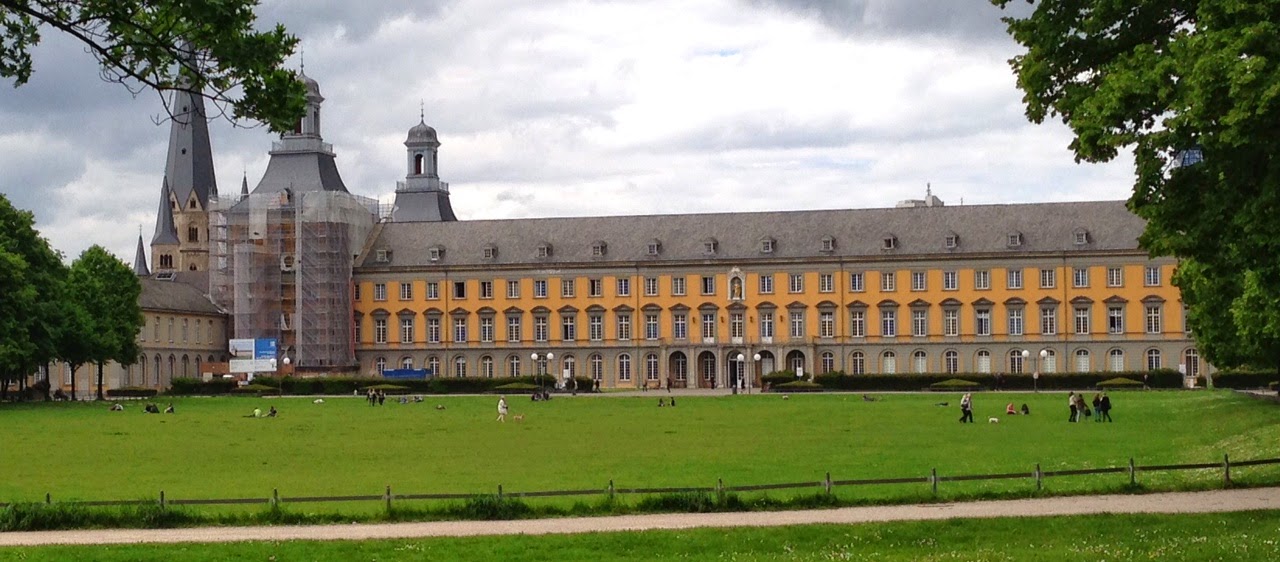
    A nice park in front of Bonn University.


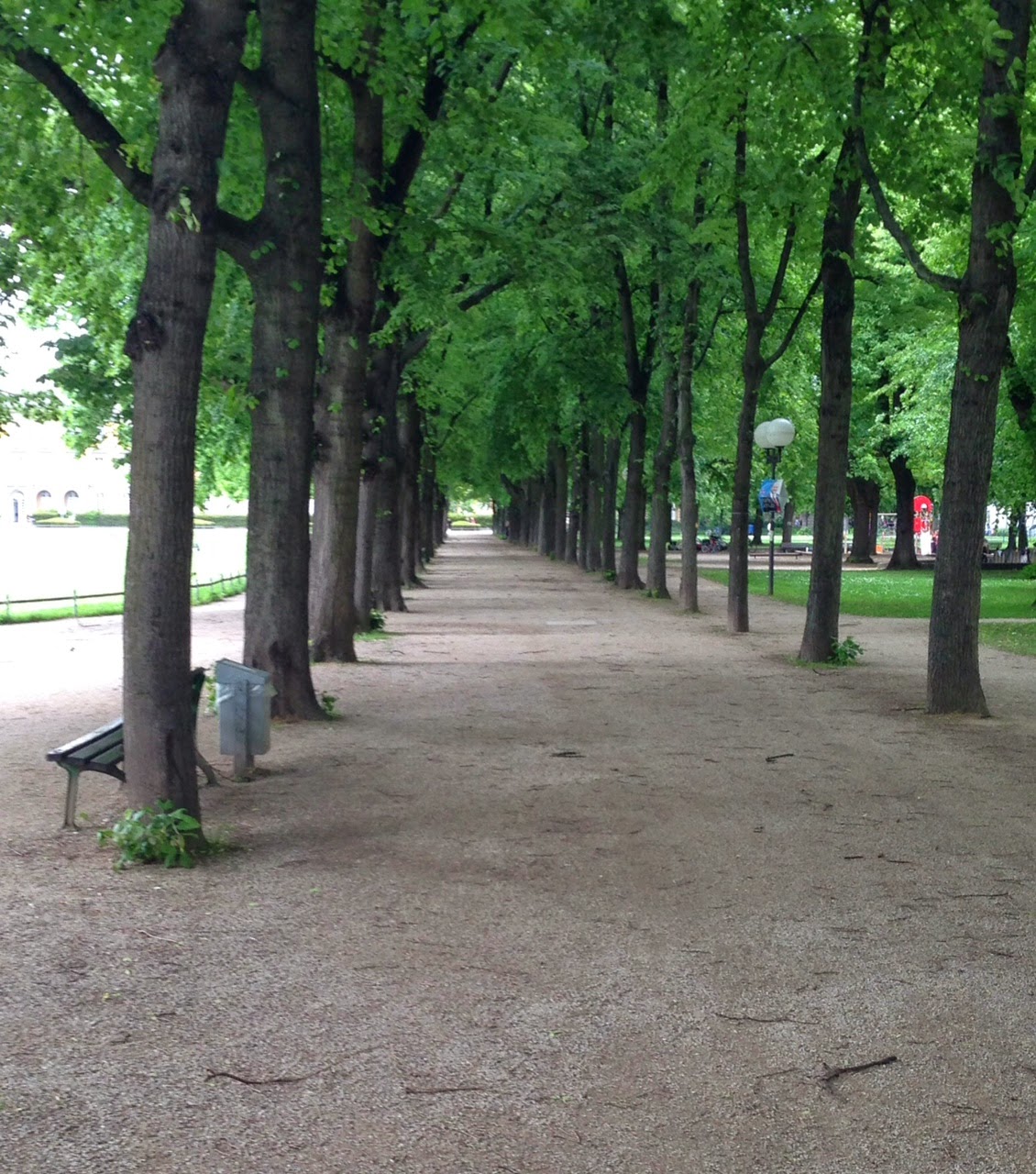
    Tree lined walk way just to the right of the park above.
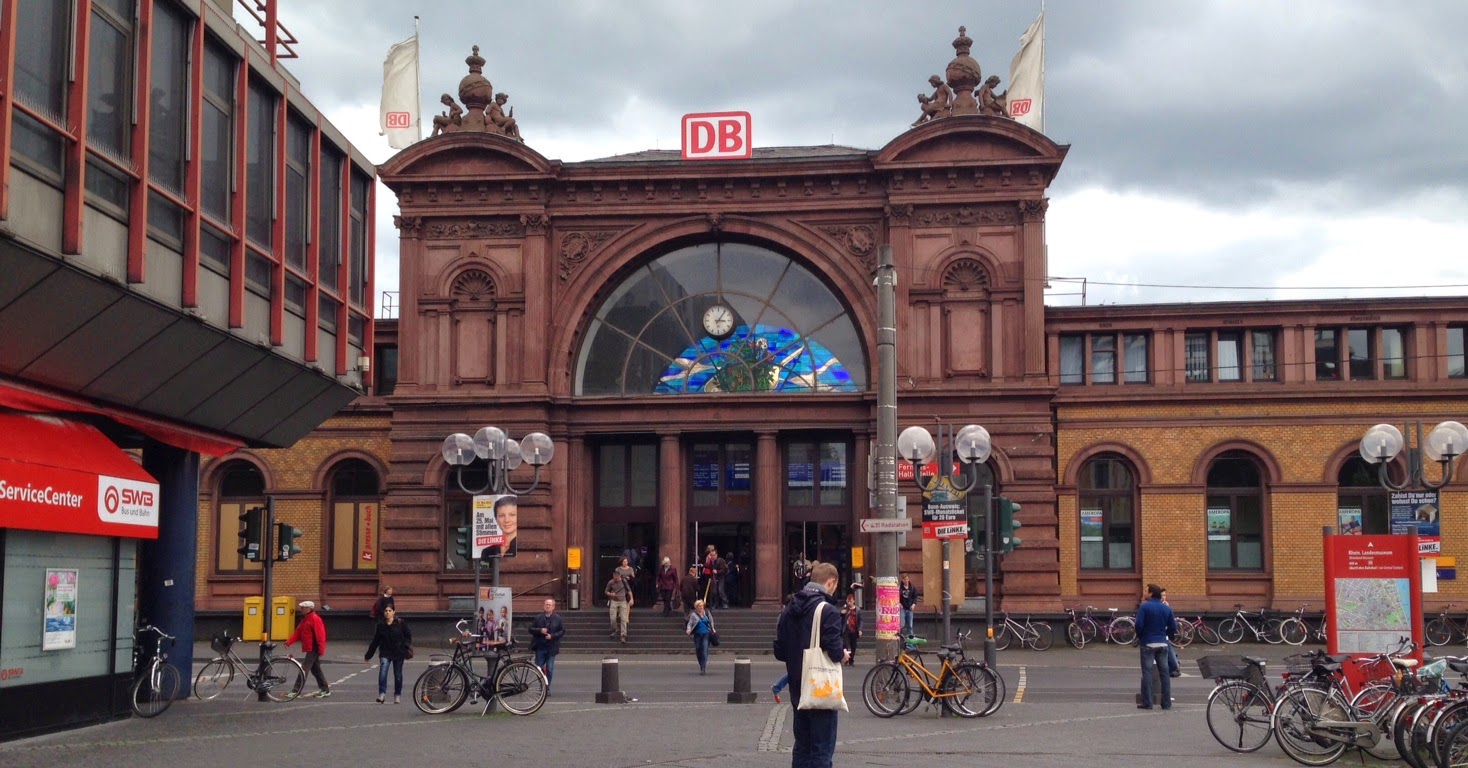
    Bonn Hauptbahnhof (main train station). DB = Deutsche Bahn. The picture below is a closer shot of that stained glass window.
     

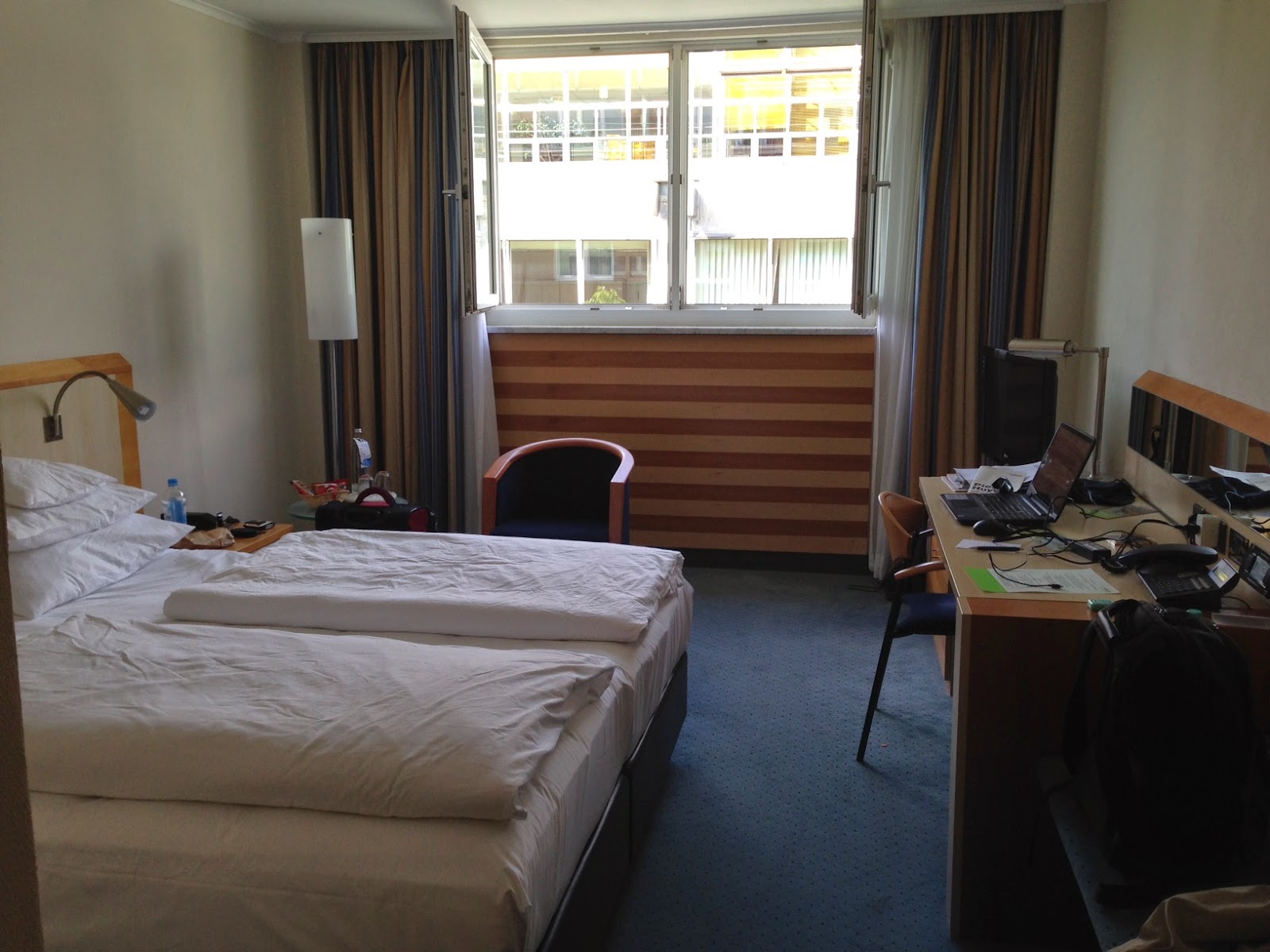
    As I was reading through last year’s blog sometime last month, I realized that I never included pictures of any of the places we stayed. I regret that now, in particular with regards to the apartment we had in Amsterdam. We stayed there a week and had many meals there; it was a significant part of the trip. So I promised myself I wouldn’t do that this year. So since this is our last night in Cologne, I figured I better thrown in a picture of the room. It was nothing special, but hopefully this will help me remember to keep doing it. We are at the Lindner.

    It looks pretty much like the ones on the website. http://www.lindner.de/en/DR/190Rooms

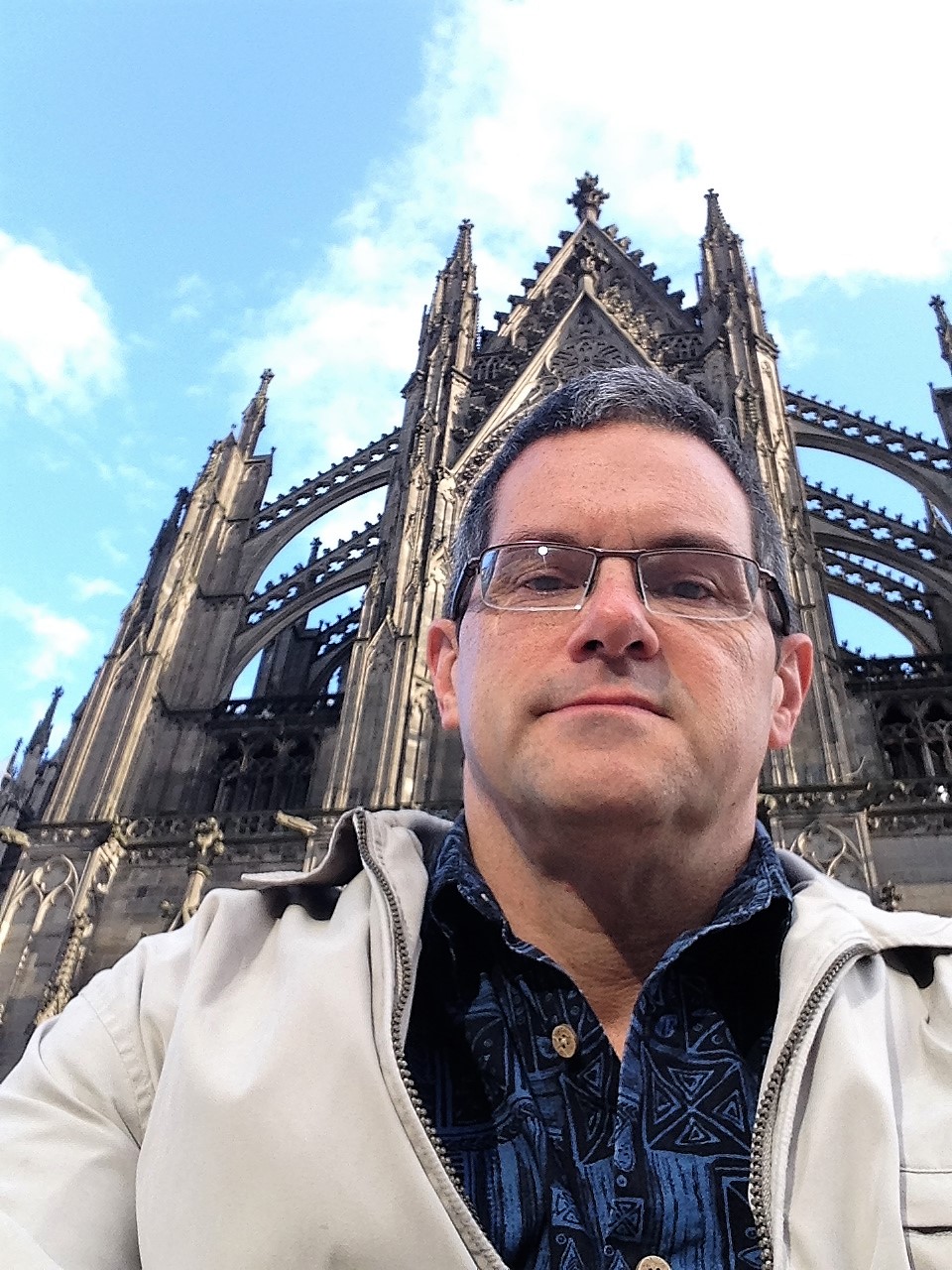
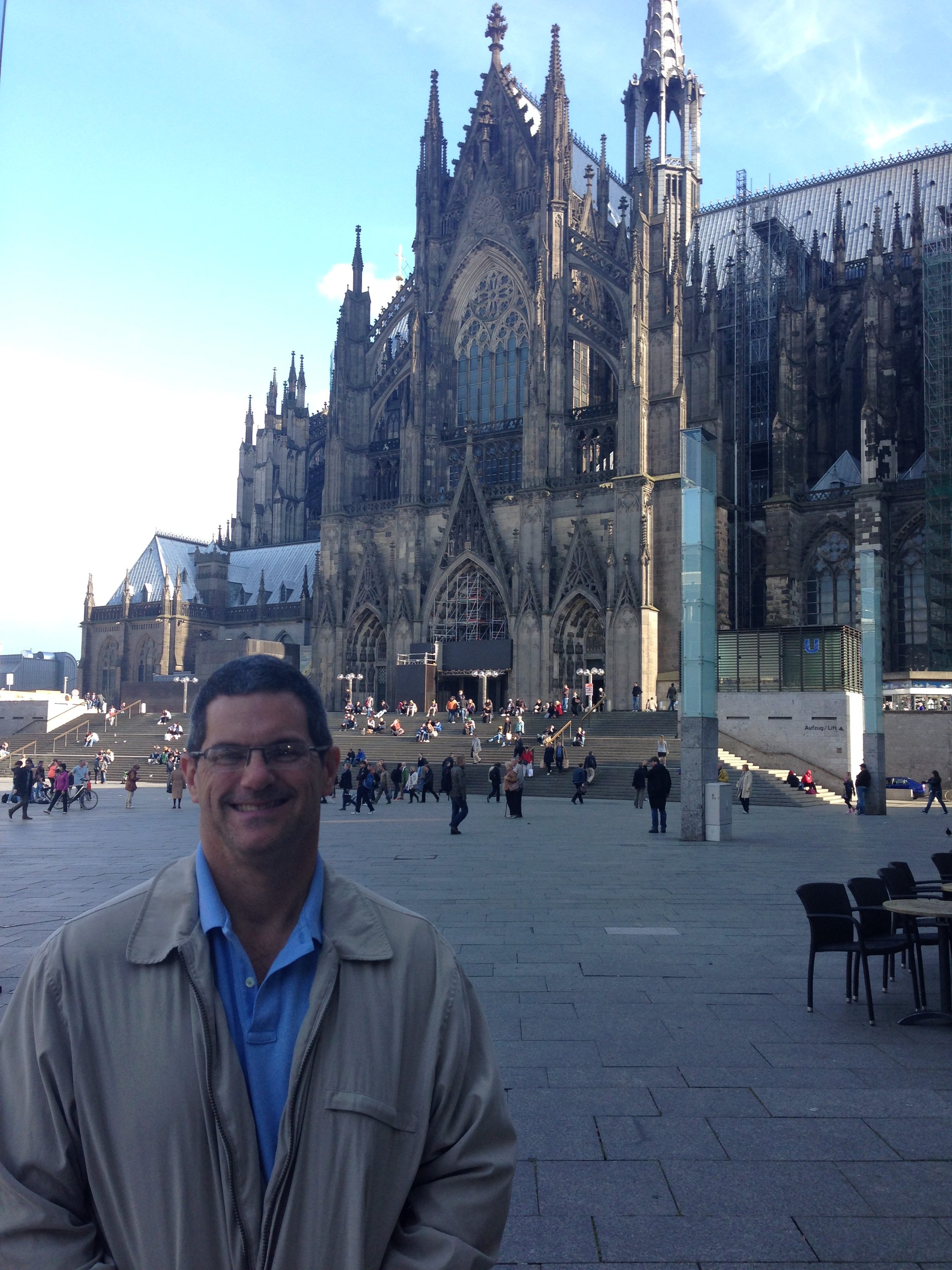
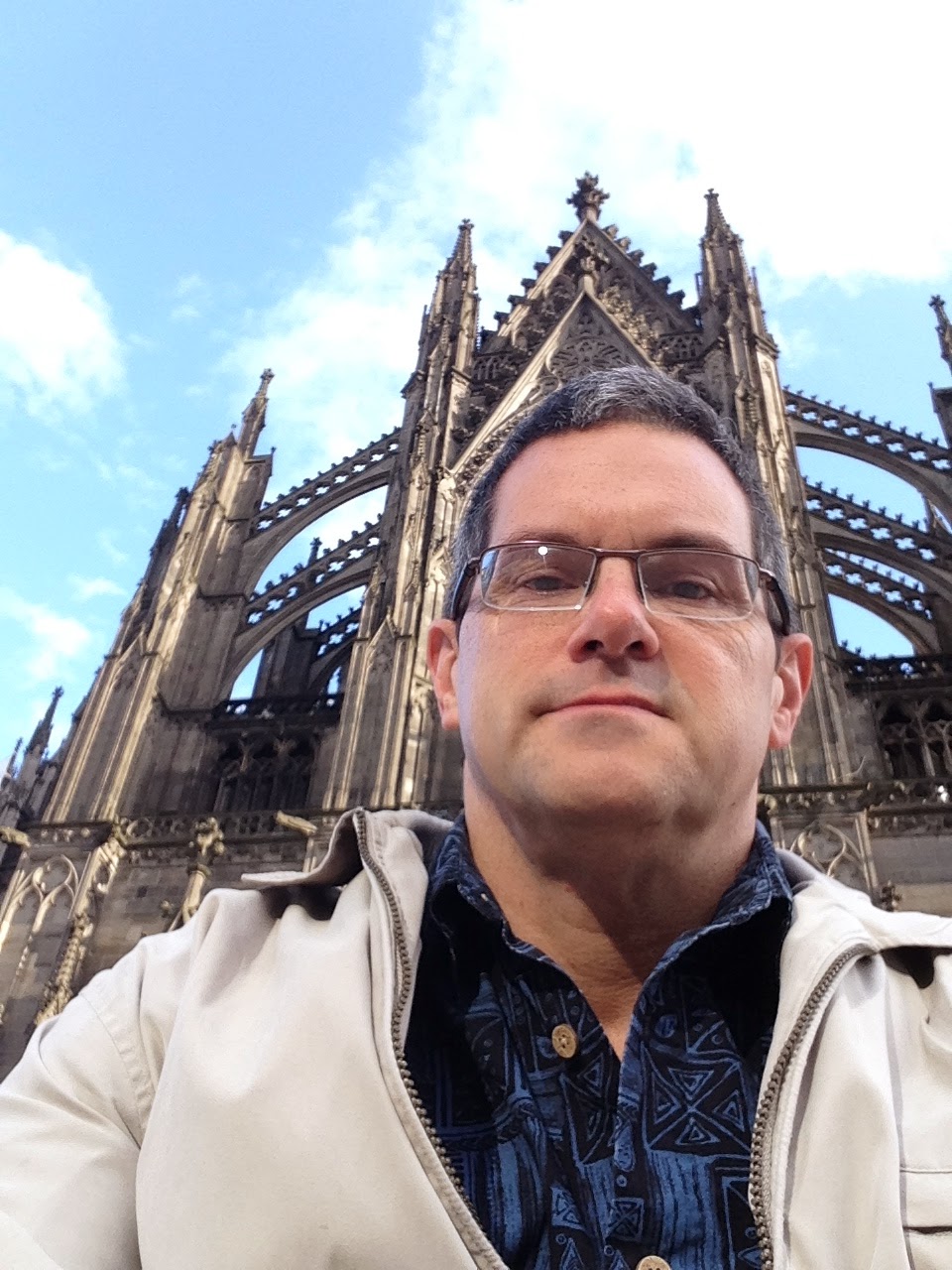
    I got back to the room about 4:30 this afternoon. Showered, rested some, got the pictures ready for the blog. Then the battery died on my wireless mouse. Dang it. Where to find batteries? The train station of course. Dan had just texted me that he would be back around 7:30. So I let him know that I would meet him there and we could go straight to dinner. I picked up the batteries and some travel toiletries at the same place we’d bought the nail clippers last year, then went to sit on the steps of the cathedral and people watch. Dan had jokingly said yesterday I should take selfies of myself when I’m out so here finally I thought, why not?

    Not 5 minutes after I took this, Dan sends me a text suggesting we meet on the steps of the cathedral. I sent him this and said “Guess where I am?” We had dinner at Istanbul Pizza, interesting blend of Italian and Greek with a twist of something else. Turkey I guess.

    That is beyond enough for today. Plus it’s past my bedtime, 11:45pm. We have a 6:44am train to Paris tomorrow.

  • Day 1: Cologne

    Day 1: Cologne

    I slept for 6.5 hours, waking up about 5:30am local time. That’s pretty normal for me in terms of length and time up; although here lately it’s actually kinda sleepin’ in! Yay for vacation. It’s also a nice indicator that my strategy of staying awake as much as I could on the way over helped me adjust to a 9 hour time difference pretty quick. We’ll see if it sticks.

    Dan, on the other hand, did not sleep as well. He was up and ready to go by the time I woke up and left about 6am; he’d been up since 3:30am. He had to work in Frankfurt today, which is about 1.25 hours away on a high speed train. He had a long day – didn’t get back until close to 9pm. Hopefully he will sleep better tonight.

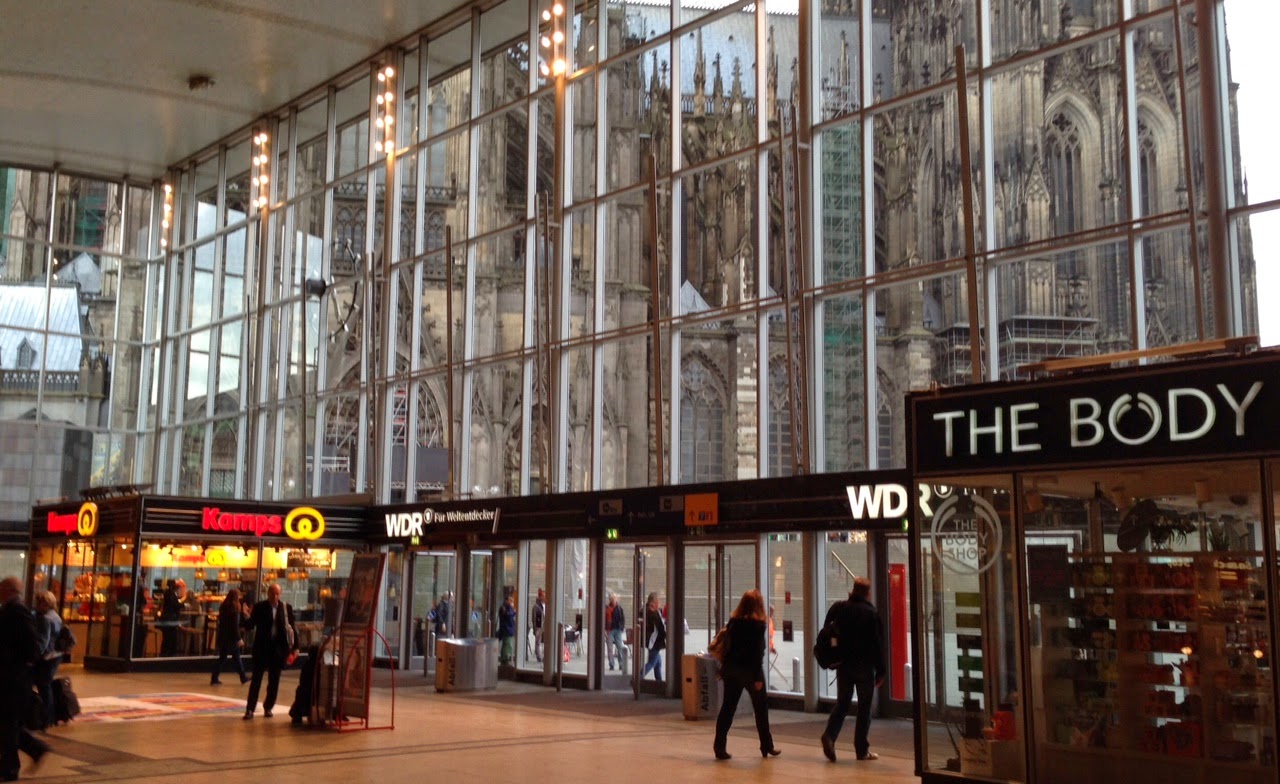
    I started my day – where else? – at the train station. The room we’re in doesn’t have coffee in it (despite supposedly being a 4-start hotel) so I was out by about 6:30 in search of. Nothing else is really open that early and I knew stuff at the train station would be. I went to Kamp’s which is one of 2 German bakery chains we’ve identified. Had 2 cups of coffee and a croissant there. I managed to get this shot from inside the station which helps depict the mall aspect that I mentioned yesterday. That’s Kamp’s where I sat and read some of my Churchill book, with The Body Shop on the other side. The Body Shop is somehow ubiquitous here – I must’ve seen 4 of them walking around today, which is certainly more than I see at home. What’s up with that?

    And yes, that’s the cathedral in the background. I love the juxtaposition of campy retail (no pun intended) and Gothic architecture.

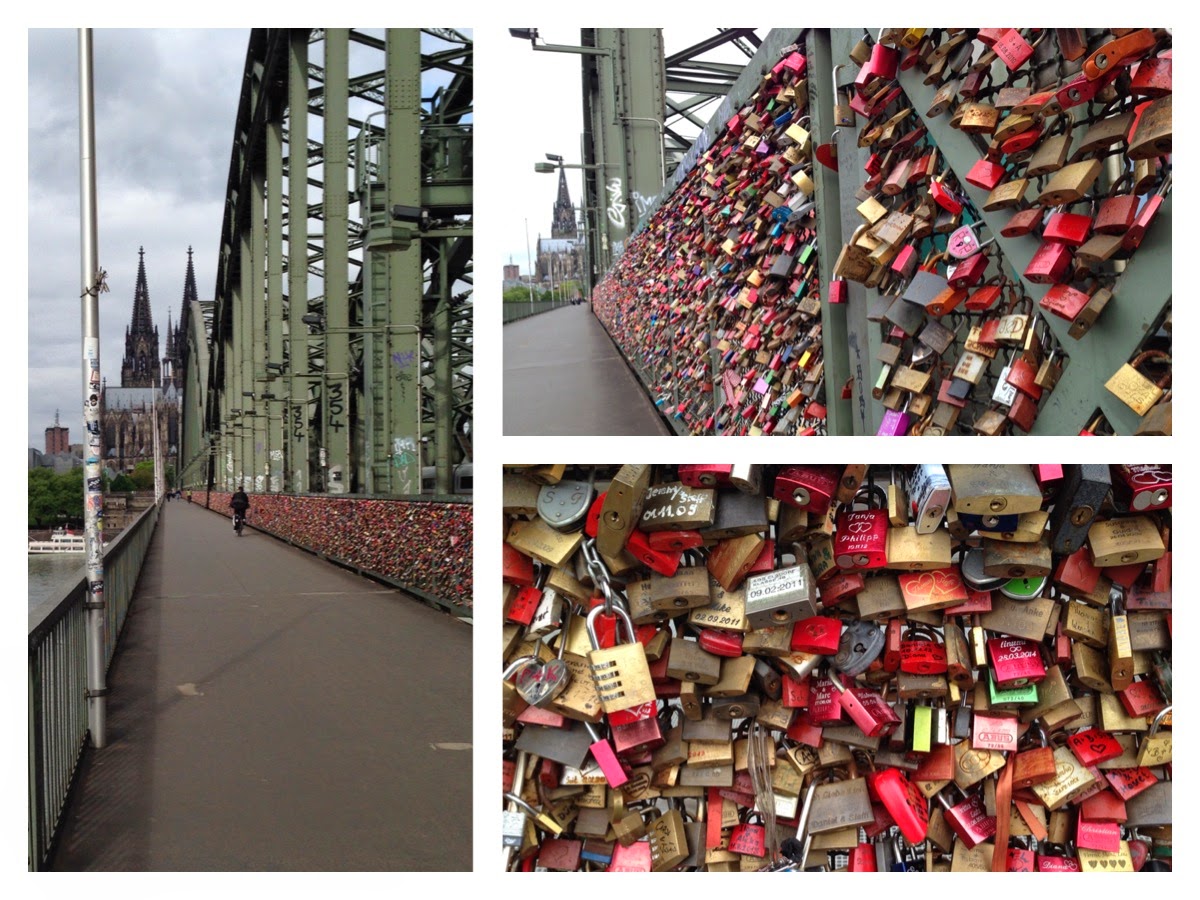
    I went back to the room and planned my day using TripAdvisor.com. First stop was the Hohenzollern Bridge. Originally built in 1907 for trains, cars and pedestrians, it was destroyed in WWII and rebuilt in 1946 as a train bridge only. Pedestrians were allowed again some years later. Today it is the busiest train bridge in Germany, serving about 1200 trains a day. The Cologne Train Station is a major transfer point for all European railways. Part of the reason we’re staying here instead of Dusseldorf is the direct line from here to Paris, which we’ll take on Saturday.

    The fence separating the pedestrian walk from the tracks is covered in “love locks”: couples put a padlock on the fence, with names and dates written or inscribed on them, and throw the key in the river as a commitment of undying love. I understand Paris has one, too, so we’ll get to compare them when we go there!

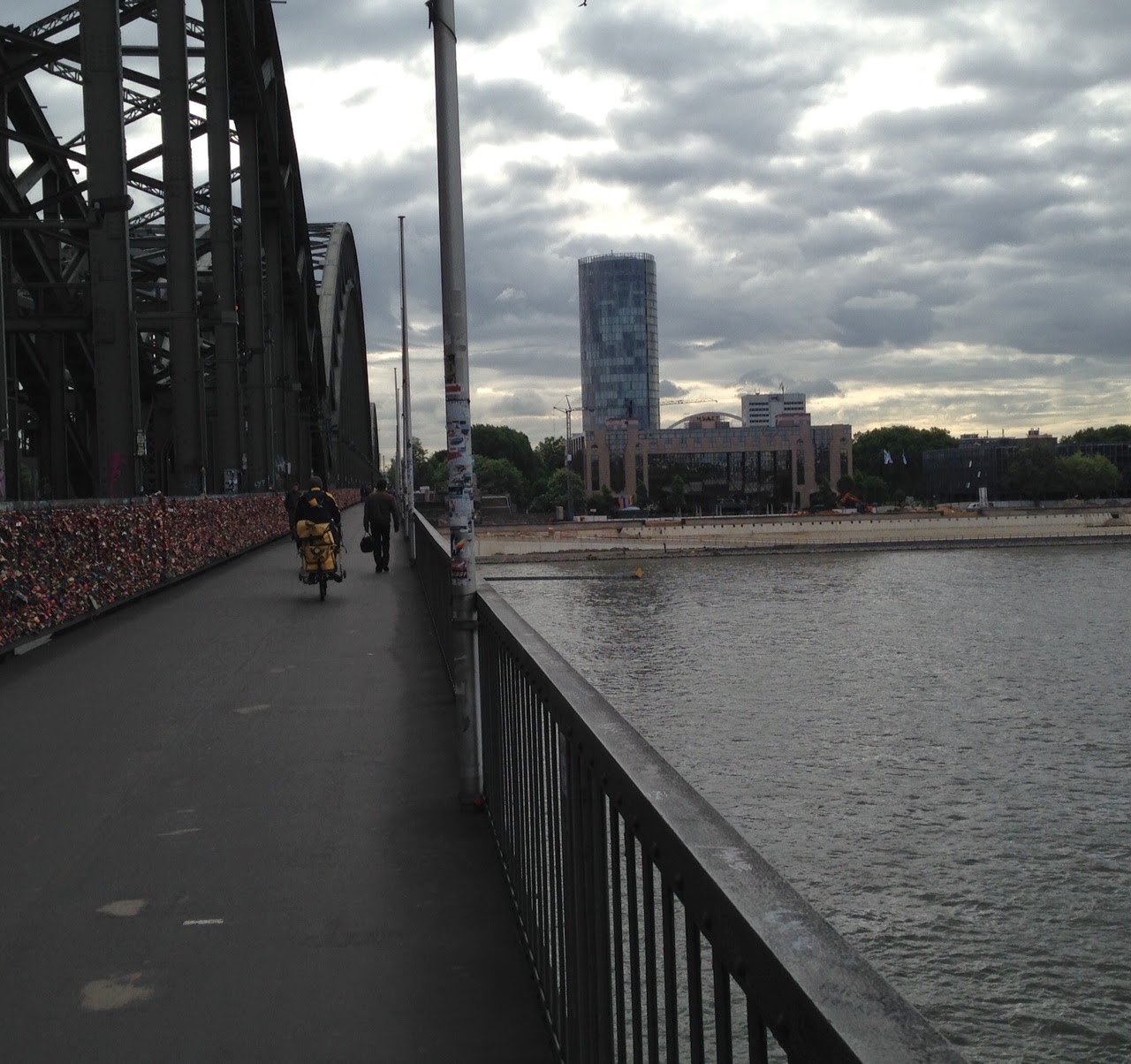
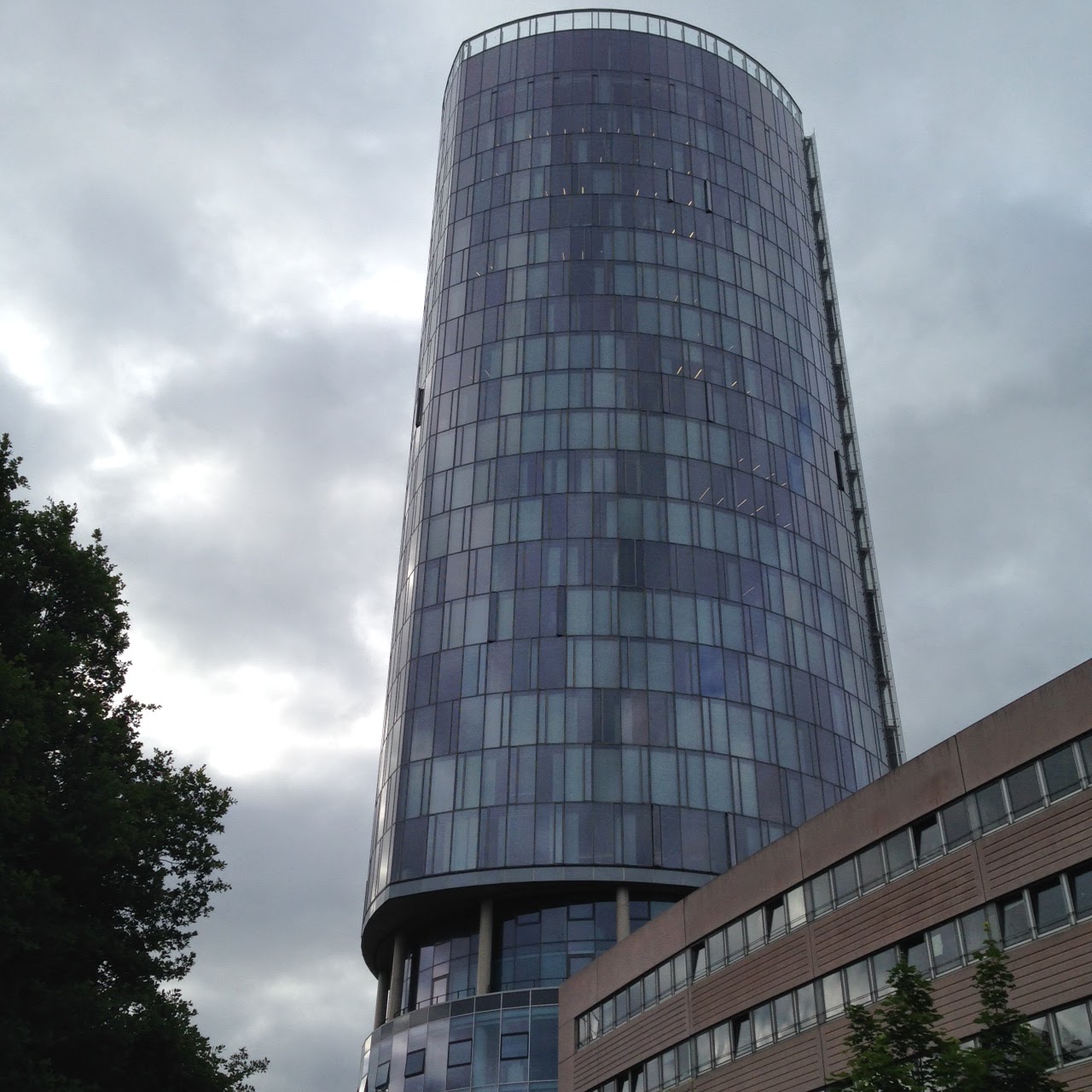
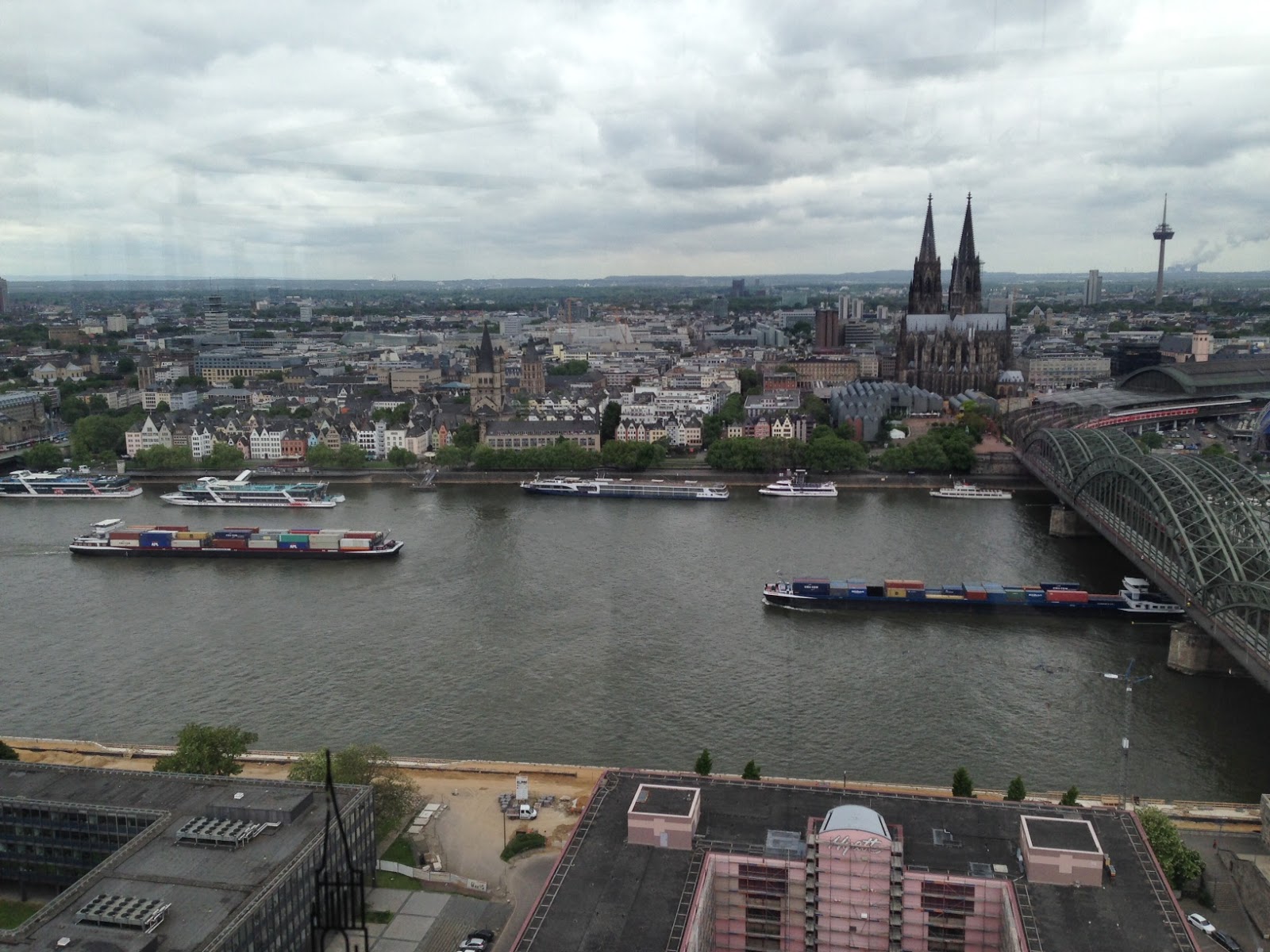
    Across the river was a business building I’d seen in the train yesterday and thought it was cool looking. I learned on TripAdvisor that it is called KoelnTriangle and has an observation deck on the 29th floor.

    KoelnTriangle as seen from the bridge.


    Closeup!


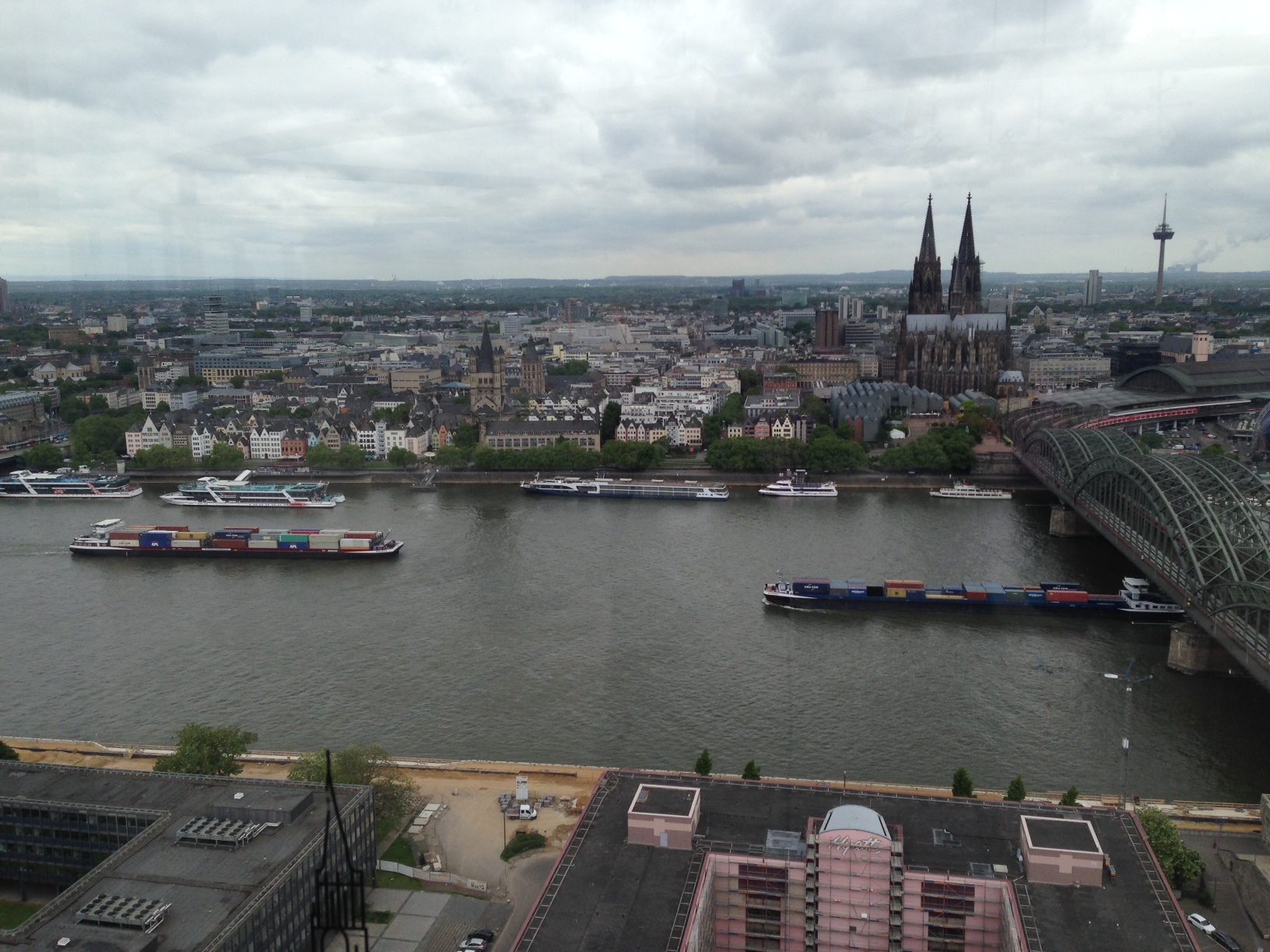
    Bridge, Rhine River and cathedral from the 29th floor.

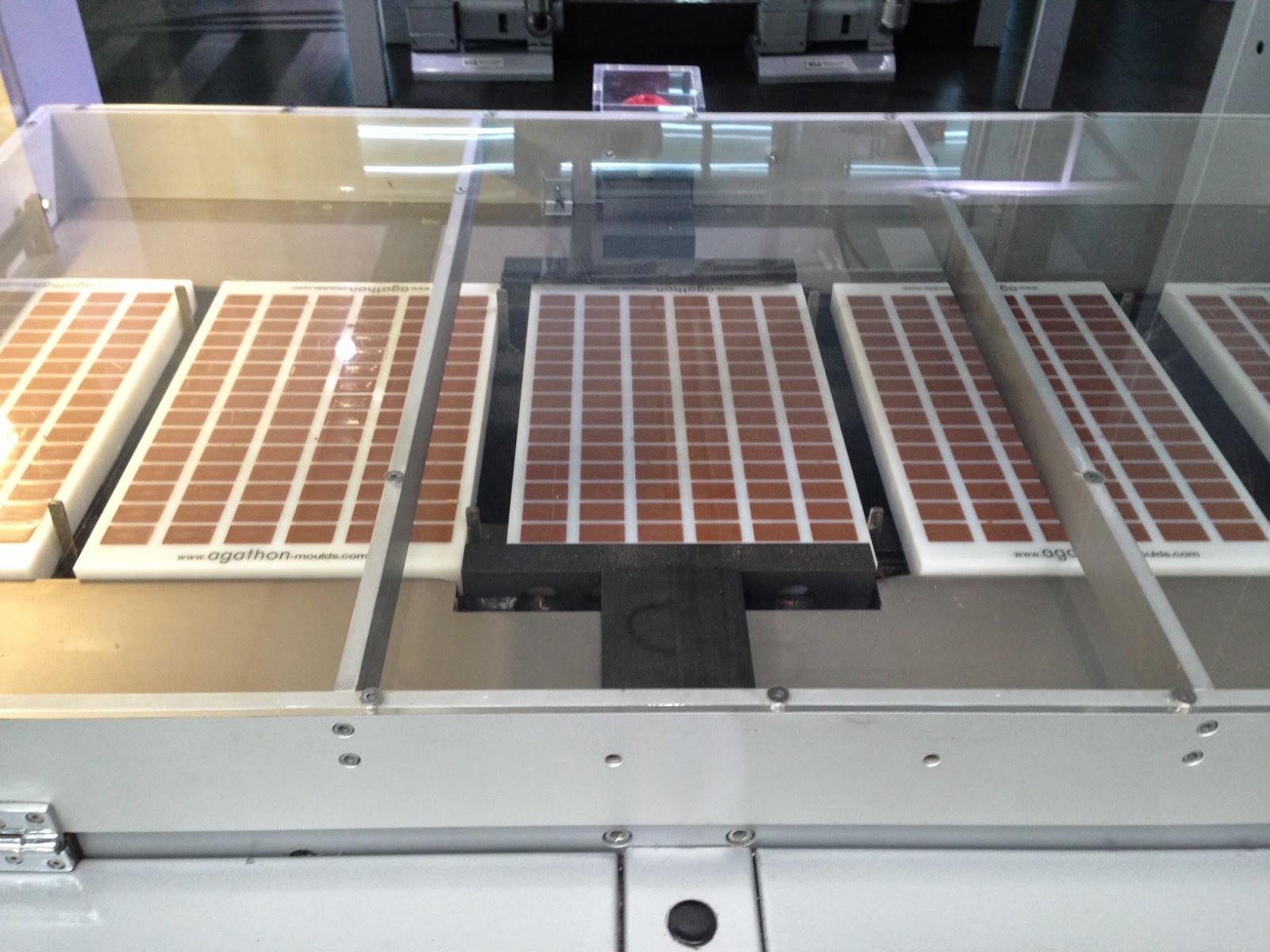
    Who doesn’t like chocolate? Certainly not the Germans, who produce 4x as much chocolate as the Belgians (who are arguably more famous for it), according to my next stop: a Chocolate Museum associated with the Lindt chocolate factory. Although there’s some speculation most of both are bought by tourists. Guilty. At any rate, we had been to a chocolate museum in Bruges last year and the reviews on TripAdvisor for this one were pretty mixed, but I decided to check it out anyway and am glad I did.

    Cocoa beans essentially only grow in the tropics, between the 20th parallels on either side of the equator. About 70% of at comes out of Africa, specifically the Ivory Coast, Nigeria and Ghana; then; Brazil, Ecuador, Indonesia, and Mexico. Much of the work is done by small families who’ve been doing it for generations. The museum had some interesting information about the socioeconomics of the industry, including this sad nugget: “In general, those who cultivate and harvest the cocoa never have the opportunity to enjoy the end product – a bar of chocolate. Experts estimate that approximately 75% of cocoa farmers and their families have never tried a piece of chocolate….while the cocoa producers are often among the world’s poorer countries, cocoa is primarily imported by rich, industrialized Western countries. 

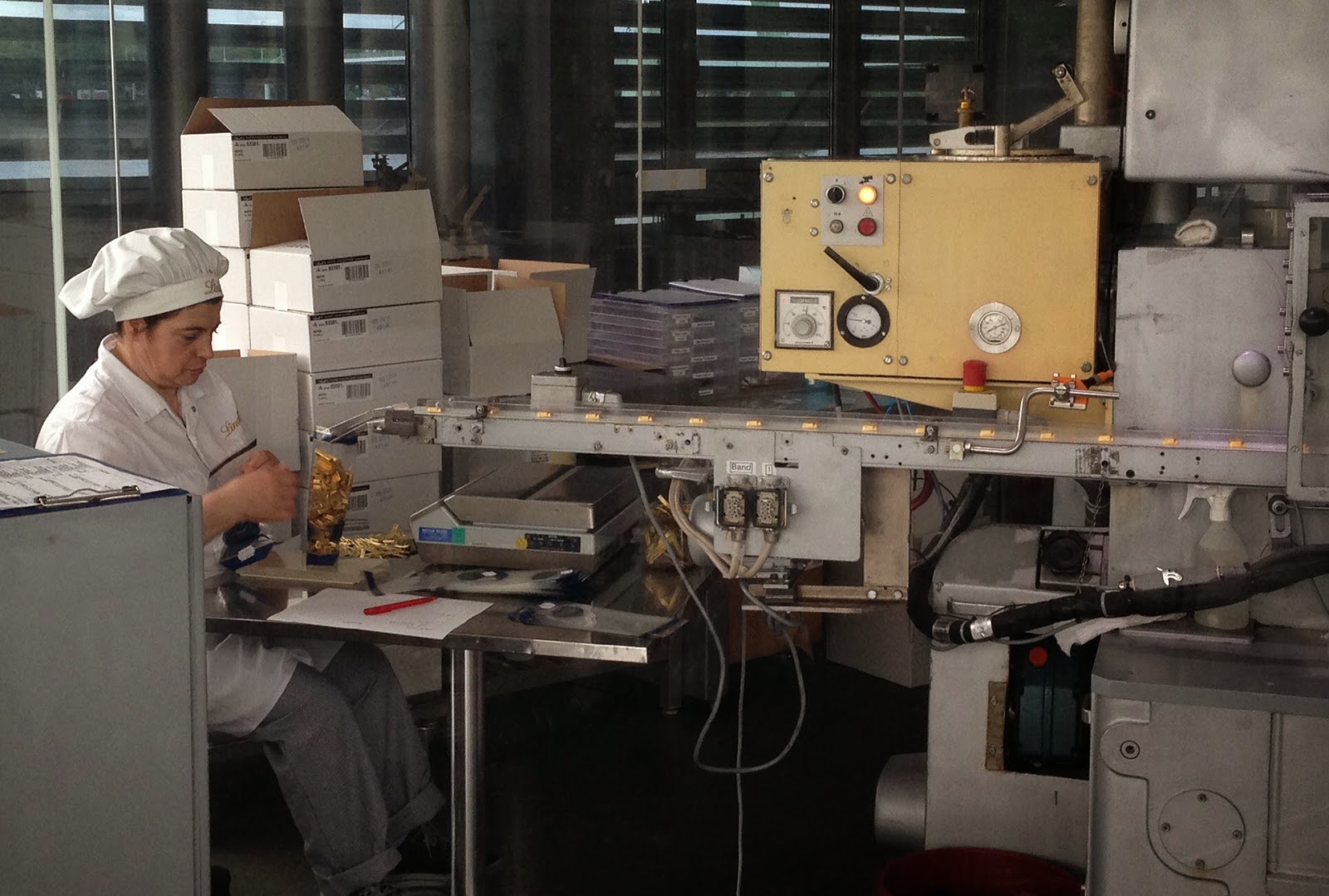
    The factory was fun to watch, with some images looking unironically like a certain “I Love Lucy” episode.

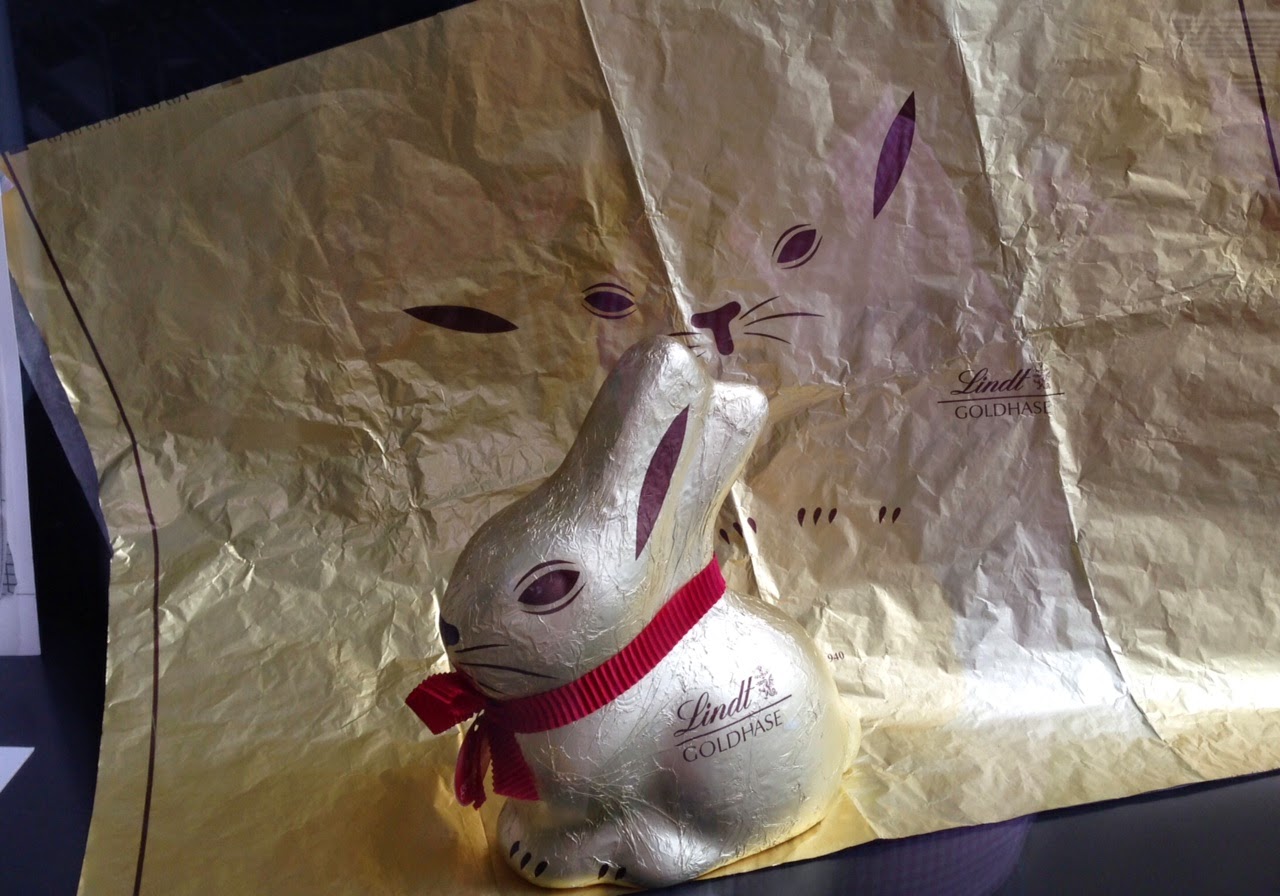
    Sometimes it’s the little things that gets my attention. In this case foil. They went into a fair amount of detail about why foil became “the” thing to wrap chocolate in, starting in 1911, none of which I’d ever thought about: foil is impermeable to vapor, water and aroma, helping maintain longer shelf life; is light weight and easy to form around all kinds of shapes. Imaging your Easter chocolate bunny wrapped in paper, the primary choice prior to foil. Not quite the same.

    Thee was a also a display of foil art – how well prepared the foil had to be first to make sure that bunny isn’t cross-eyed or something. Like I said, it’s the little things.

    I had narrowed my second museum choice (I will rarely do more than 3 in one day) to one of 3, and ended up picking the first one I ran across. It was the Museum Ludwig, a modern art museum.

    You know the saying about the definition of insanity: doing the same thing over and over expecting different results? This describes my relationship with modern art museums. I feel like I’m “supposed to” like them, that if I keep going, maybe this time it will be different and I’ll finally “get it.” Well, that certainly didn’t happen this time. What it did do was cement my preferences: I probably like history museums the most; if it’s going to be an art museum, the majority of the collection needs to be no later than 1920 otherwise I just walk around going “WTF?”

    This was one of the latter. There was a special exhibit going on, of the artist Pierre Huyghe, “a major figure in the French and international art scene…redefining the notion of art and the exhibition-format since the 1990s.” I went there first. It was the epitome of everything I don’t appreciate about modern art. I’m walking towards the entry of the exhibit. This guy is standing in the middle of the opening to the hall reading a book. As I walk by he says something to me in German, saw the confused look on my face and says in English “what’s your name?” I told him and he turns around and yells into the hall “STEVE”. I was just like “okaay….” and kept walking. When I got some decent light (the first displays were very dark) I opened up the exhibition guide and this is what I read: “A young man stands at the entrance to the exhibition space and asks each individual visitor for his or her name, in order to announce it when the person enters. (1) Name Announcer (performance) makes visitors aware of their presence in an unfamiliar space that is inhabited by other actors, objects, and visitors and thereby negates the anonymity typically experienced in the museum. The focus of attention is thus shifted from the artworks to the relationship between them and the visitors, as well as between the visitors themselves.” It went downhill from there.

    Thankfully, the permanent collection was more palatable.The Ludwig has the 3rd largest collection of Picasso’s work in the world (1 and 2 being Paris and Barcelona). Two rooms, one full of paintings easily identified as his if you’re familiar with his work, another of work he did in ceramic – painted plates, bowls, vases. If I knew he’d worked in that medium I’d forgotten. I liked them. They also had a nice collection of German Expressionists. Most of the rest of it fell into the Dan Joo determinant of what belongs in a museum: “If I can do it, it doesn’t belong here.” Just to give you an idea, these were typical of what I don’t get about modern art:

    • What looked like a 10ft x 10ft framed piece of berber carpet, single tone, like a burnt orange. Really? Whatever it was supposed to represent was in German so it was even more lost on me, although I’m not sure a translation would have helped based on past experience with this stuff.
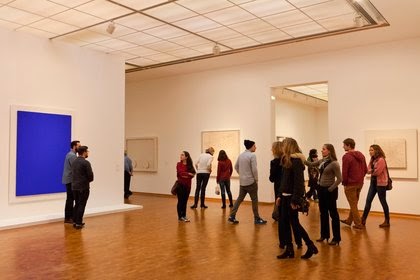
    • The requisite blue painting. That’s it. Just blue oil on canvas. You see something like this in every modern art museum.
    • A video of a kitty lapping milk from a saucer. I repeat – really?
    • And my personal favorite that I don’t get: stacked boxes of Brillo soap pads. I Kid You Not.

    You weren’t supposed to take pictures, and I didn’t, but I just pulled this off the website. See, I don’t make this stuff up.

    Let’s see if I remember this lesson in Paris.

    I had lunch at the other German bakery chain here, Merzenich. Just a quiche Lorraine and a much needed Diet Coke, although here it’s called Coke Light. Same silver background. There was a cute little gelato place around the corner and that was very nice to top it off.

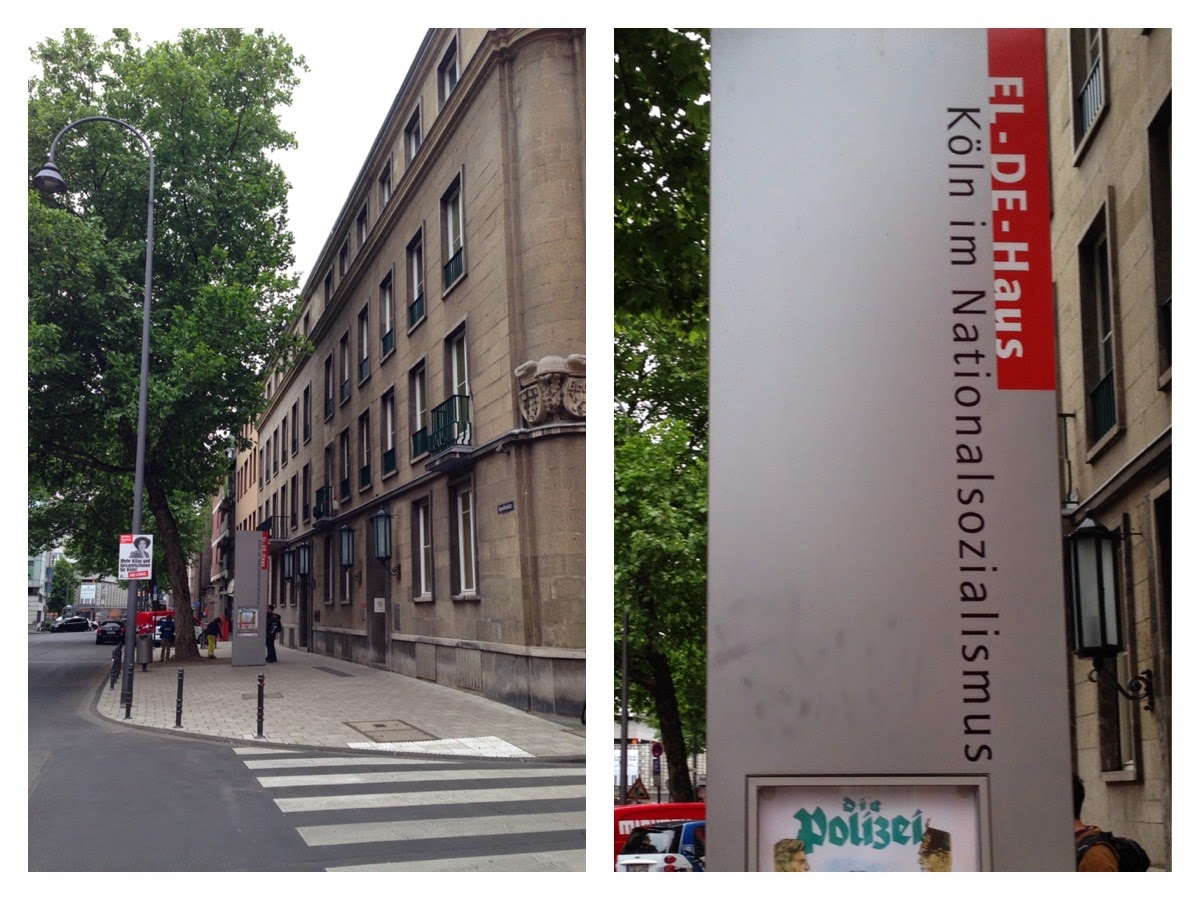
    The final stop for the day was the National Socialism Documentation Center. If it wasn’t for TripAdvisor I would have never known about it, but it was listed as #8 of all attractions in Cologne, and also on the “off the beaten path” list. It was the #1 thing I wanted to do, but it was west of the hotel and everything else was east, so I saved it for last.

    And it was off the beaten path in a non-descript building. If I wasn’t really looking for it I would have missed it easily.

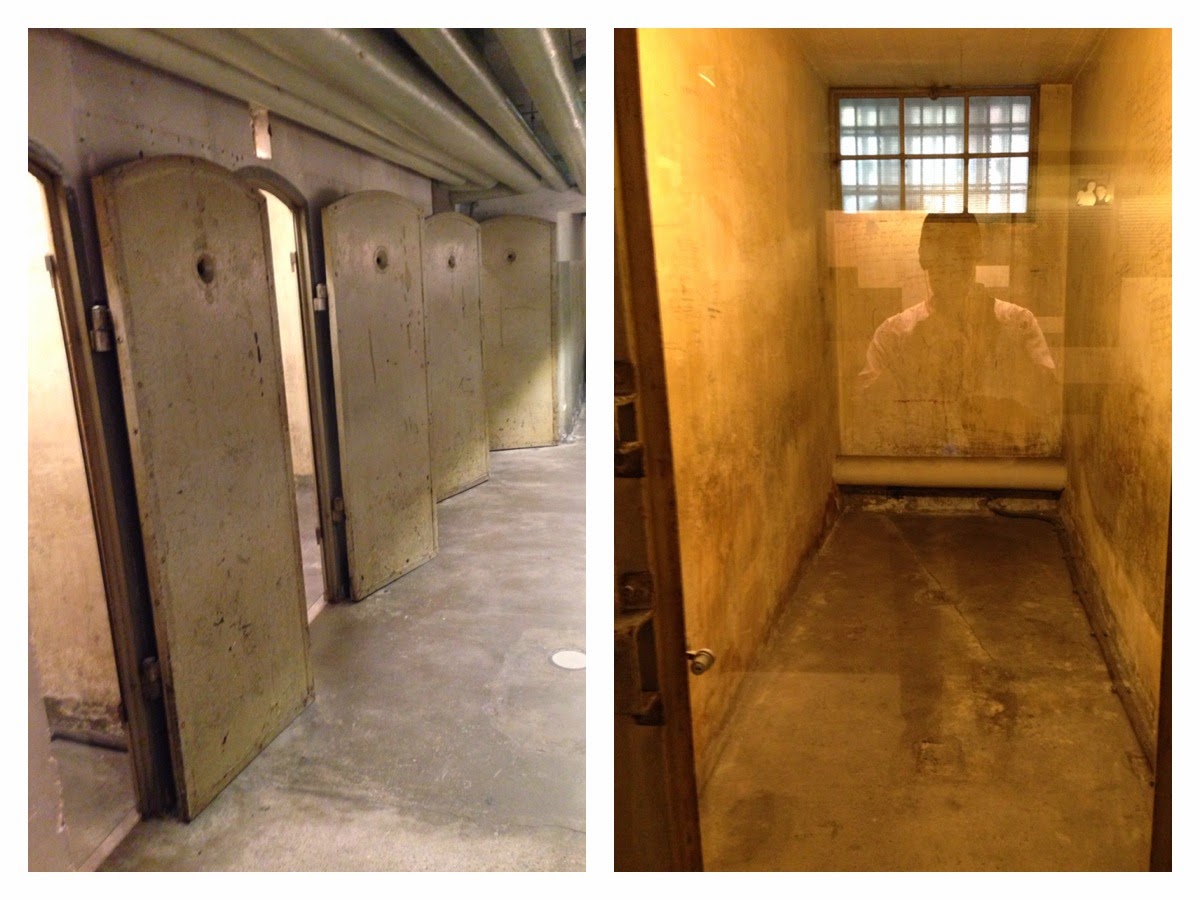
    From 1933 – 1945, this housed the Gestapo unit in Cologne, its offices and prison. Because the Germans are embarrassed about this part of their history, it was converted to government offices after the war. A young German discovered it in 1979 and waged a very public campaign to get it restored as a remembrance; that process took about 10 years, but it has been a museum since 1989.

    I was here for a couple of hours and could write a lot about it, but this is already long today so I’ll try to be brief. This is the first time I’ve been in something related to WWII in Germany, so the German perspective on it was the most interesting to me. Here are a few things I learned or was reminded of:

    • It walked you through the history of the Nazi party, starting in 1918, underscoring what I’ve said many times: it’s difficult to talk about WWII without also talking about WWI.
    • The core principle of the Nazi party was racism. In the 20’s and 30’s, it was fashionable to be racist towards Jews throughout Europe; the Churchill book I’m reading touches on this, too. And because the Nazis were committed to restoring glory to Germany after the humiliating losses and retributions suffered after WWI, Hitler was seen as a savior. Most Germans were not turned off by Antisemitism. They just didn’t realize how far it was going to go.
    • There was a fair amount of information about the Hitler Youth groups, very disturbing indoctrination stuff; 95% of all males between 10-14 were members.
    •  Prisoners were from many countries, including Germans who were considered part of the resistance, usually on very flimsy evidence. Take no chances, lock’em up.


    The cells were like 4×8, always solitary confinement.
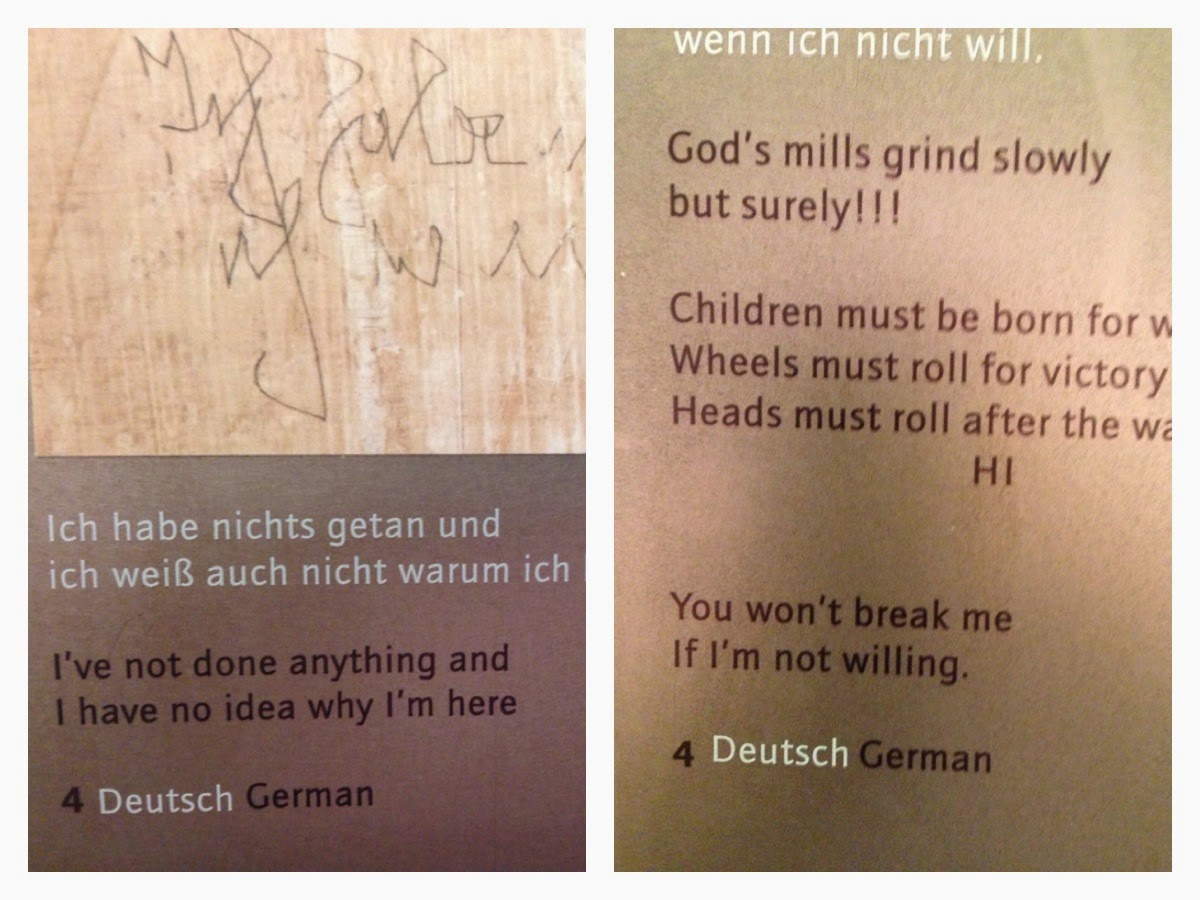
    These were inscriptions on the walls left by prisoners. They were from Poland, Russia, France, etc. But some were German, and those impacted me the most. It’s like I forget the Germans suffered, too.
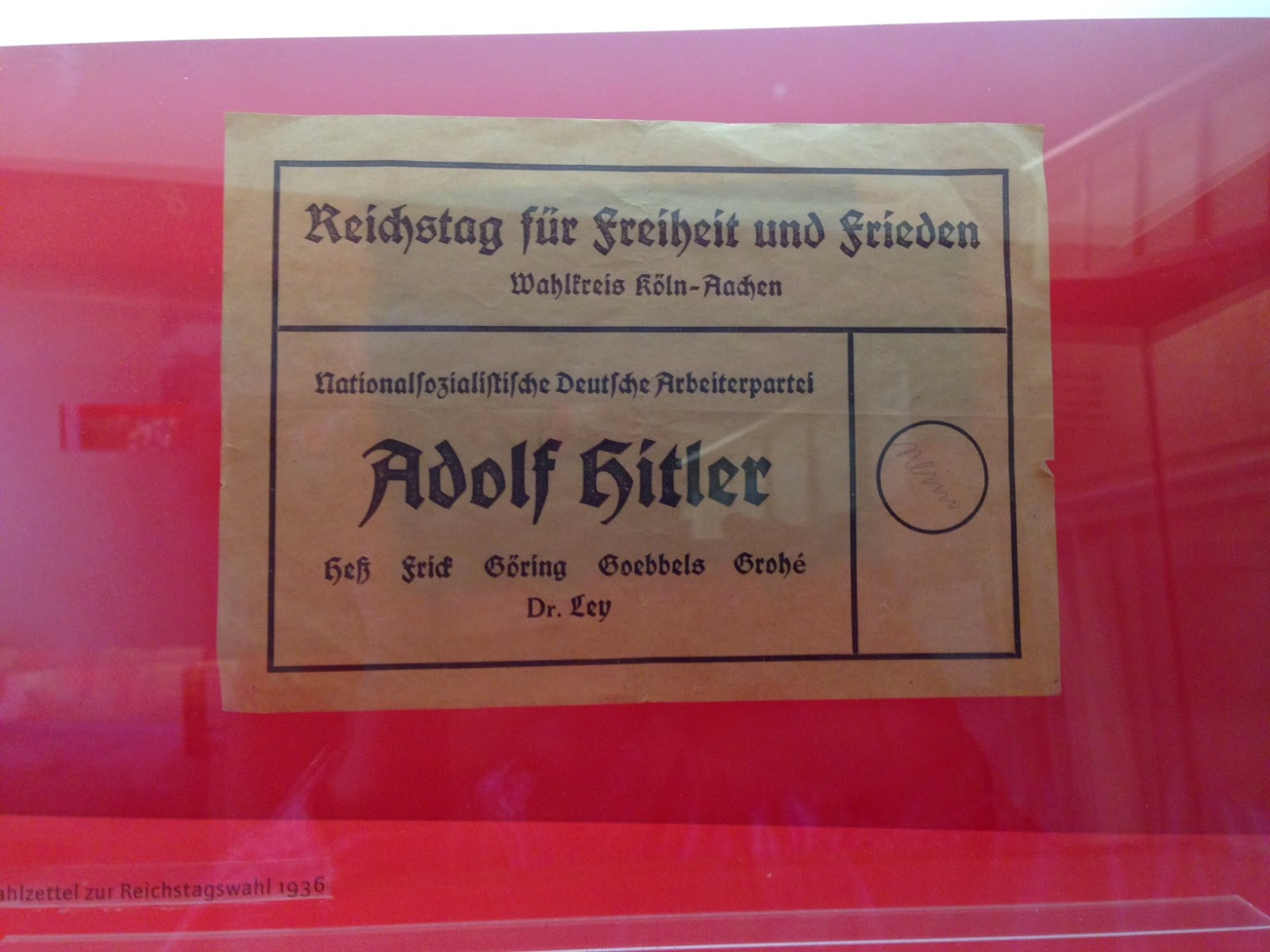
    This was a ballot. Lots of choices, huh?

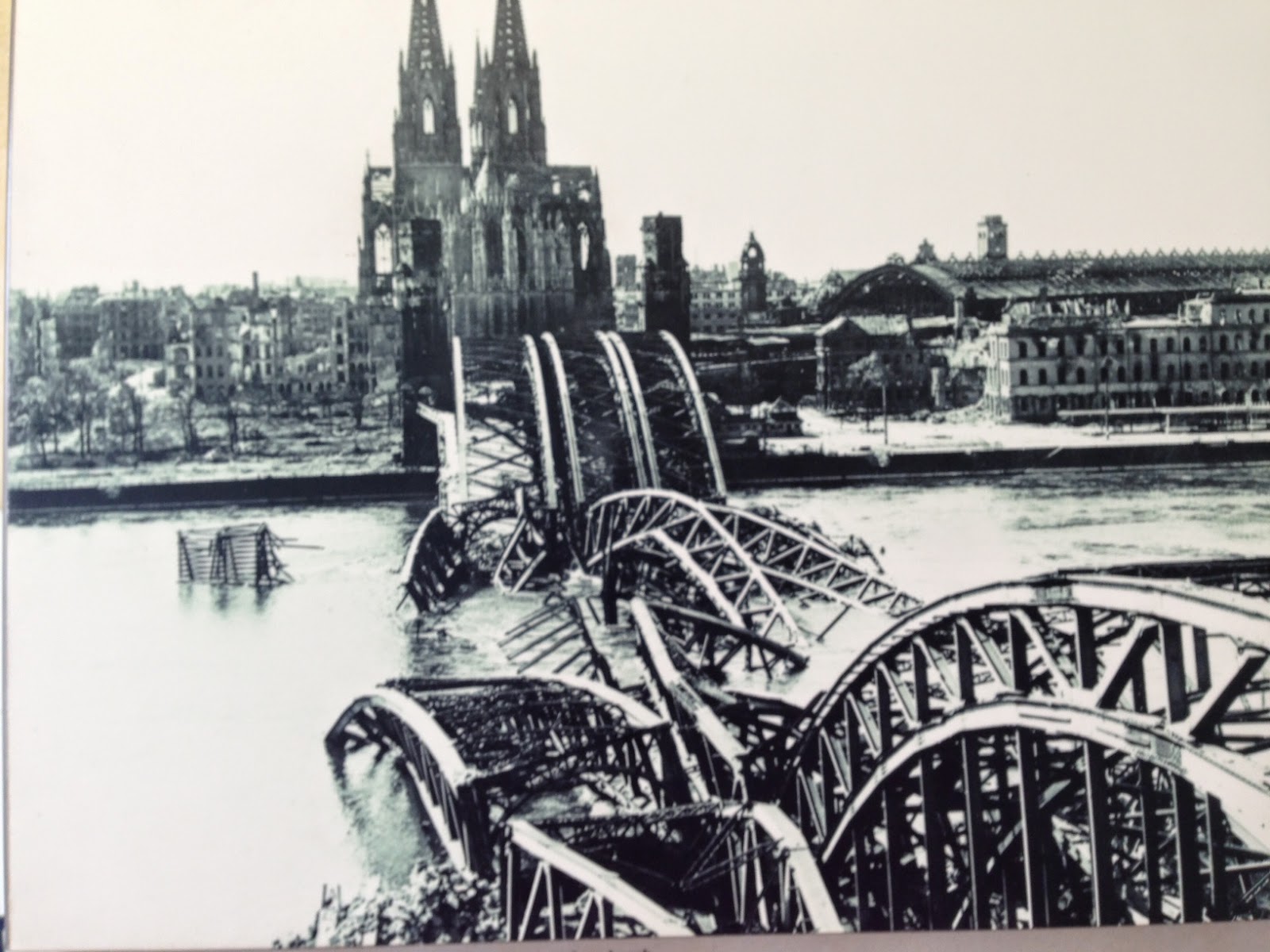
    Remember the pictures of the cathedral from the war yesterday? I was able to get a couple of more taking pictures of photos in this museum, including one of the bridge from earlier in today’s blog after the Allies bombed it in March of 1945. It was considered Germany’s link to the west.


    I am registered to vote as “unaffiliated” for many reasons which I won’t get into here. But I get highly annoyed when members of either of America’s primary political parties start slinging Nazi and Socialist names at each other – and they’ve both done it, doesn’t matter which side is sitting in the White House. We do some stupid things politically, both sides. But nothing comes close to what happened in Europe during this period. Words matter, and rhetoric and hyperbole shouldn’t be used to scare the masses and fuel the fires of hate, especially when said in complete ignorance of their true meaning.

    OK, I’m done now.

    I rested in the hotel for a little while then went back out and walked around other neighborhoods farther away from the Centrum. I found the bistro we had lunch at last year that we really liked, and ended up going there for dinner – a taste of a couple of German noodle dishes and apple strudel with vanilla sauce for dessert. Very tasty, reasonably priced, adorable ambiance, gay owned. Can’t beat that.
  • Departure: Tuesday – Wednesday

    Departure: Tuesday – Wednesday

    The actual traveling part of traveling is pretty boring. How exciting can 12 hours in a plane be? Well, I guess it could be pretty exciting, in a “Lost” sort of way, but then I probably wouldn’t be here writing about it.

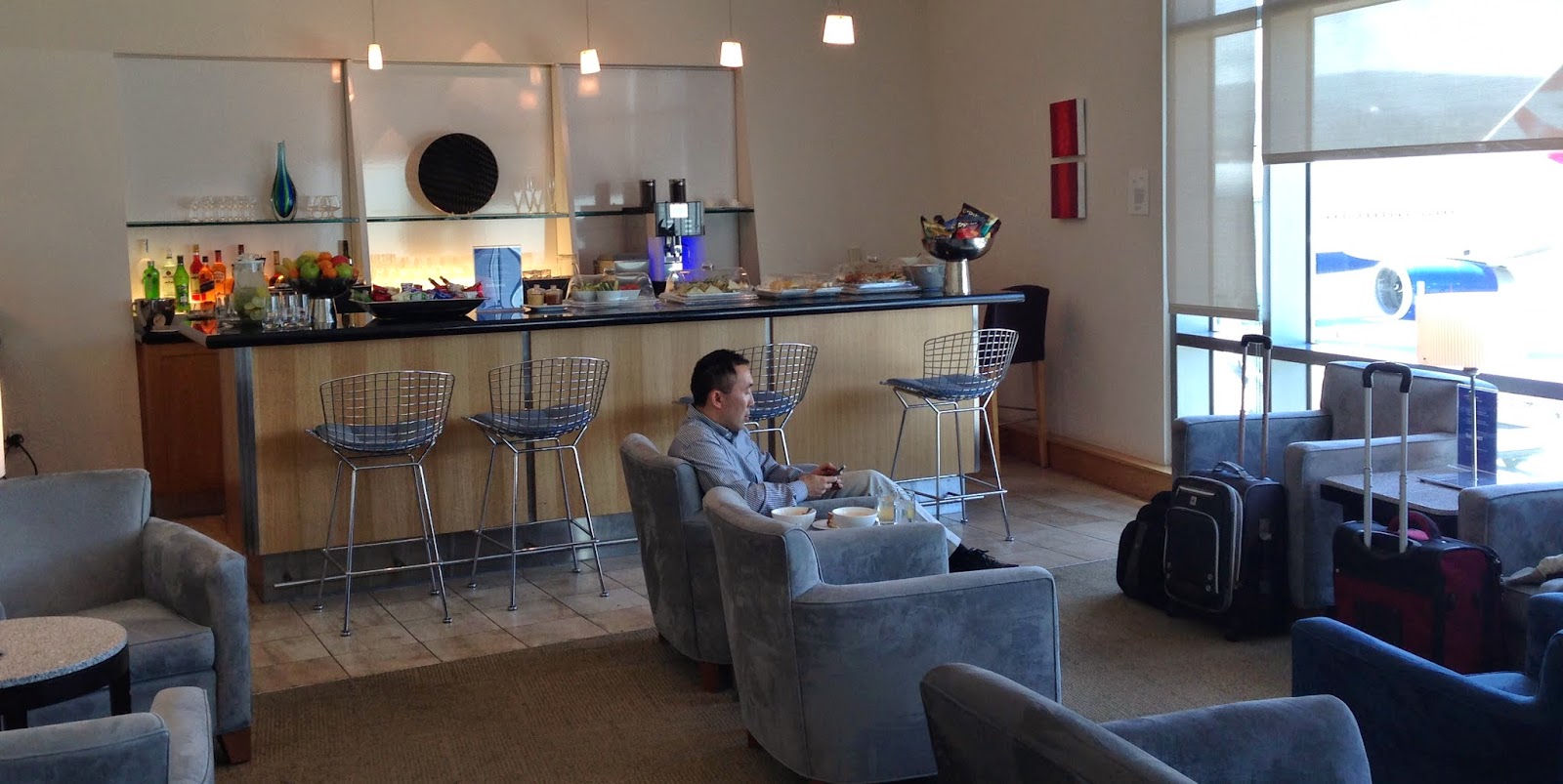
    We had a 4:40pm flight from SFO to London. Neither of us had eaten lunch because we’d planned on just eating in the British Airways lounge. While I mentioned in the earlier post that Dan’s work travel isn’t fun for him per se, it has earned him some frequent flyer perks that at times I will get to benefit from as well. Being able to wait for your flight from the lounge instead of the gate is one of them. We did that in SFO yesterday and London Heathrow today on our layover. I thought the one yesterday was nice, but the one in London was incredible. I neglected to get a picture of it but we’ll be back there at least 2 times on this excursion so I’ll try to remember later.

    Here’s Dan in the lounge at SFO. This area was a small room off the bigger lounge. The bar in the back was full of sandwiches, fruits, snacks and beverages including alcohol of all kinds, all for the taking.


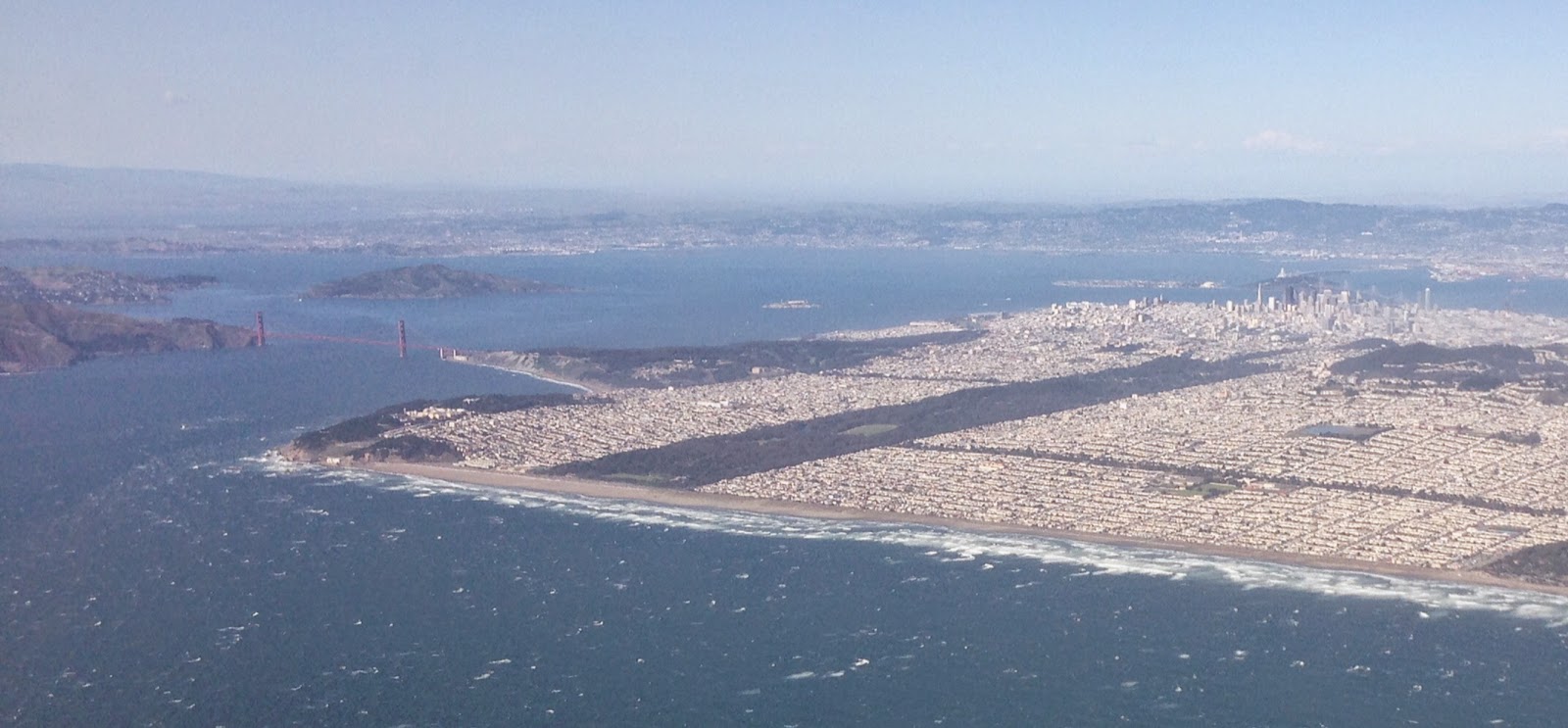
    The jet took off west over the Pacific Ocean a bit and then made a u-turn. Dan got this shot of San Francisco from the plane. I’ve never flown out of SFO before so this was a new view for me. Really breathtaking.


    We watched “The Monuments Men” on the plane. It’s the story about a task force of men who went in search of the art work the Nazi’s had stolen during WWII. Not only did it satisfy our continuing fascination with all things related to that war, there was a personal connection to the trip we did last year. We’d been in the churches in Ghent and Bruges that were in the film, and the Michelangelo “Madonna & Child” is still there in Bruges so we had seen that, too. It’s his only work that exists outside of Italy.  I also made some progress on the lengthy Churchill biography I’m reading, preparing me for some things we’ll see in a couple of weeks in London.

    We arrived on time in London around 11am Wednesday local time. Dan’s flyer status gives him access to the spa there so we both took showers, then went to the BA lounge for lunch – a full buffet with salad, sandwich and dessert bars. Considering how bad and pricey most airport food is, getting beyond decent food included with your travel is a pretty nice treat.

    We had a short flight to Dusseldorf, Germany, then a 45 minute train ride to Cologne. I’m excited to start the trip in Cologne this year. Dan will leave early for work tomorrow and I’ll have the day to myself. It will be nice to be on my own in a city I’m at least a little familiar with. Haven’t decided exactly what I’m going to do yet; the point of tomorrow for me is to be unscheduled and make it up as I go along.

    We have an odd affinity for the Cologne train station. We were in it 5 times last year – 3 for travel purposes, once for dessert and coffee, once to buy nail clippers. It’s practically a mall.


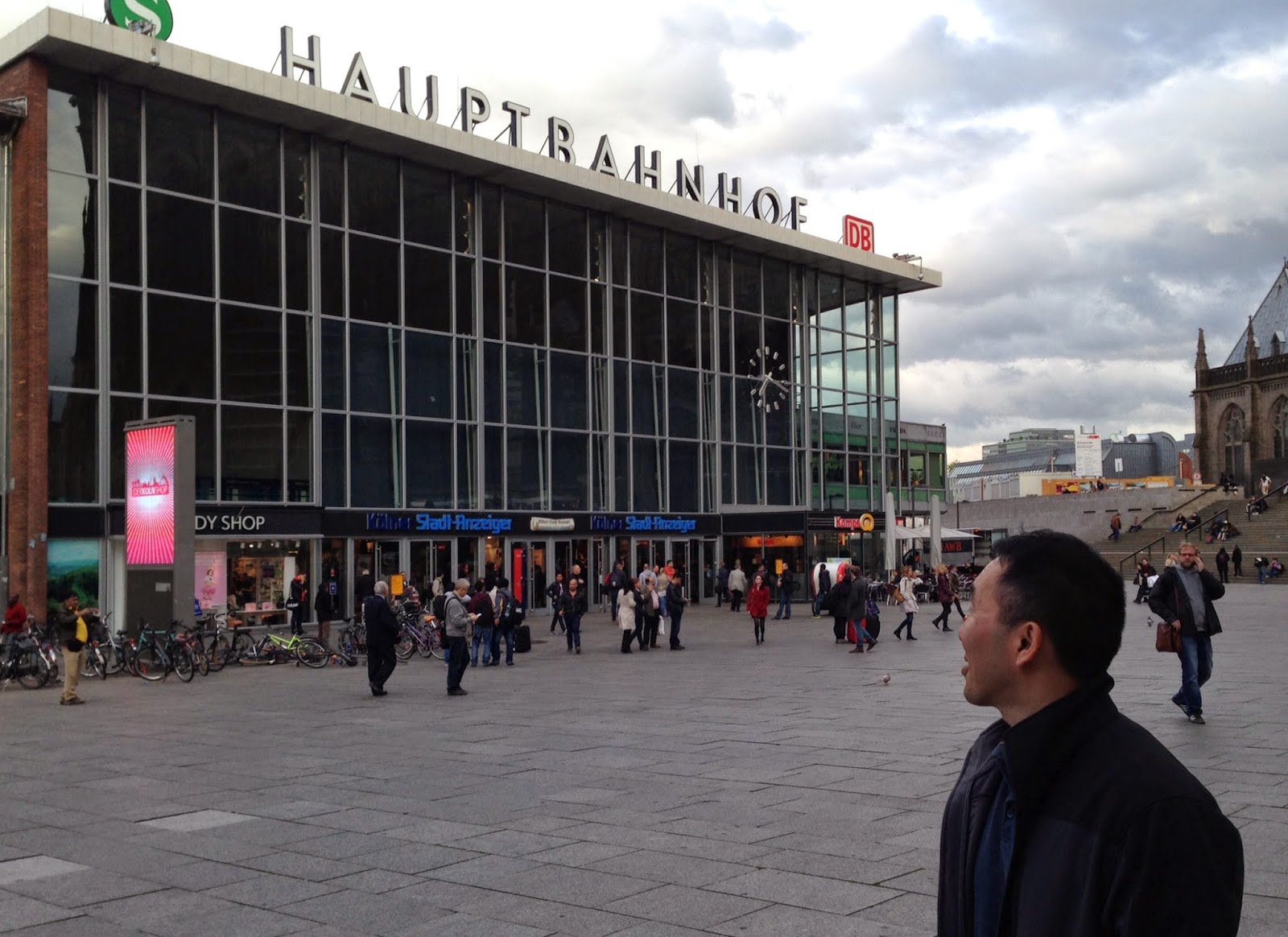
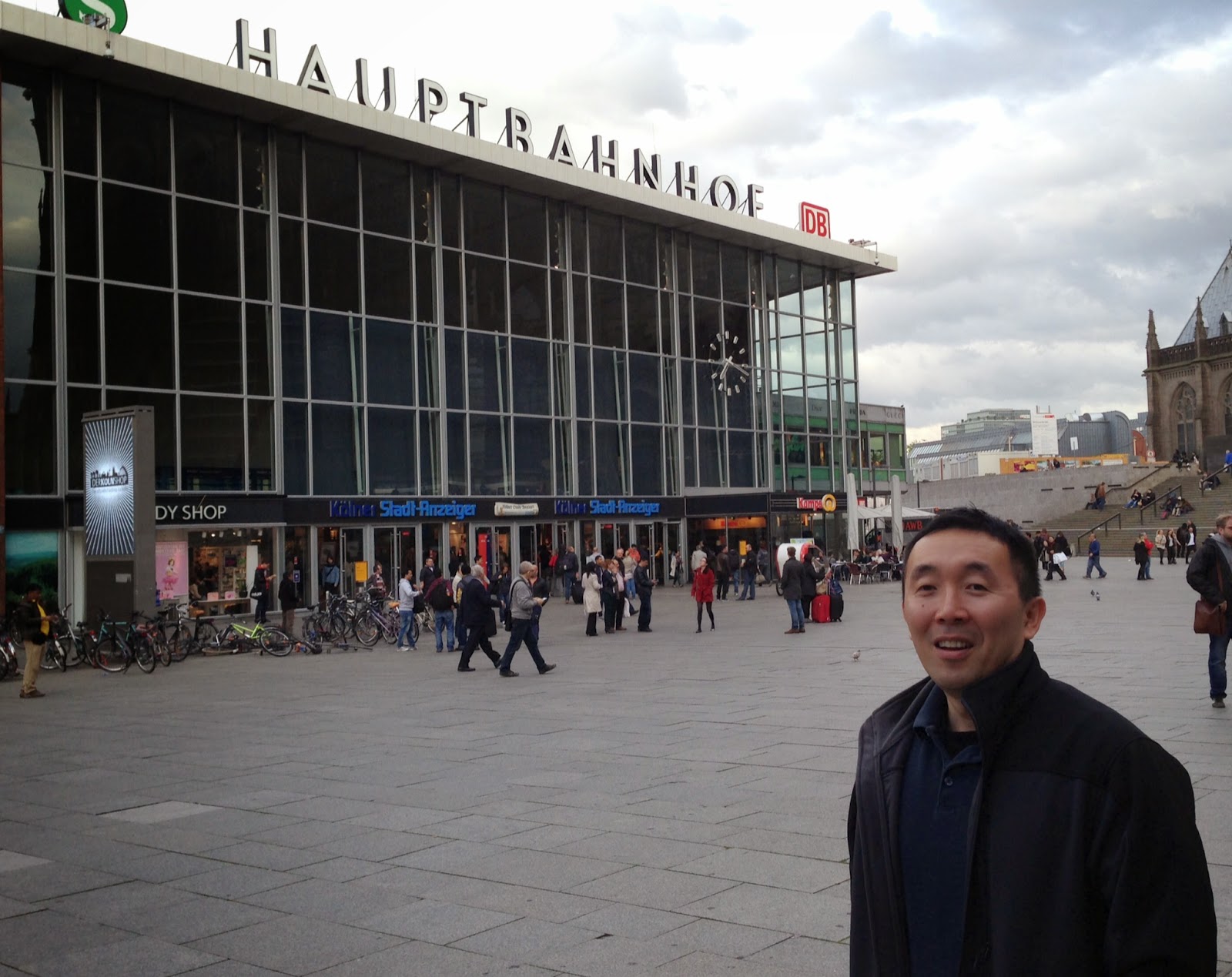
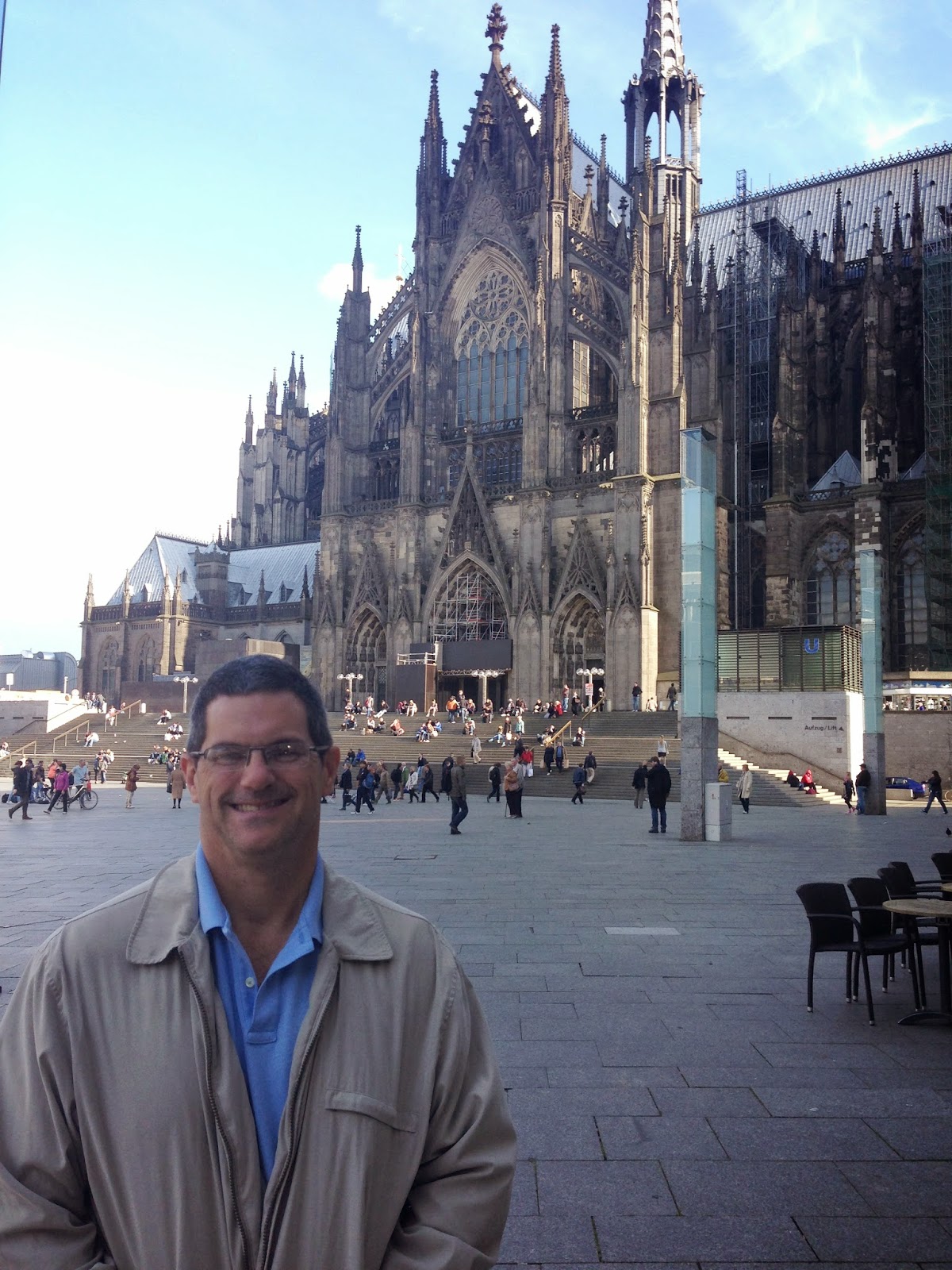
    And Dan loves the word “hauptbahnhof” (hopt bon hoff) which means central station. When you walk out of the station, you are struck by the majestic cathedral. You see the end of it on the far right side of the pictures above. Below, you get an idea of how big it is but this picture doesn’t do it justice since we couldn’t get the bell towers in it, which are even higher. See how tiny those people are on those steps leading up to it? I said to Dan as we were walking through the square that I’d forgotten how overwhelming it is. The size is a part of that, it’s hard to describe. Again, see how small those people are? And the fact that it’s 700+ years old. And still a functioning church, which we were reminded of as the bells started tolling.


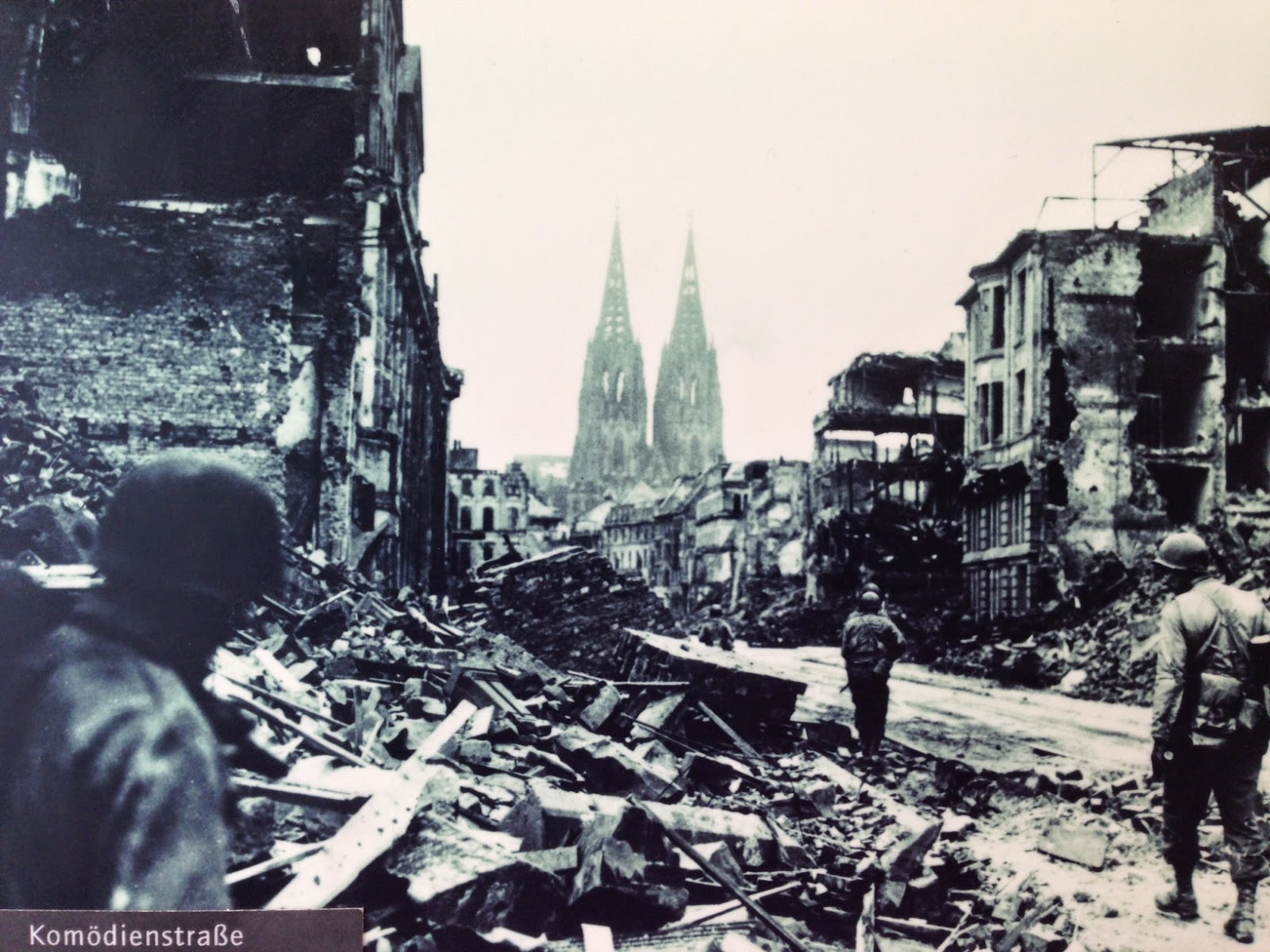
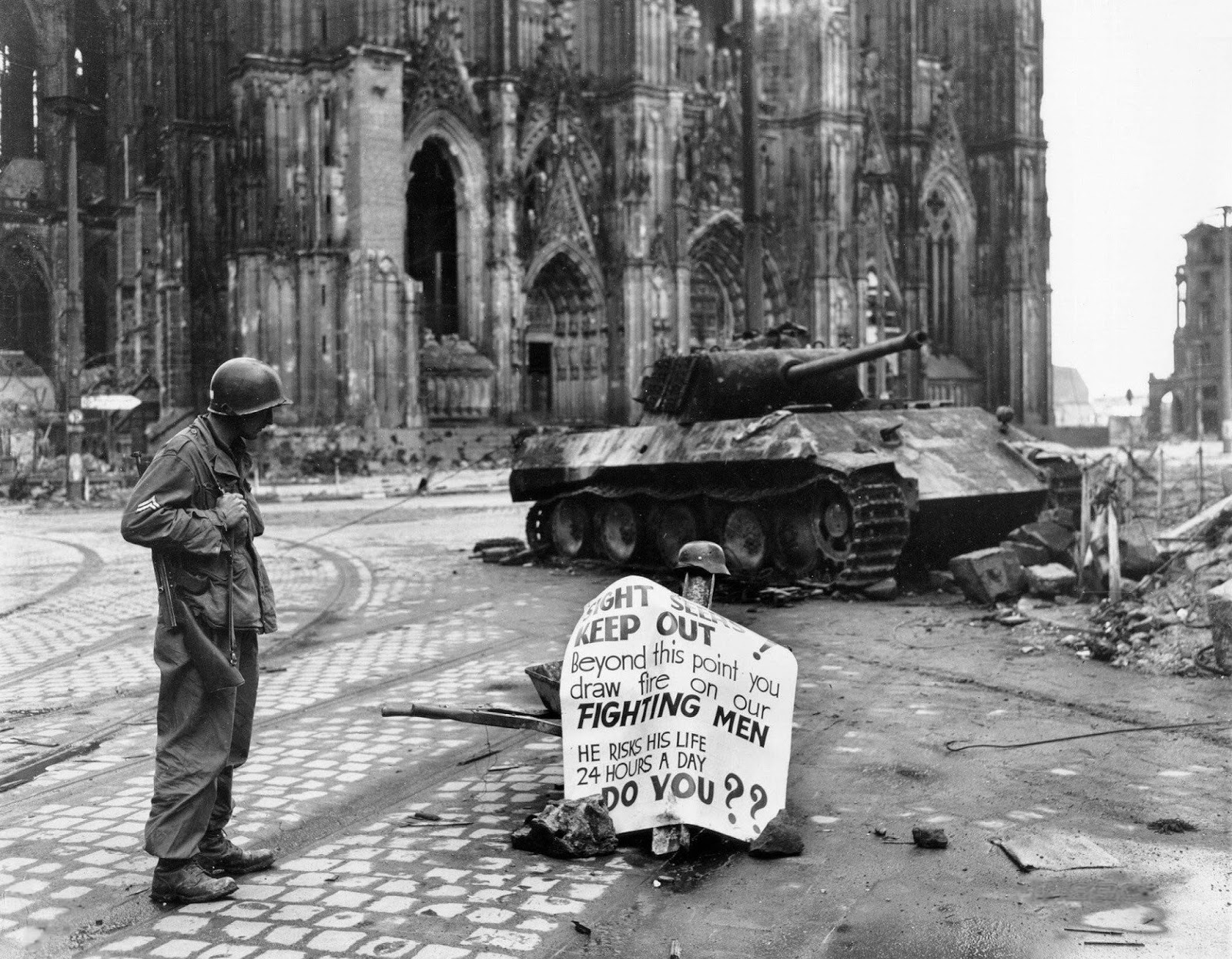
    For me, what also contributes to that overwhelming feeling is knowing some of the history. Like a lot of cities in Europe, Cologne suffered great devastation during WWII. To be in the same spots we’ve seen in pictures and contemplate all that was going on during that time puts a lot into perspective. Here are a couple of the images I thought of as I was walking around this neighborhood this evening.


    We’re staying at a hotel really close to the cathedral/train station, and found a nice little Italian place for dinner. It’s been a long day. I’m glad to be here.

  • Pre-Departure

    Many of you know that Dan works for Bayer. As in aspirin, but in the crop science division. If you look at pesticide products in your local garden shop you’ll see the famous Bayer logo on some of them. Who knew? They are based in Germany with 115,000 employees all over the globe. I’ve lost count of the number of times he’s been to Europe already since Bayer acquired the small company he worked for in Davis in the summer of 2012. Dan says 8 or 9; even he’s lost count. They are busy and productive trips for him but not much fun.

    But as long as he works there and they keep sending him, we’re going to turn at least one of those trips into a vacation for us each year. Last year we managed to plan one perfectly timed to coincide with my 50th birthday – I left 2 days later on my first trip out of the USA. And what a trip it was. Dan was already there, had gone ahead of me 6 days for work and I met him in Mainz, Germany. There was something oddly adult about having to navigate my way through 2 foreign countries (Belgium and Germany) and 3 train transfers all by myself on my first international trip. It was exciting and intimidating and fun all at the same time. It was an amazing trip: 10 cities in 18 days (Mainz, Frankfurt, Koblenz, Cologne, Amsterdam, The Hague, Harleem, Bruges, Ghent, Brussels).

    At the urging of a good friend from work, I did a travel blog for that trip and I am so glad I did. (Thanks, Melanie!) Having that objective as I went through very full and exciting days made me pay attention to things in a way I’m now sure I wouldn’t have otherwise. And while I often can barely remember what I had for dinner the night before, I remember details of all 18 days of that trip with a vividness that escapes me in my day-to-day life. I’m sure the blog did that, too.

    The most fascinating thing to me about the blog was the dedicated following it had. From the start the feedback and interactions about the blog made the trip more meaningful and interesting to us, and the blog became a thing in and of itself. Once Dan joined me on the third day when his conference was over, he became the official blog photographer. We became very disciplined about it, every evening planning what photos to use, with me doing the writing about them. I’m very glad we did it every day because there’s no way I could have remembered everything 3 weeks later had I waited.

    This Tuesday, we’re going again. Dan’s business this time is short so we’re traveling together, and I will get the first couple of days by myself as I did last year. I actually like that – it will be a nice way to disconnect from what’s been a very hectic year for me so far at work and school. (I’ve been working on a masters in HR through Golden Gate University if you’re not aware.) So I’m Ready For A Vacation!

    The lineup this trip makes last year’s trip feel like a starter package: Cologne (again for me, while Dan is working), Paris with side trips to Normandy and Versailles, Edinburgh, London, and one night in NYC on the way home. It will definitely be warmer than last year which we’re grateful for; it’s later in the year and last year was unusually cold at that time in Europe. Weather so far looks like a fair amount of rain here and there (umbrellas already packed), with temps in the 40-65 range. I can deal with that, especially since it never got above 40 the whole time last year.

    I’m surprised at the number of people who’ve asked expectantly if I will do a blog again, from many different areas of my life. Even if the interest wasn’t there, I would do it again because I got so much out of personally. That there is such interest continues to fascinate me, but I’m grateful for that as well, so to whatever degree you are following this know that I appreciate it!

    The whole purpose of this entry today was to set the stage, and create the blog address for those who’ve asked.

    We leave Tuesday afternoon, 4:40pm flight to London and then Dusseldorf. Then a train to Cologne where I’ll explore that a bit more deeply while Dan works in Frankfurt and Monheim. We were only in Cologne about 28 hours last year, so it will be nice to start somewhere somewhat familiar with more time to do things I missed. Saturday we take a morning train to Paris. (I just love writing that, gotta tell you.) We’ll be there for 6 nights, spending all day Sunday on a side trip to Normandy. We are both Very Big on World War II history so this was a must and in some ways the thing I’m most excited about. The following Friday we fly to Edinburgh and spend the weekend there. Monday morning, a 4 hour train ride to London where we’ll spend the next 5 days. Saturday morning, May 24, we fly to NYC and spend one afternoon/evening there before coming home that Sunday before Memorial Day.

    The planning of all that was a project in and of itself. Planes, trains and lodging have been booked for some time, as well as the Normandy trip and 2 shows in the West End. (I have my priorities!) I learned a lot on last year’s trip and enjoyed the planning of this one in a way I didn’t the last time.

    So we’re ready! Mail has been stopped, pNut plans are arranged (thanks, Art & Mike!), we’ve been eating only whatever is left in the house so as to empty the refrigerator as much as possible. It’s going to be a great adventure and I look forward to you coming along for the ride….


  • Home on Saturday, 4/6/2013; Epilogue

    Home on Saturday, 4/6/2013; Epilogue

    We were pretty happy to be going home. Three weeks is a long time, it will be awhile before we do that again. Especially at the pace we kept. But we liked the pace, so will probably just choose to do less next time. As I learned in early March, three weeks is a long time to prepare to be gone, too. So many details – mail hold, don’t leave perishables out or in the fridge, dog sitting, bill paying, work stuff, etc.

    We left around 7:20am and walked to the train station, got there in about 20 minutes. So the above is the official last picture of the trip! For a variety of logistical and mileage collecting reasons I won’t get into here, Dan and I were on different airlines. His flight left at 9:45am, got him to SFO at 3:30pm. Mine left at 11:20am, got me to SFO at 4:30pm. My flight was completely and gratefully uneventful. Dan’s had some turbulence that he claimed was either the worst or 2nd worst he’d ever experienced, with two big drops and lots of screaming. One of the passengers was injured and there were paramedics waiting when they got to SFO. The pilot on my flight had announced that he was rerouting a bit because of a report of planes ahead that there was significant turbulence!, so we managed to avoid it.

    Dan had left his car and pNut with Stephen in Burlingame, so we took a cab there, visited a little and headed home, arriving around 7:30pm. At that point it was 4:30am Brussels time so we were definitely pooped.

    But So Glad To Be Home.

    I wanted to use this as a sort of summary of various impressions and things learned on the trip in general, as well as some logistical and planning details to help us with next time, and perhaps others who are making similar plans.

    Learnings, Surprises and Perspectives

    1. I have to admit that this American at any rate was not clear about the full impacts of certain kinds of warfare. We’ve never been “occupied.” It’s one thing to send people overseas and lose them to fighting; it’s a whole other thing when you’ve been invaded, when EVERYONE’S life has been completely turned upside down with no apparent end in sight. The terror these people lived with during WW II is difficult to fathom, but I deeply appreciate the opportunity to explore that in ways I hadn’t before.
    2. On a lighter note: at least in the three countries we were in, American pop culture is their pop culture. I had always assumed every country had their own celebrities, music, movies, etc. Not so. Almost without exception, music played in restaurants and cafes was American, and usually from the 60’s and 70’s. Movies in theaters are largely American. Celebrities on the covers of gossip magazines in bookstores and the grocery checkout are the same we see. A big fascination with Marilyn Monroe and the Kennedys. It was odd, but comforting in this weird way to have all these touchstones around you. Made things feel less foreign.
    3. Their fast food was our fast food. With the exception of some bakery chains in Germany, we didn’t see anything like that which was theirs, just ours: Subway (was probably the biggest), McDonald’s, Pizza Hut. Starbucks – although their coffee is much better so I don’t know why you would go, except for the free wi-fi! And this weird thing with Dunkin’ Donuts in Germany. Again, didn’t get that at all because their baked goods are so much better. But there you have it. Oh. And the ubiquity of The Body Shop (soaps, lotions, other foo foo stuff). Didn’t get that either.
    4. We picked the countries we did for a couple of reasons, the first being they were centered around Dan’s work, the second being we knew there would be few language barriers. And for the most part, there weren’t any. English is the predominant language in business, entertainment, and education – even our new friend Erwin said he teaches some classes in English at a Belgium university – so it seemed the vast majority of people we met could get by if in fact they weren’t fully fluent. In Germany, when we asked “do you speak English”, we would get “yes” maybe 50% of the time, but just as often “nein” or “a little”. In Belgium and Netherlands, 80% of the time the answer was “of course” accompanied with a “you’re so silly” look on their face. We learned that in Germany, American TV is dubbed. In Belgium and Netherlands it’s not, it’s broadcast in English with subtitles, so their exposure to it is much different. All that said, next time I will take the time to learn some functional phrases. Especially in Germany, it would have been beneficial to be able to order off a menu properly and ask for directions.
    5. Simple differences in restaurant culture that took me the whole trip to get used to: you seat yourself, you ask for the check, and you don’t tip.
    6. There are more American cars than you might think – Ford Fiesta seemed popular – but very, very few Japanese. Not surprisingly, mostly BMW, Mercedes, Audi, Mini, and some names I don’t think I’ve seen since my USAA days: Peugeot, Opel, Renault. And the whole time we only saw 2 SUVs, one of them was owned by an American business – a California tanning salon!

    Logistics and Planning

    1. Three weeks is too long, although for my first trip honoring a milestone birthday it was appropriate. Maybe again for my 60th!
    2. Staying a week in one place and doing side trips from there was ideal.
    3. Take multiple plug adapters in case you leave one at the last place you were, and/or just have multiple devices with you. We had 3 adapters and that was just right. (And if you don’t know what I’m talking about – different countries have different electrical outlets – our plugs won’t work. We got ours at Radio Shack, Ace Hardware.)
    4. Credit cards without a “chip” were a big issue in Netherlands, a small issue in Belgium. They often require cash or ATM card. Good thing Dan’s bank was also in Belgium so he could get cash out, otherwise it would have been tricky.
    5. Wireless access is unpredictable. The best for us were the apartments we stayed in where there were no bandwidth issues; every hotel we stayed at, our tablets/laptops would be OK, but not our phones. Netherlands had free access almost everywhere you went; in Belgium and Germany, there were plenty of hotspots but you had to pay for access – 24 hour, monthly, etc.
    6. Cell coverage – we would have literally been lost at times without Dan’s cell phone availability, which his company pays for. Talk to your carrier. If there’s a cost effective way to arrange that without the ridiculous international roaming charges, I highly recommend it, especially if, like us, you’ve come to heavily rely on mapping technology.
    7. We were very glad to have not dealt with rental cars. Can’t imagine having to navigate streets and freeways when you can’t read signs. (Although we did finally piece together what “einbahnstrabe” meant!) And who needs them: the trains, buses and streetcars are fabulous. Note: no need to make reservations on trains unless you’re doing something 2 hours or more, and even then maybe not. Exception is ICE trains (InterCityExpress) – the high speed trains – where it’s required. And 2nd class is More Than Fine. Don’t waste money on First Class.
    8. Pack light! That first time I had to take my bags through a turnstile and had to drop a Euro in to use the bathroom in the Cologne train station on Day 1, I couldn’t imagine having a big piece of luggage with me. And because we chose to move around so much, it was much easier to do so with one roller carry-on and one backpack, which was all each of us had.
    9. Dan had equipped me with Euro paper money and coins before he left, because he brought some back from his last trip. If you don’t have that luxury, be sure to stop at the airport and take care of that before you leave, or you might be surprised the first time you have to go potty!

    Next year: London & Paris. I’ll be ready!

  • Day 18: Brussels (Friday, April 5, 2013)

    Day 18: Brussels (Friday, April 5, 2013)

    So I ended this trip the way I started it: exploring a foreign city by myself. Dan had to go back to Gent for an all-day work meeting, a compromise move so he didn’t have to extend his stay to attend a session in Mannheim, Germany, the following Tuesday. He was never able to really disconnect from work on this trip, so he’s still in need of a vacation.

    But it was good for me in a way. It reminded me – as did those first days in Mainz and Frankfurt – of when I was 16 and explored Chicago all day by myself. I’m very comfortable being alone, even when everything around me is – literally – foreign to me. I like the time for reflection and being completely independent, and just going wherever my mood takes me.

    I set out about 8:30am. Mostly I just walked, had laid out a plan based on the map Sven gave us of what I wanted to see. I decided I was museumed-out at first, but changed my mind about that later. It was enjoyable to just go at my own pace, casually stroll through their version of Central Park, and start thinking my way through the transition of not being on vacation anymore. Three weeks is a long time.

    I took a few pictures, below, stopping once at a cafe for a croissant and coffee. Which reminds me, I don’t think I’ve talked about the coffee in Europe: spectacular. In every cafe or restaurant we were in, the coffee was always ground and brewed to order using a high pressure coffee maker, so it was always very smooth, very fresh. The only time we had bad coffee was in hotels where it was brewed and poured from a carafe. And in hindsight, those probably tasted much like what we get at home, we’d just gotten spoiled by then.

    I also explored chocolate shops!, tasting here and there as I went. The Belgians really do know how to make chocolate.

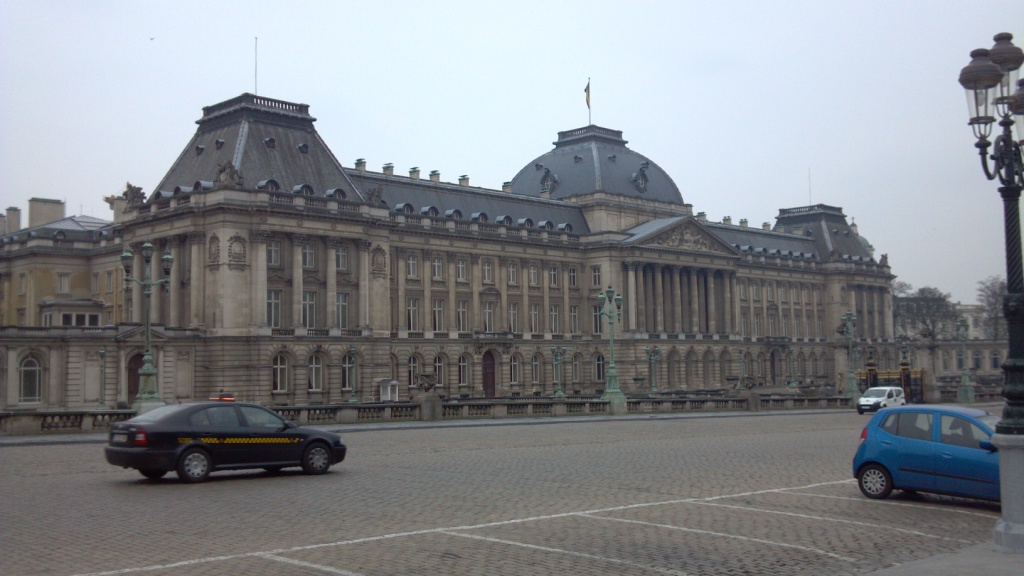
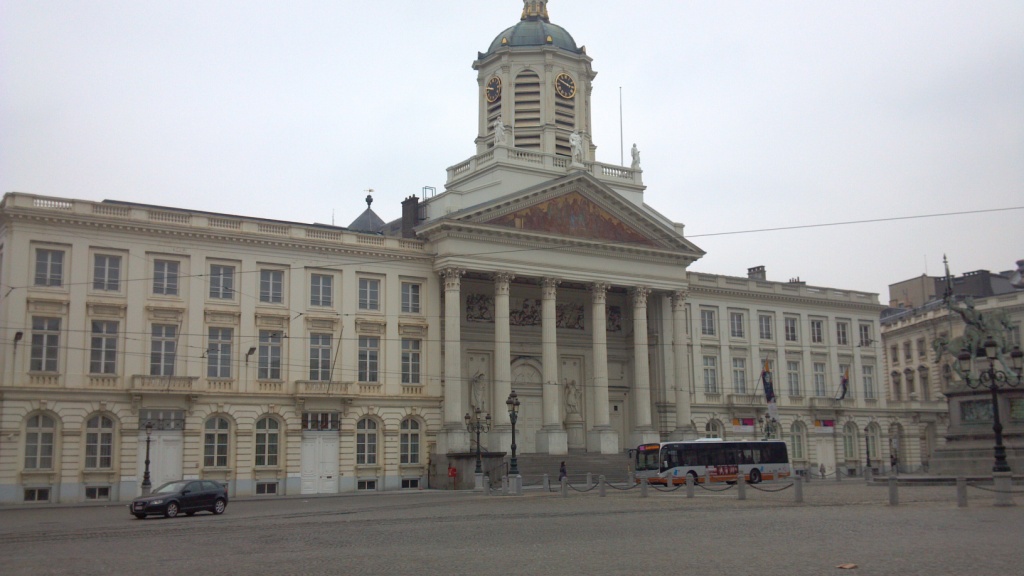
    Side view of the Royal Palace.


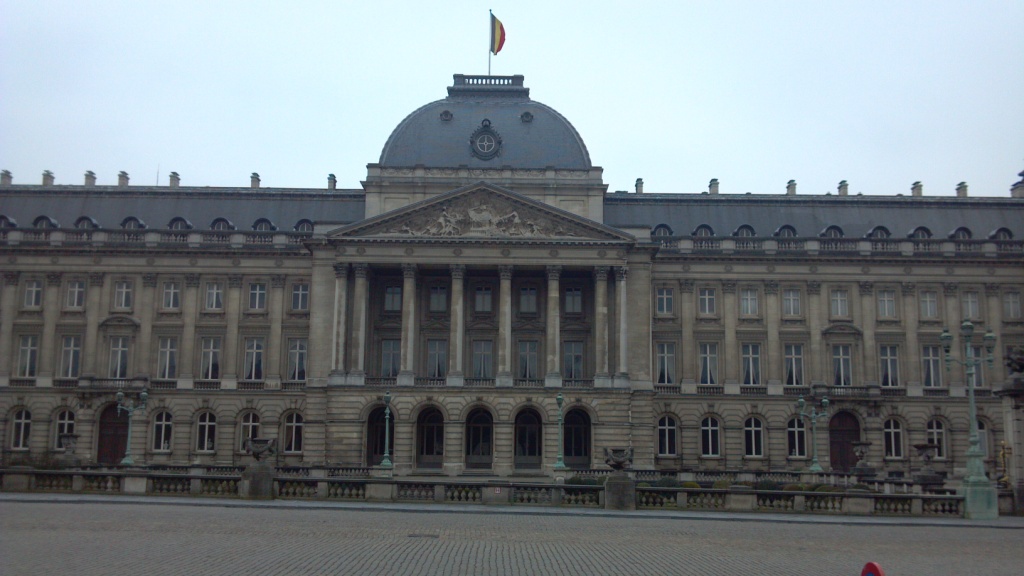
    Front of Royal Palace.


    Another random square! I didn’t notice until I got home how much this building looked like the Royal Palace in Amsterdam.
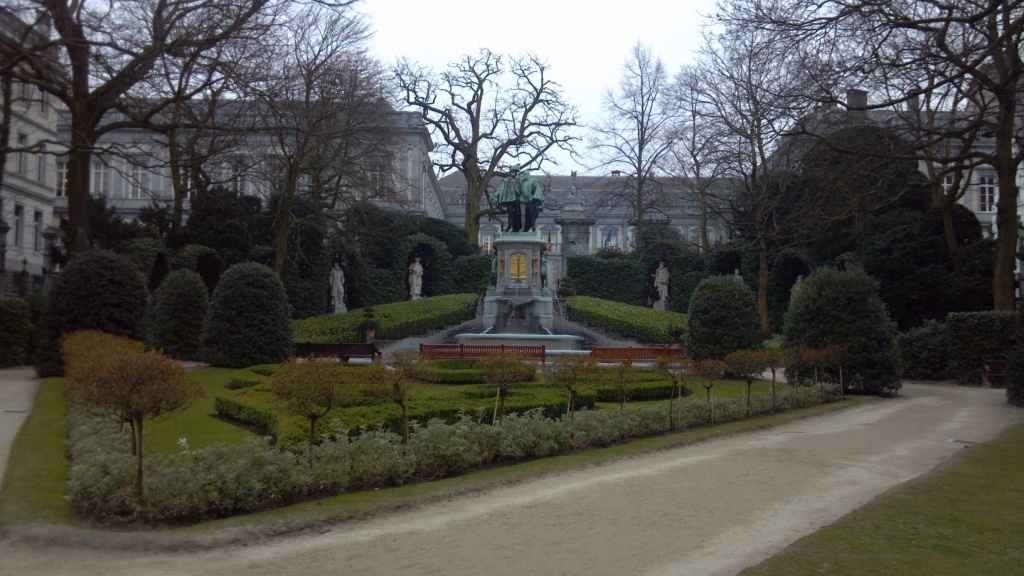
    This was a very cool little park across the street from the coffee shop I stopped at.
    This is the old Stock Exchange building, now used for exhibitions. It’s where we met Erwin and Yannick the night before because it’s pretty central and hard to miss. Since they were having a Da Vinci exhibit, and how often do you get a chance to do that?, I decided to check it out. It was pretty cool. Mostly it was prototypes made of all of his inventions – including a tank! – that even he had never actually made, only sketched.

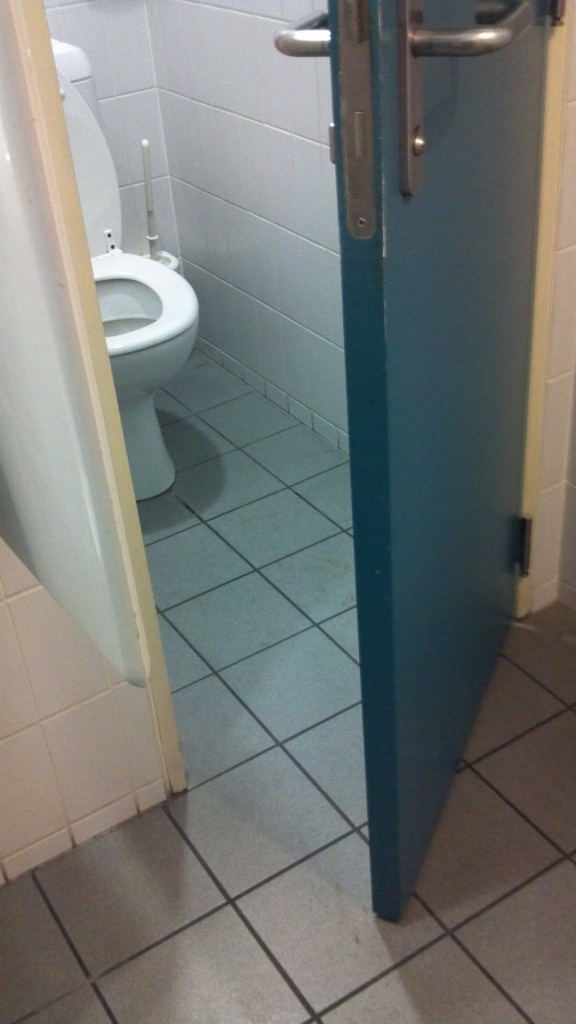
    And finally, by special request:

    The infamous closed door toilet rooms. Never did see a stall in 3 weeks in 3 countries. This was taken in the building above.

    I stopped for lunch at a place Sven had recommended – Ellis, funnily for Ellis Island! – and had a good burger and Belgian fries, probably the best fries I’d had the whole trip. I was tired and just went back to the townhouse and showered and vegged until Dan got back around 6pm. We went out for dinner at another place Sven had recommended, had a great meal. We typically eat around 6:30 and some restaurants don’t even open until 7pm we discovered, so we didn’t need reservations as we were the first ones there. But it filled up quickly and was packed by the time we left around 8pm. We made sure we were packed and all that, knowing we’d have an early start the following day.

    Home. We were So Ready.

  • Day 17: Bruges to Gent to Brussels (Thursday, April 4, 2013)

    Day 17: Bruges to Gent to Brussels (Thursday, April 4, 2013)

    The hotel owner in Bruges (Paul – we found his place on PurpleRoofs.com, too) honored our request for an early breakfast and we left at 8am to catch a bus to the train station. While we had walked the almost 2 miles on Monday, it was a bit of a hassle with the luggage. Plus we were tired!, and we knew it would be a long day and wanted to save time and energy.

    Our next stop was Gent. Dan had been there several times for work (to return the next day, 4/5/13, for work again…while on vacation…*sigh*), but had never had the opportunity to do much other than work. Since it’s on the way to Brussels from Bruges, we made a somewhat last minute decision to get to Brussels later than we’d originally planned and spend some time in Gent.

    The train ride was just about 30 minutes. (Seems like you can get to many other places in Europe in just 30 minutes by train!) We checked our bags into a locker and walked the 2 miles or so from the train station to the Centrum. We found the visitor’s office and got a self guided Walking Tour that served us just fine, and started right outside that spot.

    So first a little comparison between Bruges and Gent, from our perspective, that will likely horrify a few folks who are very fond of Bruges. When we were planning this trip, we went back and forth between these two in terms of where we were going to spend decent time. After carefully considering the recommendations of several different friends, and Rick Steves (the travel writer if you don’t know that name), we decided to stay in Bruges, and the place we wanted to stay had a 3 night minimum so we went with that because we knew we would lose a big chunk of the day that first day in train travel from Amsterdam, so that would still give us two full days. So the plan was: 3 nights in Bruges, 2 nights in Brussels, and we threw the Gent stop in later.

    If we were doing it over again, we would stay 2-3 nights in Gent, 2-3 nights in Brussels, with a day trip to Bruges. Bruges was beautiful, interesting in a learn-what-kills-a-city sort of way, and yes romantic. But oh-so-touristy. More like an amusement park from that perspective. It’s a town that gets by completely from tourism. There’s not really a “local” vibe there. In fact, the locals we talked to really, Really didn’t like living there, because it was so touristy. And a big part of our pleasure in traveling is getting a local vibe, a feel for how does one live in the place we’re visiting, and from that perspective this wasn’t a good place to do that. It’s like Main Street, Disneyland, only with a population of 120k, and of course a lot older.

    Gent, on the other hand, had more of the energy we were looking for. It’s a fully functioning city of about 250k, plus it has old beautiful buildings just like Bruges did, and perhaps more. The belfry is also a UNESCO World Heritage Site (that’s now 6 on this trip). We loved the churches – cause we couldn’t seem to get enough on this trip – and one for sure was up there with the prettiest we’d seen on the whole trip.

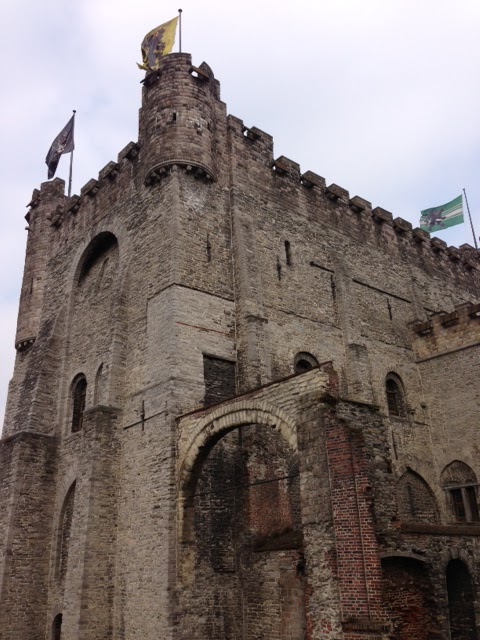
    We started with – yay! – visiting another castle. This one was completely different than the first we saw in Koblenz. For one, it’s right in the middle of everything, you turn this corner and suddenly: Castle. And it’s older, dating back to 1180. It’s function was more fortification, less residence, where the first was the other way around. But we enjoyed it. Here are some pictures from that visit.

    Right away, you get that “old and authentic” feeling when you approach this thing.

    And it’s still friggin’ cold, can you tell?

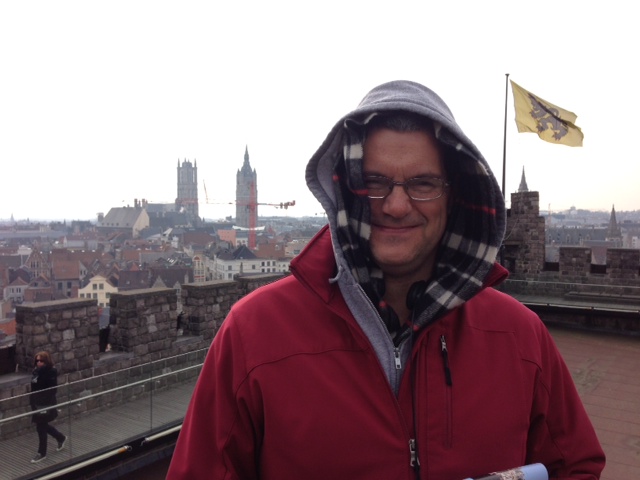
    Some of the Gent skyline from the “fortress” part on the roof of the castle.


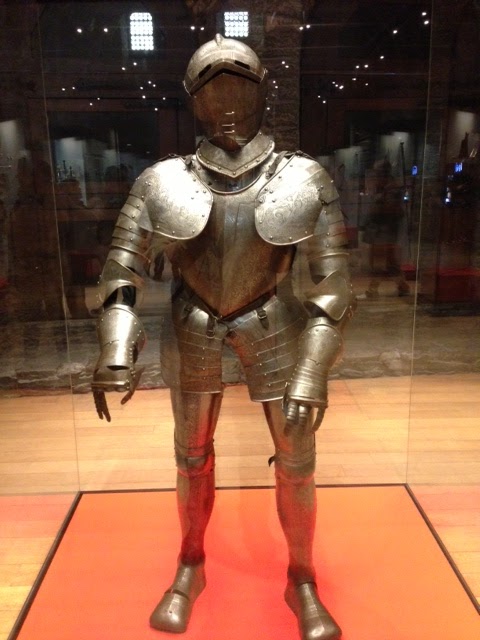
    They had a cool weapons room. This suit of armor was intricately engraved.
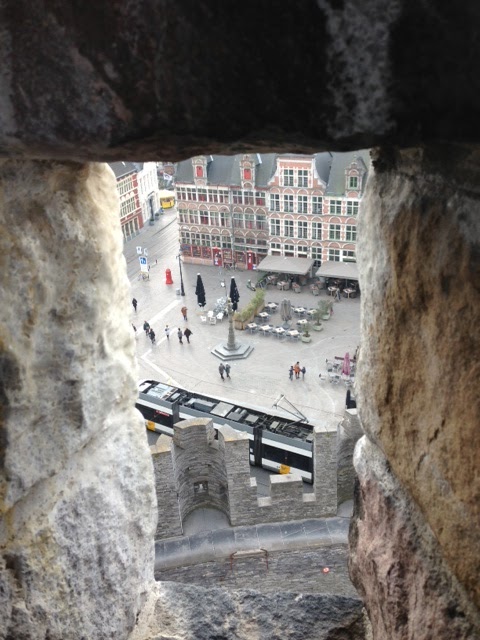
    A view of the square below from the little lookout window at the top.
    Guillotine!, last used in 1861.
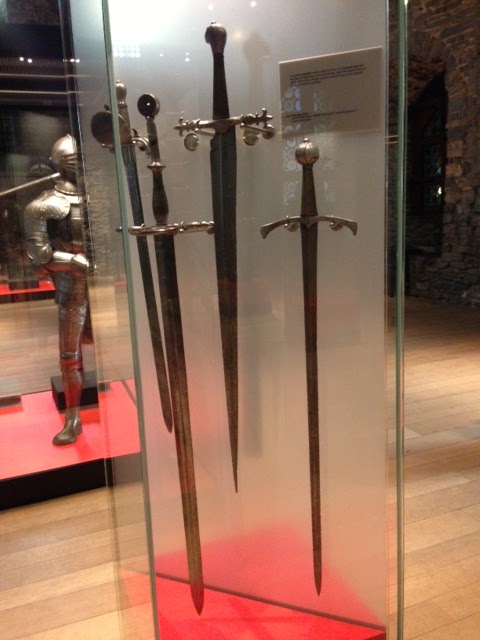
    Just some of the old weapons on display.


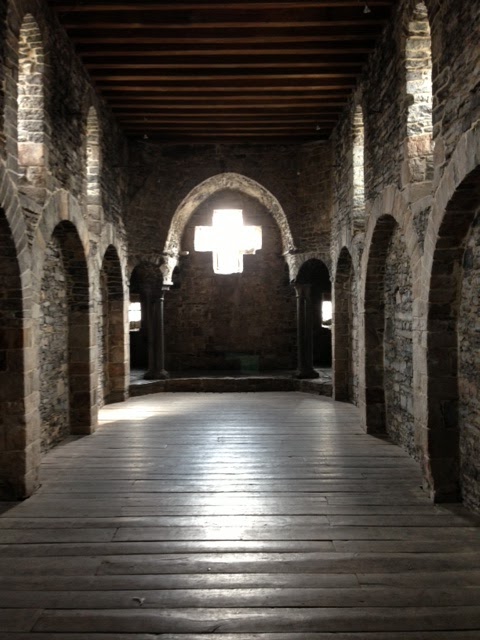
    This was used as a chapel.
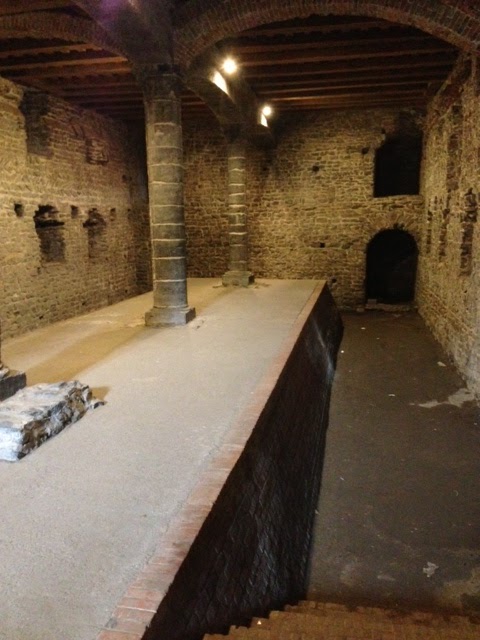
    Basement? Dungeon? It was sorta underground.
    A little park as we continued the walking tour, next to a little restaurant where we had lunch.
    It was adorable, and had possibly the best onion soup we’ve ever had. Dan had a pasta dish he really liked and I had a local favorite – Flemish Stew, a beef dish in a rich, dark brown gravy.
    There wasn’t any place to sit at first, then we noticed the people at this table vacating, so we snagged the best spot in the place.
    The canal view from the St. Michael’s bridge. The walking tour said “many tourist guides describe this as one of the most beautiful cityscapes in Europe.” That statement incorporates this and the next three pictures. What do you think?


    Also from the St. Michael’s bridge.
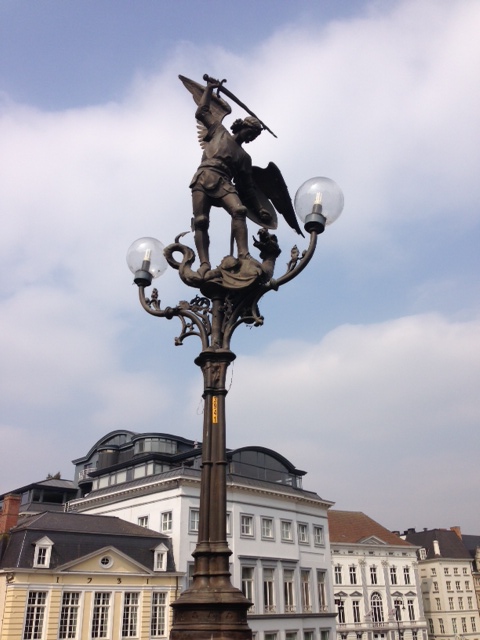
    Lamppost on the bridge.
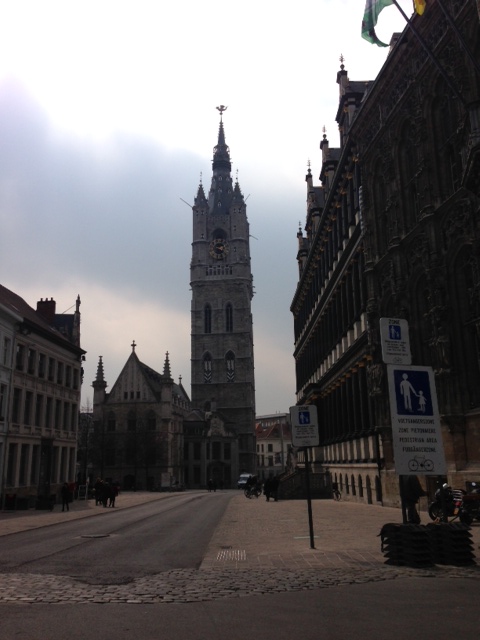
    The Belfry. Since we had already climbed Cologne and Bruges we passed on this. Like the castle, this was built in 1180; UNESCO deemed it a World Heritage Site in 1999.

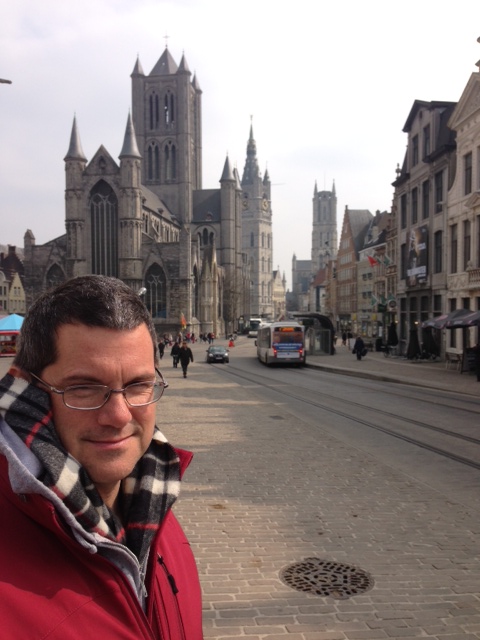
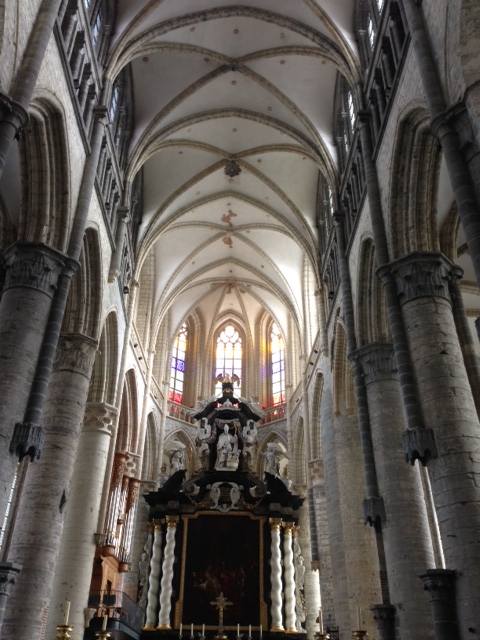
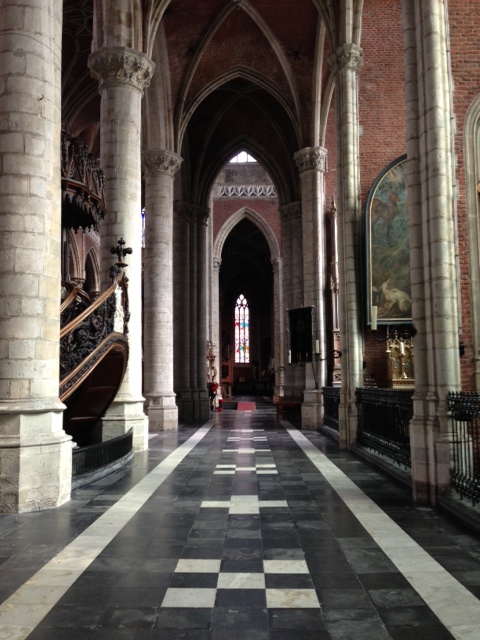
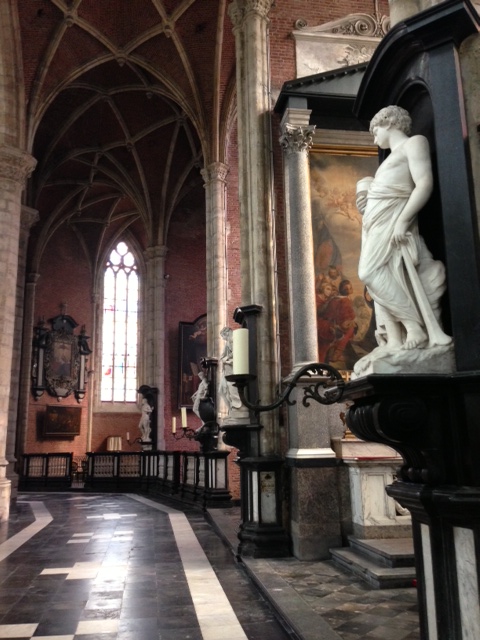
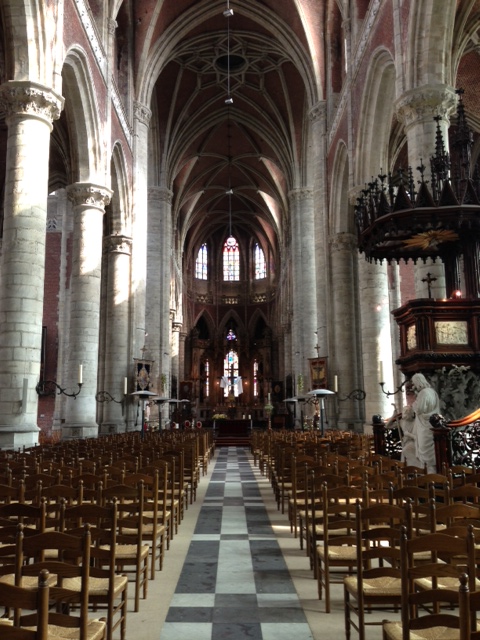
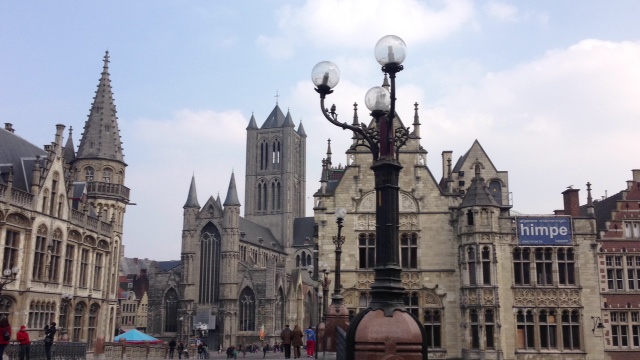
    There are a bunch of churches in the Gent Centrum. Dan went crazy with pictures, but I’m only going to include some from the most impressive – the St. Bavo’s Cathedral. The contrast of dark wood and marble was stunning.


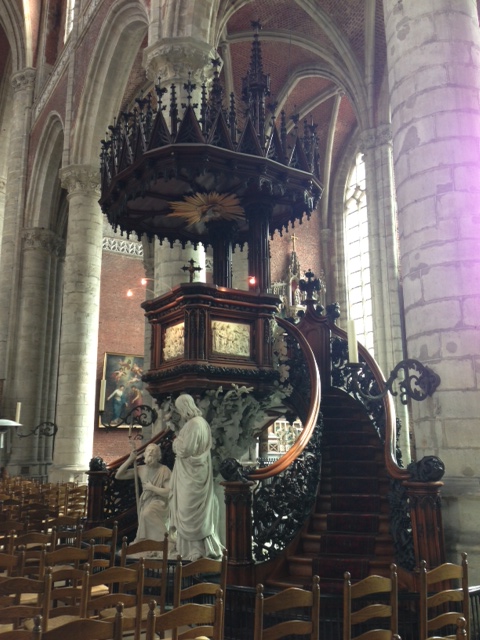
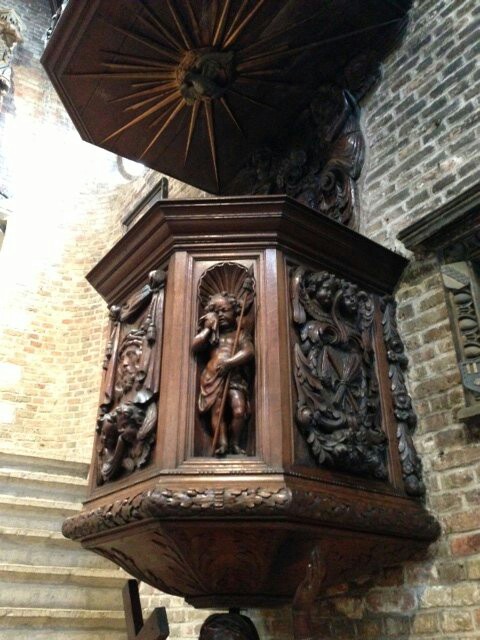
    This is not St. Bavo’s and I no longer remember which church it was. But it’s a good shot of a couple of things I wanted to point out: 1. The chairs. That’s what we saw in every church in Belgium and Netherlands, where in Germany the churches all had traditional pews. I guess the Dutch don’t kneel! 2. The pulpit. That’s that thing on the right in the middle of the church. The priest climbs the stairs and delivers the sermon from there. The picture below is a closer shot. We saw these in just about every church we went into. I’ve never seen one in America that I can recall.


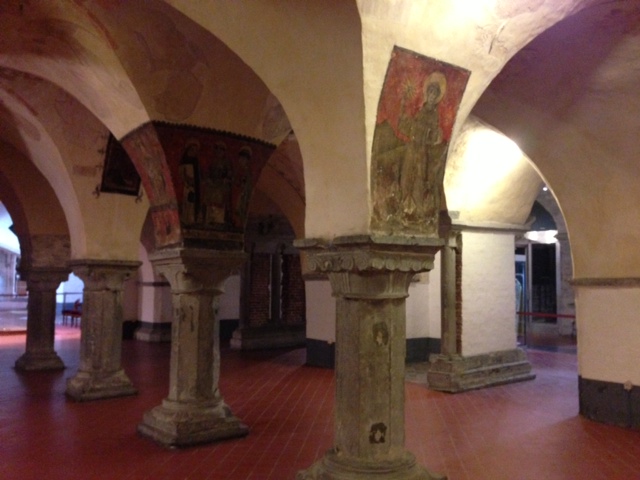
    These are original pillars from the 1100’s in the crypt, where archbishops are buried.
    A little neighborhood we walked around that had that look I love with the narrow streets….

    And that’s enough of Gent. We have more pictures but I think you get the idea! We did really enjoy this city, and today gave Dan an interesting perspective compared to what he’d seen before, including walking by one of the hotels he’s stayed at. He had no idea he was so close to everything we saw today when he was there. We took the bus back to the train station, collected our luggage and went on to Brussels.

    Dan’s work colleagues had influenced our decision to minimize our time in Brussels, that it’s mostly a big city, known as “the capital of Europe”, but there isn’t much to see as a tourist. We disagreed almost as soon as we walked out of the train station, because we really like hanging out in really active places and that’s clearly where we were. I got a NYC vibe right away, although this is much smaller than that. Dan will likely find a way to spend some more time here on one of his trips back.

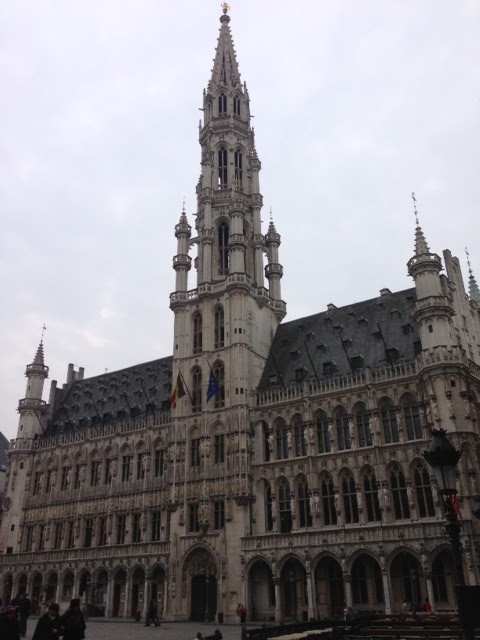
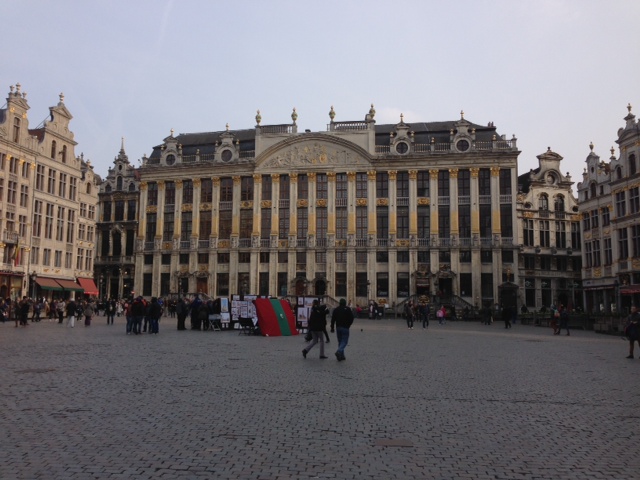
    We were making our way to the townhouse we’re staying in, a single-guest bed & breakfast in the home of a gay couple, Erik and Sven, also found on PurpleRoofs.com. We come across a little square where there’s a lot of activity, including some street musicians on a random Thursday afternoon, and Dan’s like “hey, this is very cool so far, I wish we were spending more time here.” We keep walking through this narrow street, and at the end take a right into another square. And stop dead in our tracks. Our jaws dropped as we stared at what we decided is the most impressive and beautiful square we’d seen on the whole trip: Grote Markt, or Great Market, all of it built around 1669 and also, we learned later, a UNESCO World Heritage Site. That makes #7 for this trip. Here are some pictures of the that square. They really don’t do it justice.


    We made it to the townhouse and were greeted by Sven, who was very gracious, offered us coffee, gave us a very useful tourists map of the central area, and made several suggestions for restaurants and other places of interest. The decor of the townhouse was, well let’s just say not our style. It was very stylistic, not exactly comfortable, a good example of form over function we thought. Our hosts, however, were very nice and we enjoyed visiting with them here and there the next couple of days.

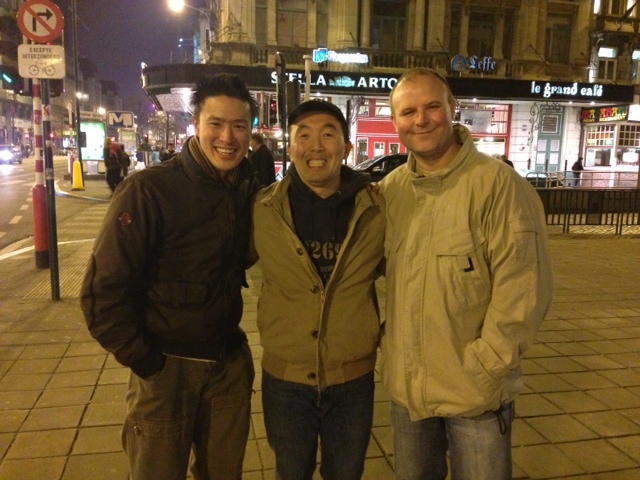
    We’d gotten to their place around 5:15, and left around 6:45 to explore a bit before meeting some folks for dinner at 8:30 for dinner. A friend of mine had suggested we get together with her friends while we were in the neighborhood, so we did. (Thanks, Michele!) Their names are Erwin and Yannick. Right away, we knew it would be interesting. Erwin had said in his email as we were finalizing plans, “You’ll probably notice us quite easily: a Caucasian/Asian gay couple isn’t very hard to spot.” We were like “hmmm, what a coincidence.” Erwin, on the right below, is an MD working on a PhD; Yannick, on the left, is in HR. Funny, right? (If you missed that: Dan has a PhD, I’m in HR; it’s like they were this reverse mirror image of us…)We had a great local meal – this time Dan had the Flemish stew – and lively conversation. It was fun!

    For those of you who have never met Dan before, you were probably starting to wonder if he is real! But here he is, between Yannick and Erwin. He doesn’t like his picture to be on Facebook or anything like that, but I got him to agree to just one in the blog. So that’s it :) He doesn’t think he’s very photogenic. What do you think?
  • Day 16: Bruges, Part 2 (Wednesday, April 3, 2013)

    Day 16: Bruges, Part 2 (Wednesday, April 3, 2013)

    We are definitely ready to come home, especially Dan who came out 6 days ahead of me for work. And, he just learned he will have to work in Gent on Friday, but that’s instead of having to extend his stay into next week. Definitely better than that. It means I will do Brussels by myself, which is fine; I feel bad that he hasn’t really been able to disconnect from work much this trip. And at the same time, grateful that that hasn’t been an issue in my job at all.

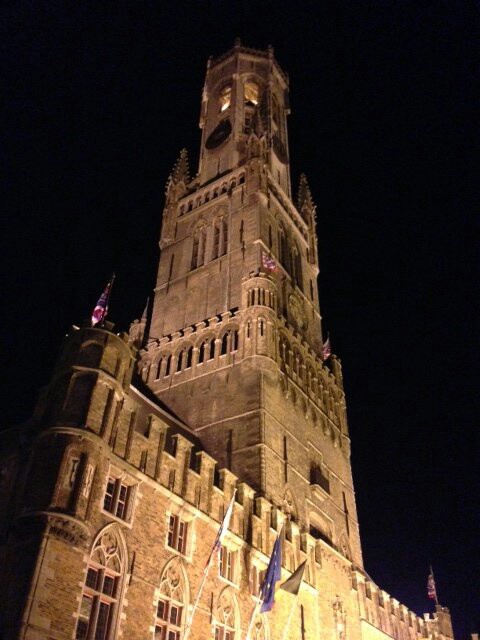
    We did so much yesterday there wasn’t much left to see. After breakfast in the hotel, we went to Belfort to climb the 366 steps to the top of the belfry. After 533 steps in the Cologne belfry this was a snap! It was a spiral staircase, of course, only with a literal twist: it would be clockwise, then suddenly counter for a bit, then clockwise again, an  then change one more time.

    Have I mentioned how much Europe likes spiral staircases? They are the rule apparently, not the exception. Even the staircase in our hosts home in Amsterdam was spiral. He was an architect – so I asked him about that. Was it to save space? Yes, he said, they take up less space, but mostly we just like them. Alrighty then! Since you can’t get furniture up them, you either assemble yourself – the appeal of IKEA made sense for the first time – or hoist up through windows. We saw lots of furniture hooks in Amsterdam, and today we saw an outside ladder with a lift on it taking things up to a 3rd floor window. Do we have this stuff in America and I just never noticed?
    Anyway, I digress. Belfort:


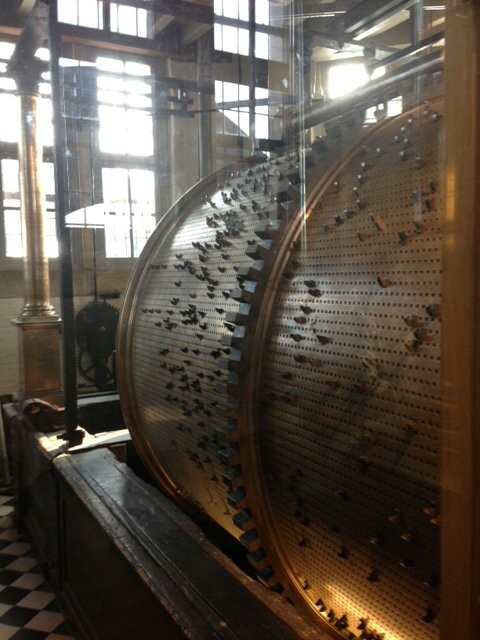
    In addition to being a carillion, it’s a music box! This is about 6 feet high.


    There was a market going on in the square and we perused that for a bit after. Always fun to see what the locals buy.

    That was the last of the “must-do’s”, and we went to the list of “maybe” and “if we get around to it”. Bruges is full of drive-by things to do that may or may not be interesting to you, but don’t take very long. I list them here for our own memory but most are not worth writing about:

    1. Chocolate museum – the most interesting on this list, and of course there were samples!
    2. Lamp museum – I kid you not. The only reason we went was it was in the same building as the Chocolate place and came with the pass we were using. We were the only ones in it!
    3. Fries museum – as in Belgian. History of the potato and how to make Belgian Fries. No samples, but we had lunch here and it was decent.
    4. Folklore museum
    5. A two room place about a local poet, Geselle.
    6. Lace museum – only because it came with the next one
    7. Jeruzalemkerk – this was not on our list, we stumbled upon it and are glad we did. It’s a family chapel modeled after a church in Jerusalem, which also serves as the family tomb. We’ve seen a lot of churches on this trip and this was the most unique.


     A small chapel behind the main room.


    There are skulls and demons in there.

    We went back to the room to rest and clean up, and had the best meal of the trip for dinner at a country French restaurant. It was in an alley and worked by two sisters. 18 people capacity. Every table but one was reserved and that filled early. It was a lovely dinner. Dan had cassoulet and I had sea bass. Both were excellent. With coffee and dessert of course.

    We will spend the day Thursday in Gent and our last two nights in Brussels. Home on Saturday.

    You know you’re tired when you’re looking forward to being immobilized for 12 hours on a plane.

  • Day 15: Bruges, Part 1 (Tuesday, April 2, 2013)

    Day 15: Bruges, Part 1 (Tuesday, April 2, 2013)

    We did so many little things today I am not even going to attempt to write about each one. The reader can go to Trip Advisor if interested in more detail :) I am going to treat this instead as a photo diary, with a simple list, maybe some description, and photos to support. Dan sent me 72 pics to consider out of the 100+ he started with. I am including 25 here.

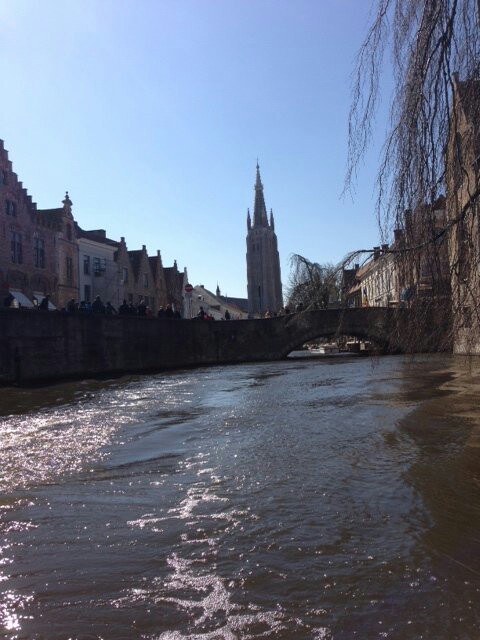
    I will start with a brief history for context. Bruges was a major center for finance, trade and art in its prime, during the centuries between 1200-1500. It fell out of favor when it didn’t keep up with mercantile progress, and lost its shipping capabilities when the canal to the North Sea silted. Antwerp became a bigger economic center after that, and remains so today (especially in diamonds). Bruges was considered a dead city by 1850, but tourists became interested later that century. For much of the next hundred years it focused on building tourism and restoring its medieval roots. This paid off big when UNESCO (covered yesterday) added it to its list of World Heritage Sites in 2000. It now gets about 2 million visitors a year.

    The purpose of most of the attractions is to give the visitor a sense of the city’s history, a sense of what it was like to live there 600 years ago, enjoy really beautiful things, and various combinations of those objectives.

    All that said, here’s what we did today:

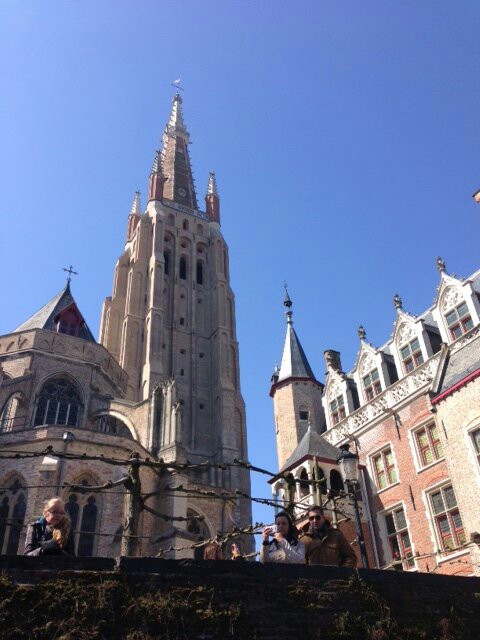
    Church of our Lady


    The Madonna and Child in the middle is by Michelangelo, the only known piece of his work outside of Italy.
    Gruunthuse Museum – centers around a manuscript of poems, secular songs, and prayers from the 1300 and 1400’s. This was probably our favorite because it felt very personal. Between the music, poems, jewelry, etc., you got a real sense of life at the time. It was in an amazing house built next to the church, with its own chapel on the second floor whose windows looked into the church itself; they were connected. Dan got a picture of one of the books, where each page is itself a work of art.
    The Diamond Museum was next, interesting history of diamond trading in Bruges as far back as 1370, with a cutting demonstration included.
    This guy did the demo in 3 languages: English, Dutch, French. It was pretty impressive. He had a slight cough and would even say “excuse me” in whatever language he was speaking at the time when he coughed! He easily switched to whatever language the audience used during the Q&A session.
    Next was lunch in a tiny sandwich shop, then a canal ride.


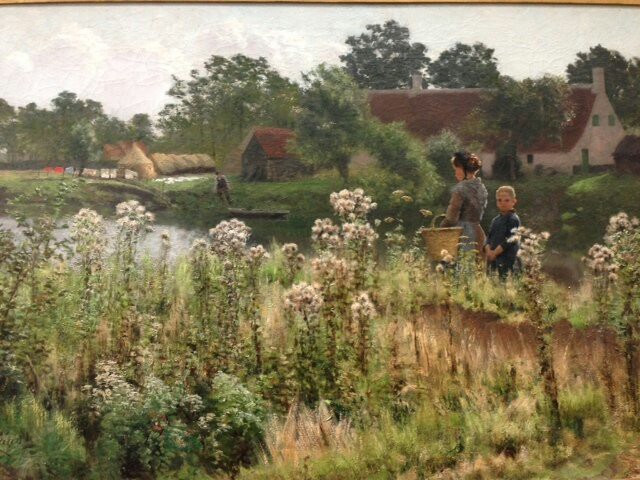
    Then Groeninge Musem, focusing on local painters from 1400 to 2000. This was my favorite; I love Impressionism, and I love that the kid is looking at you.
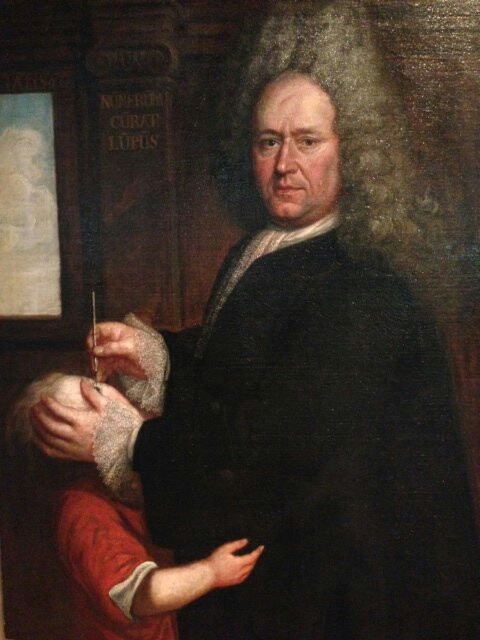
    Next, another two-fer museum, focusing on local artists, displayed in what had been a hospital for 400 years. This one is so bizarre.
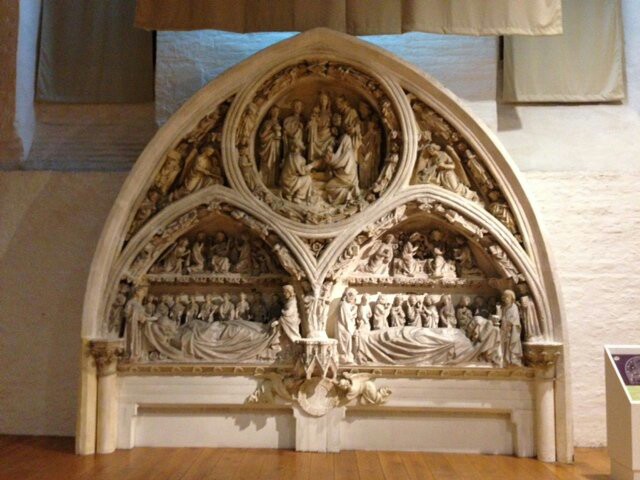
    It also had a huge empty room upstairs with a lone gothic sculpture at one end.


     City Hall was after that. It’s meeting room on the second floor had Dan declare it was  probably the most ornate room he’s seen in Europe.
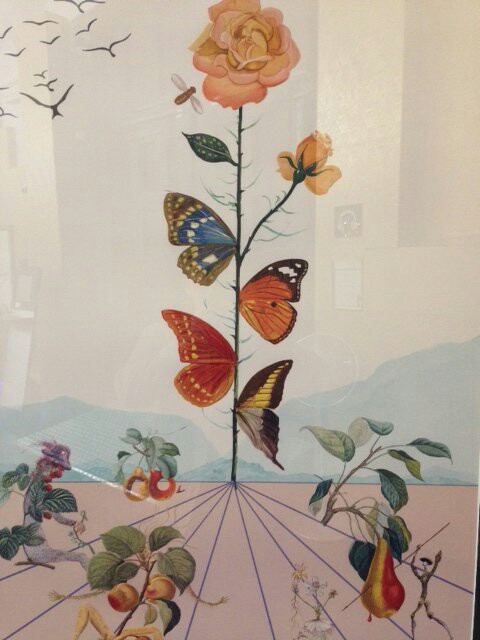
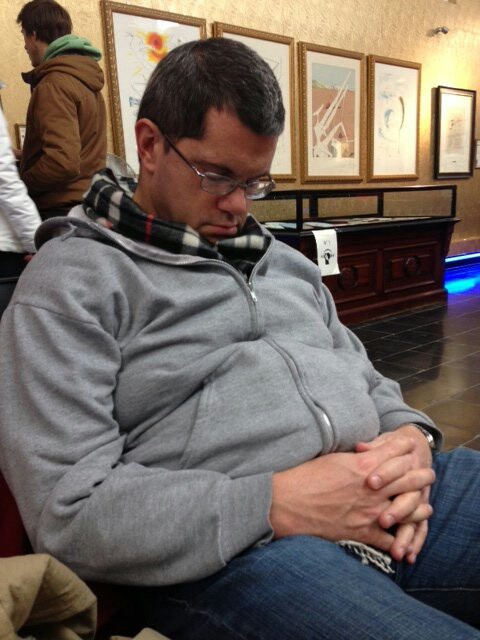
    Salvador Dali exhibit was last. Here are a couple of Dan’s favorites from there.
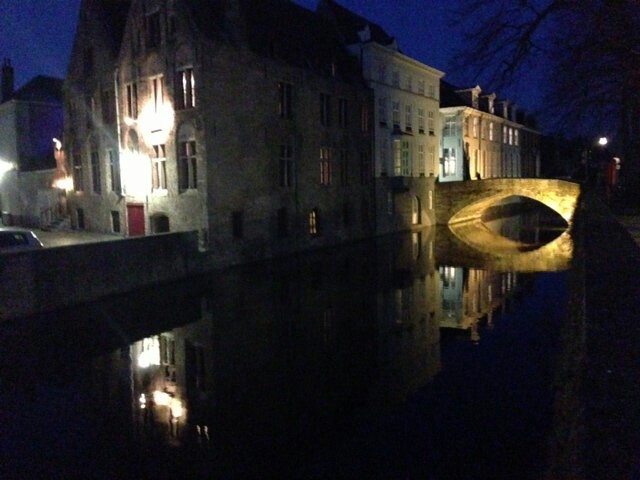
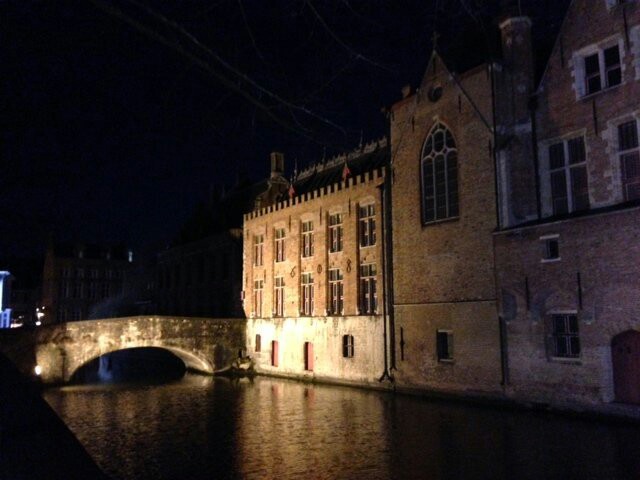
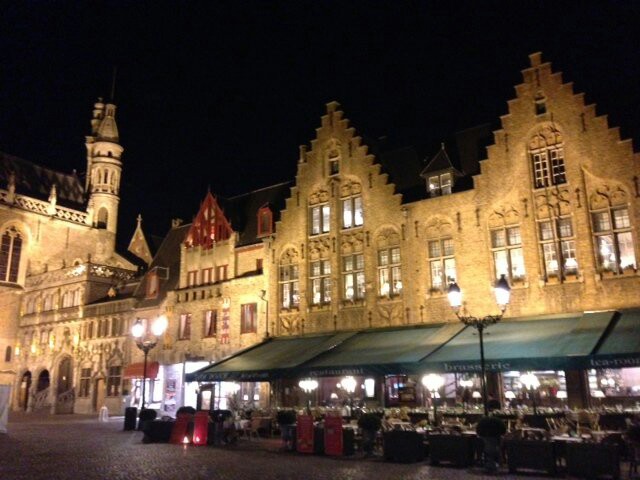
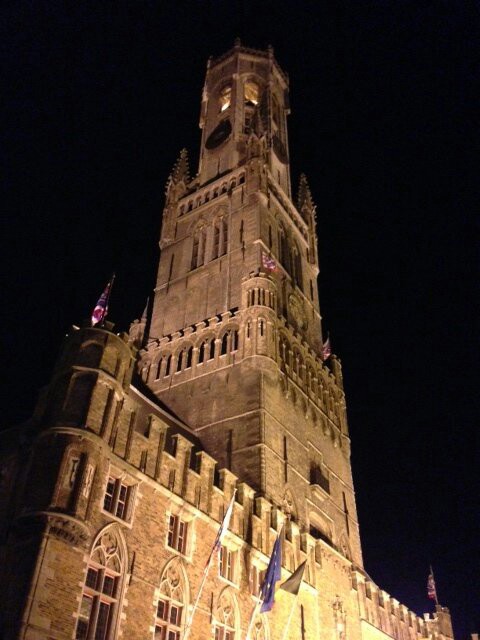
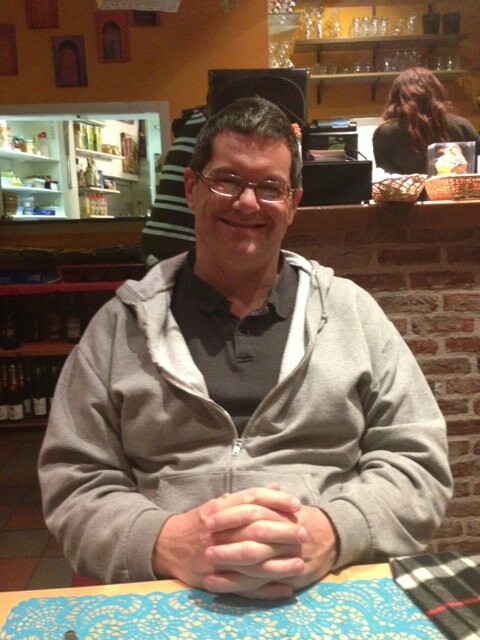
    And finally, some night pictures, and me after a very satisfying warm apple pie, excellent vanilla ice cream, and fresh whipped cream. At a Morrocan place! (See photo at the end.)