Blog

  • Day 3: Saturday, 11/26 – Still More Philadelphia

    Day 3: Saturday, 11/26 – Still More Philadelphia

    I am writing this Sunday evening from home in Sacramento. We had a great day in Philadelphia yesterday and just decided to enjoy the evening and relax a little. The blog is “a thing” every night – minimum two hours – and I just didn’t feel like it last night. So there :)

    This was the day we put together ad hoc; the original plan was to go to Harrisburg then Lancaster. We are Really Glad we did this instead. We loved everything about Philadelphia and were happy to get more of it, plus it just made it more relaxing not having to deal with getting a car, etc.

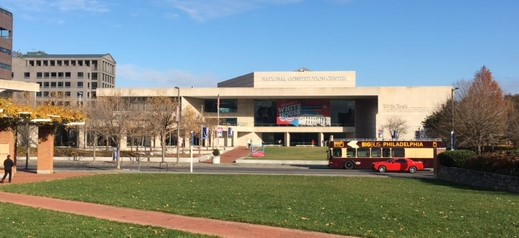
    We had breakfast in the hotel of course and headed out about 9:15. Our first stop was the US Constitution Center, a modern building across the mall (park) from Independence Hall.


     Dan getting tickets. Our Crocker membership worked here, too, so we got in free.


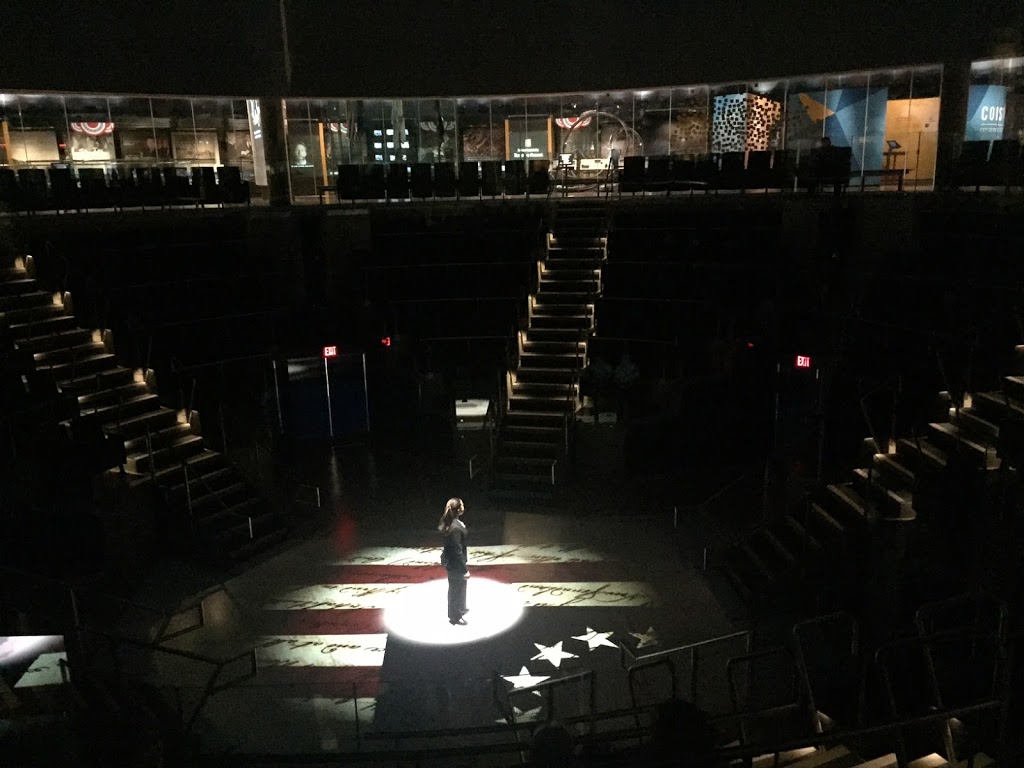
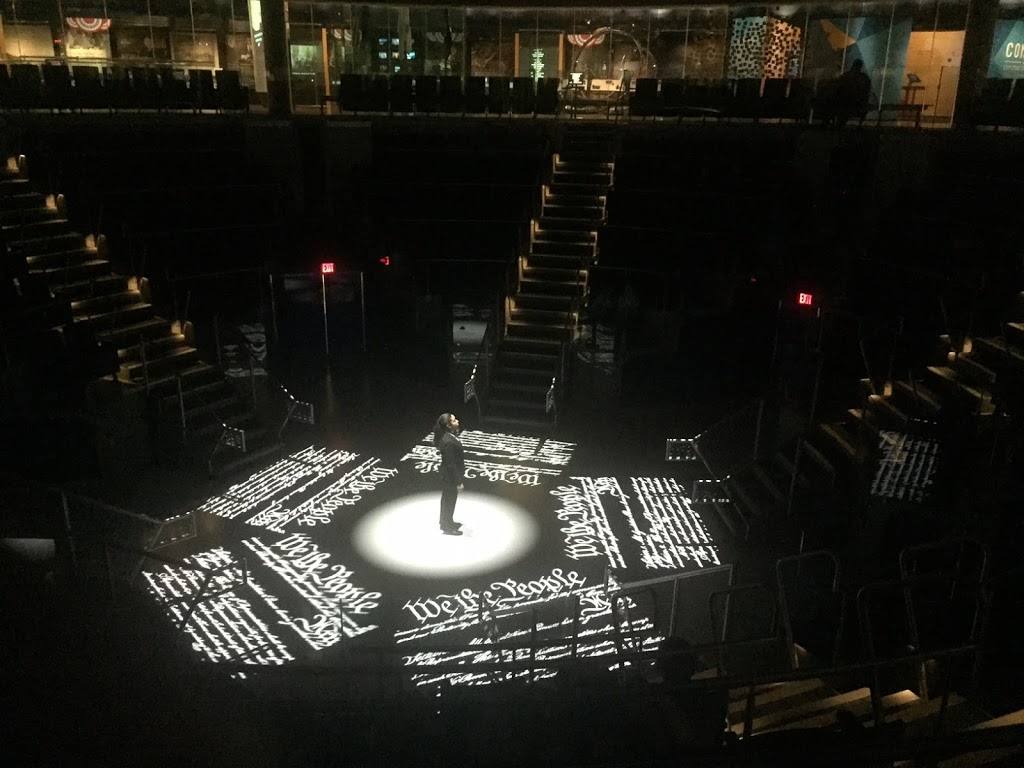
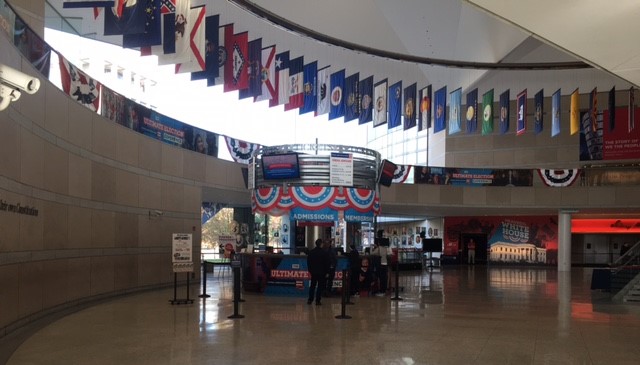
     We started with this pretty cool exhibit/demonstration in this sunken theater with fun visual effects. You were not supposed to take pictures (anywhere in any of the exhibit areas actually) but you know Dan! Sneaky. It was 17 minutes long, interesting and entertaining.


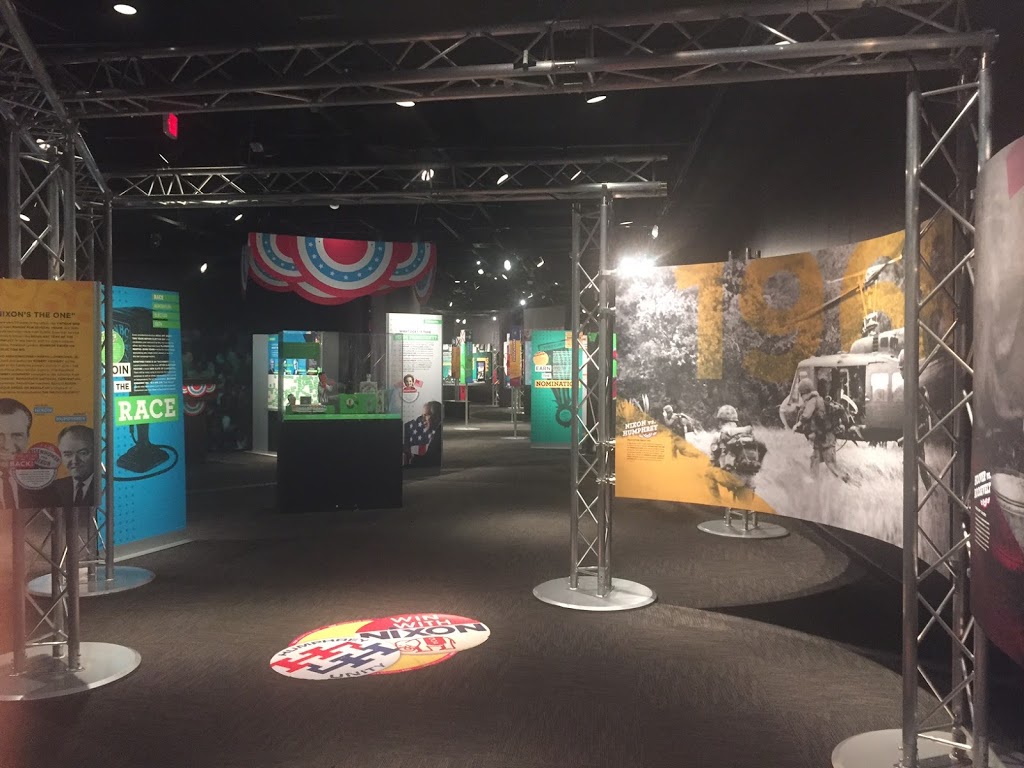
     This was a special exhibit on the process of Presidential elections and the role of the national parties.
    Dan was very depressed after leaving this museum. Will just leave it at that :)

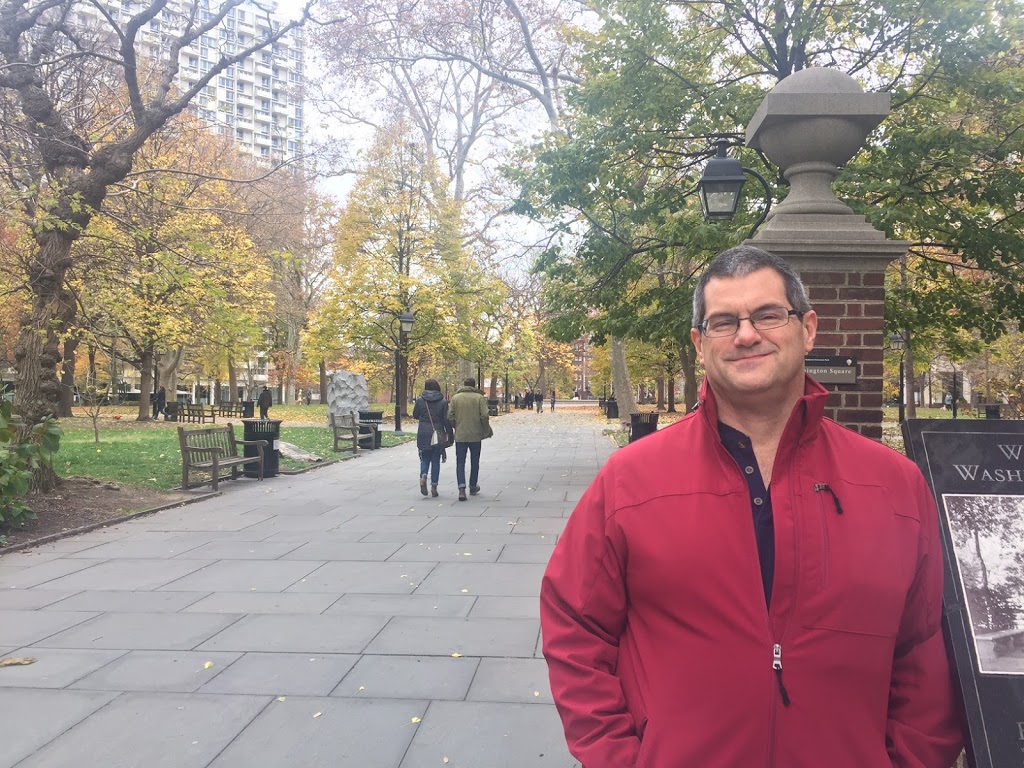
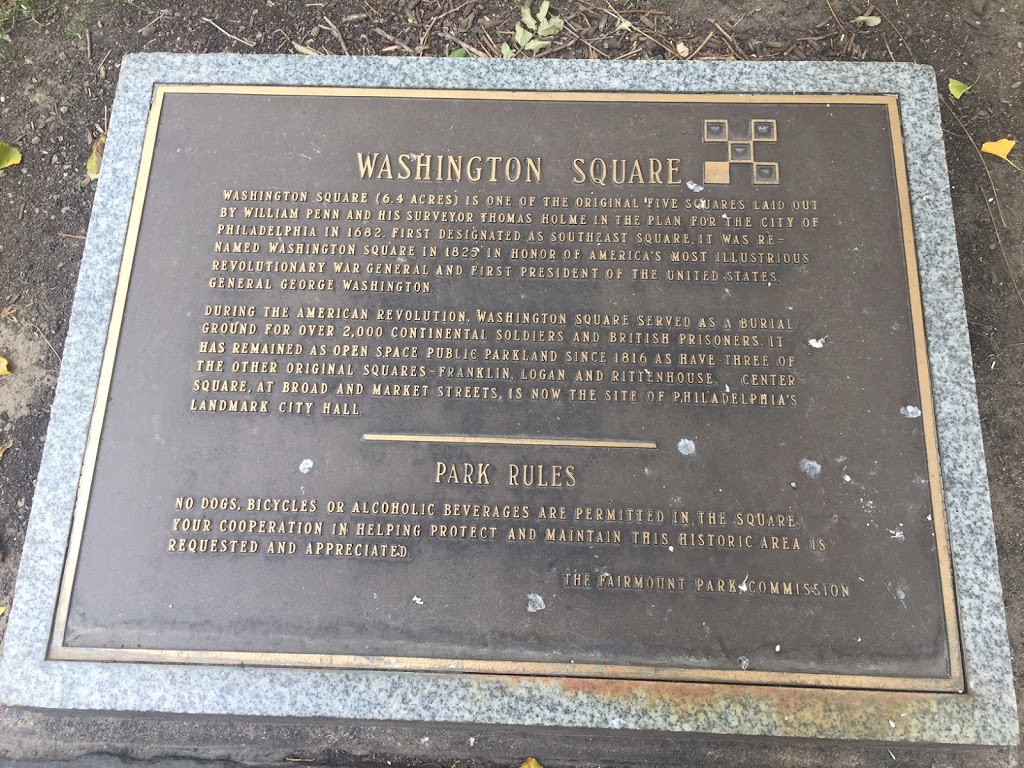
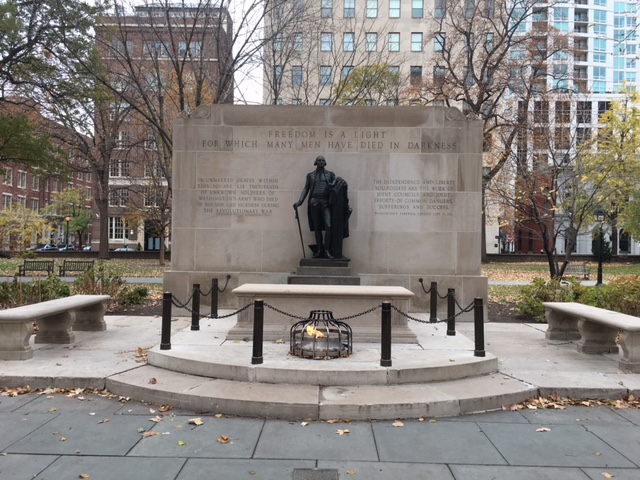
    We came across Washington Square for the first time on this trip, and then encountered it like 2 or 3 other times as we went through our day. If you see the emblem in the top right of the plaque below, it indicates which of the 5 primary squares this is relative to the rest of Center City (what they call downtown). In William Penn’s original city design for Philadelphia, much if it still in tact, it’s a grid where the north/south streets are numbered, and the east/west streets are named for trees. There were 5 squares designated as public spaces: City Hall in the center square, and then what has become Logan Circle, Franklin Square, Washington Square, and Rittenhouse Square (which we were at Friday night but I forgot to mention. It was raining; it was quick!). The emblem is not facing north for some reason; since most maps have north orientations, Washington Square is actually in the southeast corner; here’s it looks like southwest.


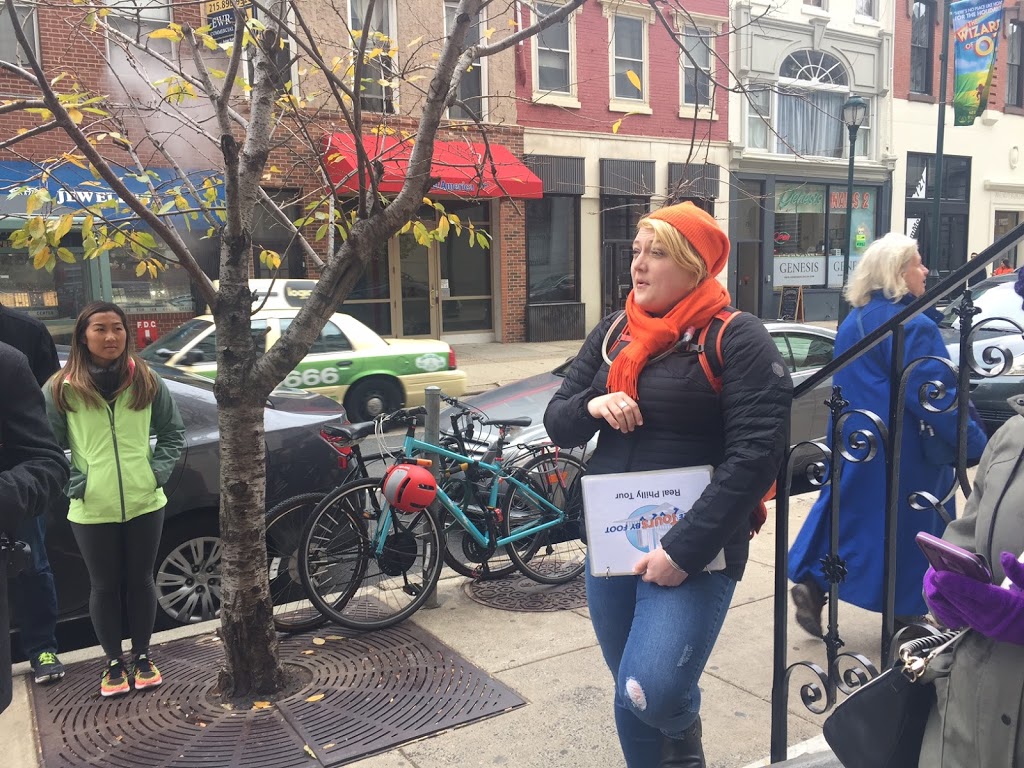
    Meet Jenn, a tour guide we signed up with via “Free Tours by Foot.” It’s a “name your own price” service; no cost to participate per se, but they ask you pay what you can at the end. (We paid $40 and it was well worth it). This tour was 4.5 hours; we ducked out on the last hour of it for reasons I’ll get to later. There are similar options available in other cities so we will definitely look for it again. Jenn was energetic, knowledgeable, a great story teller, and kept us moving at a nice pace. Also did a decent job of trying to keep us out of the wind where she could; it was a tab bit cold.

    She gave us lots of very detailed explanations of things at every stop. In fact, our first stop was Washington Square – we had Just been there! – and much of what I wrote above I actually got from her. This stop was a discussion about an architectural design called Federalist, the first “American” architecture, designed to drift away from Georgian (after King Georgian) and incorporate lifestyles that had shifted as less people were building homes with shops on the first level.

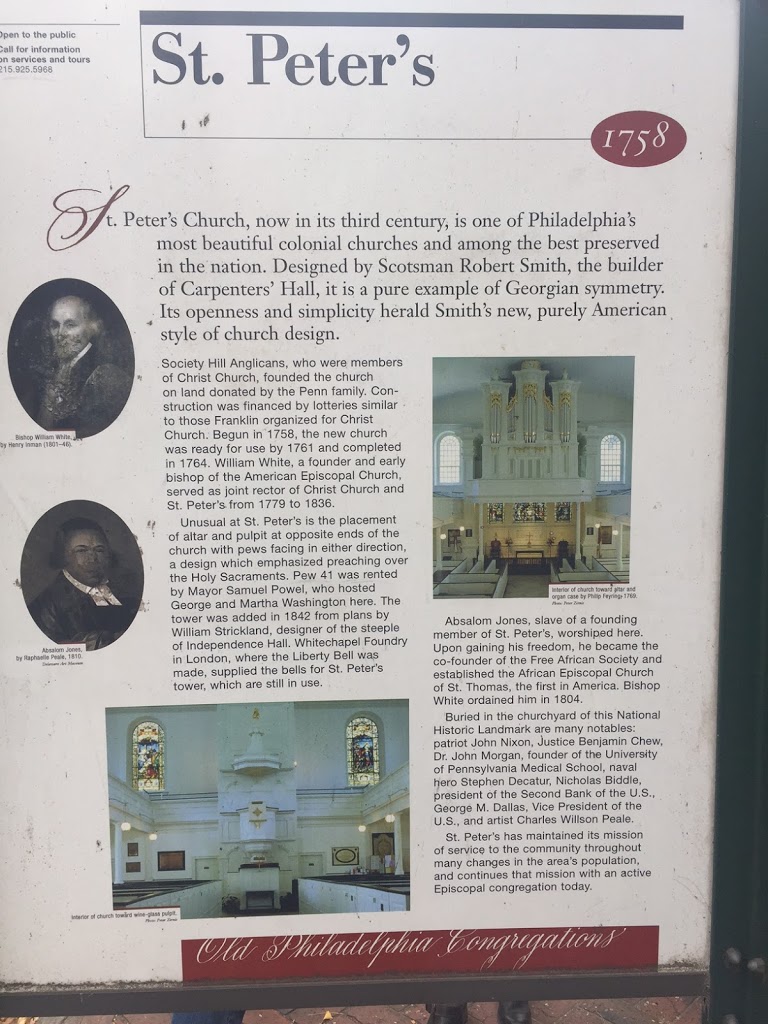
    This is a 250+ year old church with lots of history, including regular visits from George and Martha. Washington that is. We couldn’t get in but it may be the only church left where the communion area is on one side and the pulpit on the other, to emphasize preaching over the sacrament. The photos on the plaque outside will have to do.


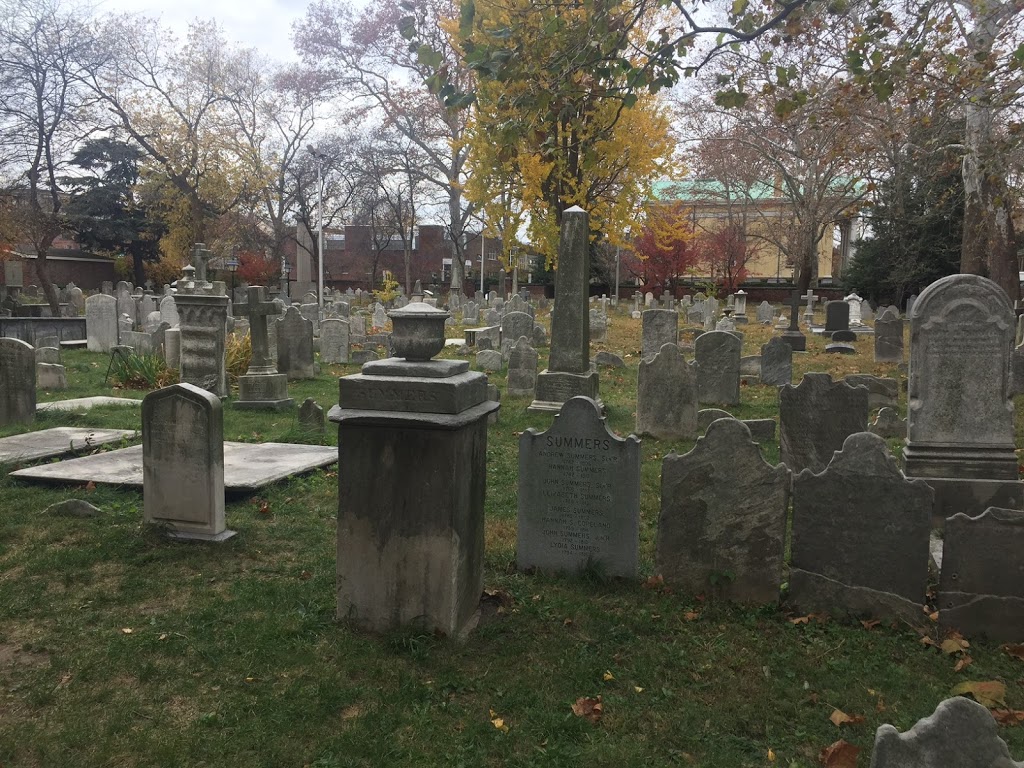
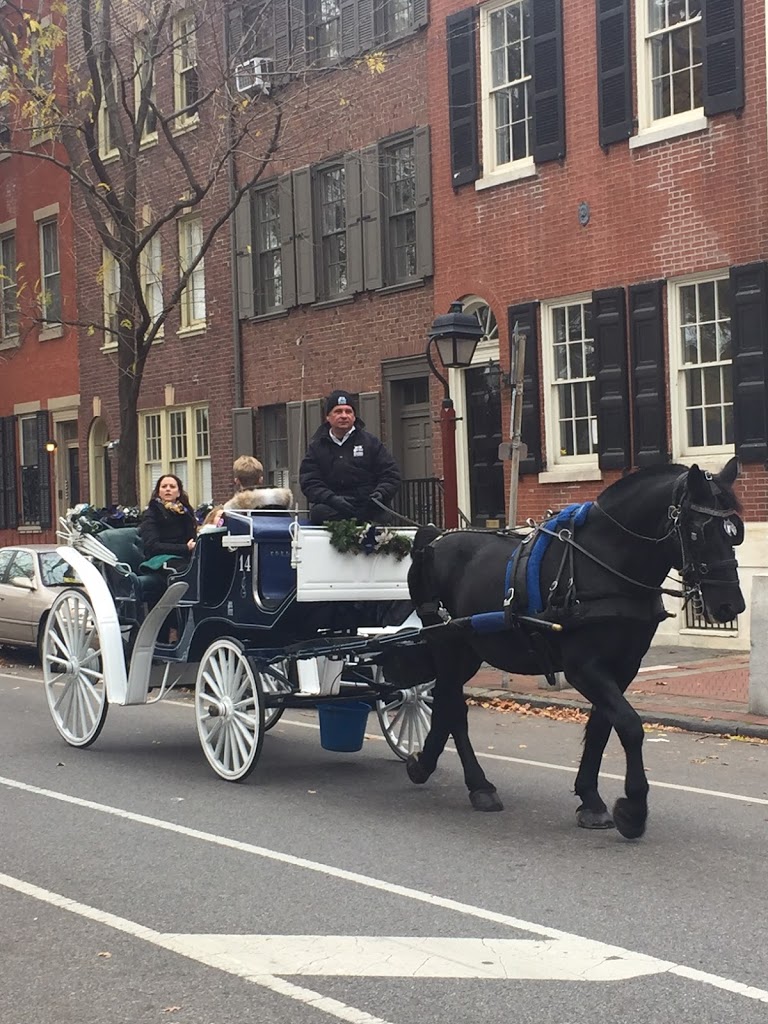
    A cemetery at the church above, and a carriage ride going by us while we were standing there below.


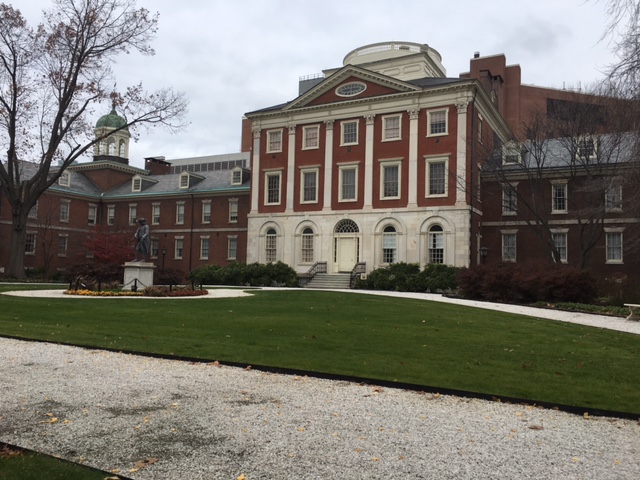
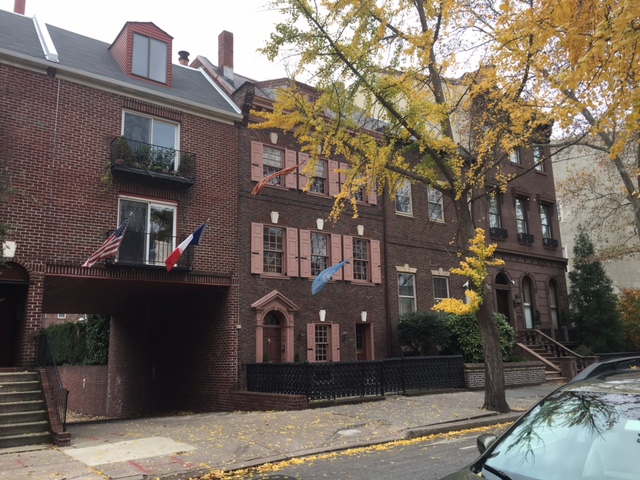
    Pennsylvania Hospital, the first one in the US, established 1751 by, guess who? Ben Franklin and a Dr. Thomas Bond. Still in operation. Across the street were nice homes, more in the Federalist style. One of them was for sale: 3000 square feet for $1mil. That’s cheap by California standards.


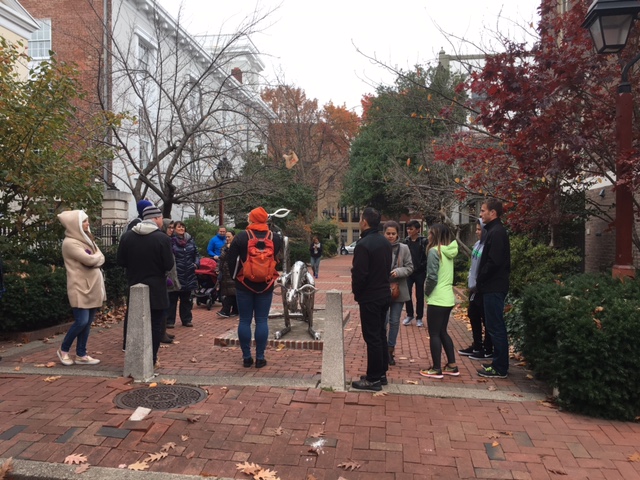
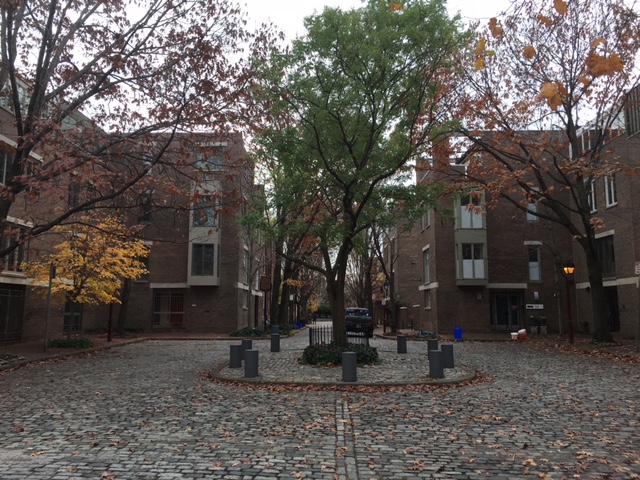
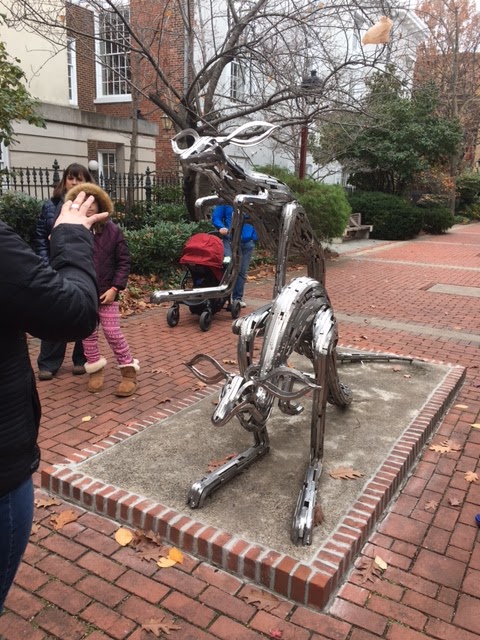
    A little residential square we stopped at so she could explain Philadelphia’s art program. This shows the whole group, about 15 folks I guess, from literally all over the world: US, Spain, Germany, Uruguay, Australia from what I recall.


    Starting in 1959, construction projects had to include 1% of the total amount reserved for art in the area of the construction, and it usually took the form of sculpture of some kind. This explained why we’d seen so much of it, something we noticed right away.

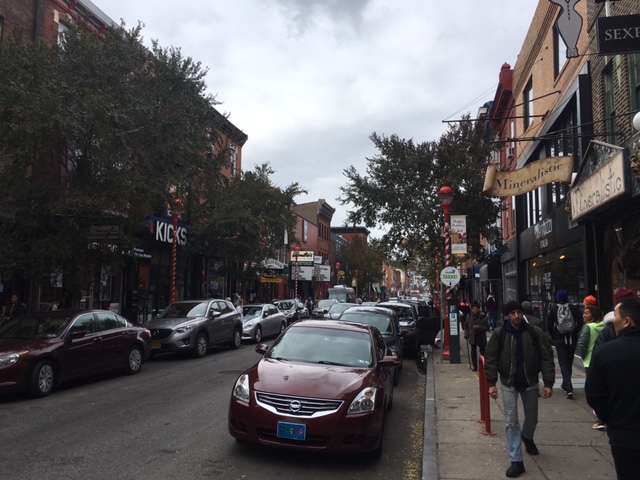
     South Street, a fun and lively neighborhood, with a very different vibe than Society Hill where we’d just come from.

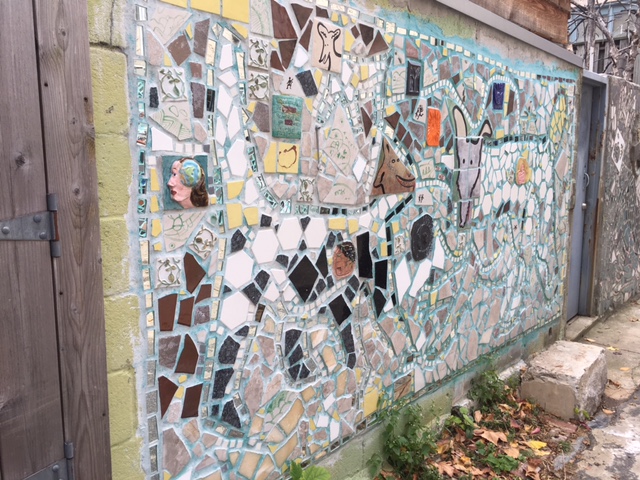
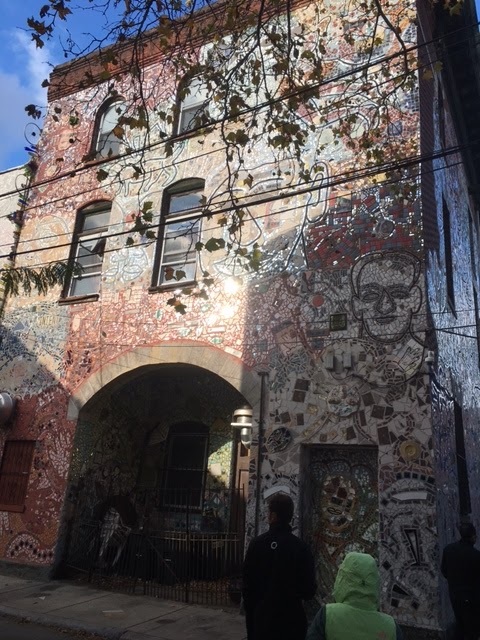
    There are also murals all over the city – something like 4000 of them – and on this walk we came across a particular artist who did them in mosaic in seemingly random places just to brighten things up. More about him a bit later, too.


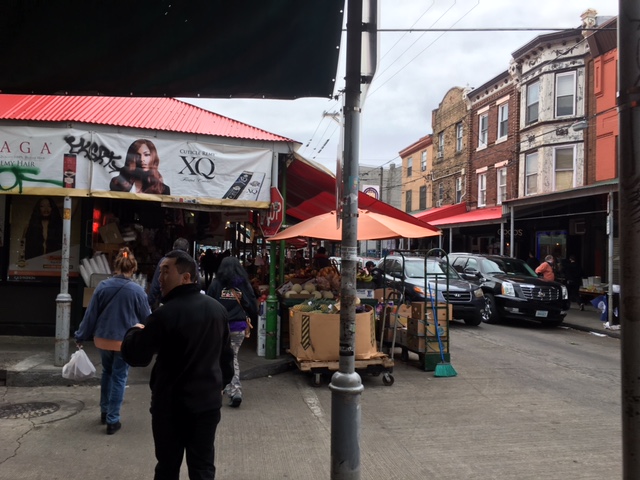
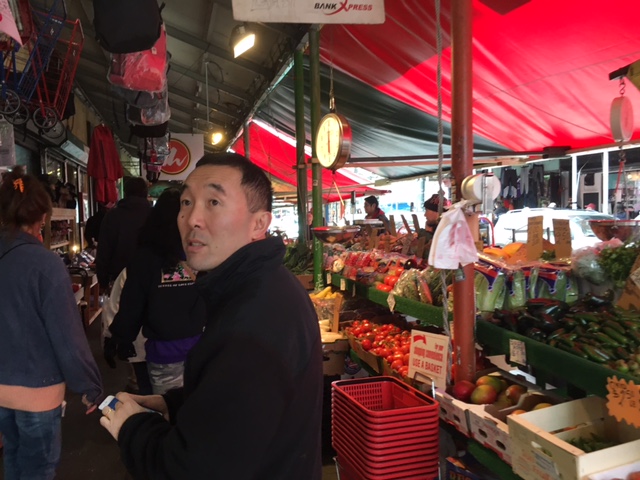
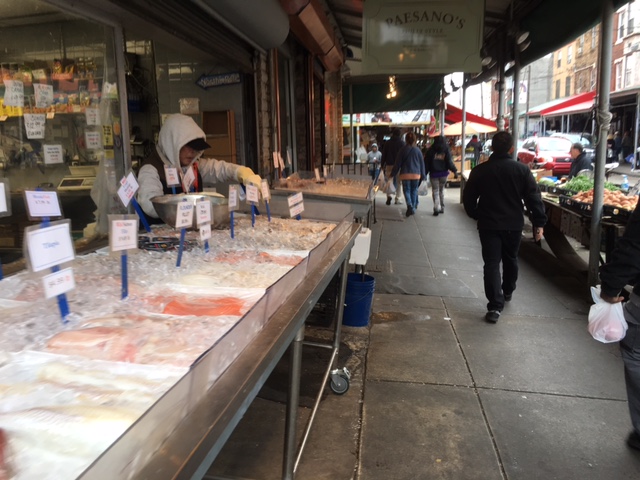
    We made our way to the Italian Market – or 9th Street – which is 1.5 miles of shops and restaurants. We stopped here for lunch, and Jenn made more than a handful of recommendation of places to go to cater to a wide variety of tastes and budgets. As soon as she said “Paesano’s – and it gets crowded so if you’re going to go you should go soon” we took off. Dan had been studying “best of Philly” sandwich lists and this was on most of them. But we had to bob and weave through the locals on the way.

     I was trying hard to keep up. As usual :)

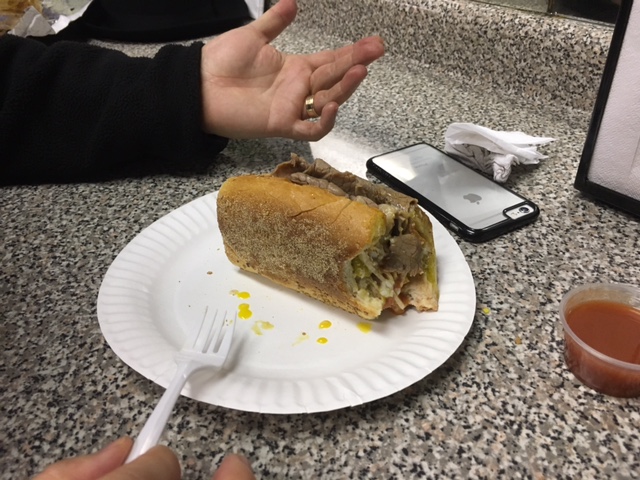
     This was Dan’s favorite sandwich of the whole trip. In addition to sharp Provolone again, it had tomatoes I think, other stuff I don’t remember, and we added a homemade Tabasco-like sauce.
     We learned our lesson the day before and split this one. So Glad we did.
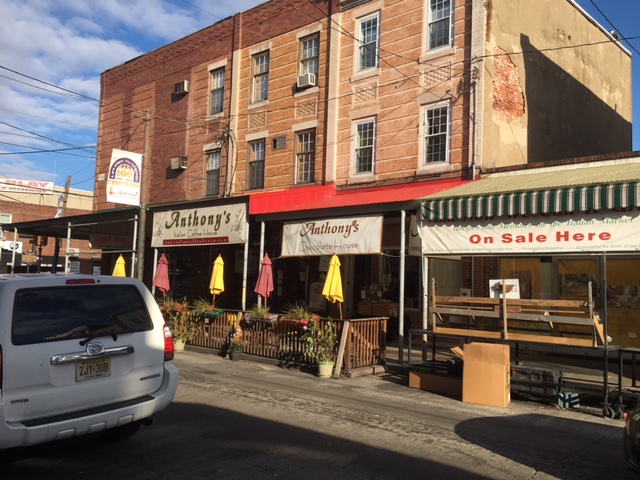
     Because after we went to Anthony’s, a little cafe for coffee and dessert. The tour group was meeting up again at 2pm across the street from here (about where I’m standing to take the photo) and we still had about 20 minutes to relax here.


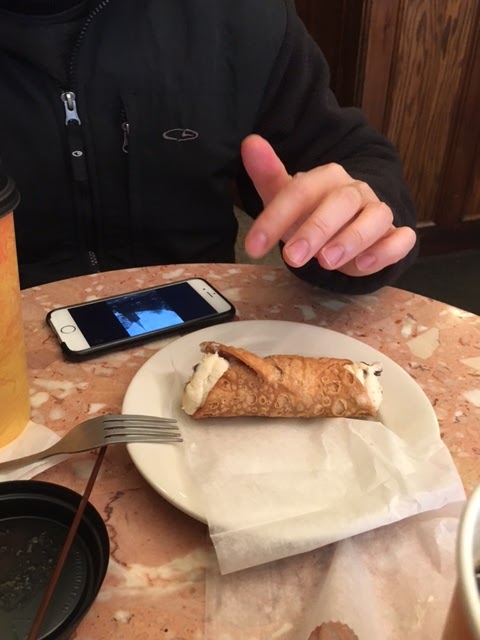
     A very nice cannoli, which we also split.


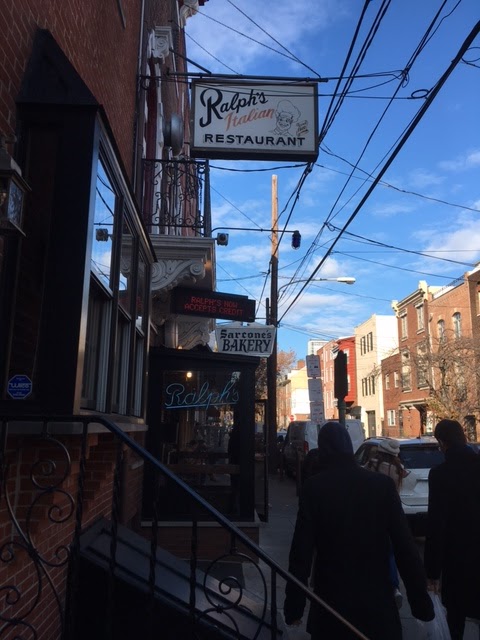
    Ralph’s is officially the oldest restaurant in the country that’s been in the same family since it opened – in 1900.
     More murals of the same guy.
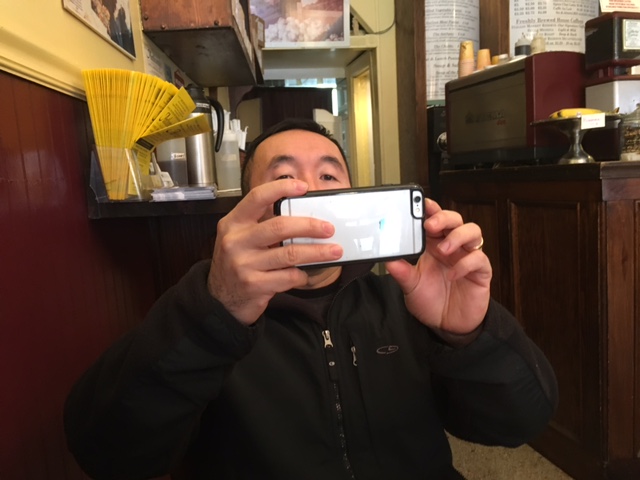
     One of the couples on the tour offered to take this. And the of course Dan took theirs!

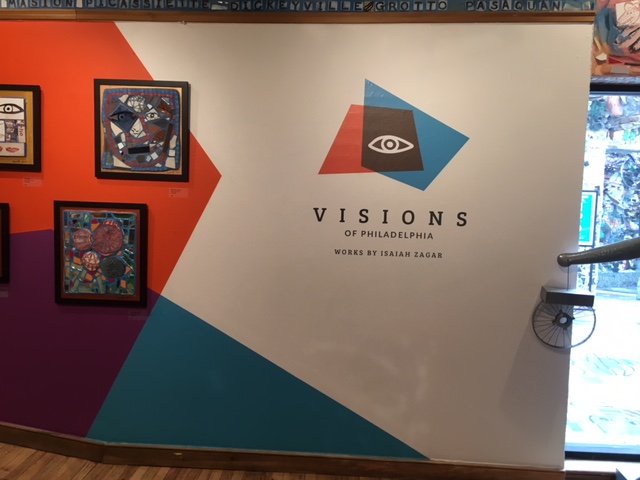
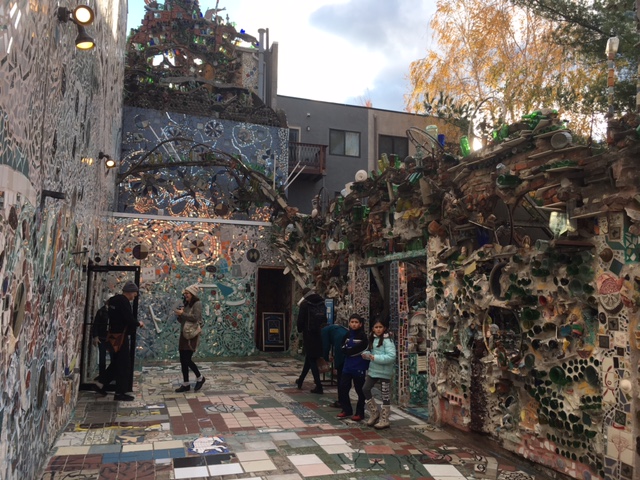
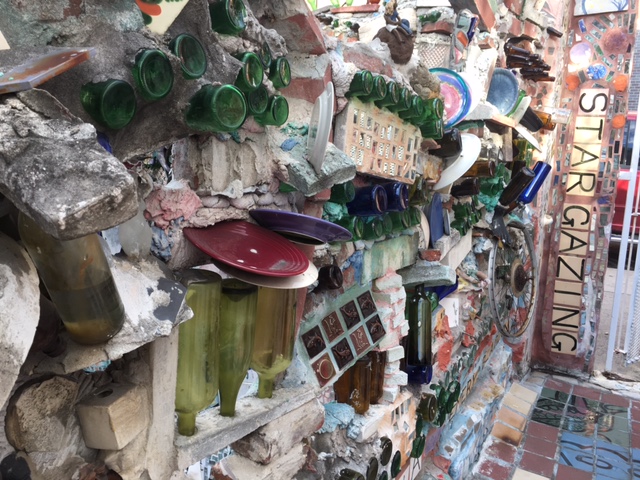
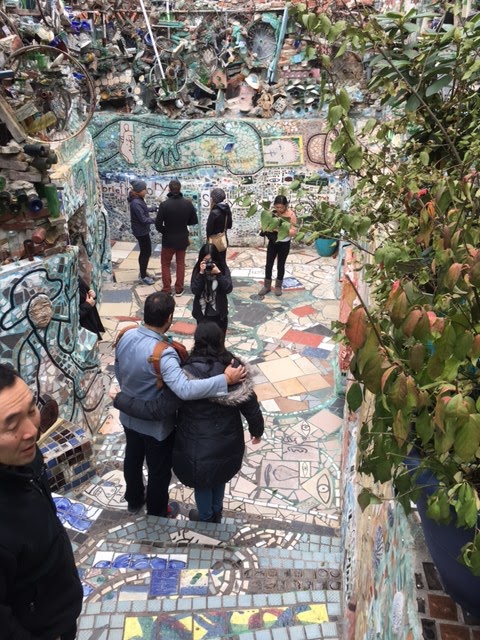
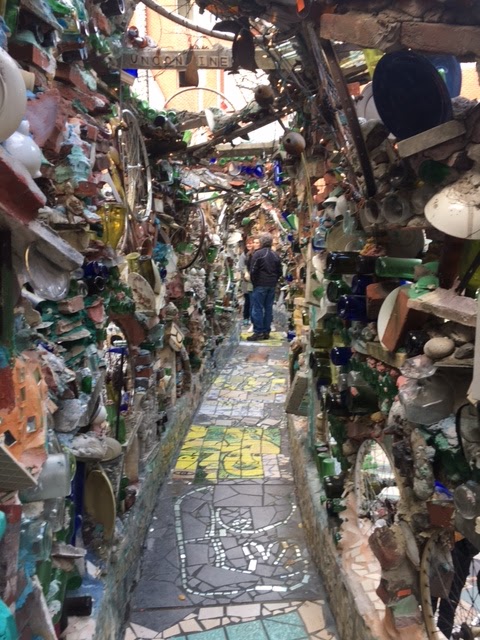
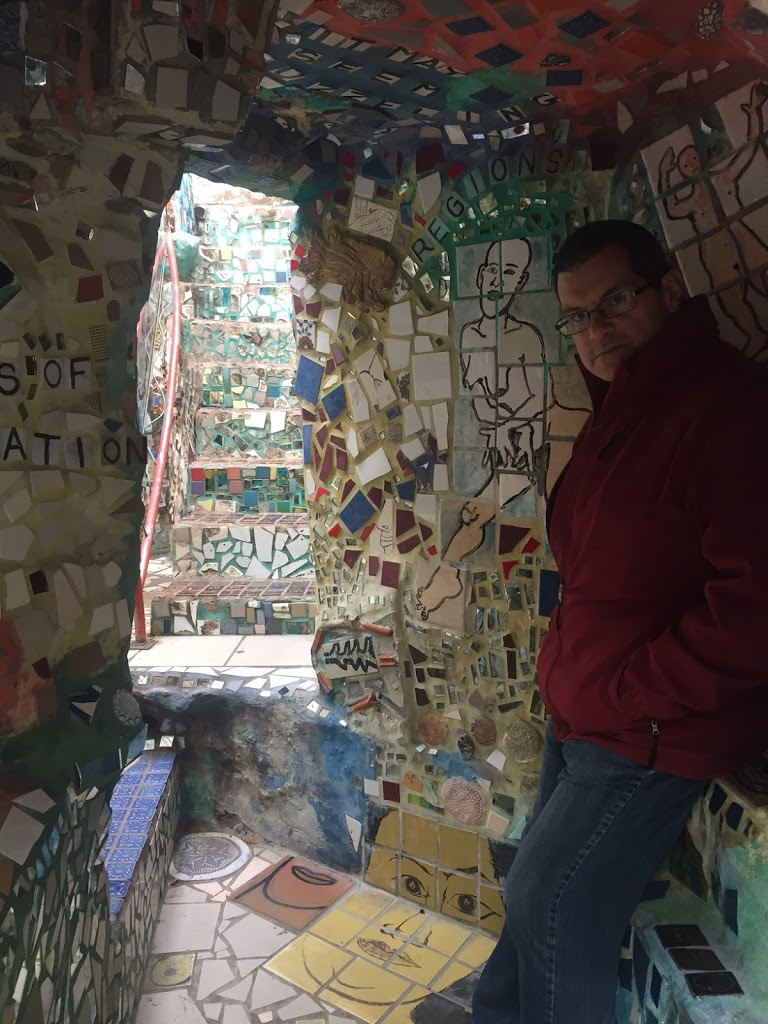
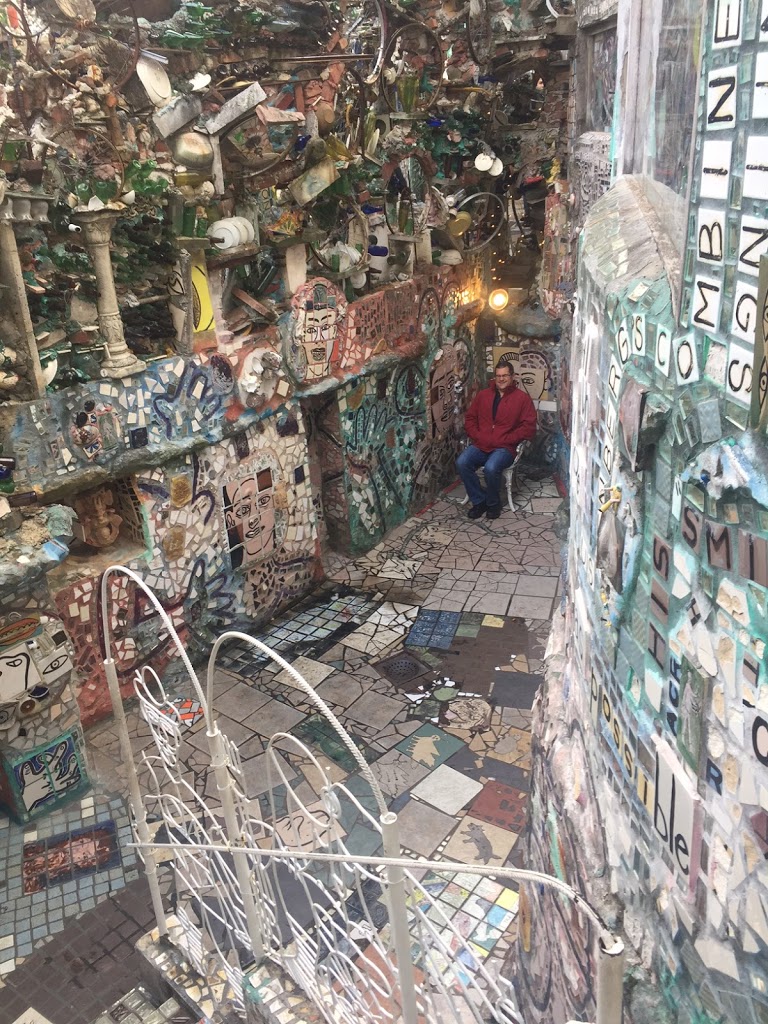
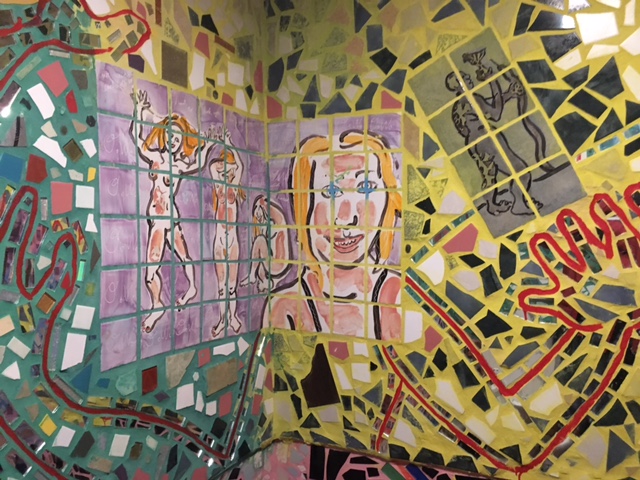
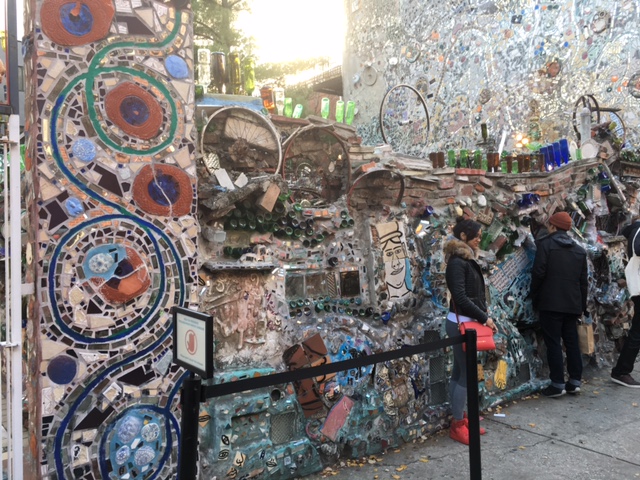
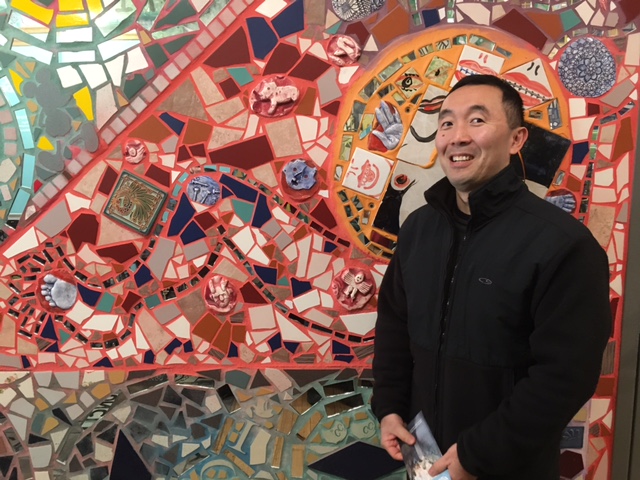
    Same artist, only now – WOW – this was something else all together. The artist that did the other mosaics we passed – Isaiah Zagar – turned the vacant lot next to his art studio into this over the course of several years. When the owner learned of it he was going to dismantle and sell it – until the neighborhood stopped in and bought it. It now operates as a nonprofit called Magic Gardens. Like nothing we’ve ever seen. The tour stopped at the wall above to sort of peek inside, but you really needed to go in to get the full effect. Dan checked with the guy handling the line outside, and our Crocker pass would get us in here, too. When he learned it was just the two of us, he said we could go right in. That was when we left the tour. She had only about 45 minutes left and it included City Hall and Reading Terminal which we’d already done.


    The photos above is just the room off the ticket area where Dan is standing two photos above. The photo below is the first full area of the garden.


     This sort of took my breath away. I certainly wasn’t expecting it to go down a full level.


     All sorts of nooks and crannies.


     Another lower level.


     This was actually the bathroom!
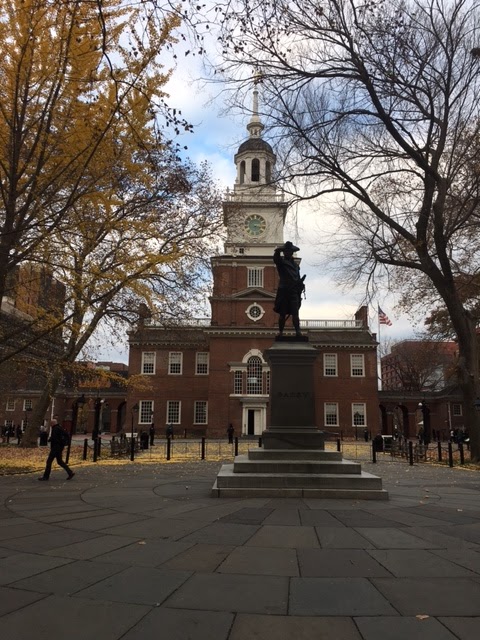
     As we were heading back across town we came across the backside of Independence Hall (after going through Washington Square again) and couldn’t resist.
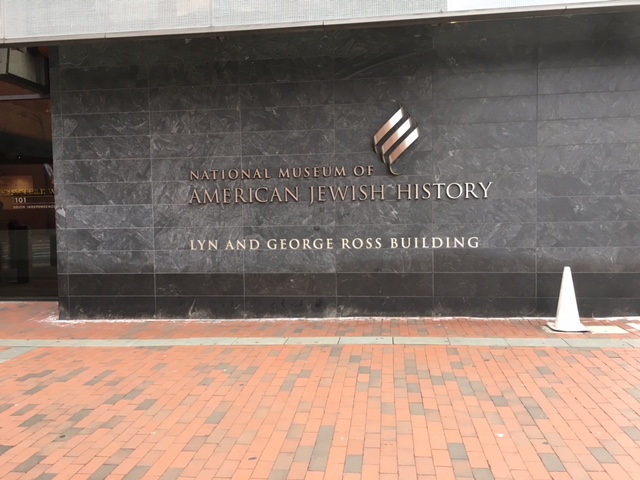
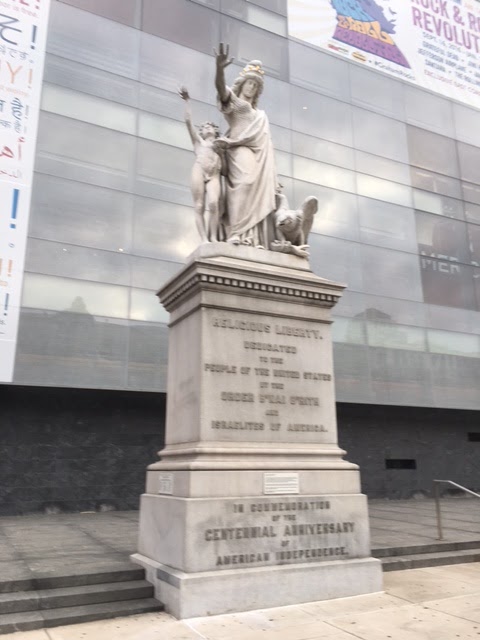
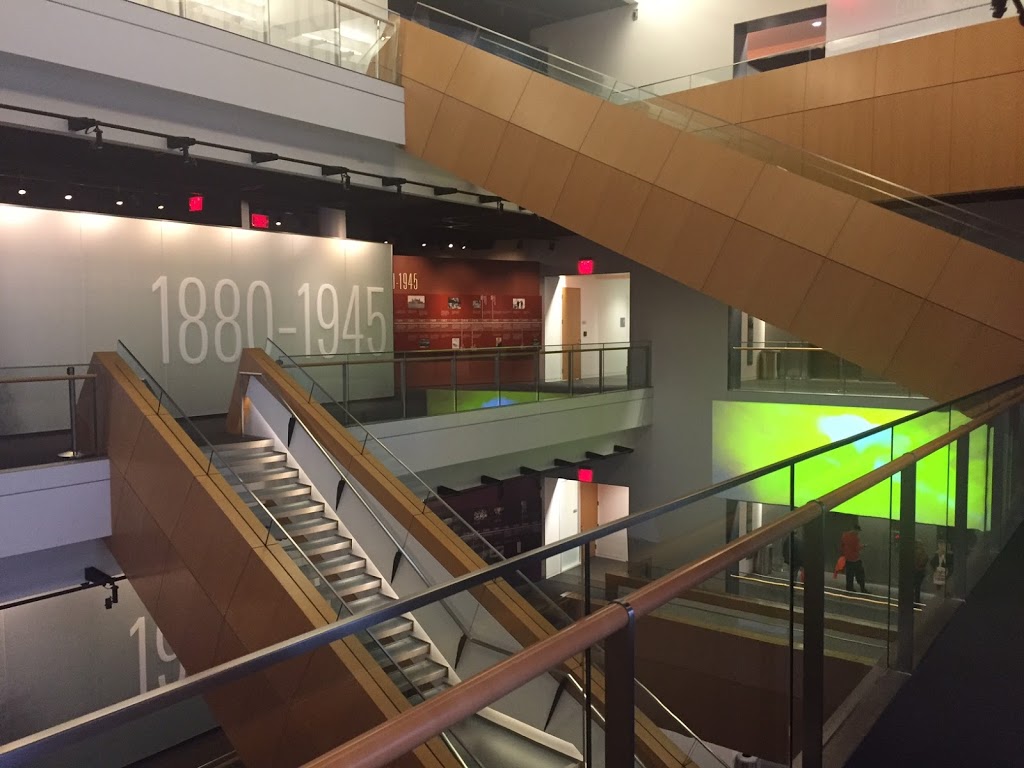
     Jewish History museum was next. We spent about and hour here I guess, maybe a little more. Photos were not allowed. Our Crocker pass worked here, too. That’s 3 for today, 4 for this trip. (And although I keep saying Crocker, it’s actually that Crocker is a member of NARM – North American Reciprocal Museum association. So if you’re a member of one, you’re a member of all. Convenient for us.)
    A couple of things struck me that I hadn’t known or thought about:
    1. That anti-semitism was alive and well in this country in the 20’s and 30’s. Business had “Gentiles Only” and similar signs just like they used to have “Whites Only.” I knew it was like that in Europe before WWII but didn’t know it was that widespread. I don’t get it.
    2. That after WWII, there were more Jews in America than any other country in the world. Makes sense but it hadn’t occurred to me. (Because most everyone else was dead, if you missed that…)
    3. That Hollywood was pretty much created by Jewish men who struggled to get jobs in “professional careers” and this was something they could do from scratch. I knew the moguls were mostly Jewish back in the day, but hadn’t known how they got there.


     One more of Independence Hall at night as we made our way back to our room.


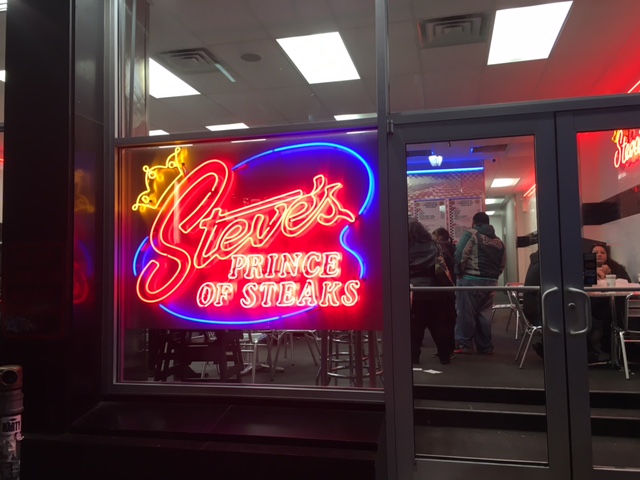
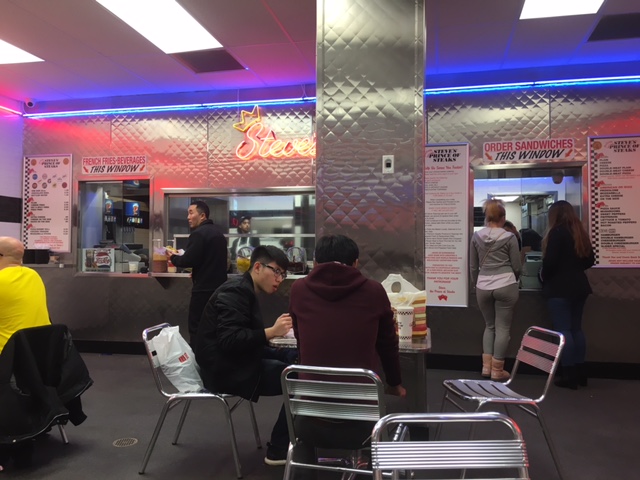
    We only stayed at the hotel about 45 minutes before heading out again for our last sandwich. This time it was Steve’s Prince of Steaks, just about a 10 minute walk from the hotel. It was on one of Dan’s lists and Jenn the tour guide said she hadn’t been yet but several of her friends liked it a lot.

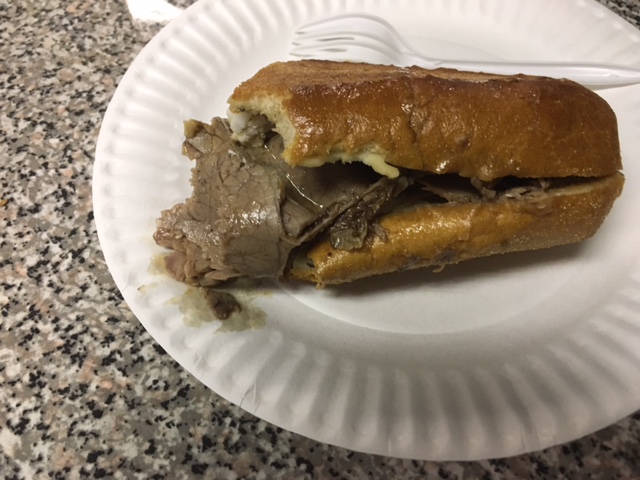
    Doesn’t look like much but this was probably my favorite sandwich: high quality meat and cheese (not sharp this time!) on simple sandwich bread. Very comfort-food-like. And Dan ordered cheese fries with cheese whiz on them – oh so bad and oh so good. 

    We went back to our room and just relaxed the rest of the evening. We decided to watch Rocky because it kept coming up on this trip, Dan hadn’t seen it in awhile and I’d actually never seen it. It was just OK :) But at least now I can say I’ve seen it.

    ————————————————————————-

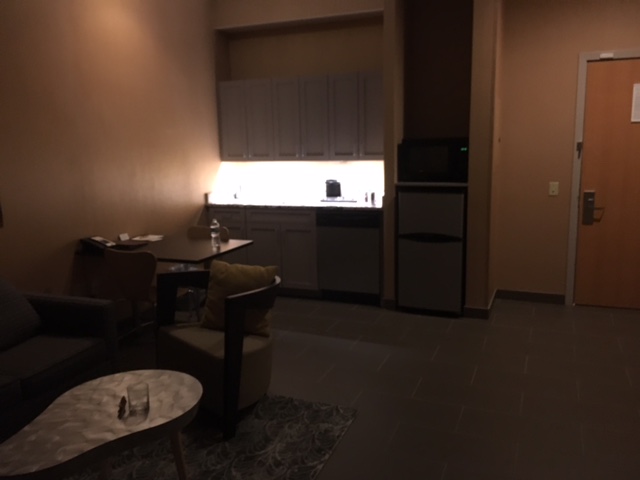
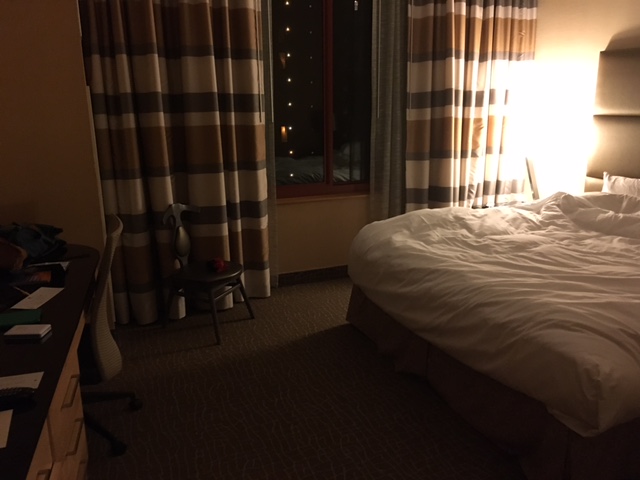
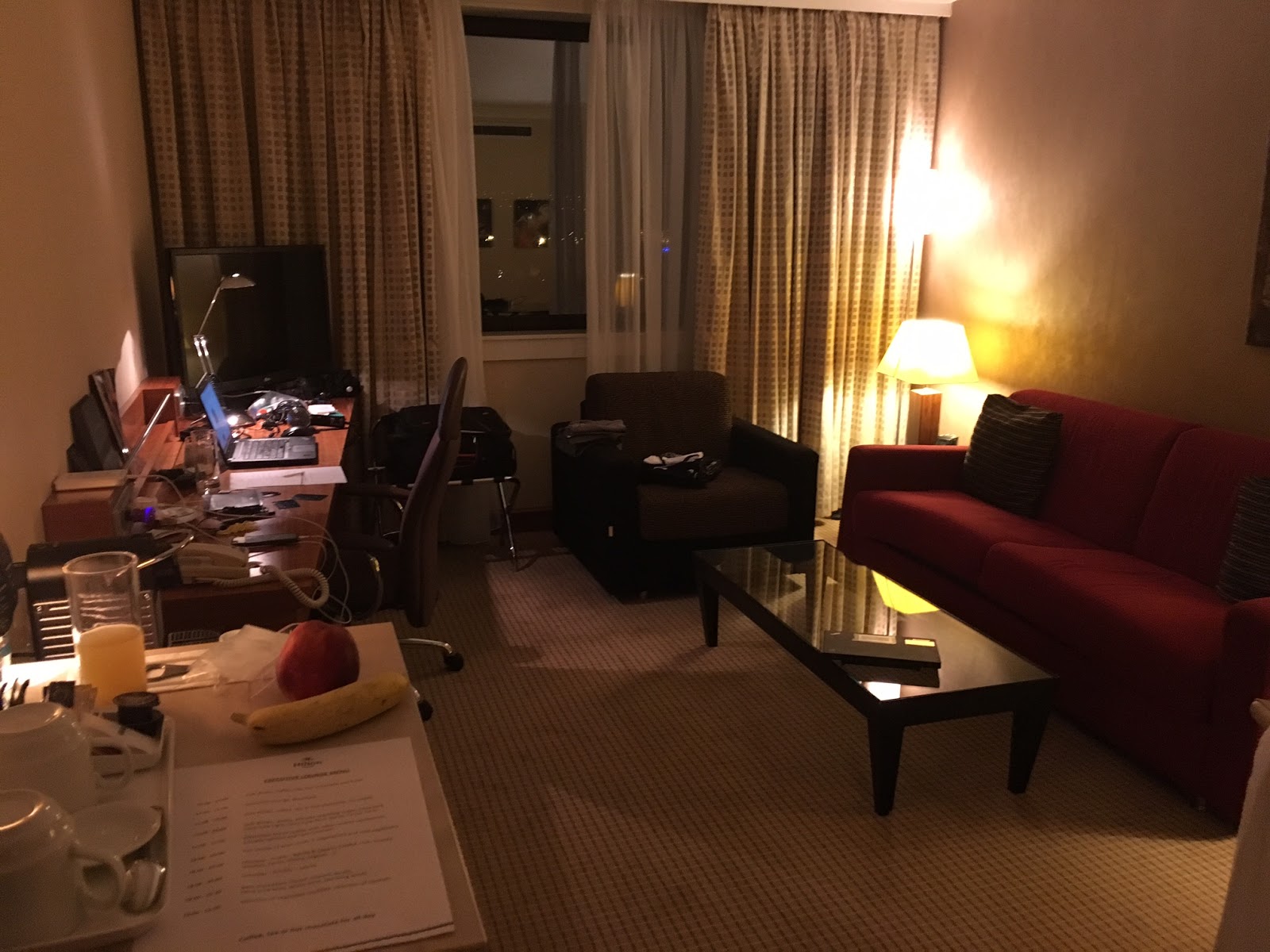
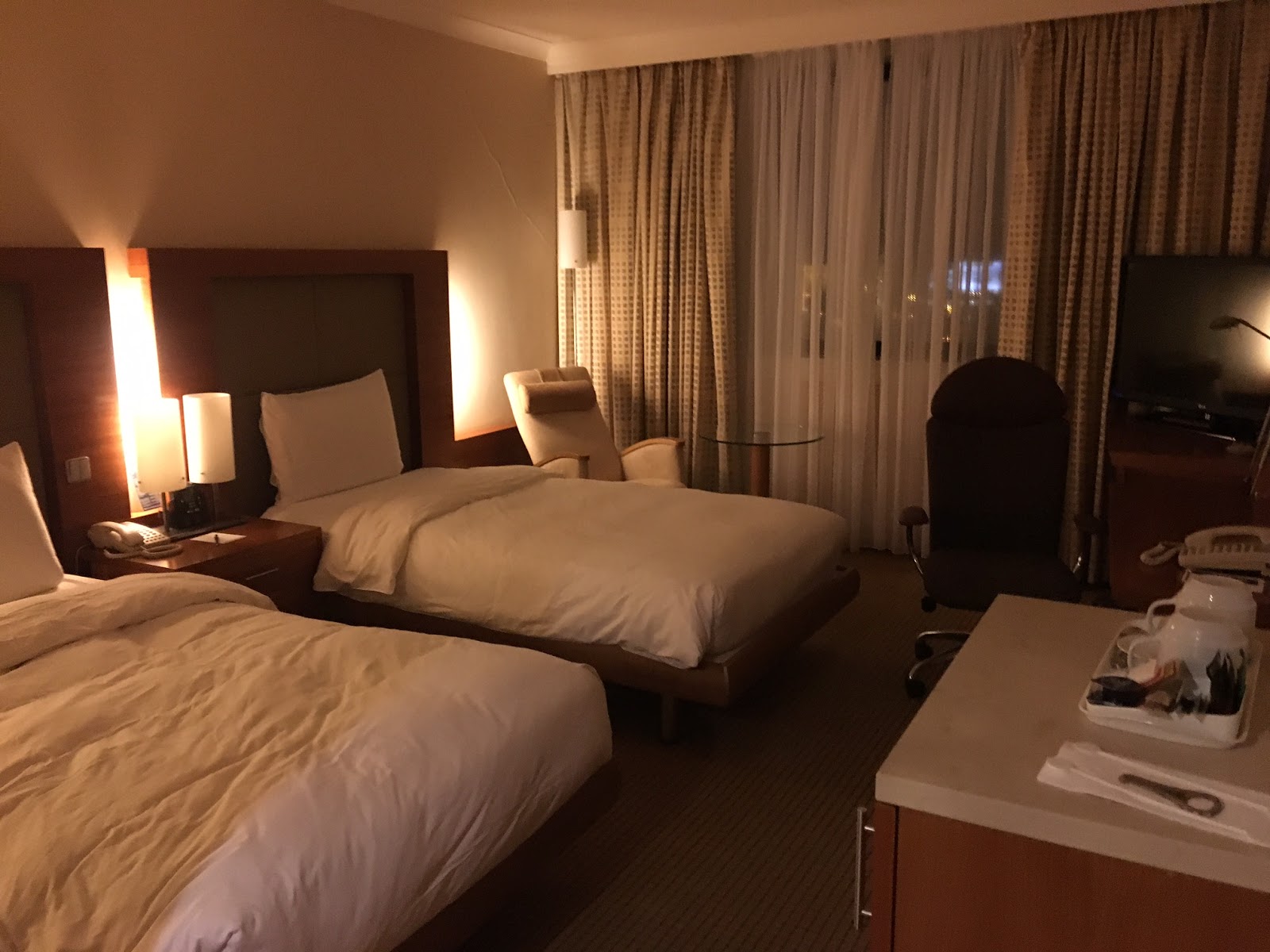
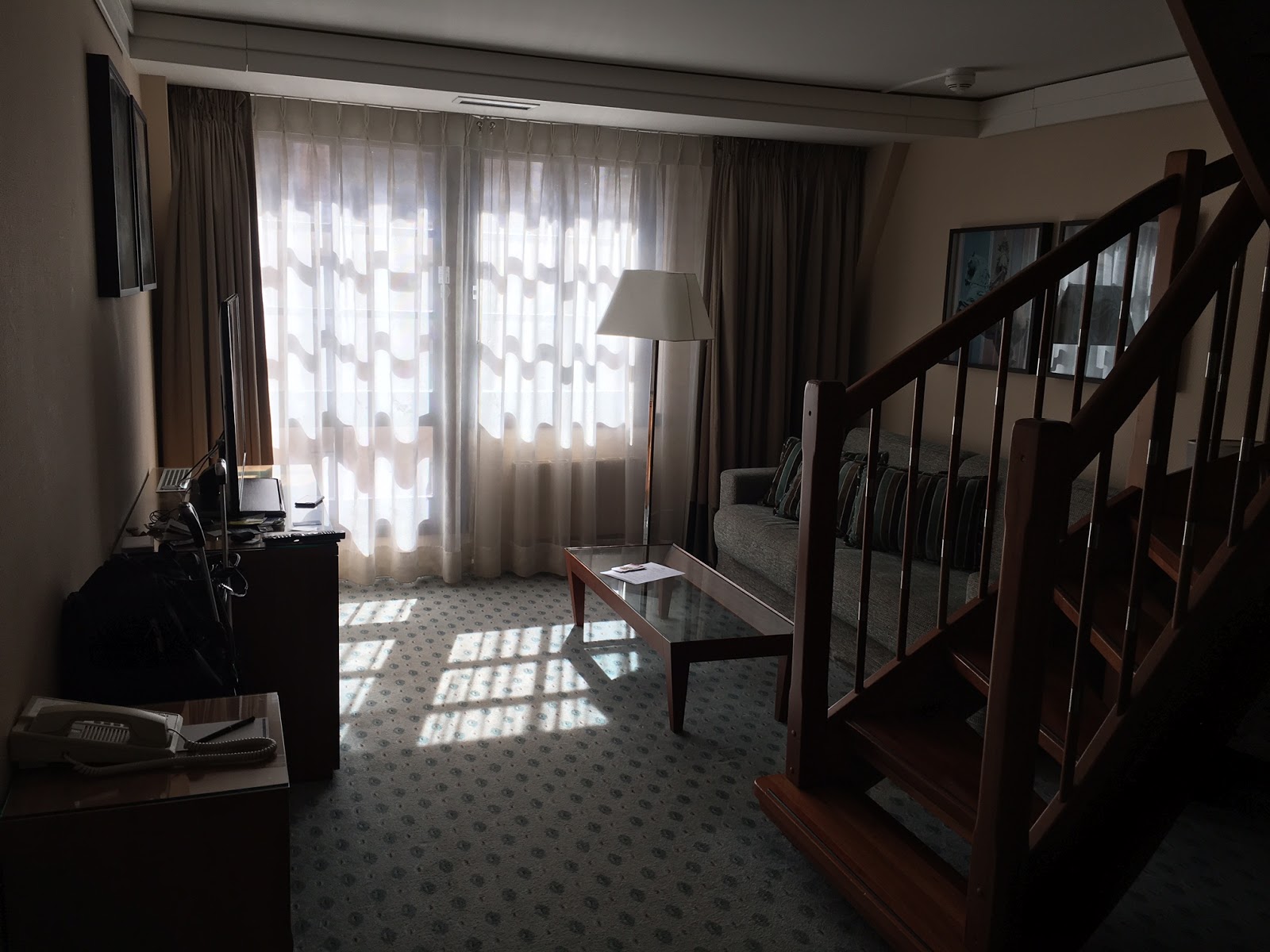
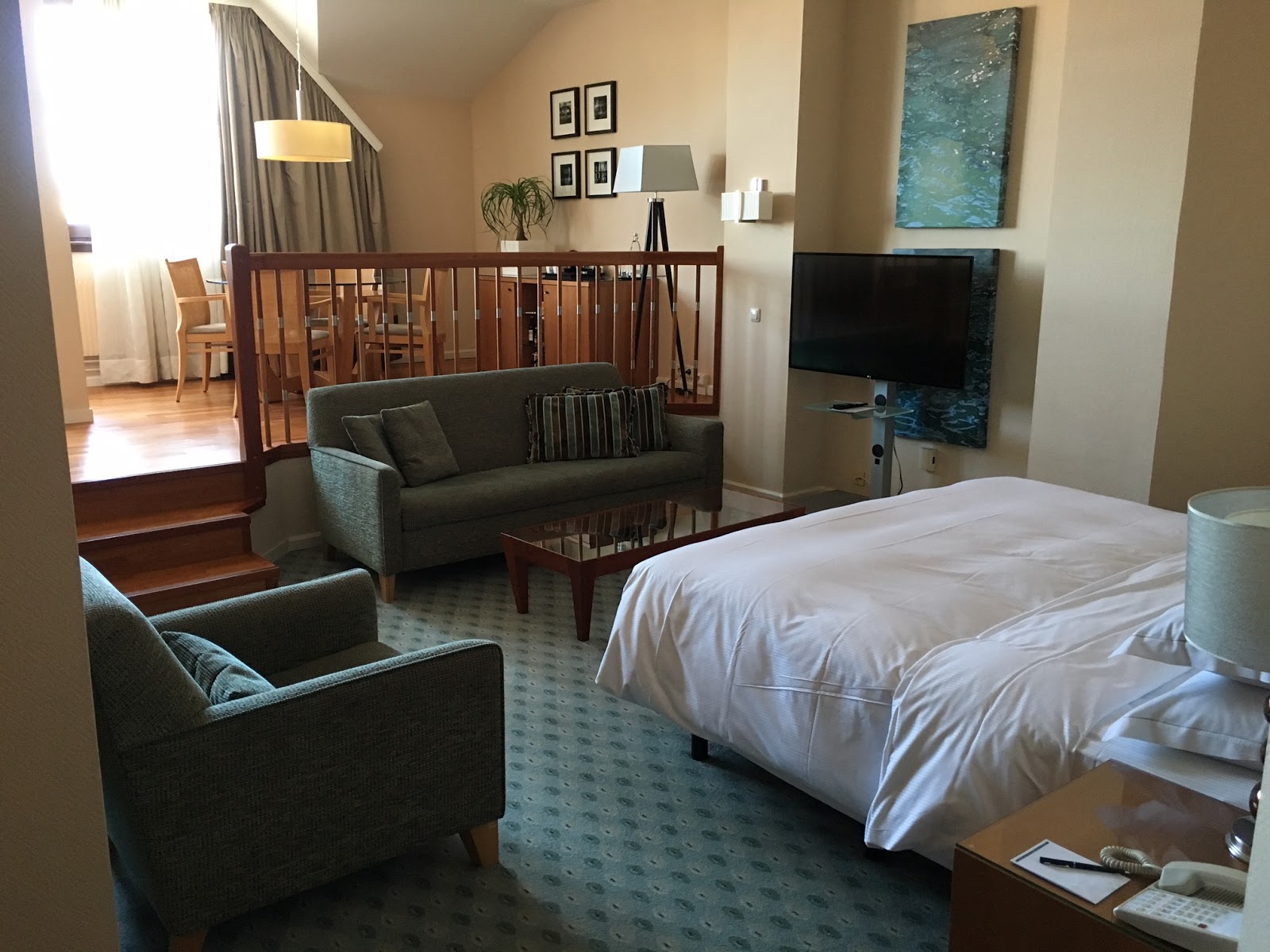
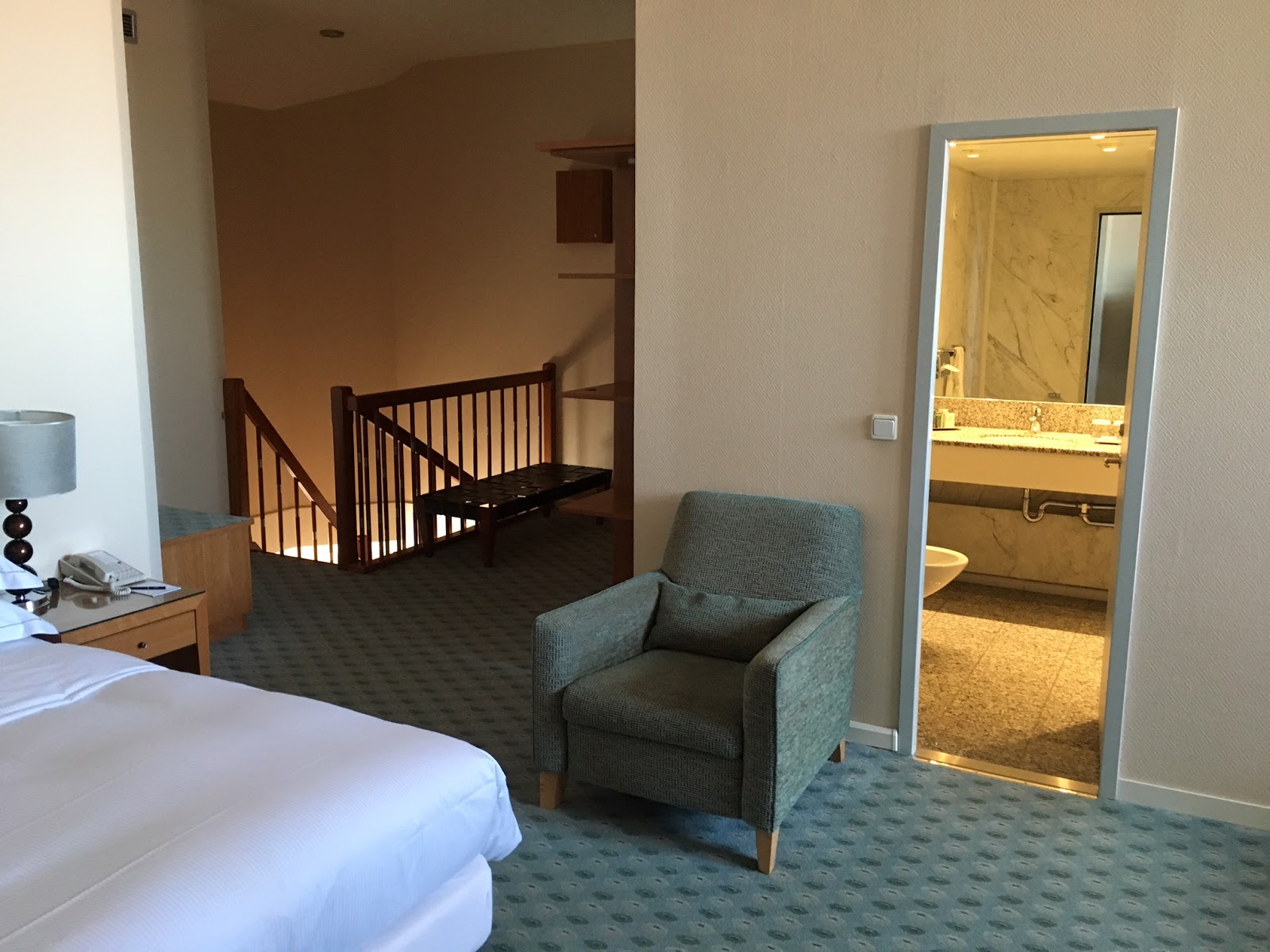
    Sunday morning, on our way out, I remembered to take photos of the room. Dan’s status got us a suite which was nice, but it was hard to get to – you had to take the lobby elevators up to 5, then get off, walk through to another building, then a different set up elevators up to 8.


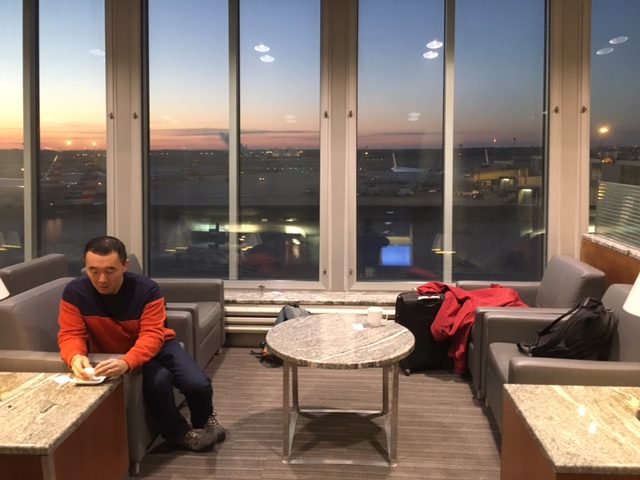
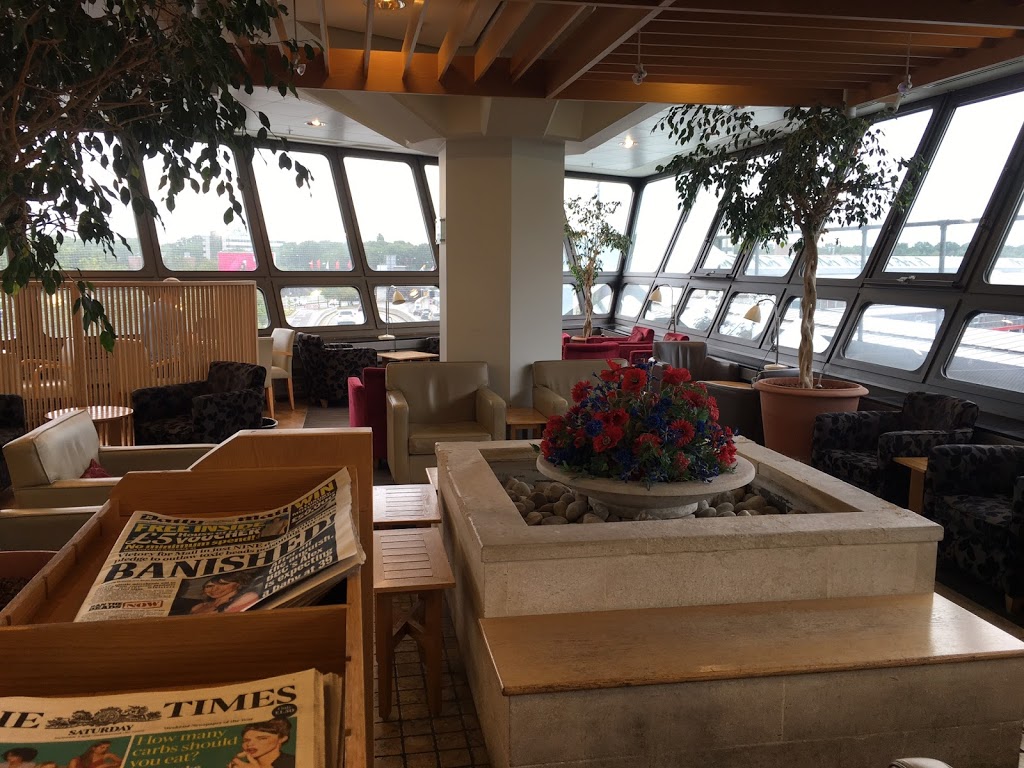
    We left about 6:15 and took Uber to the airport. We went to the lounge and had a bite to eat, just yogurt and a bagel.


    It was a really long lounge!
    My flight was at 8:15 and Dan’s was at 9:30, so we parted after a wonderful three days together. It was a great trip, we LOVED Philadelphia – like we could live here easily – and enjoyed just spending time together. He will come to Sac later in December just before Christmas and we’ll have another 10 days or so, spending half the time here in Sac and the other half in Los Angeles. The next big trip we’re thinking will be late June into early July, and at the moment (this changes from day to day so who knows) it’s 5 nights in Istanbul and 5 nights in Wales. We’ll see how that turns out.


  • Day 2: Friday, 11/25 – More Philadelphia

    Day 2: Friday, 11/25 – More Philadelphia

    I managed to sleep 8.5 hours last night, which I haven’t done probably since our last vacation in August. That caught me up a little from the little sleep I got on the red-eye and seemed to fend off  the cold that kept trying to catch Thursday. That and I’m sure the handfuls of chewable Airborne I’ve taken helped. Dan slept well, too, but was up by 5:30, about an hour before me.

    We went down for breakfast in the hotel about 7am. I look my laptop with me and finished Thursday’s blog, uploading the photos the night before. We had nixed the idea of going to Harrisburg/Lancaster on Saturday because there’s definitely enough to do here and it would just be more relaxing to not get a car and deal with driving. So we spent some of breakfast planning what we would do Saturday.

    I don’t remember what time we left the hotel now but it was early-ish. 9 maybe? It’s Black Friday, biggest shopping day of the year, and we were expecting lots of people out.

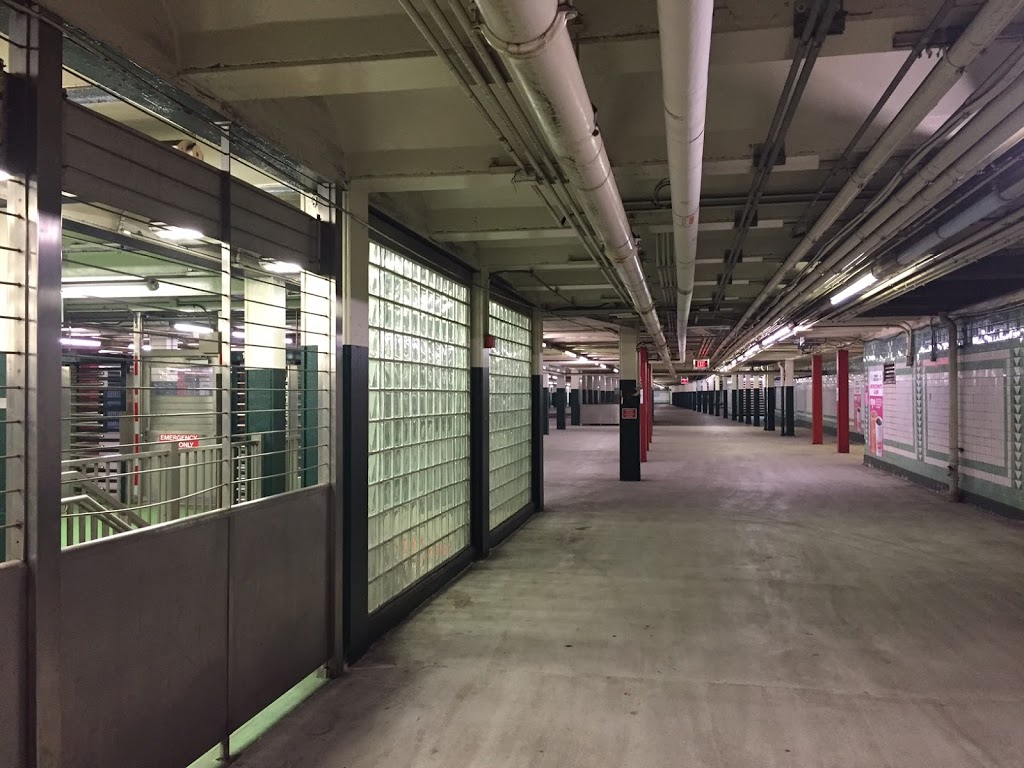
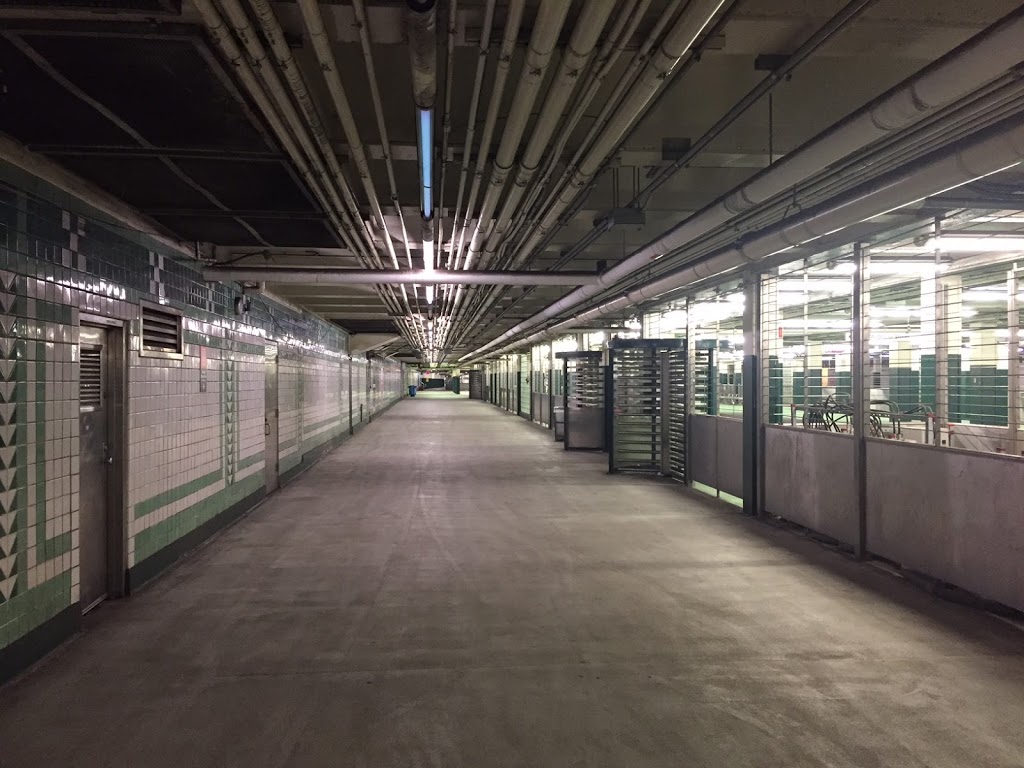
     Imagine our surprise when we went into the subway to buy transit tickets and this is what we saw. It felt like something out of a horror movie. Where the heck are all the people? It was bizarre.

    Our morning plans were really loose: walk around downtown until lunch at the Reading Terminal Market. So mostly we just meandered.

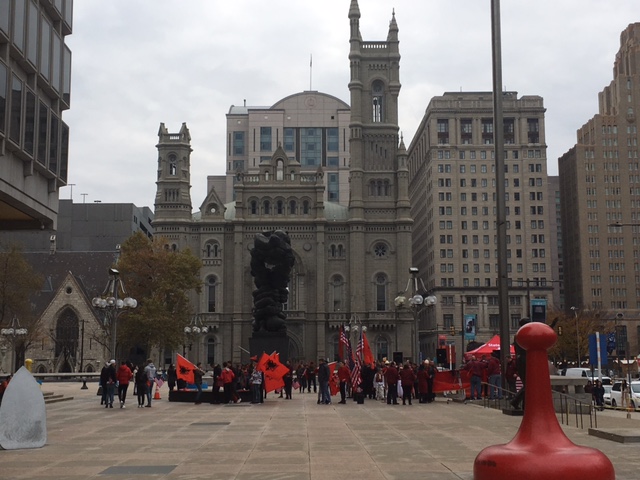
     JFK Plaza and the Masonic Temple in the background. Built in 1873 or somewhere in there.
     Saints Peter and Paul Catholic cathedral, built 1846.
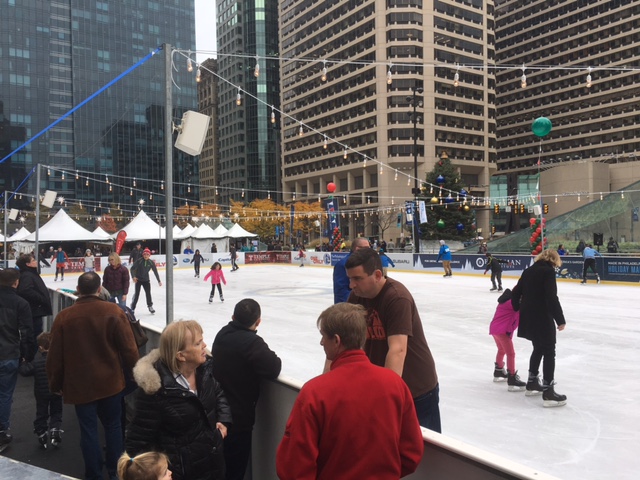
     Dilworth Park in front of City Hall. There were lots of Christmas vendors out, and in ice skating rink.
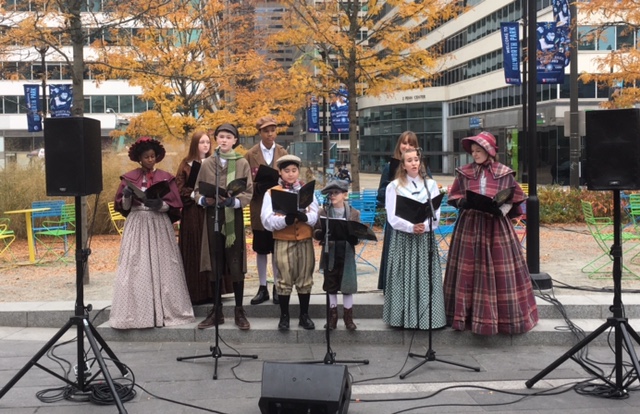
     And carolers!
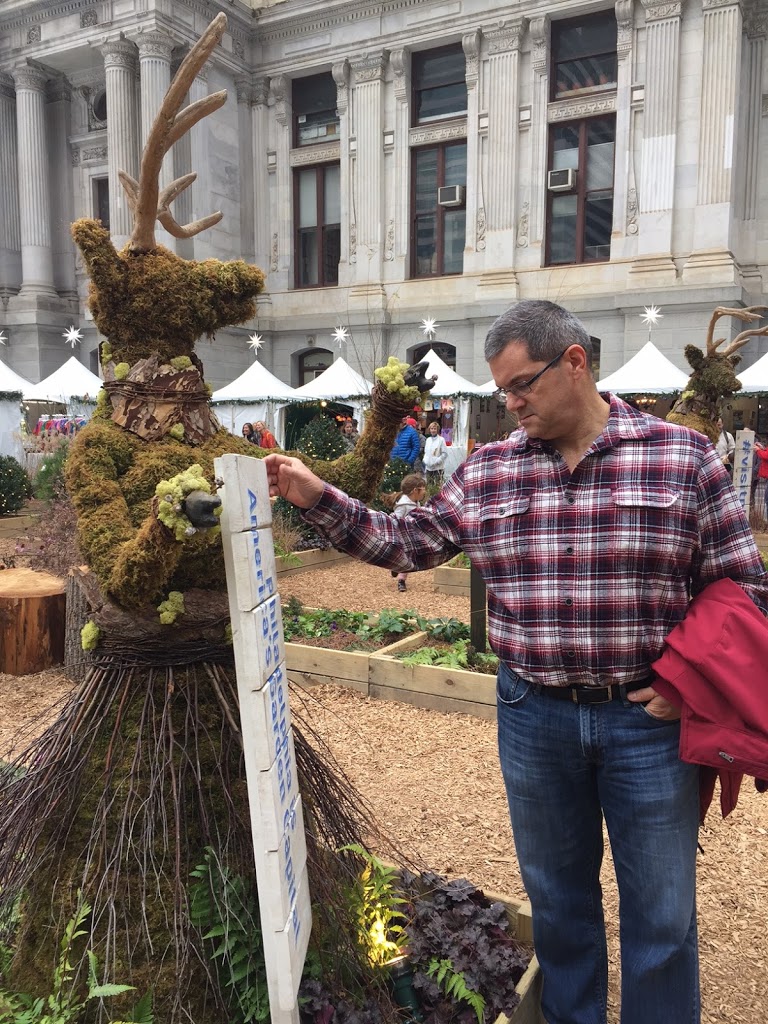
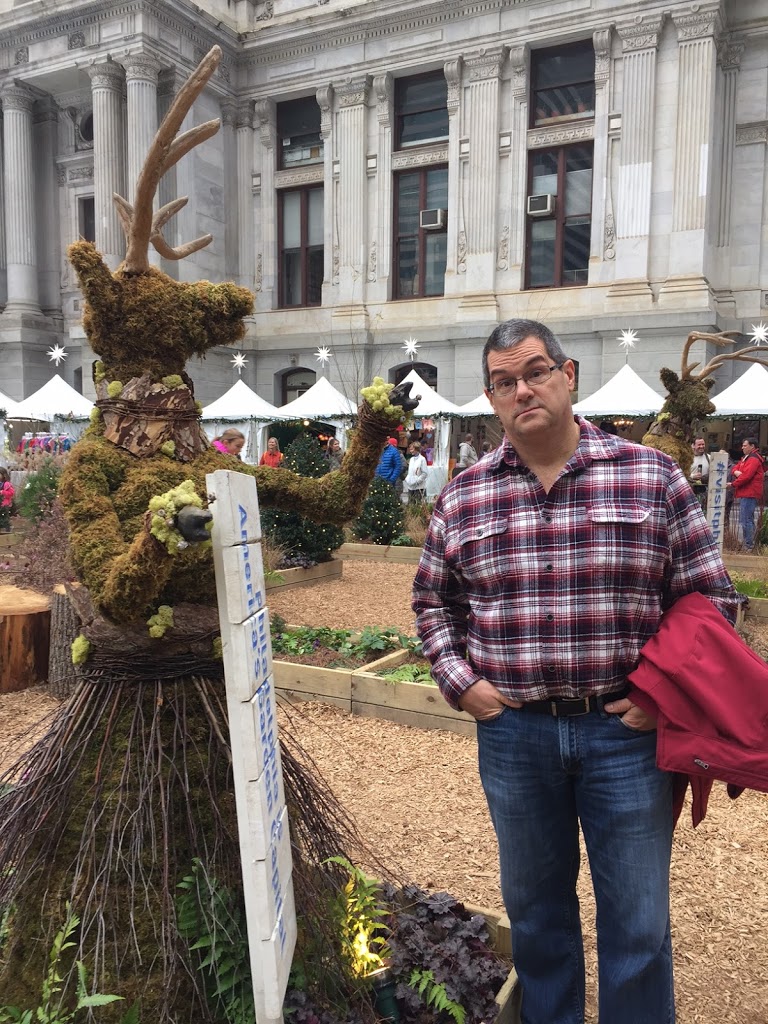
     This was an odd little garden maze in front of City Hall.


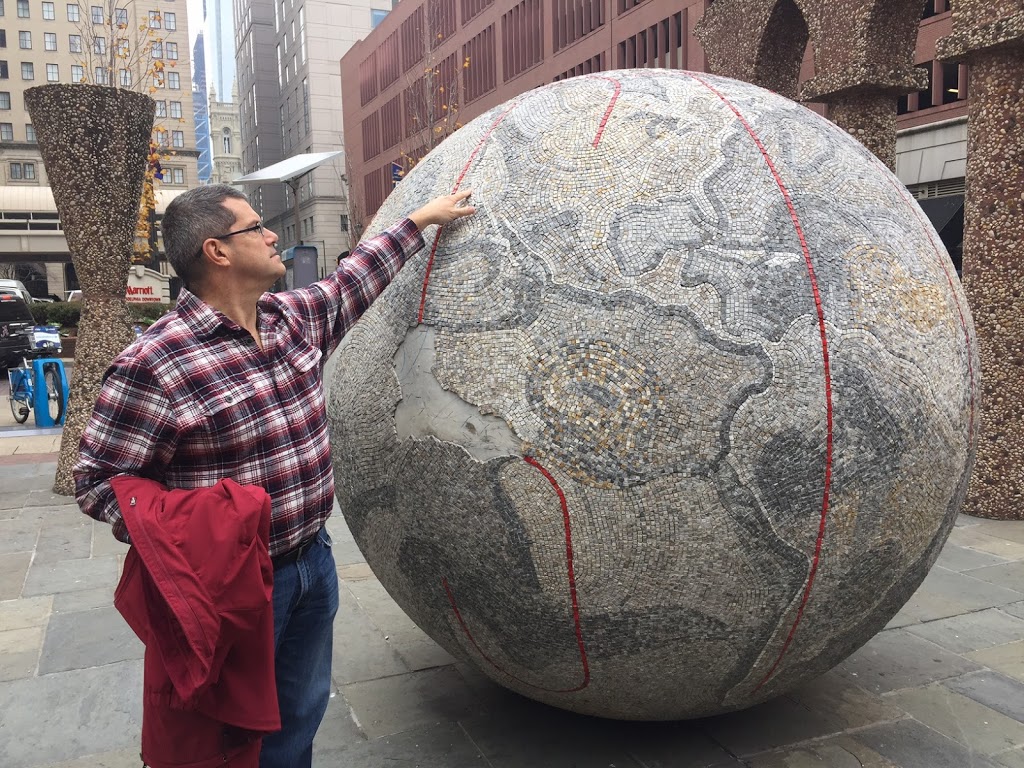
     I don’t remember exactly where this was other than somewhere downtown. It took us a second to figure out it was a globe done is mosaic. I’m pointing approximately Sacramento.
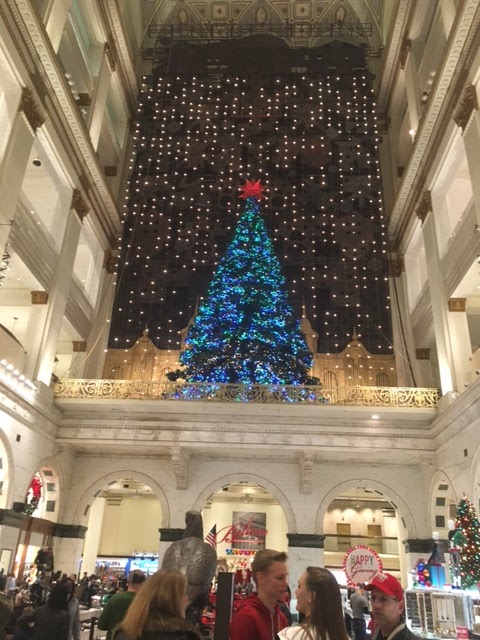
     We ventured into Macy’s just to see if the light show we’d heard about was running. It wasn’t until later, but it would be about here somehow. We didn’t stick around for it. But, from a shopping perspective, it wasn’t the zoo we anticipated.
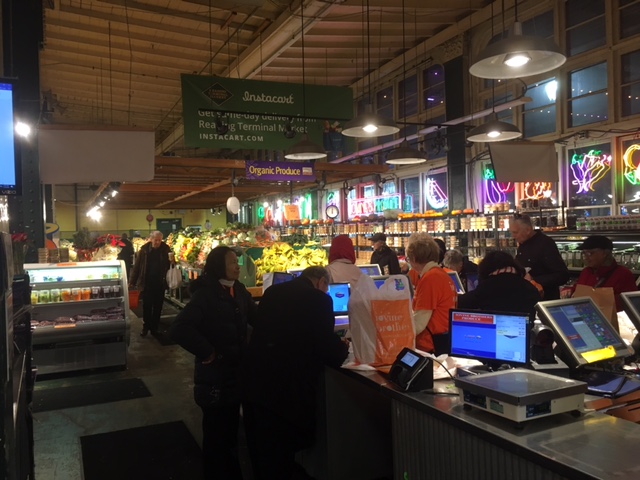
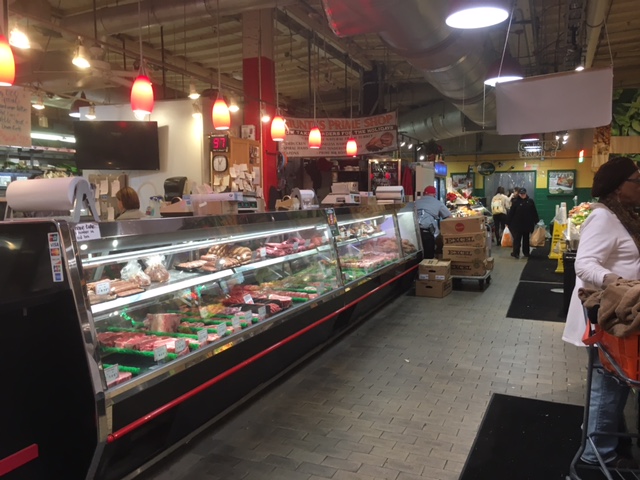
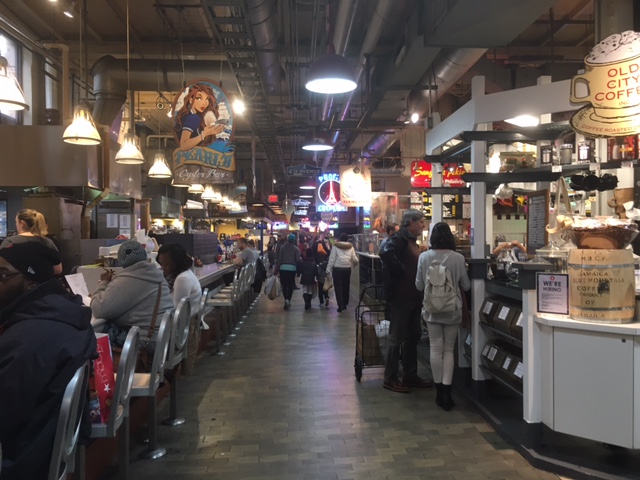
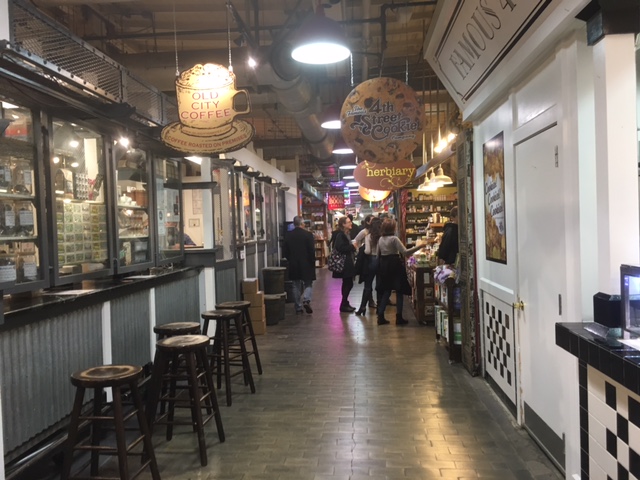
    We wandered into the Reading Terminal Market about 11am. We love markets like this and wish every city would do one. This had a nice and wide range of goodies – produce, meats, seafood, bakeries, candy, and lots of different food vendors.


     The shots above and below were taken from the same spot, and intersection of aisles, at a 90 degree angle.


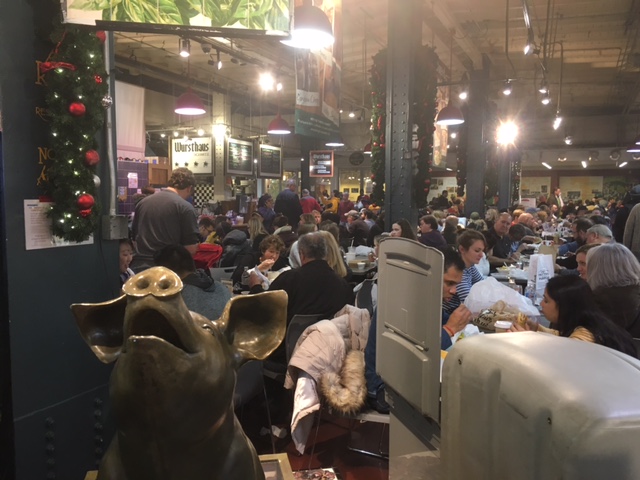
     This was essentially the food court. Remember, it’s only around 11!
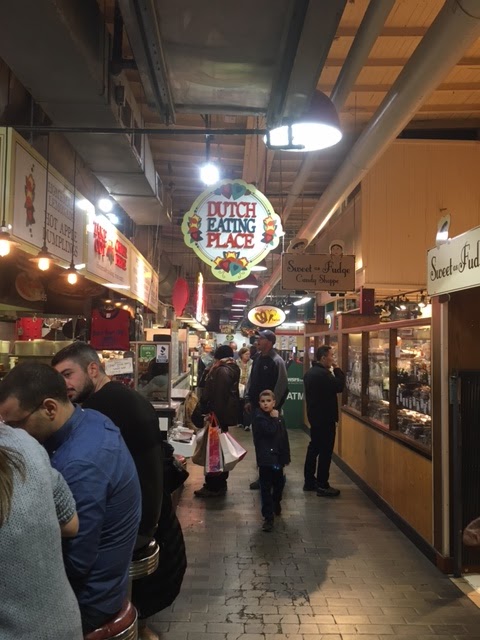
     There were lots of Amish vendors as well.
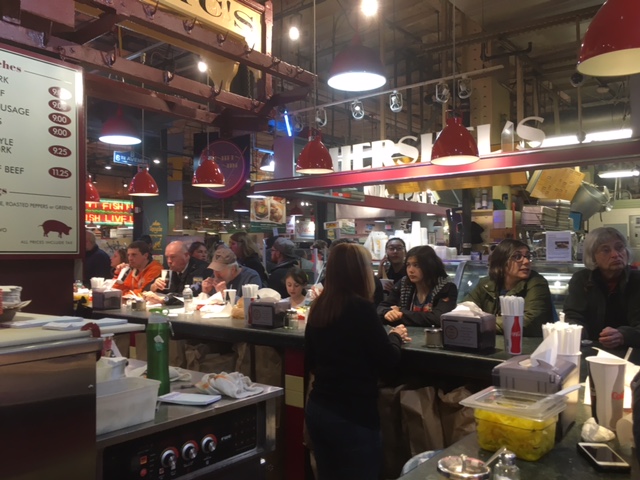
     This is where we stopped for lunch. That’s Dan about to grab a couple of stools opening up. It was a little earlier than we would normally eat, but as soon as we walked into the Market we both got an appetite out of nowhere from the aromas all around us. Plus we had to wait probably 10 minutes for these seats to open up and that would just get worse the longer we put off eating.
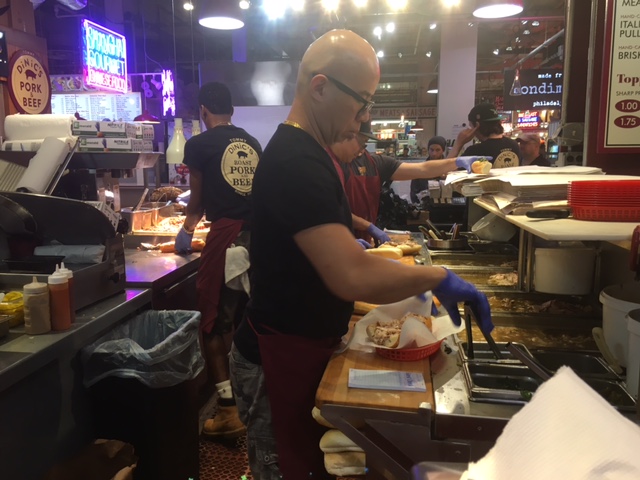
     They had essentially one thing on the menu: a sandwich. Your meat choice was beef or pork. One kind of bread. For an extra charge you could add a sharp Provolone cheese (we did), peppers, or greens. That’s it. That was the whole menu. Simple food done well, people will line up. The seat that opened up happened to be right where the staff were preparing the orders. They were fun to watch and friendly. We also noticed it was a very diverse staff, something we’ve noticed in Philadelphia a lot. A lot like California from that perspective. In several places we’ve read about how Pennsylvania was founded by Quakers with a focus on religious freedom and equality, and have seen that theme play out in many ways still.
     There was a to-go line that doubled behind the folks on the stools all around the counter. This was #18 of all restaurants in Philadelphia on TripAdvisor.
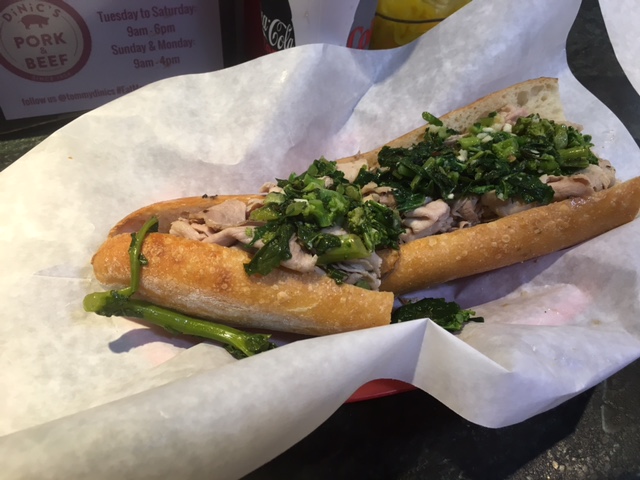
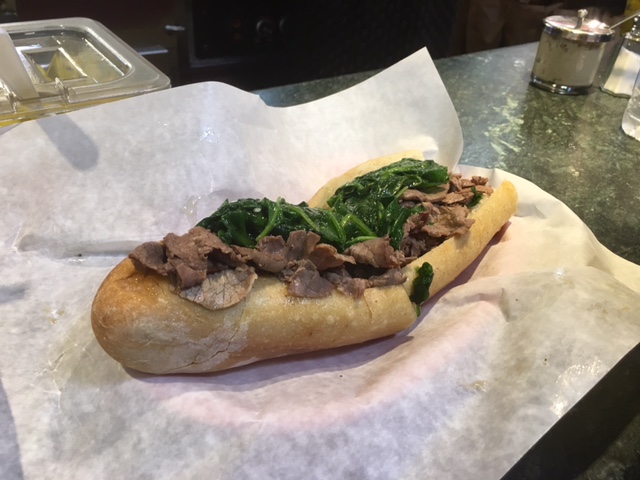
     We got one each and split them. Above is the pork with broccoli rabe, below is beef with spinach. We both liked the beef better. And I decided I didn’t care for the sharp provolone. I generally like sharp cheeses – and didn’t know provolone came that way – but this had an edge to it that I didn’t care for. Dan liked it fine.

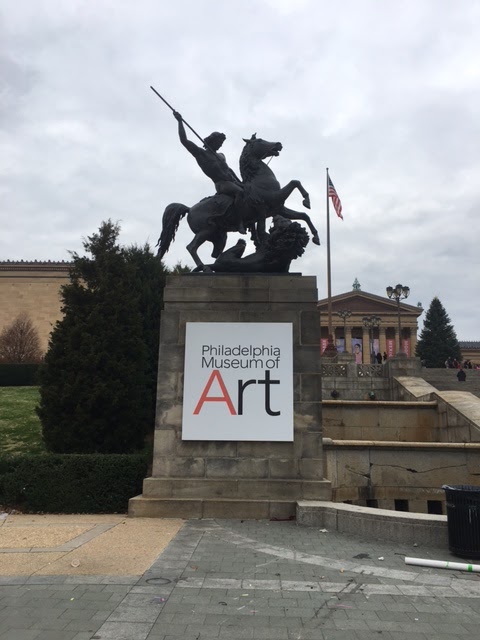
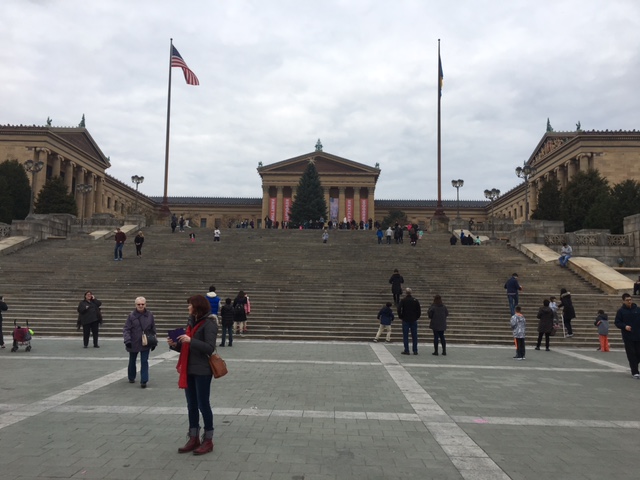
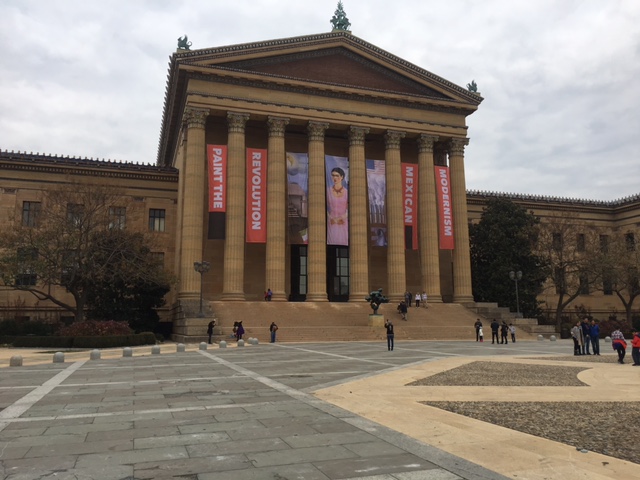
    We left Reading Terminal Market around 12:15 and took a bus to the Philadelphia Museum of Art. This is the #1 thing to do on TripAdvisor’s list. This is an excellent museum and deserves the rating. Although I have a feeling some of the rating has something to do with an item I didn’t know about until I got there, that has nothing to do with art. Do the steps below look familiar to you at all? Made famous in a certain movie in 1976?


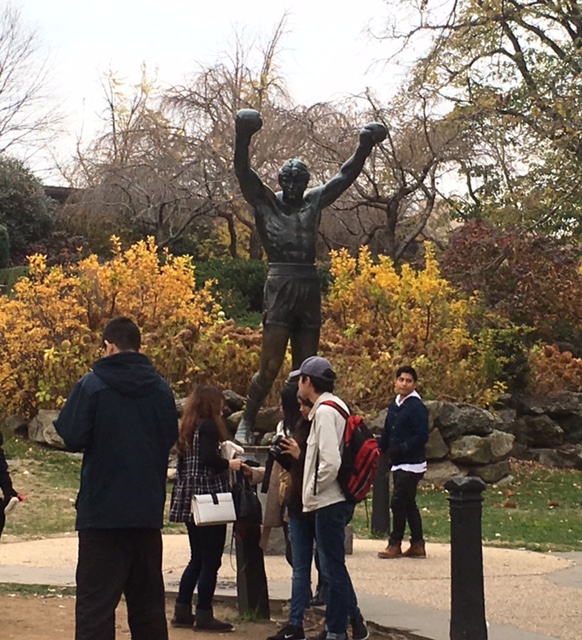
     These are the steps that Sylvester Stallone ran up at the end of the famous theme during the movie Rocky. There’s a statue of him to the right of the museum commemorating that. And people literally line up to take their picture with it, as seen below.


     It’s also apparently a thing to mimic the movie and run up the stairs, throwing your arms up in victory when you get to the top. LOTS of people were doing this. And we noticed later, that many of those folks never made it into the museum. Lots more people around the top of the steps than there were walking into the museum, or so it seemed. (We passed on the running.)
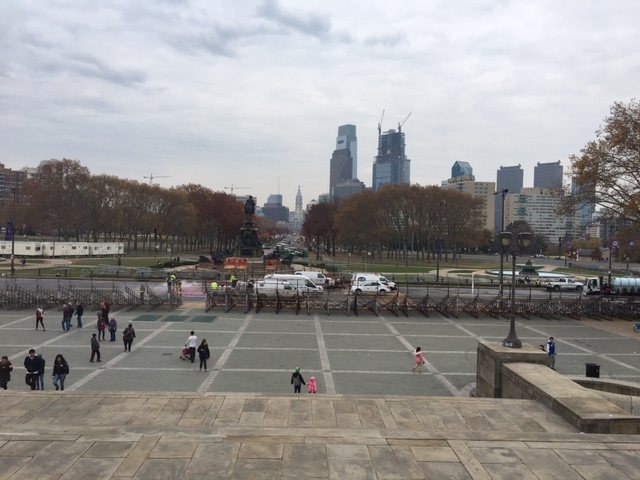
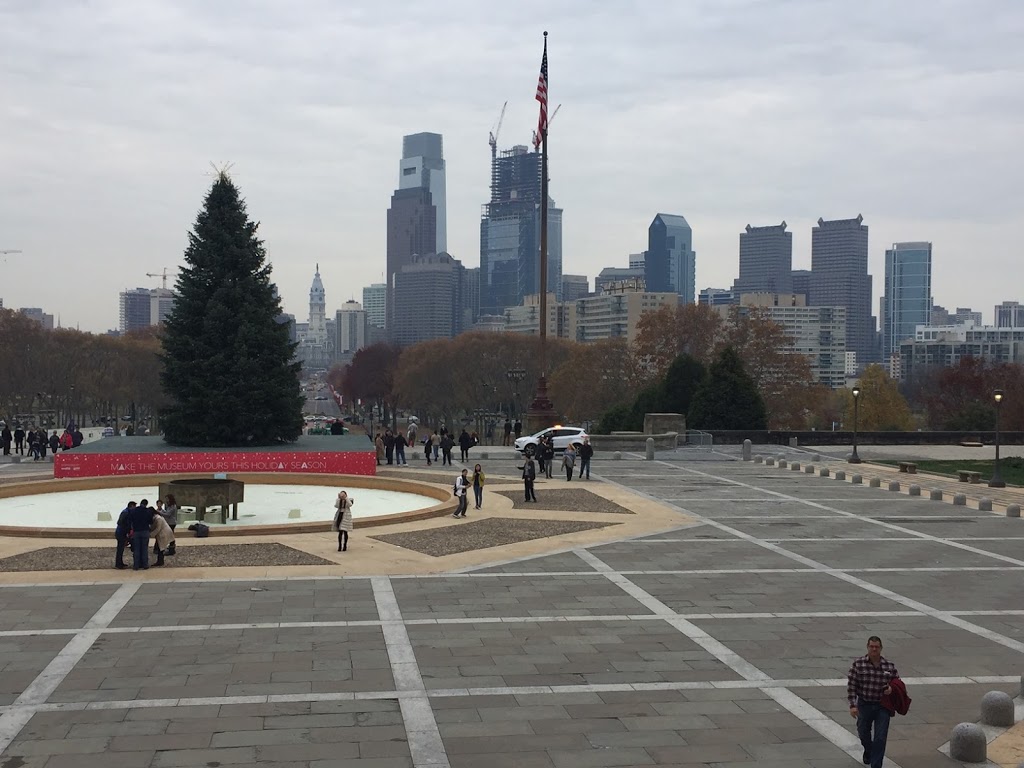
     There is a great view from the top, including City Hall dead center. That’s Benjamin Franklin Parkway that connects this to City Hall.
     Where did they all go?
     The view was even better from the top of the museum steps with the Christmas tree worked in. That’s me walking up on the bottom right. I had just taken the photo below, of Dan about to take this shot. He’s standing next to the fourth column from the left .


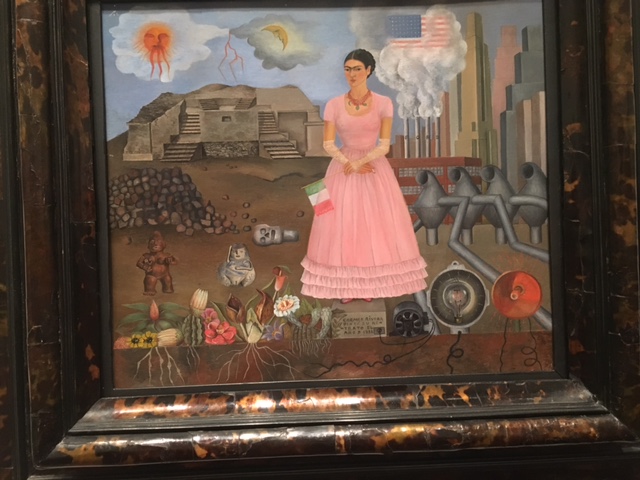
     The special exhibit was on Mexican artists from the early 20th century, with a focus on the Mexican Revolution. This was Frida Kahlo’s first self-portrait, and generally understood to be the one that launched her professionally.
    This is a piece by Diego Rivera. (Diego and Frida were married from 1929-1939.)
    This is Frida’s representation of the clash between tradition and modernity, which she framed based on her experience in the US and a clash between indigenous and industrial cultures. The US is to the right, Mexico to the left, with her standing between each
    This is her more scathing version of American modernity, with symbols of industrialized production, waste, misery, and an oppressed populace. Note that this was from the early 30’s, so during the Depression.
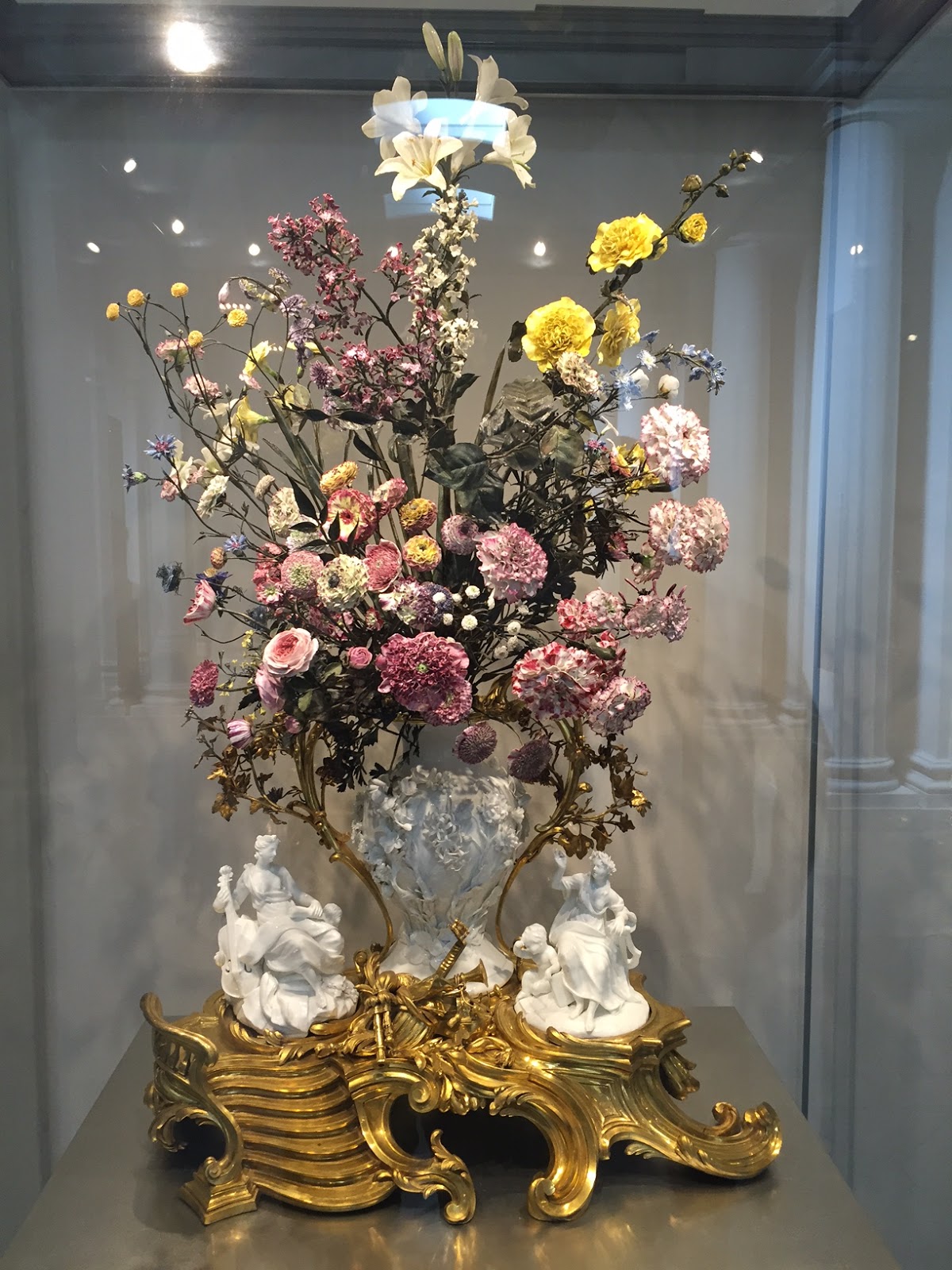
    We left the Mexican exhibit and went into the hall on American art. Somehow, neither one of us took many photos although we enjoyed it. There were portraits of famous people and American scenes, but also a lot of furniture and silver, which we appreciate but are never moved to photograph for some reason. Just the one photo of the flowers from this exhibit.
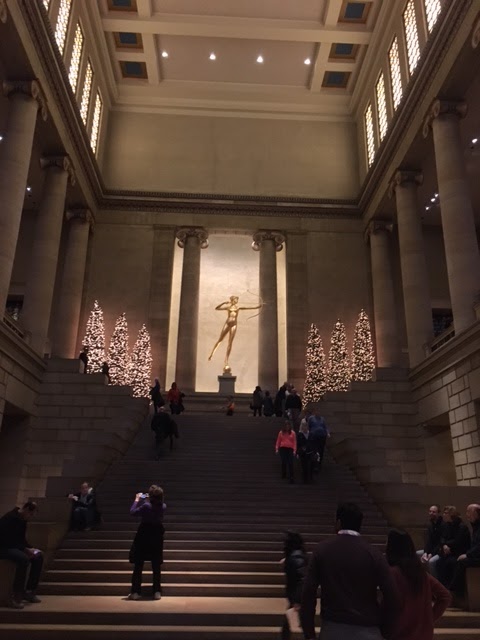
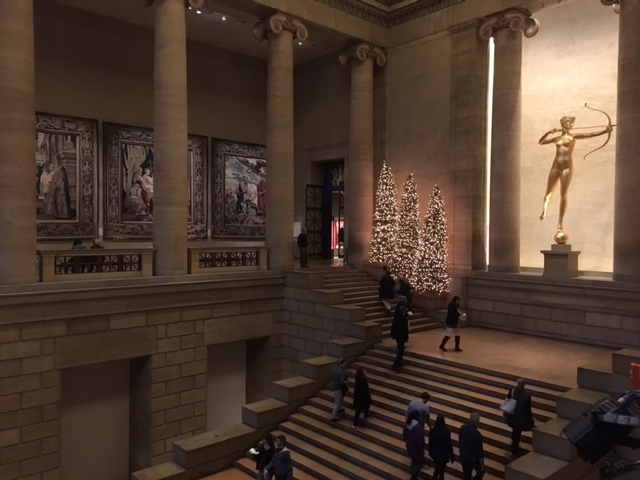
    The Grand Stairs in between the two wings.
    We passed on Asian art, and European art from 1100-1500. We know both of those well enough to know we didn’t need to see anymore. We were going to pass on European art all together, but had to walk through a section to get to the Modern section. (Which I was ready to pass on but Dan decided we needed the amusement, and there was a lot of it.) As we were walking quickly through the main hallway, something caught our eye on the right.


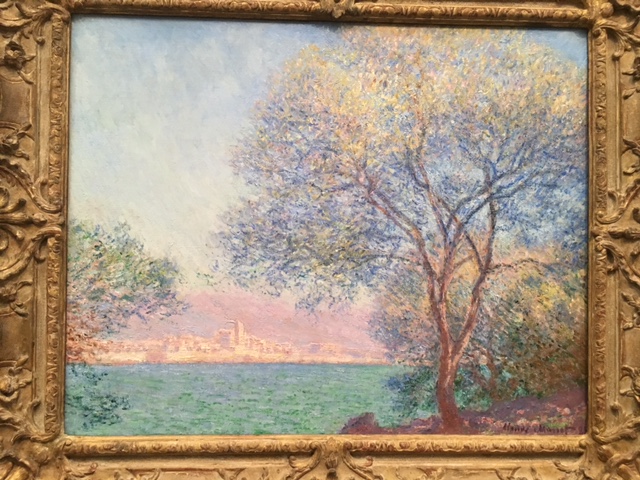
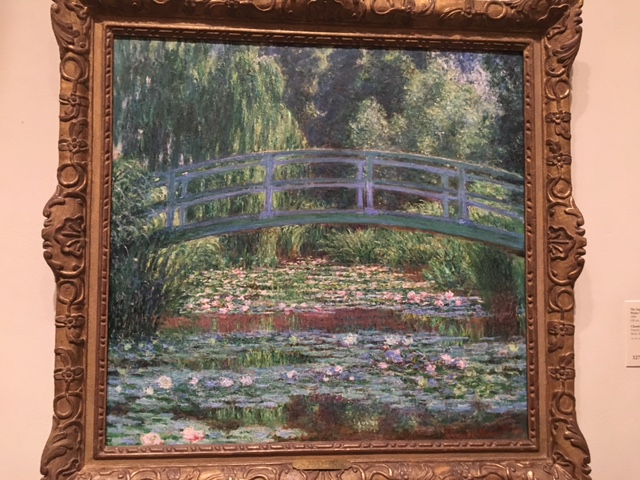
    We were like “uh, this is a Monet, what is this doing here?” I don’t know why I wasn’t expecting to see this; what surprised me most of all were how many there were. LOTS of Monet’s, in fact I don’t think I’ve seen this many in one place since the d’Orsay in Paris. As well as some Cezanne, Renoir, Gauguin, and Manet.
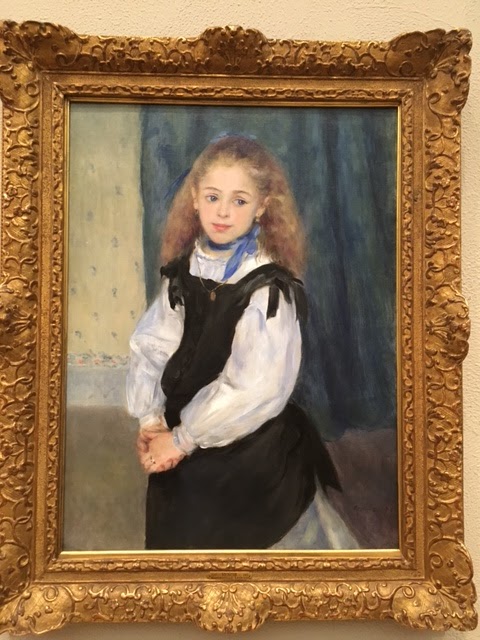
    Renoir
    More Monet
    And more Monet. He’s always been my favorite.
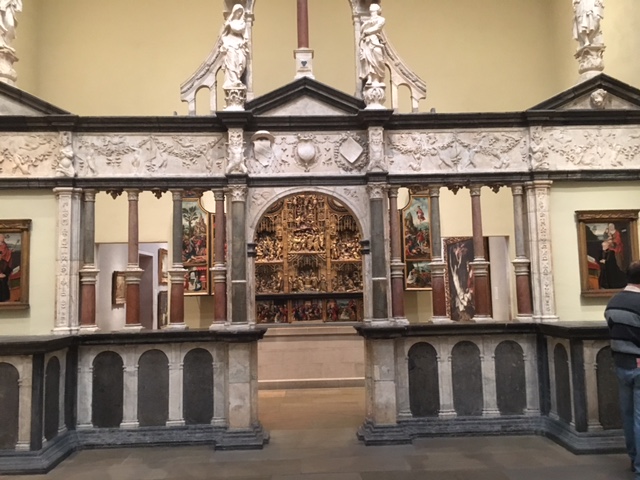
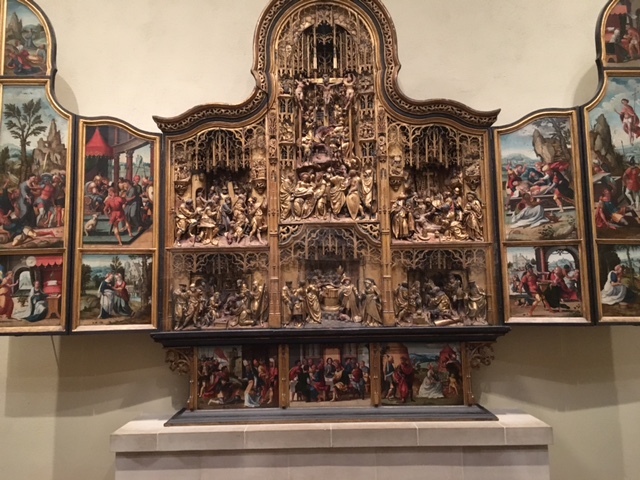
    We walked into this room which was a complete reproduction of a side altar from this period, which I correctly guessed was from Antwerp. We’ve seen a bunch of this stuff over the years, but usually it’s just the altar piece as below.


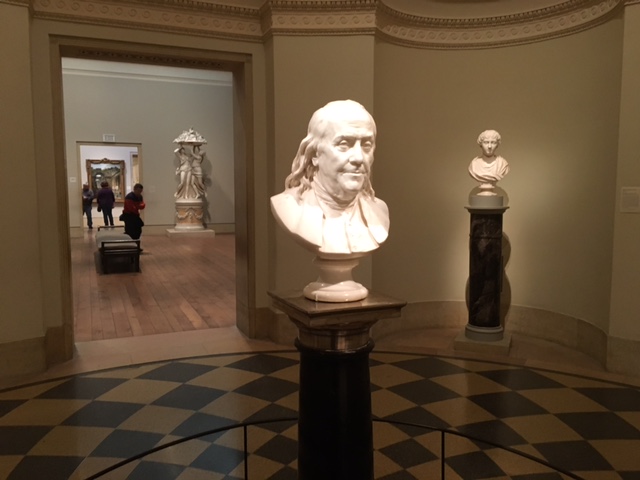
    Guess who? Richmond was all about Thomas Jefferson; Venice all about Mozart; London all about Churchill; Paris all about Napoleon. This town is crazy for Ben.
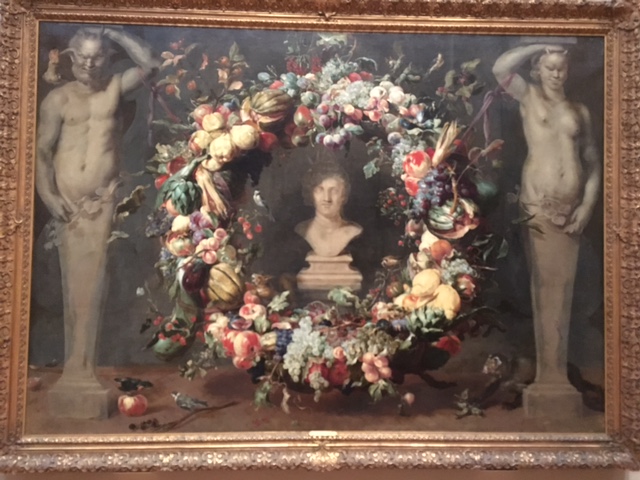
    While it didn’t show well in this photo, the colored wreath over the monotone background had a 3d effect that was trippy.
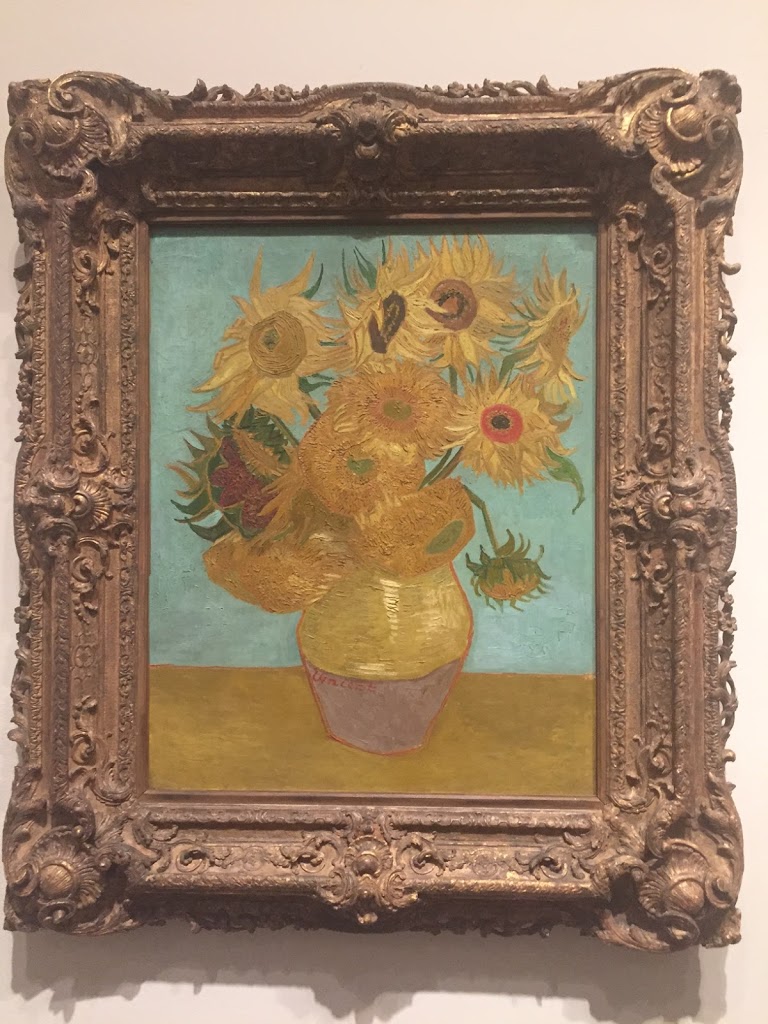
    Van Gogh
    We have entered the Modern section and will start with a few that we liked. The above artist is Wolfgang Paalen from Austria. Combat of the Saturnian Princess II. Dan liked the morbid and depressed sense of it. This was a painting of nightmarish conflict the artist completed just before leaving Europe on the eve of World War II.
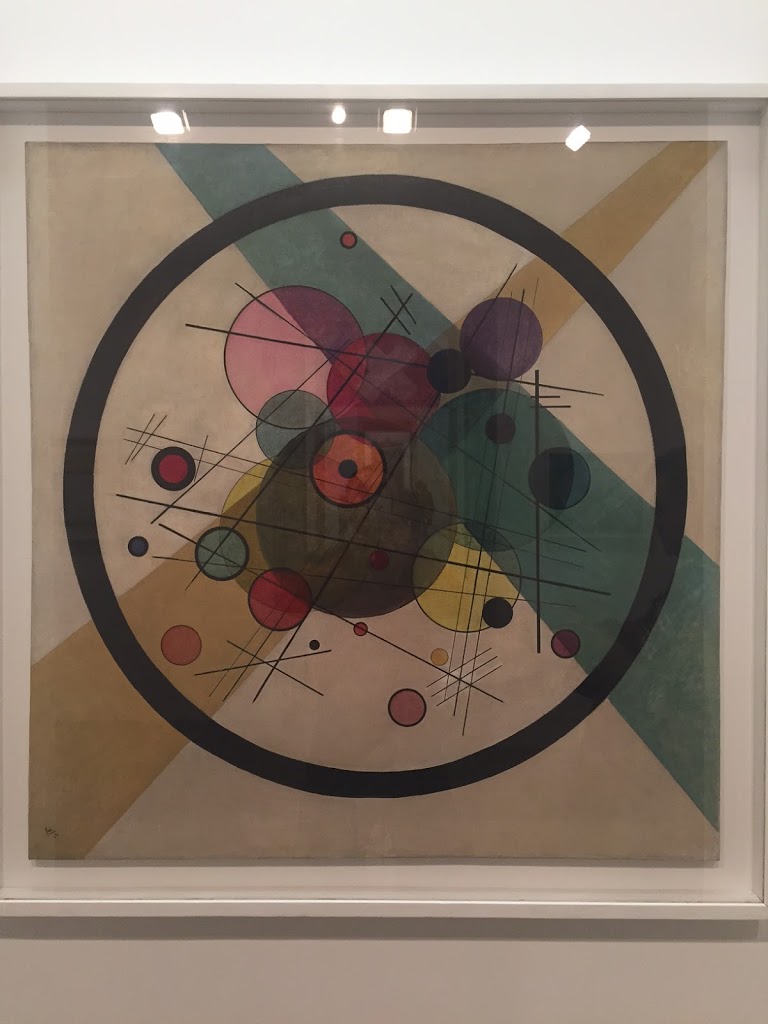
    This is one of the first items we saw in this section, a piece by Kandinsky, an artist Dan likes.
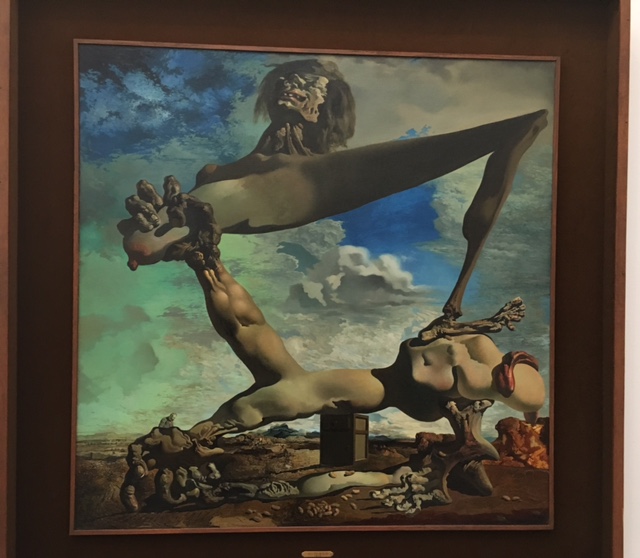
    Dali. Both Dan and I separately took photos of this so we must’ve liked it.


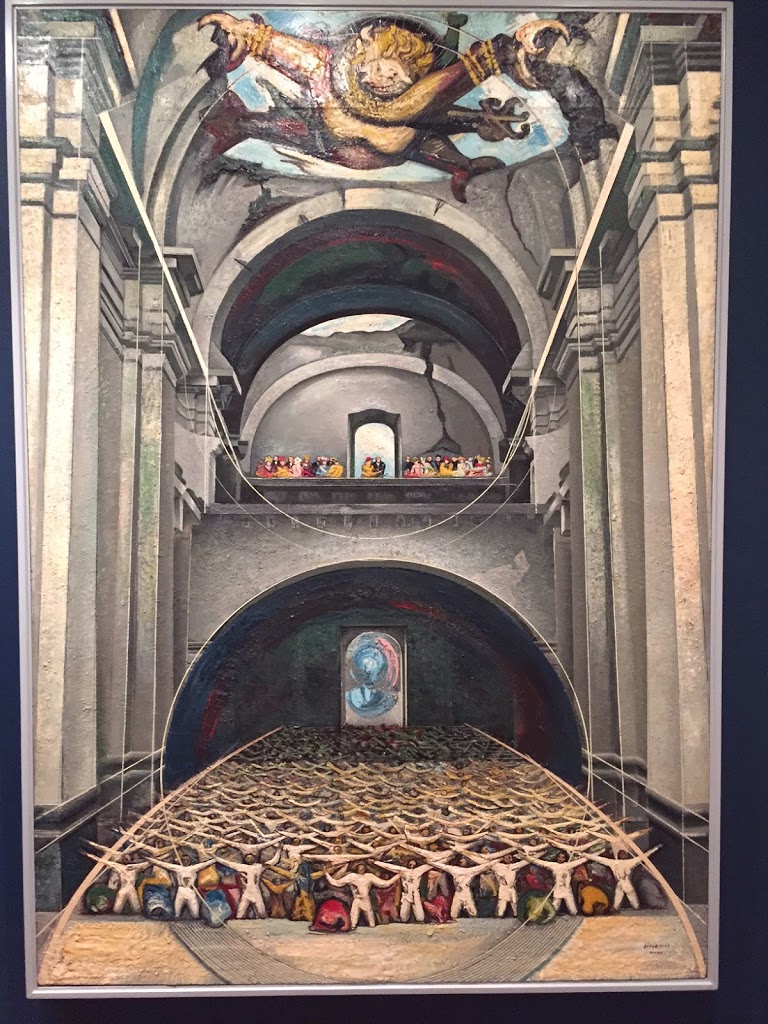
    This is called Devil in the Church, by an artist named David Alfaro Siqueiros.
    And now we enter the amusing portion of our tour. If you’ve been following us, you know we have this love/hate relationship with modern art. Above was the love. Now we get into the hate.
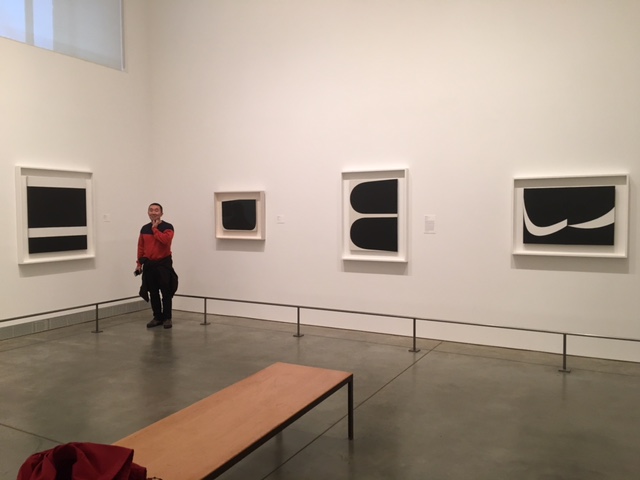
    We walked into this room and literally both started laughing. This represents everything we hate about this particular brand of modern art, which Dan describes as “if I can do it, it doesn’t belong in a museum.” Dan’s expression is even “on no, here we go…”
    See the video here in order to see the next room. When we first walked into this room we thought “oh no, not again” and thought it was the now famous (well, infamous to us anyway) room we encountered in The Hague, Netherlands, that was full of nothing but plastic wrap strung up from the ceiling. This wasn’t quite as bad, but just as pretentious. It’s what we perceive as the pretentiousness of it all that gets us. This was essentially a study of movement of the human form, all videos of the artist, loftily described as similar to the poses and counter poses that ancient Greek artists used in their sculptures. Yea, sorry, not even close.
    “With objects.” So no attempt to even connect the specifics with the art. What’s the point?


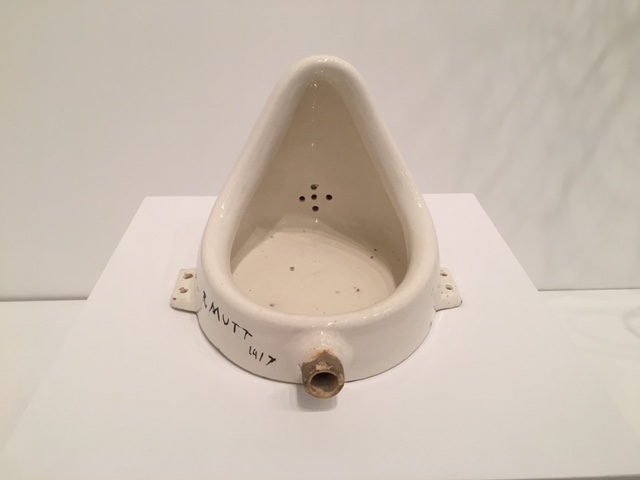
    “The Fountain.” Yea, no, I don’t think so….


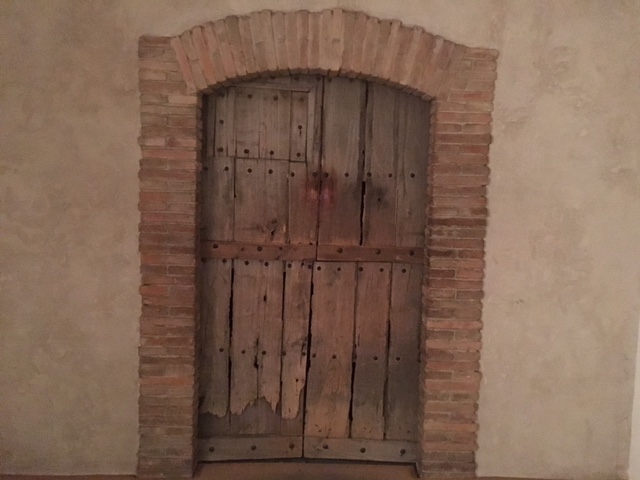
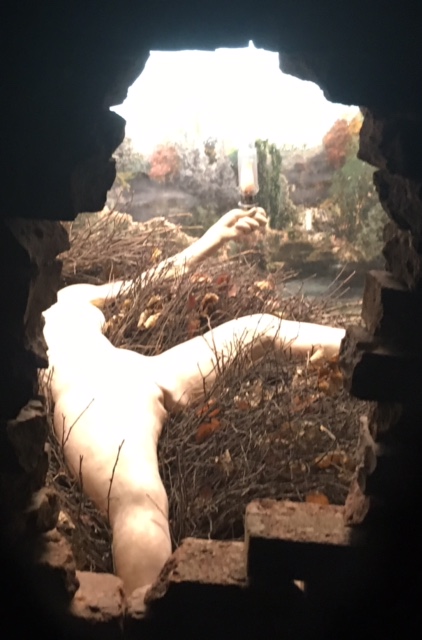
    This at least made us laugh. Hard. This door in the wall was in an empty side room all by itself. Somehow you could see the holes in it and were drawn to look to see what was on the other side. When you got to it, you were treated to the image below. Consider yourself warned.


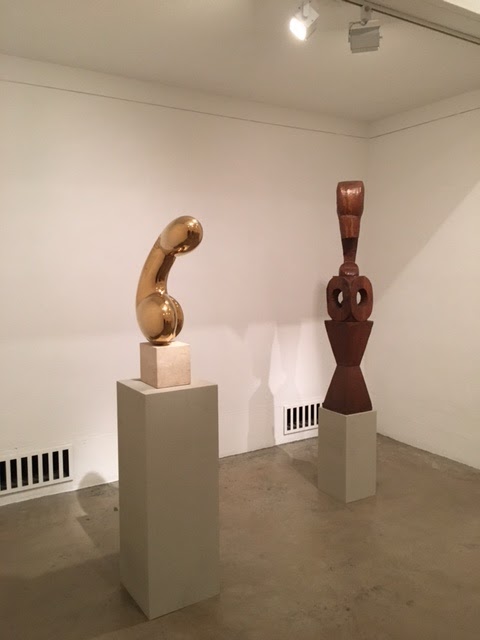
    As we were going through this section we were keeping score of the number of phallic symbols but eventually lost count. This one on the left took the prize though for most obvious. It’s title? “Princess X.” Hmmm.
    But the funniest thing of all was this guy, drawing the object to the left of the above Princess X. Everything about him screamed “you are everything we hate about modern art.” Definitely not the dude we want to get stuck with at a party.
    The Grand Stairs from the top as we headed out. We spent about 2.5 hours here.
    Overall we were very impressed with this museum. And were thrilled that they honored our Crocker membership as part of their museum reciprocal, although at first it didn’t look like they would. That got us out of a $20/each ticket cost. Score! It would still have been worth it to pay it though. That ticket also got us into several other things that were part of the Philadelphia Museum of Art system. We could have gone to the Rodin on the same ticket but passed since we’ve been to that museum in Paris. Instead we went to a little house that’s been preserved from the mid 1700’s on the north side of town. It was about a 15 minute bus ride away.
    The house is located in Fairmount Park, which is huge. This is a Civil War Memorial in the park.

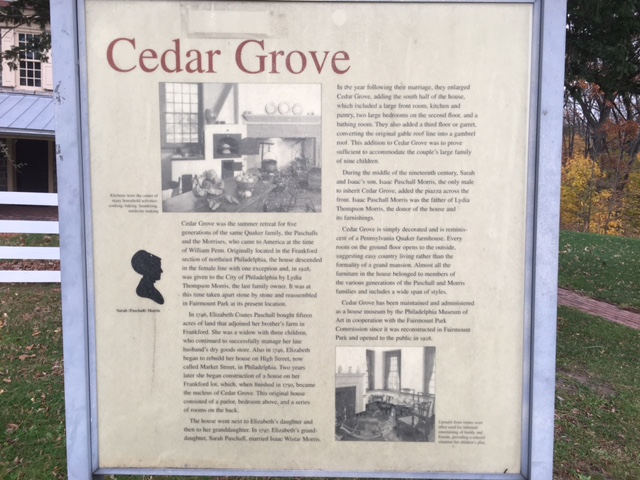
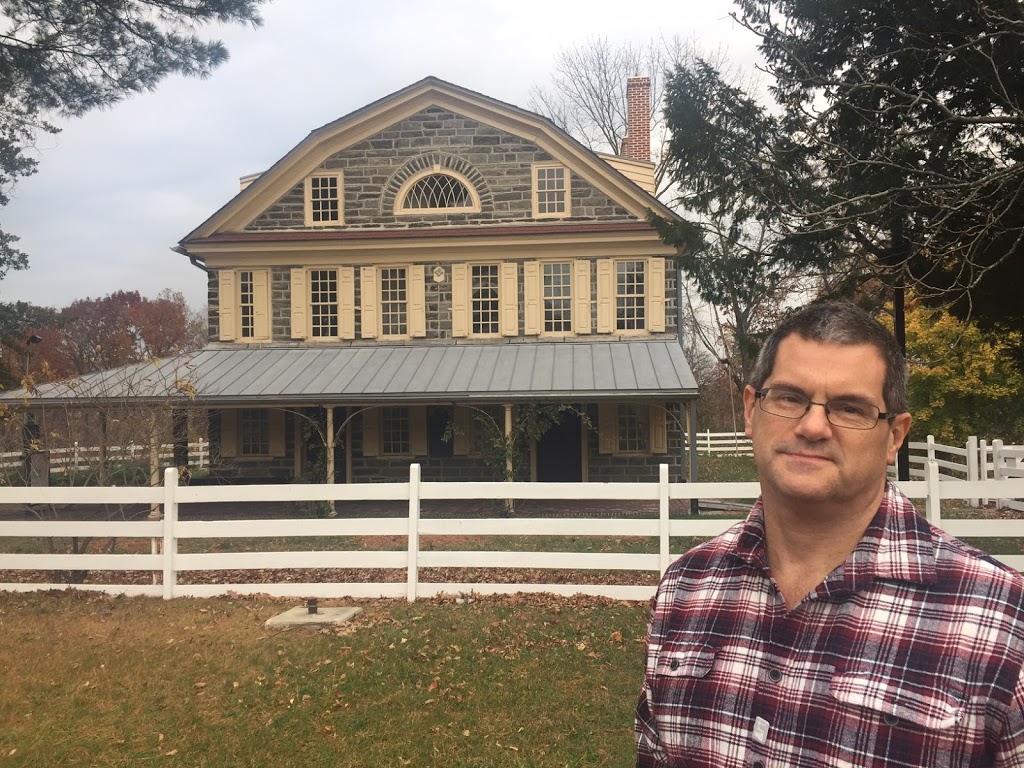
    The house is called Cedar Grove. It belonged to the same family for 5 generations. The last owner bequeathed it to the city on the condition that it be moved to a location that would keep it away from the bustle of city life, and that it would be open to the public. We didn’t get any photos inside because it was sort of dark and we just weren’t thinking of it. But it was fun to see how folks lived 250 years ago in this country, something you don’t get to see very often. We were there around 30 minutes, then took the bus back into town.


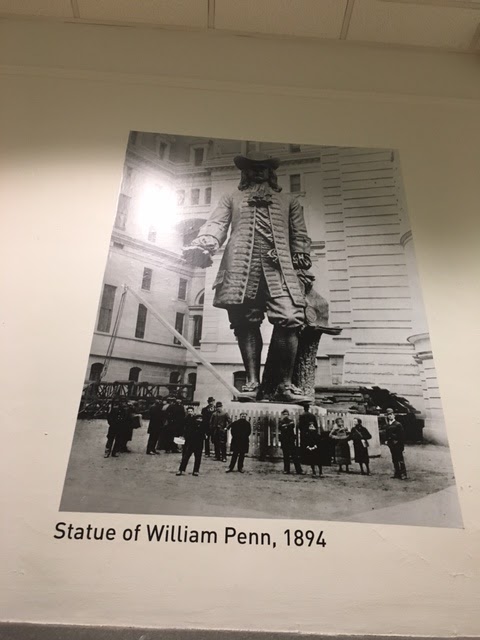
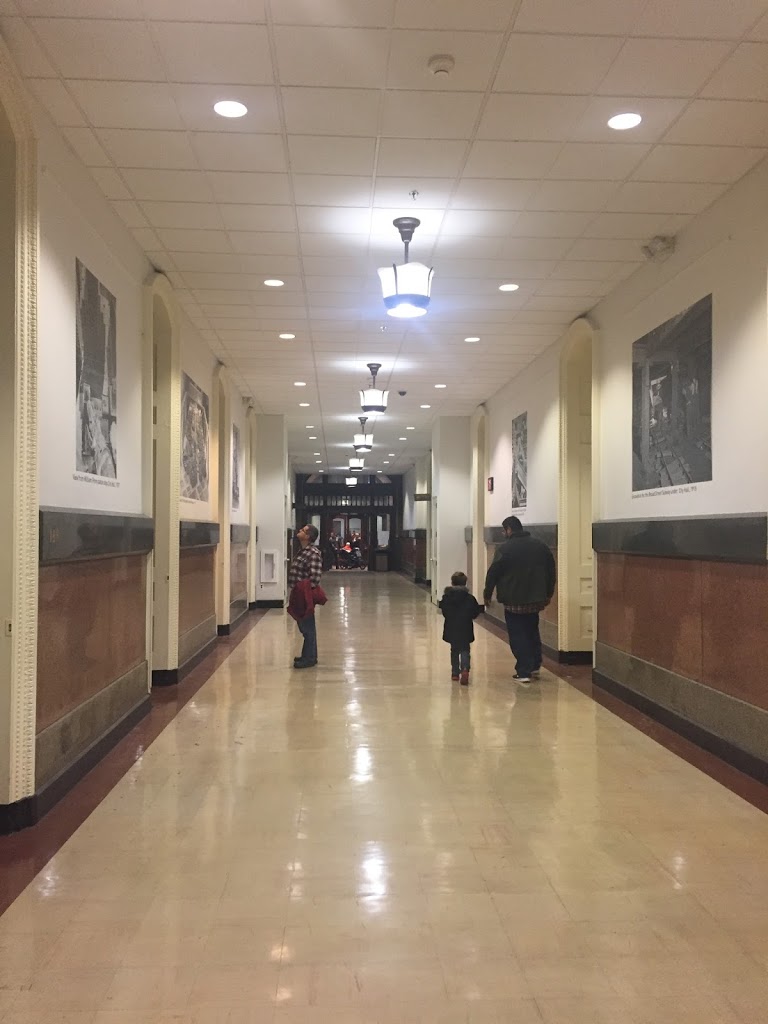
    City Hall has a couple of hallways lined with historical photos as shown below. Above is one of the statue of William Penn that sits at the top of the clock tower.
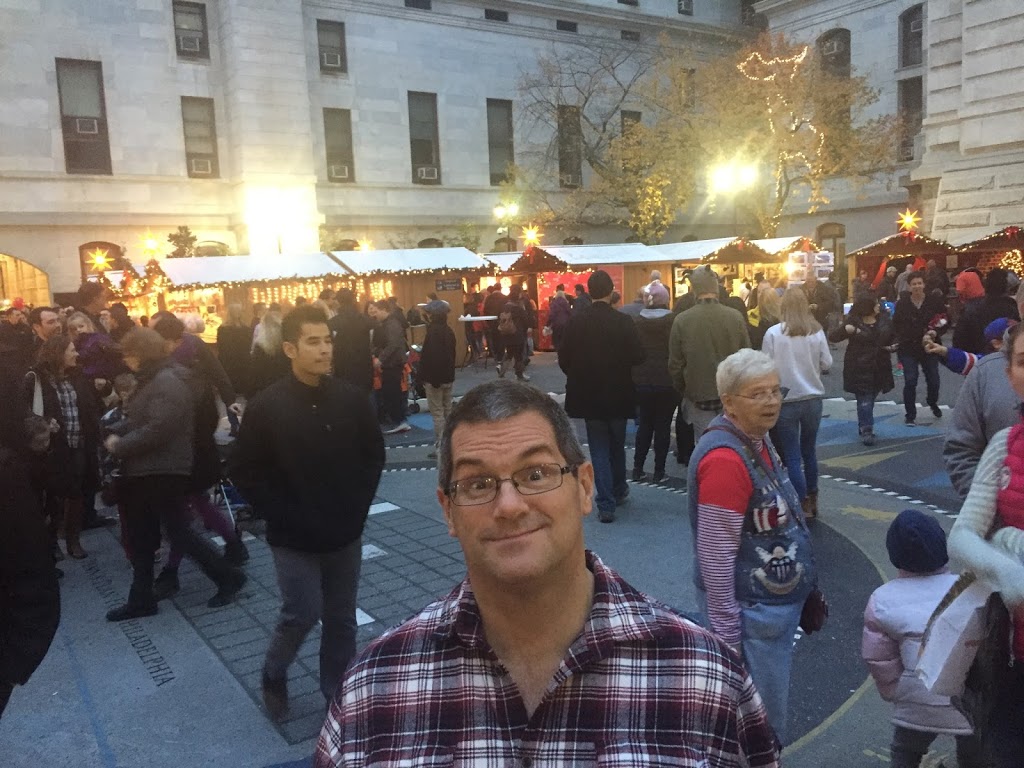
    The square in the center of City Hall was thriving at about 4:30pm. We went back to the hotel to rest up for a bit before we headed out for dinner again around 5:40. We went to Ristorante Pesto, listed as #1 in Restaurants on TripAdvisor. So high expectations and they were met. LOTS of food, reasonably priced, great service, cozy ambiance.
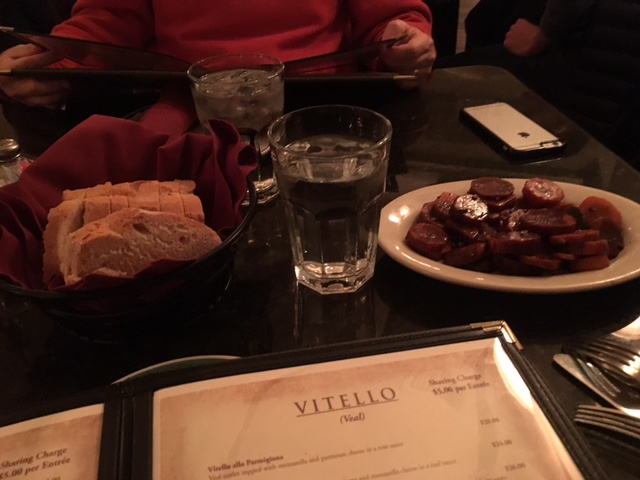
    Bread, and carrots marinated in balsamic vinegar.
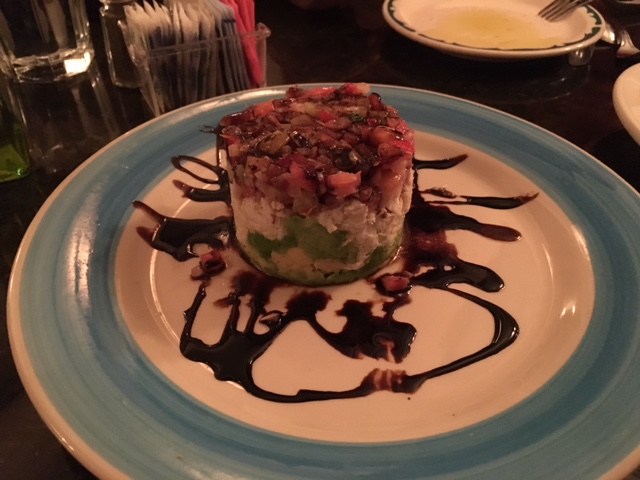
    This was the appetizer we ordered, which had avocado, cucumber, onion, other stuff, and of course “crammy.” When the waiter was going over the specials, he wasn’t pausing sufficiently between each (and there were a bunch) so it was difficult to discern when one stopped and the other started. But everyone seemed to have “crammy” in it. So at the end of his monologue we finally asked “uh, what’s crammy?” “Crab Meat.” OH. Then we made him repeat a few of them.
    This was a manicotti they gave us on the house. The tomato sauce was amazing.
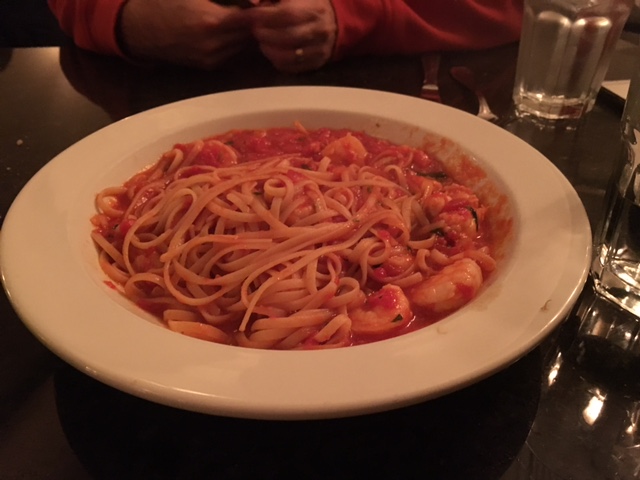
    Dan ordered the linguine with lobster and shrimp above, I had a lightly breaded veal with “crammy” in a butter and lemon sauce. It was amazing, despite Dan ribbing me about the slaughter of baby cows. Oh well. I’d do it again.


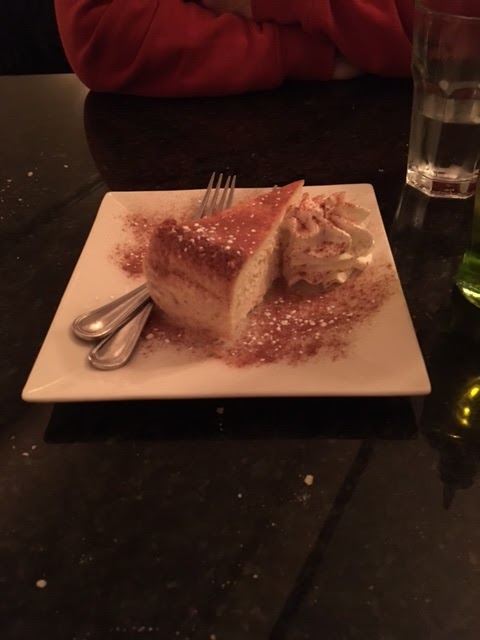
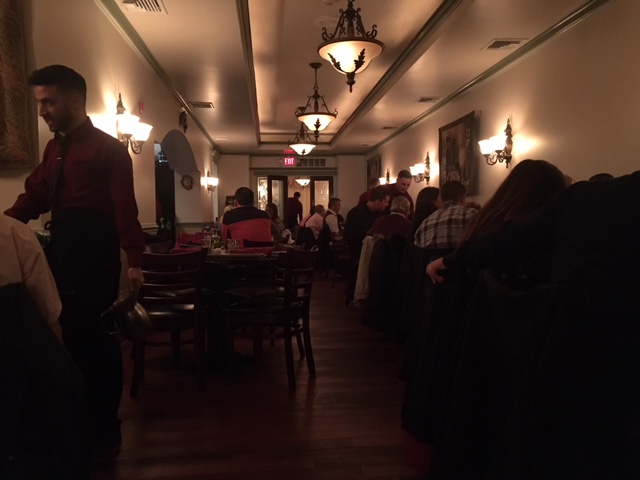
    We were So Stuffed at the end we passed on dessert, fully planning to go for a walk and get dessert at another place in town. (This was about a 10 minute bus ride away.) But we nixed those plans when they brought us this cheesecake on the house. The owner stopped by and asked how everything was; we said it would have been great anyway but now with all the free stuff we can barely walk. She said she never wants anyone to go away hungry. No chance of that. Completely family run, this cheesecake was her mother’s recipe, baked by her husband. Photo of the dining room below, that’s Dan’s back to you left center, and our waiter on the far left.

    A successful day in Philadelphia. Looking forward to one more.


  • Day 1: Thursday, 11/24, Thanksgiving Day

    Day 1: Thursday, 11/24, Thanksgiving Day

    I had a 7:30pm flight out of Sacramento Wednesday night, which got me here about 7am Eastern after an almost 3 hour layover in Phoenix. Dan had a 7am flight out of Raleigh which got him here around 8:30am. I just hung in the airport and met him at his gate, and we took the train to the hotel. We are at a Doubletree downtown, and they actually had our room ready and let us up despite it being only about 9:30am! We were glad for that though. We settled in, I took a shower, we got a small bite to eat from the lounge just as they were putting that food away, and went out about 10:30 to get on with our day.


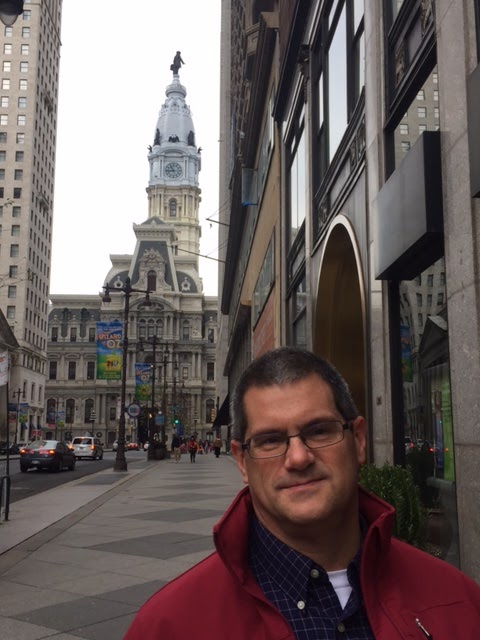
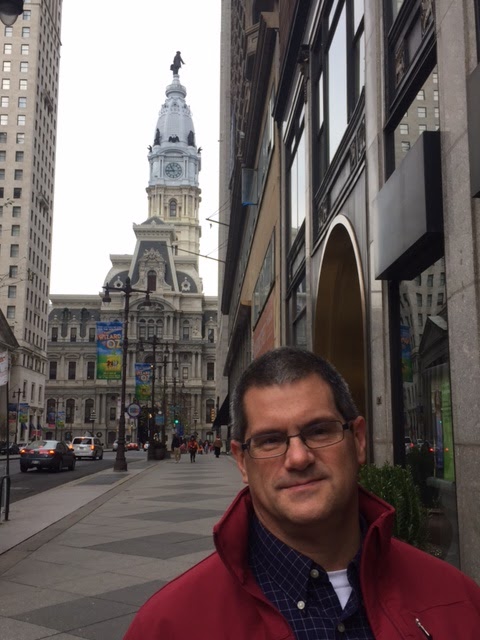
    Our hotel is at Broad and Locust, which seems to be a good location. Broad is one of the major thoroughfares, and City Hall, behind me there, is the focal point at its center.

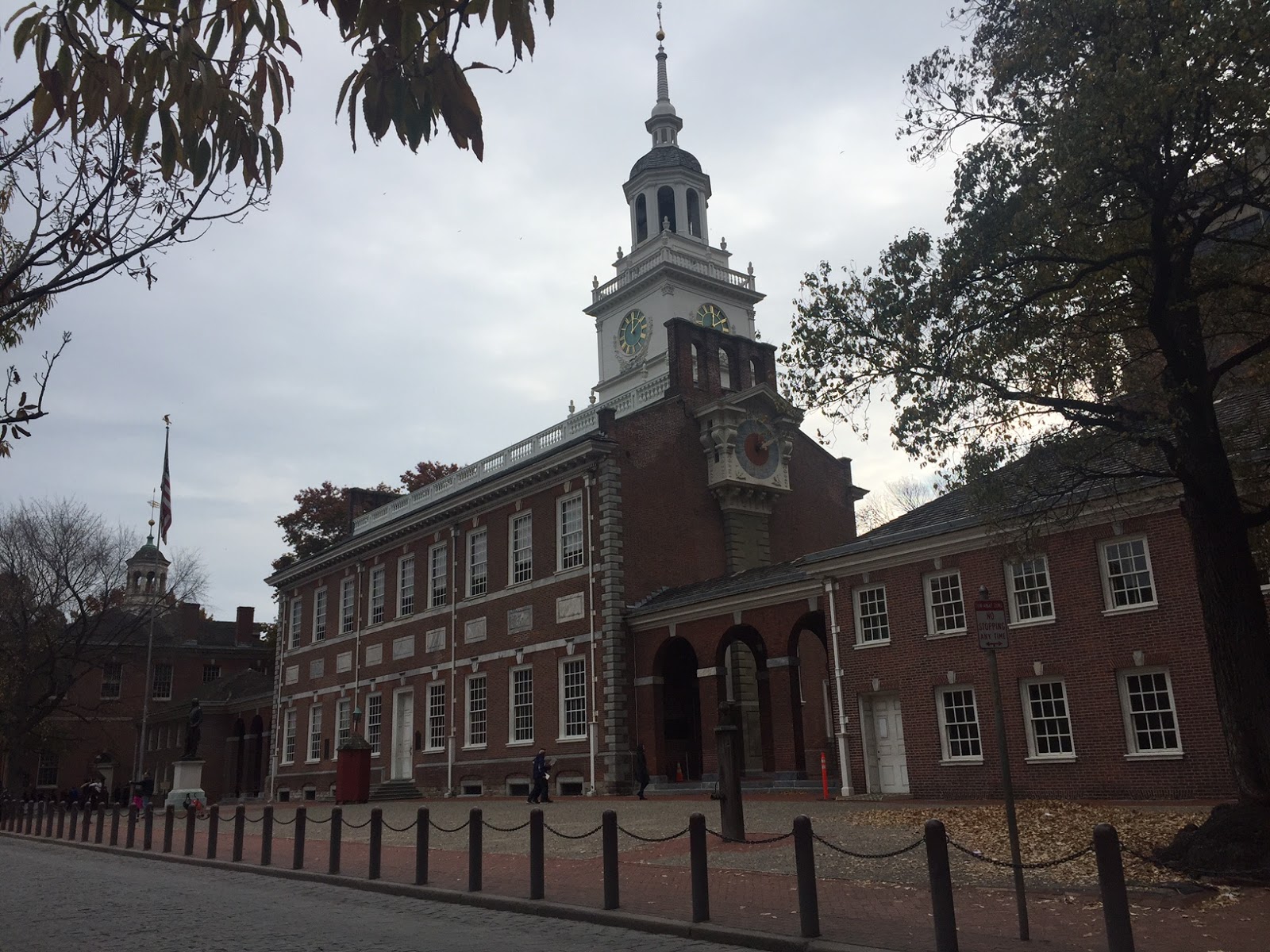
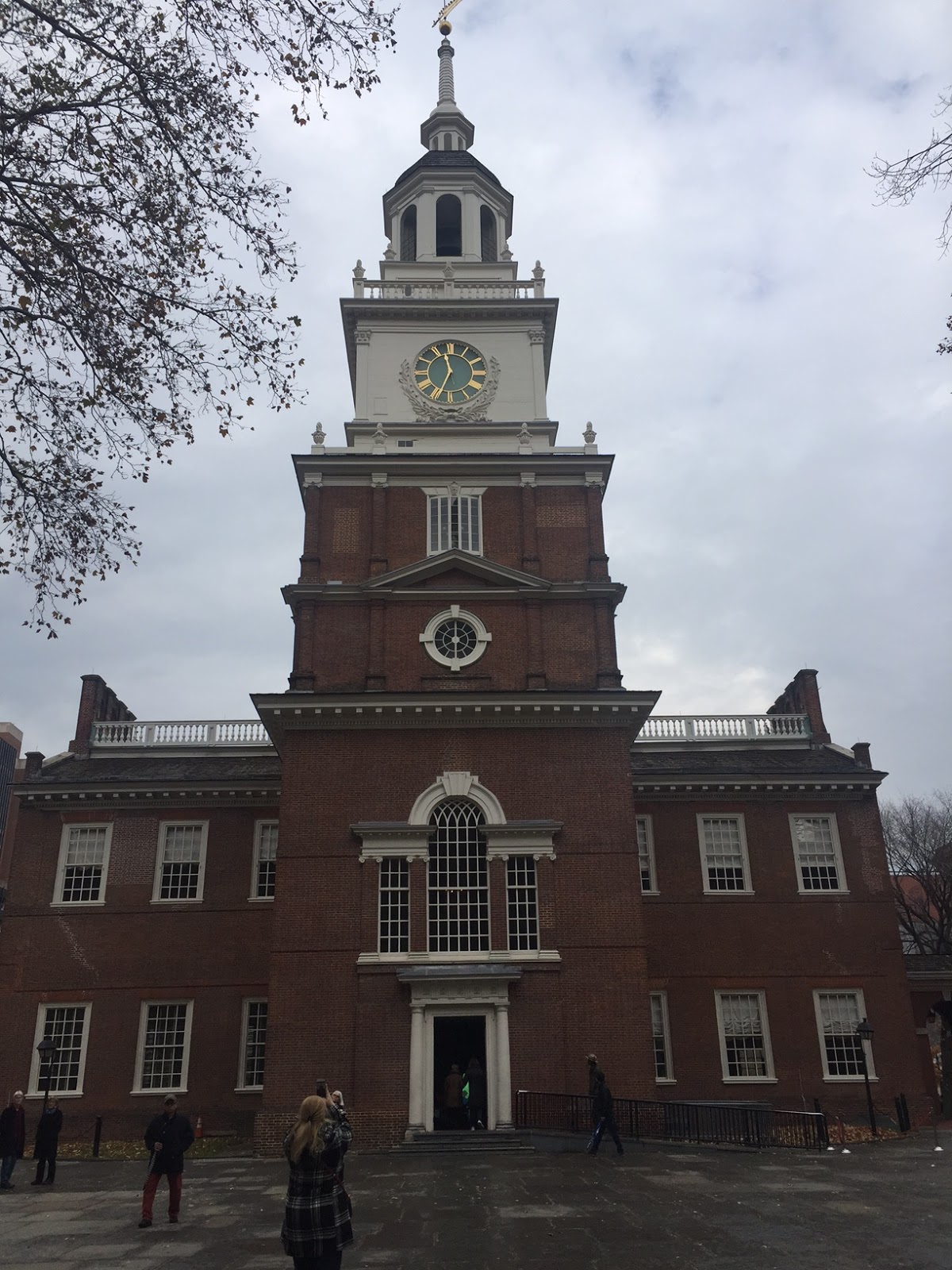
    We went first to Independence Hall. Built in 1753 as a colonial assembly then the Pennsylvania State house, it was the location of the genesis of the United States of America, since both the Declaration of Independence and the Constitution were written here. It was only open today from 11-4, and not everything was – it’s a park with several museums – but we knew we could see what we wanted to and it fit into our schedules nicely.

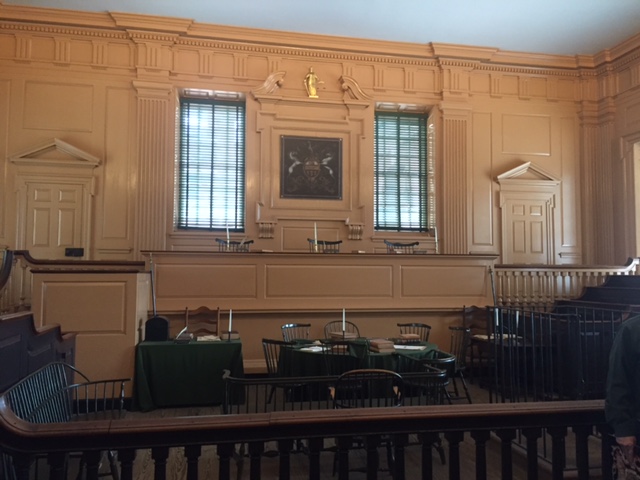
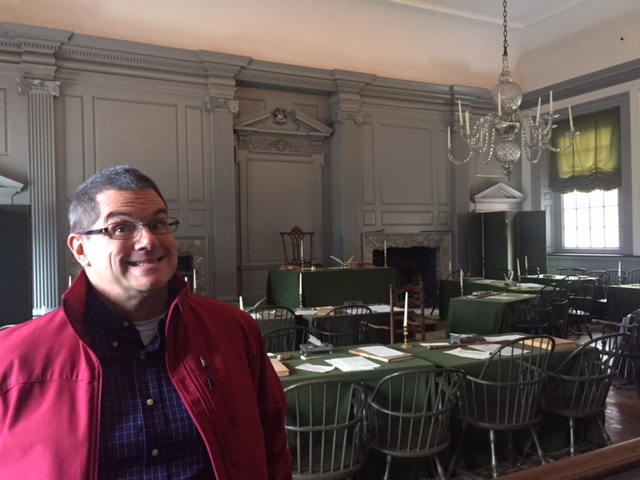
    The main hall itself was small and essentially just two rooms on the first floor; you weren’t allowed upstairs, at least not today. This is the room on the left which was designed as a court room. And a British court room at that. In that period, during the trial the defendant stood in that little cage to the far right of the photo. It’s where the term “to stand trial” comes from.

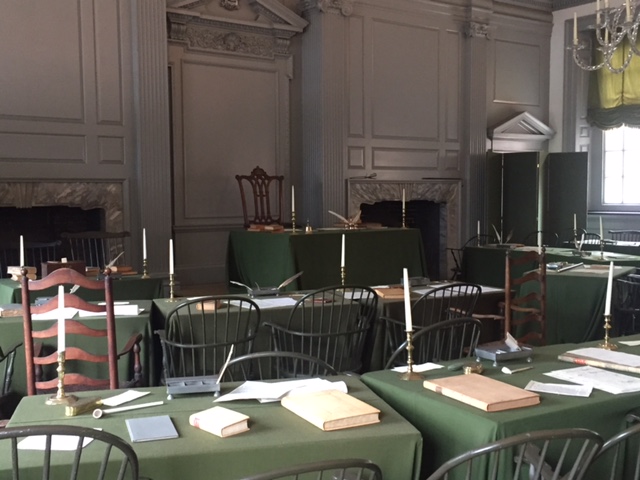
    This is the room on the other side of the hall and it’s where both the founding documents were written.


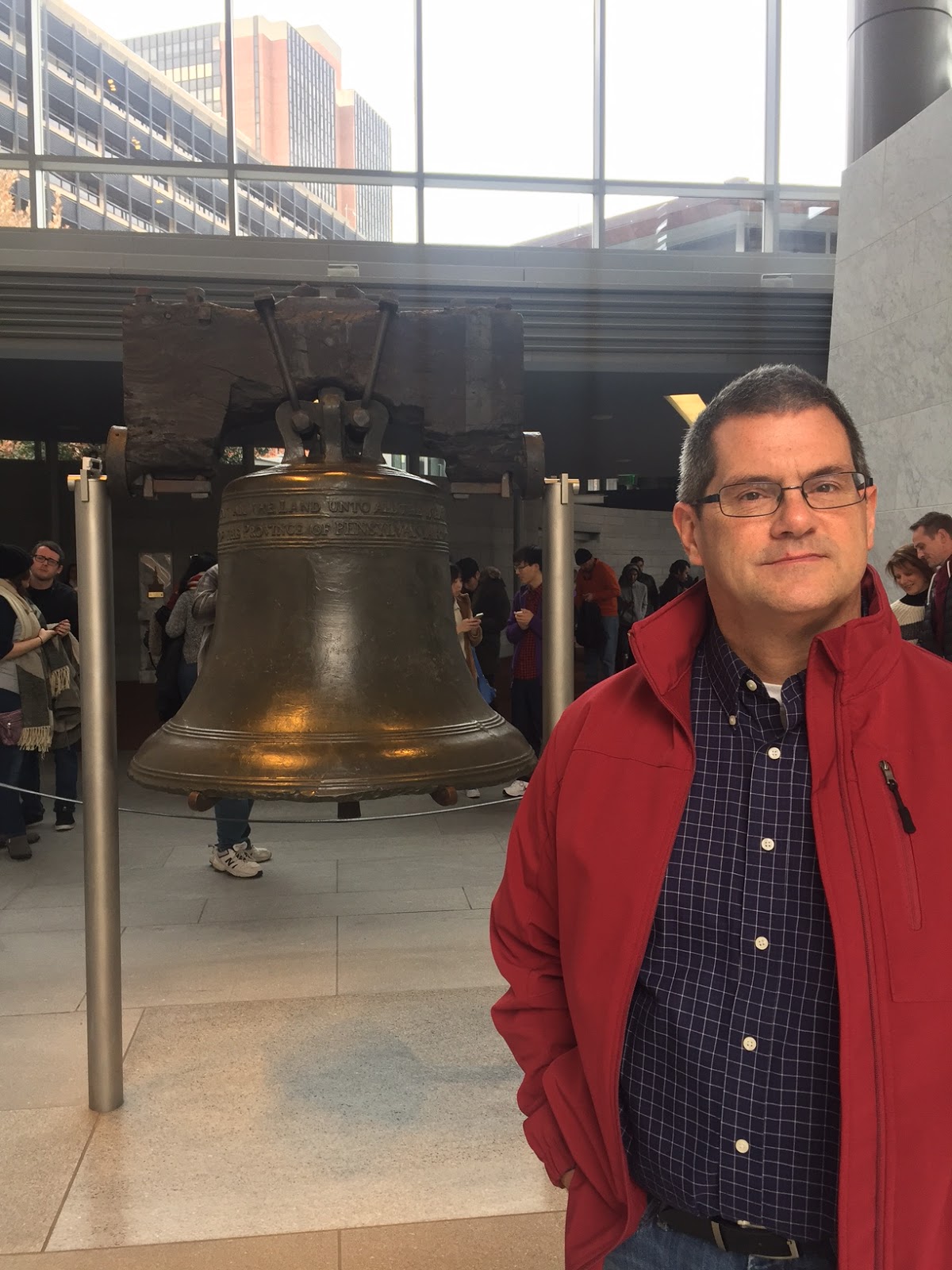
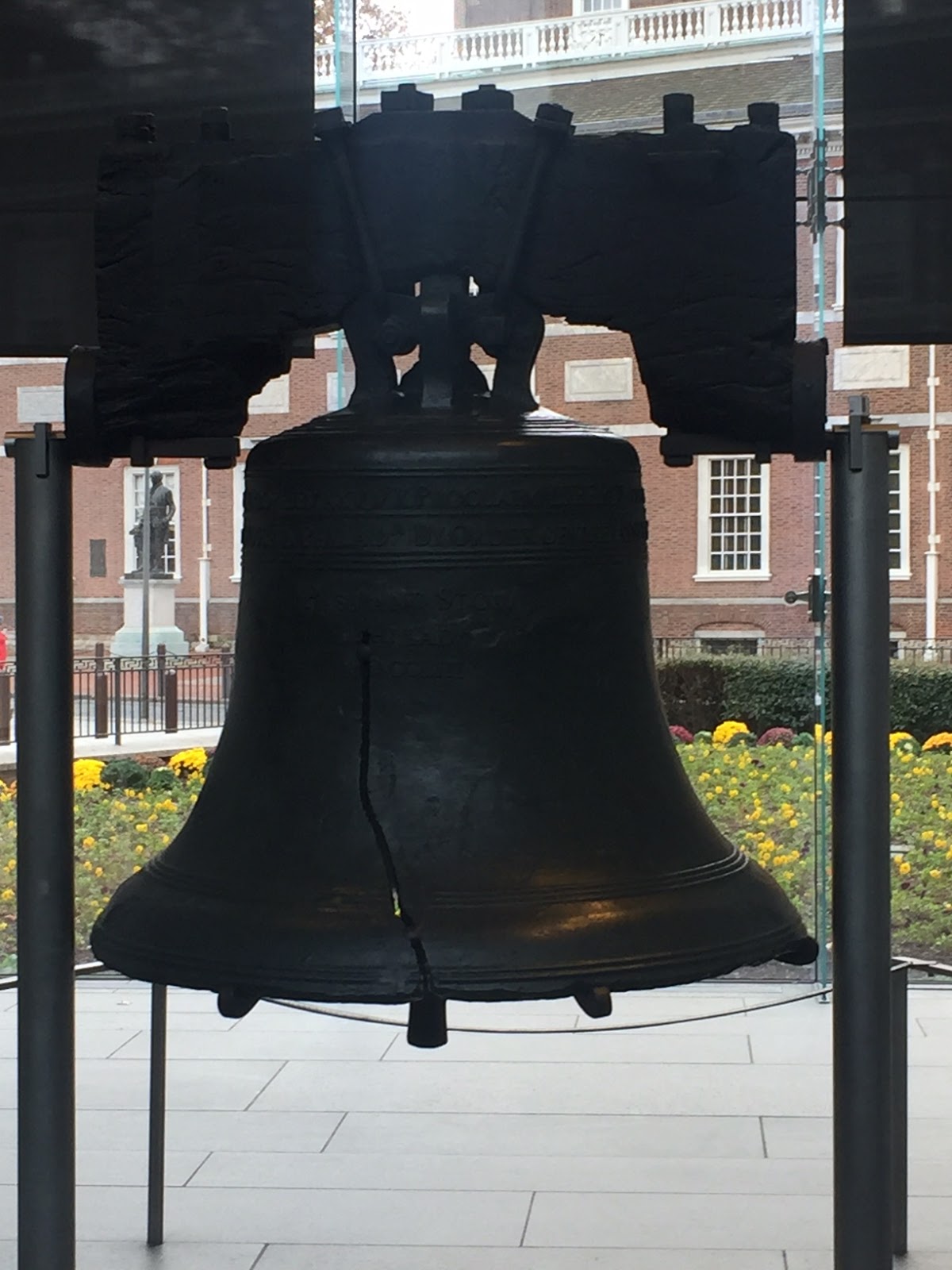
    This is the backside of the Hall. There’s a nice little park behind us; we’d intended to go back to it but never made it. We instead went the other direction and across the street to the Liberty Bell museum. The exhibits had an interesting perspective that I hadn’t expected but which made perfect sense in hindsight. It was originally just the State Hall bell.

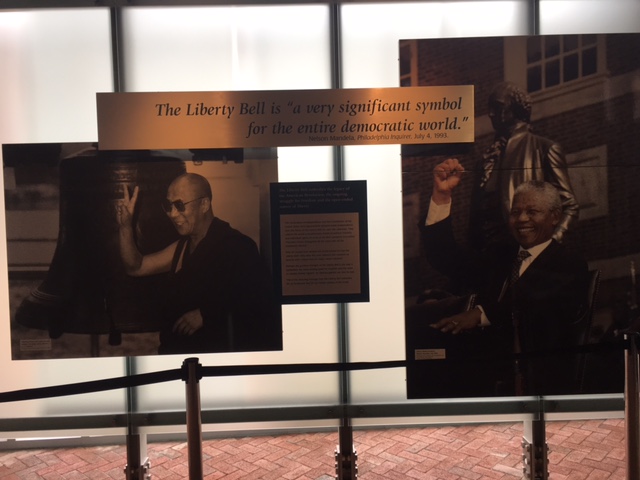
    Most of the displays in the museum focused on the evolving and enduring message of freedom that rings from the bell, and how that message wasn’t always applicable to all Americans. In fact, it didn’t become known as The Liberty Bell until the mid-1800’s when it became a symbol of the anti-slavery movement.

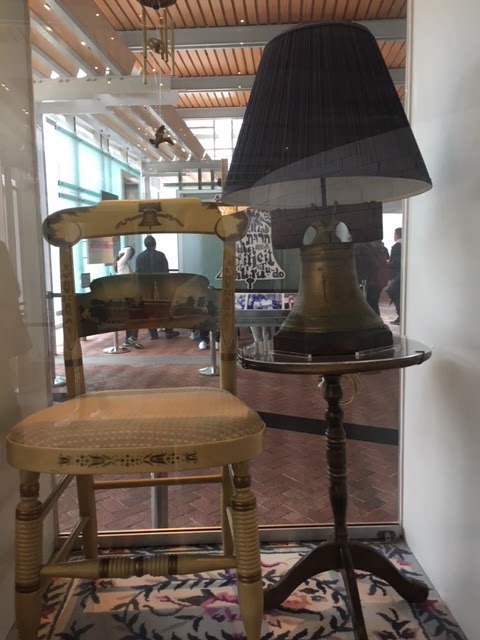
    A little kitschy but I liked it: a Liberty Bell lamp, and a chair with an image of Independence Hall painted on it.
     
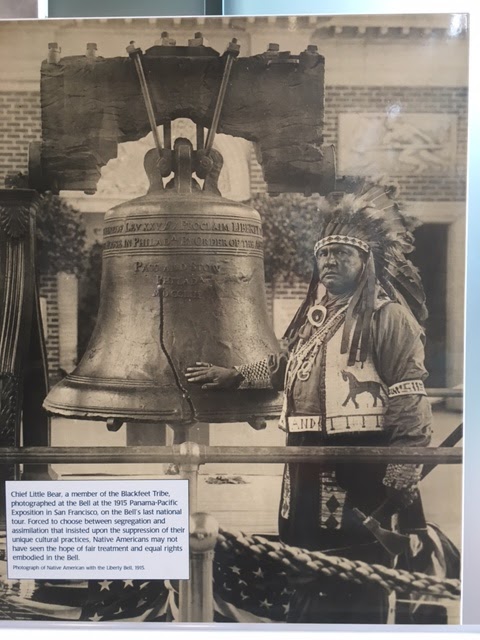
    In the early part of the 1900’s, the Liberty Bell went on a national tour. This was taken at the 1915 Panama-Pacific Exposition in San Fransisco.  Some of the text is: Forced to choose between segregation and assimilation that insisted upon the suppression of their unique cultural practices, Native Americans may not have seen the hope of fair treatment and equal rights embodied in the Bell.


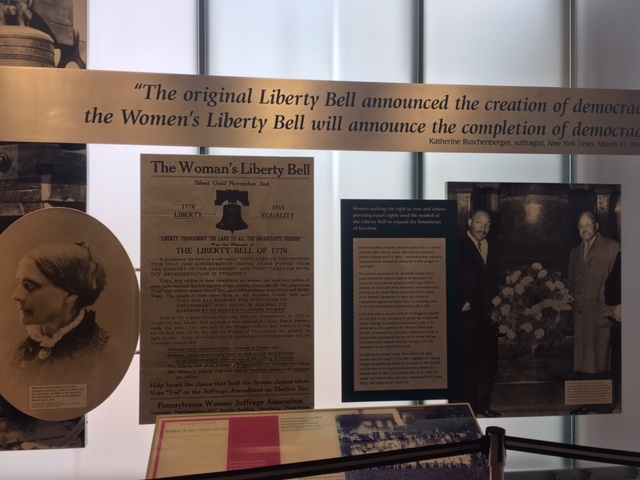
    The Women’s Suffrage movement used it as part of their campaign as well.


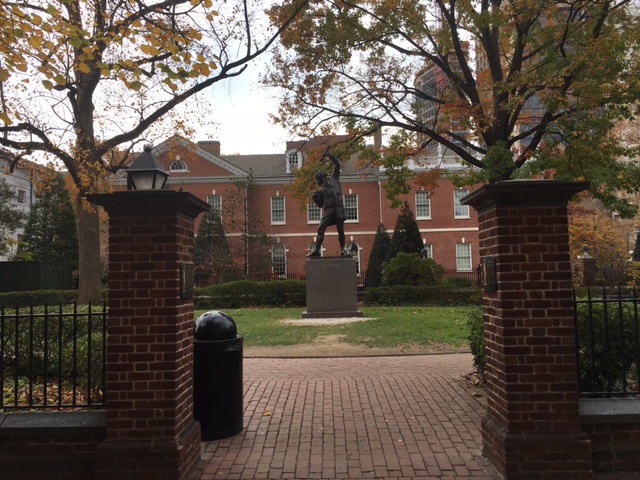
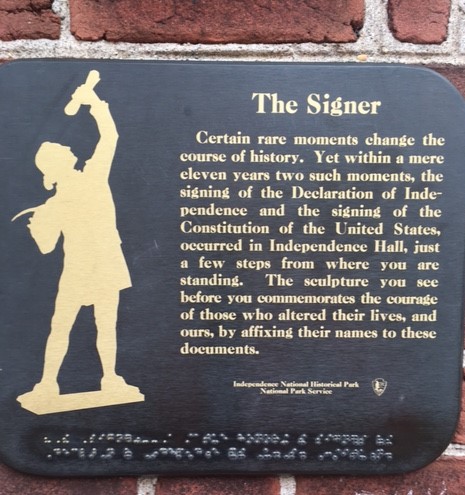
    A good chunk of downtown Philadelphia is part of the National Park Service with lots of historical buildings and monuments. This was a cute little park we stumbled across, dedicated to the signing of the founding documents.


    We went in search of food, knowing finding something open mid-day on Thanksgiving would be difficult. We ended up at a place called Rotten Ralph’s. Mostly a bar, it had a second floor dining room. Dan got their Thanksgiving dinner and while the turkey was good, most of the rest of it was canned. Certainly the corn, green beans and yams. I got a Philly cheesesteak sandwich that was actually pretty good.

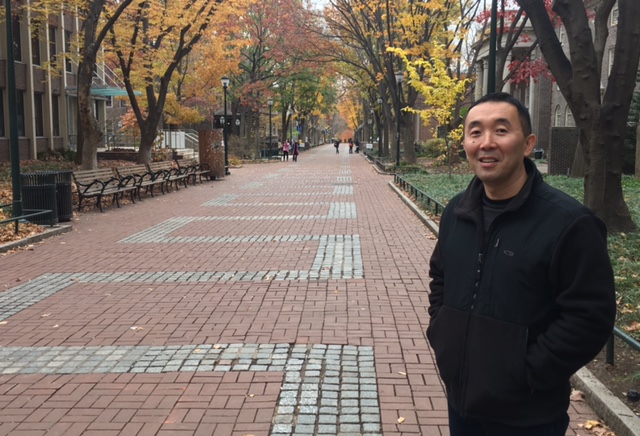
    Next we went to the University of Pennsylvania. Dan went to school there for 5 years (double degree in biology and computer science), leaving in 1992 and he hasn’t been back to Philadelphia since. We spent a couple of hours walking around a beautiful and very large campus that has bits of town woven through it, as he pointed out the various places he lived (he moved every year), where some of his classes were, open fields that are no longer where he played football, and the labs he slaved in. None of it was open so we could only see things from the outside; there were still quite a few people milling about, a tribute probably to the park-like nature of much of it.


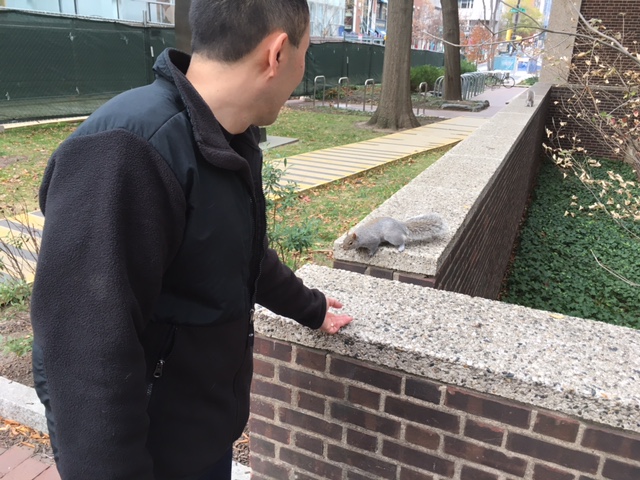
    I have never seen so many squirrels in such a small area as we did here. And they were quite friendly. Clearly, students feed them quite a bit, as they were expectant and approachable. And Dan kept saying “that’s a fat squirrel!” What you can’t see in the photo are the 4 or 5 that are milling around our feet. (Also notice the one in the background on the wall making his way towards us.)


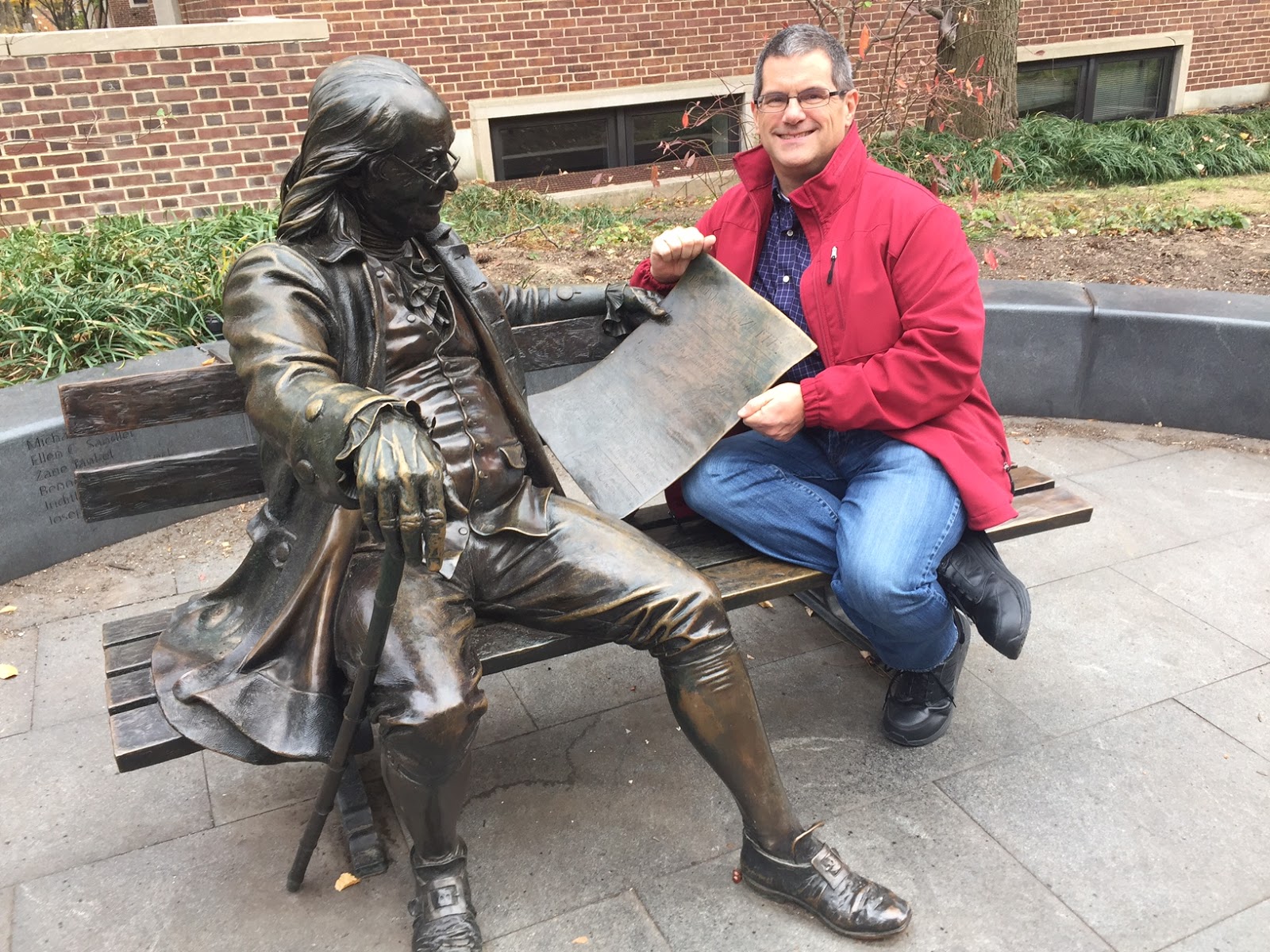
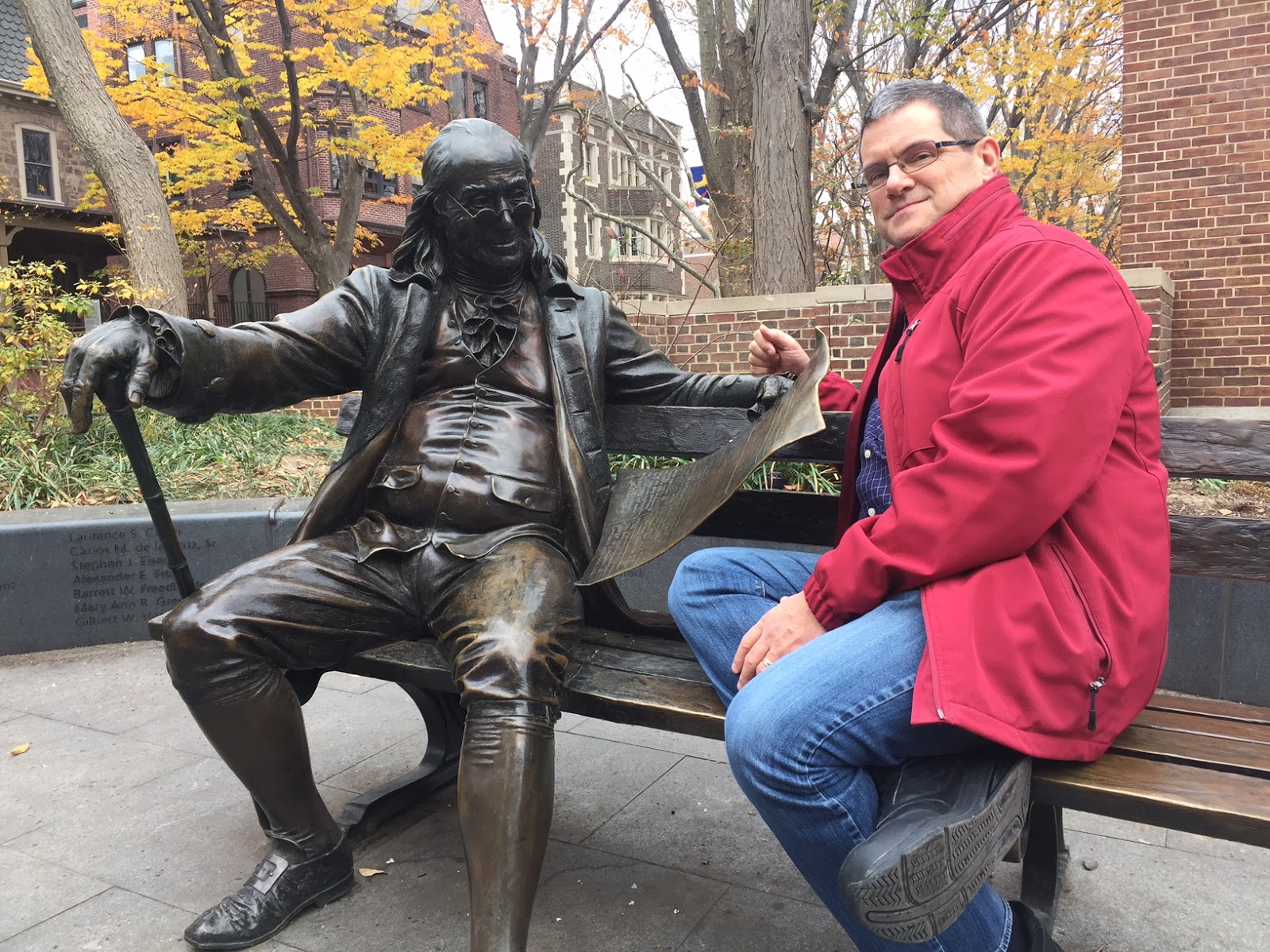
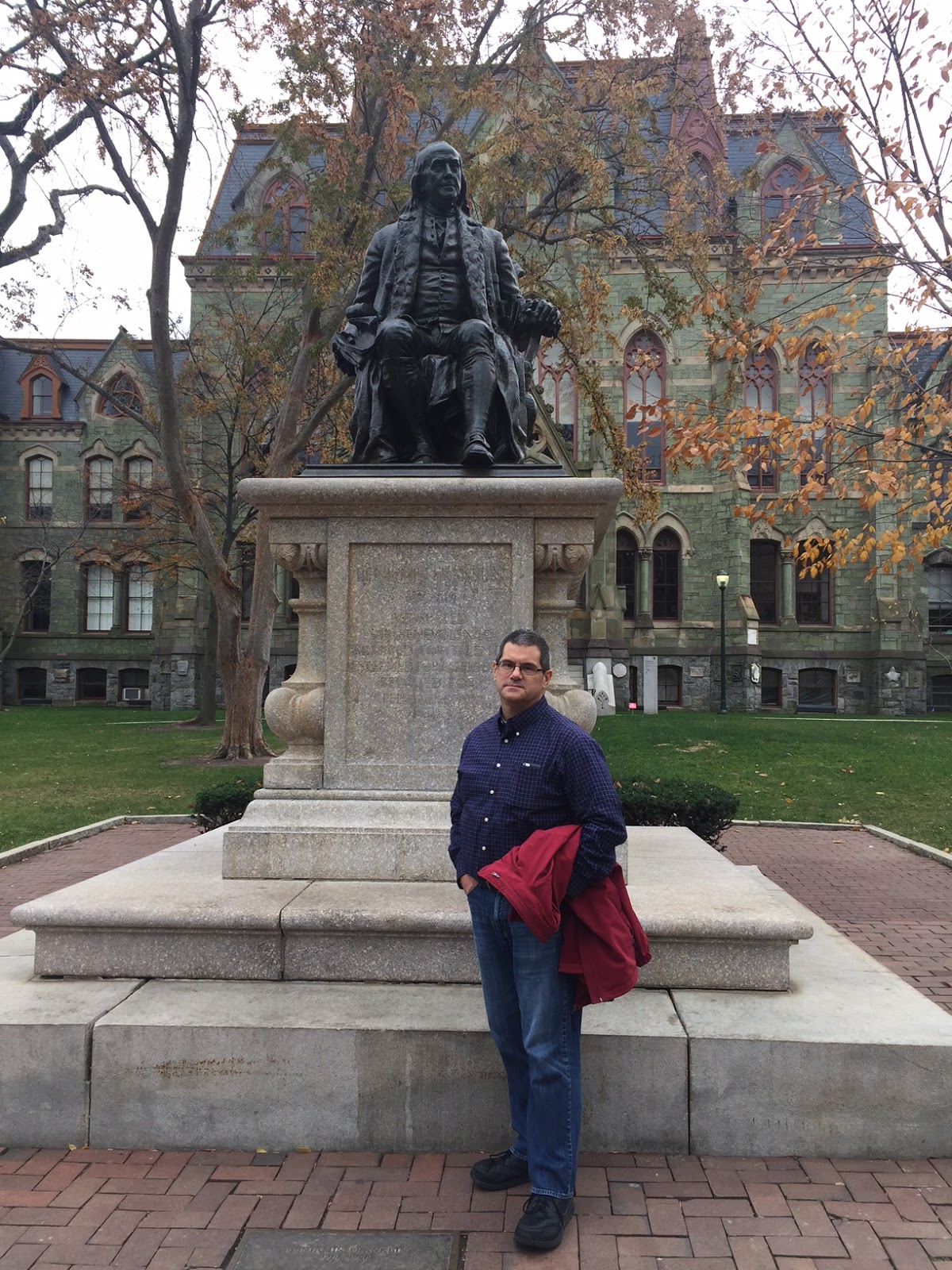
    Penn was founded by Ben Franklin in the mid 1700’s. This statue is in the middle of a walk that has many of sayings inscribed in it.


    “Let’s meet at the button” is something you hear on campus frequently according to Dan. This is in an open area in front of the Admissions building.


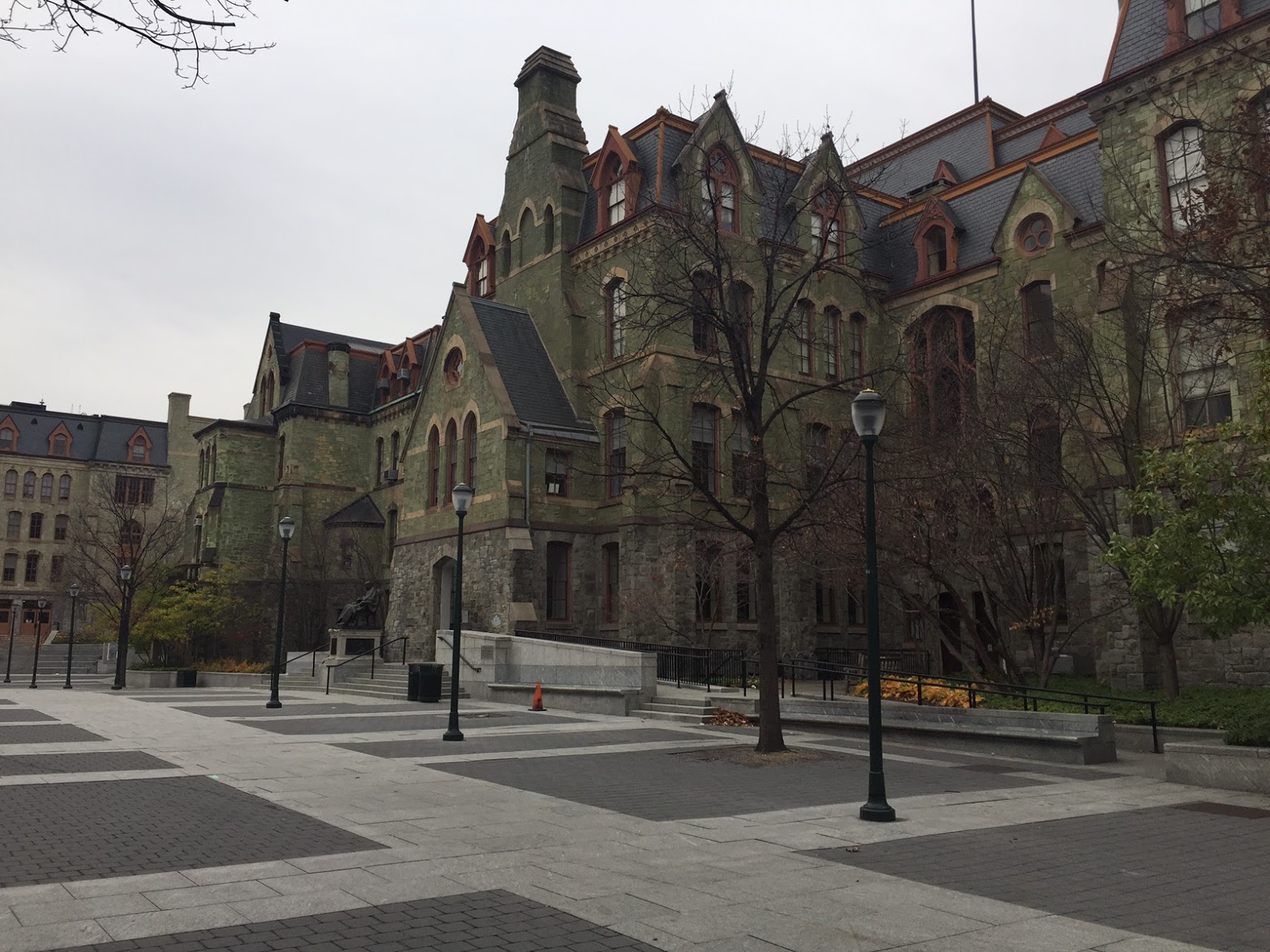
    The Admissions building above, and Architecture building below, two of the oldest on campus, both from the late 1800’s.


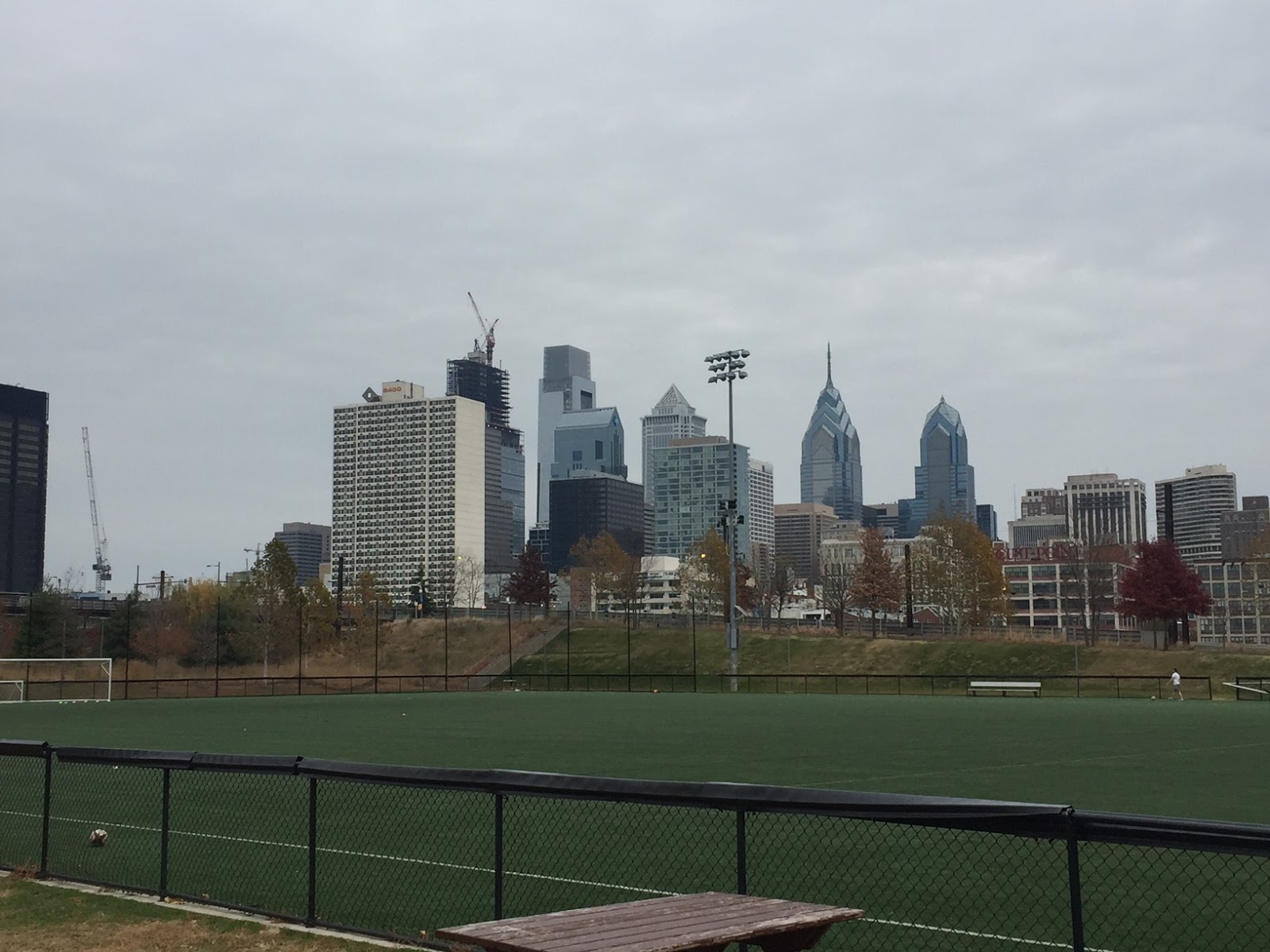
    The back of Admissions above. Below, Penn Field, open to the public, with downtown in the background.

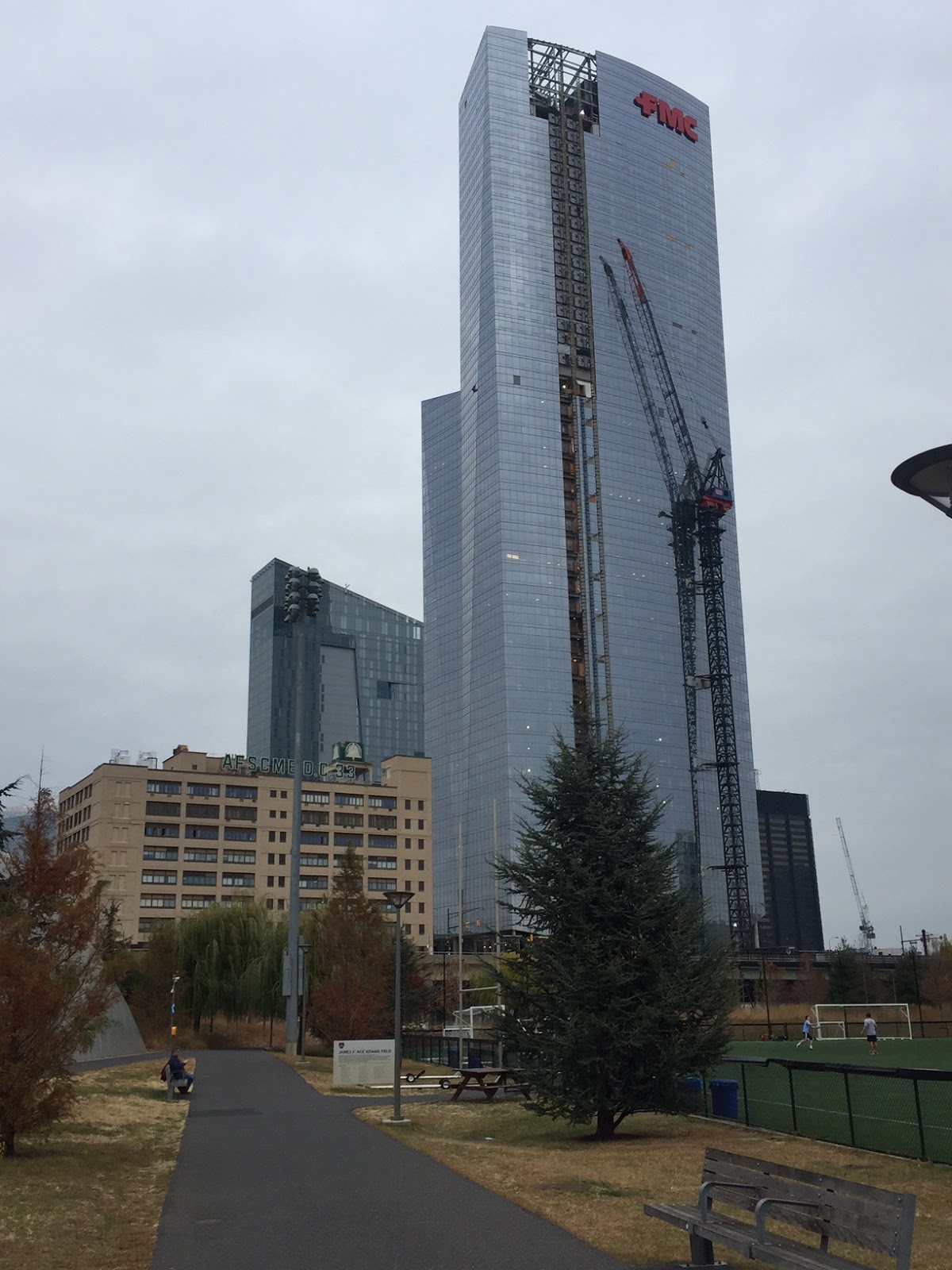
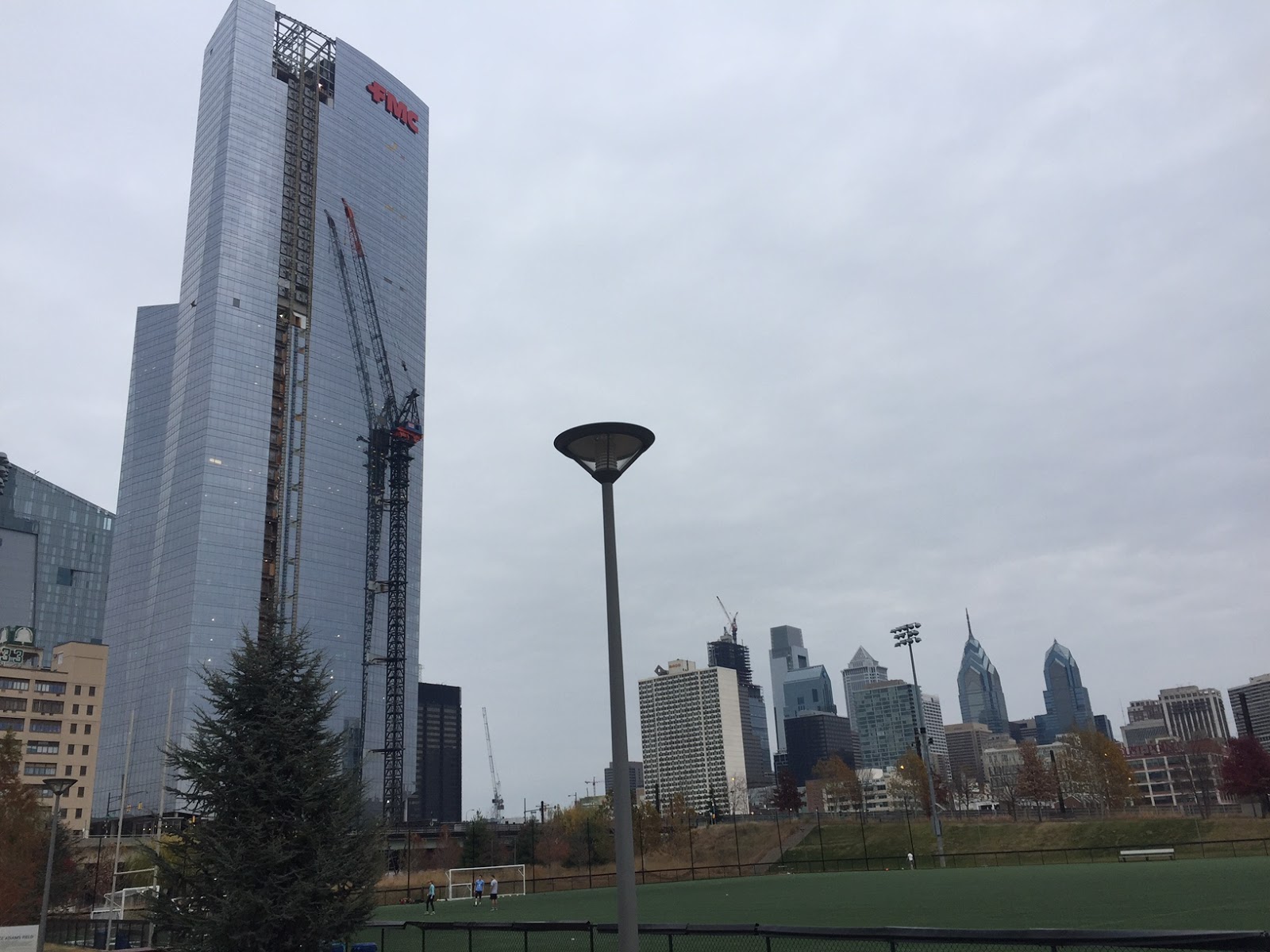
    That’s me sitting on the bench bottom left. This is new construction being called a “vertical neighborhood” which incorporates a mixed-use building of residential, office and retail. Being city boys who appreciate high density living, we loved the concept.

    We got back to the room about 4pm. Having had only 3.5 hours of unfit sleep on my red-eye flight, I took an hour nap before we headed out for dinner.


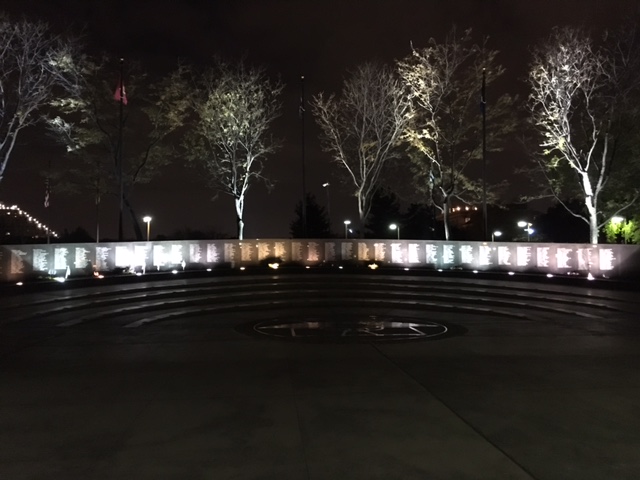
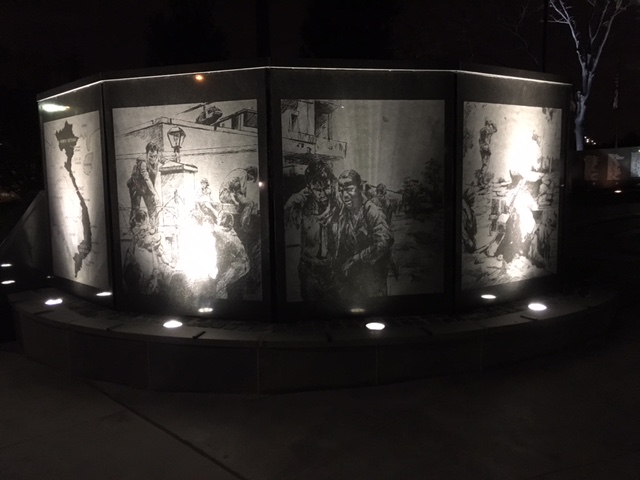
    We took the bus to Penn’s Landing and at our stop was the Philadelphia Vietnam War Memorial, above and below.


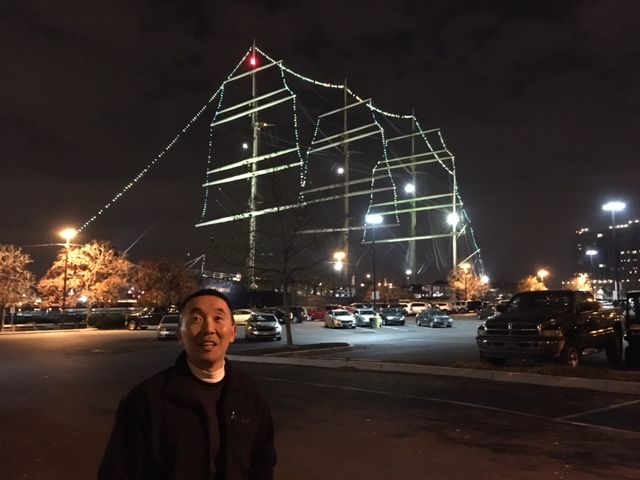
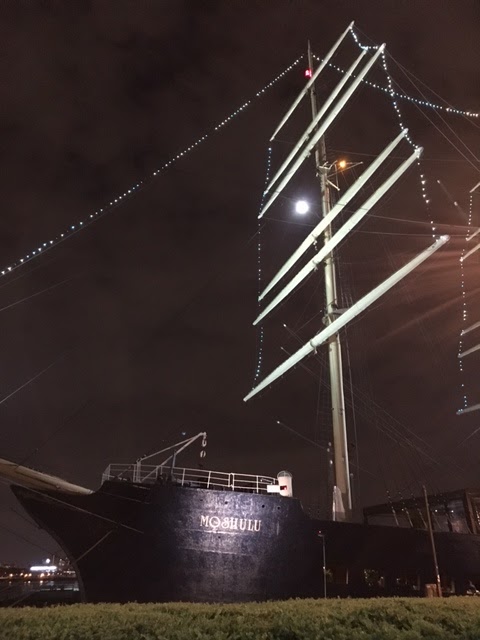
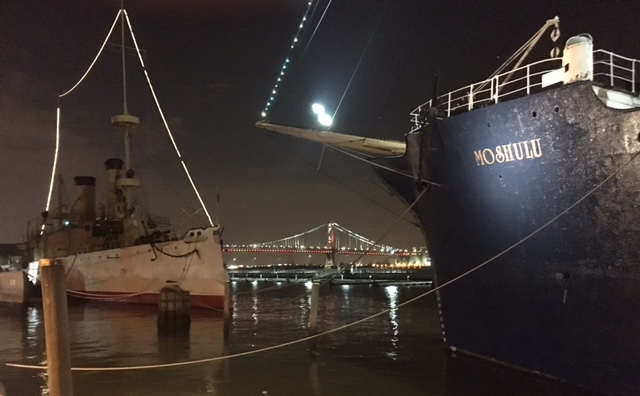
    We had dinner at Mushulu, a ship-turned-restaurant. Originally built in Hamburg (Germany) in 1904 as a shipping vessel, it was captured by the US Navy in World War 1 and brought to the states. Mrs. Woodrow Wilson renamed it Mushulu in honor of the Native American Seneca Indian tribe meaning “one who fears nothing.” It served many purposes over the decades until being permanently docked and turned into a restaurant in 1989.


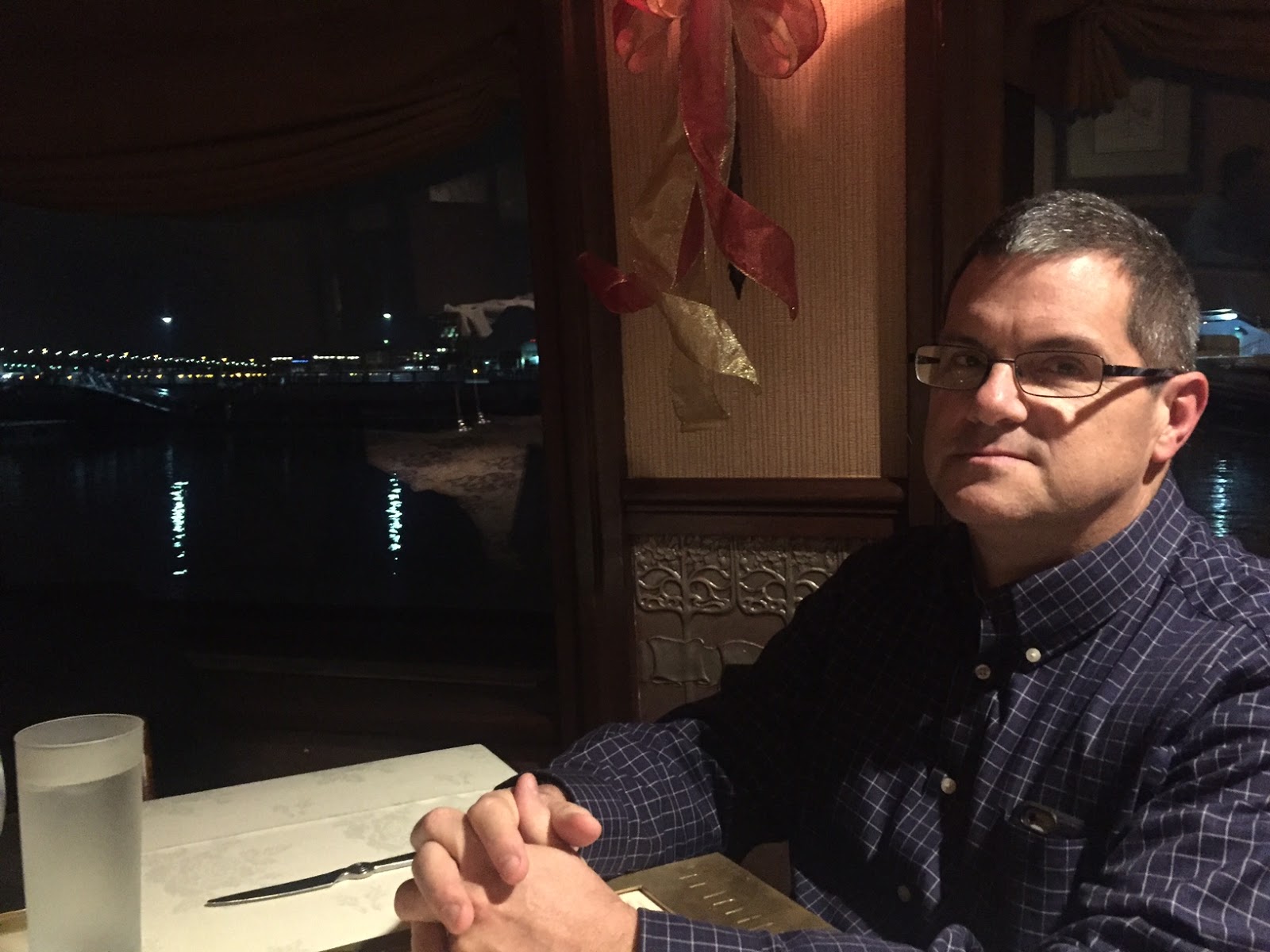
    That’s the Ben Franklin bridge in the background, part of Interstate 676, and also essentially the view I had from my seat.


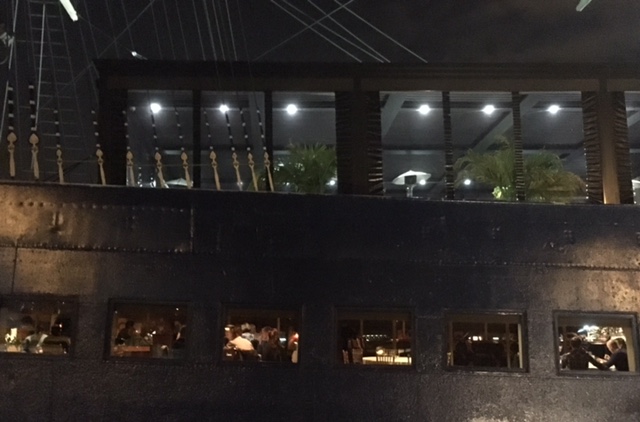
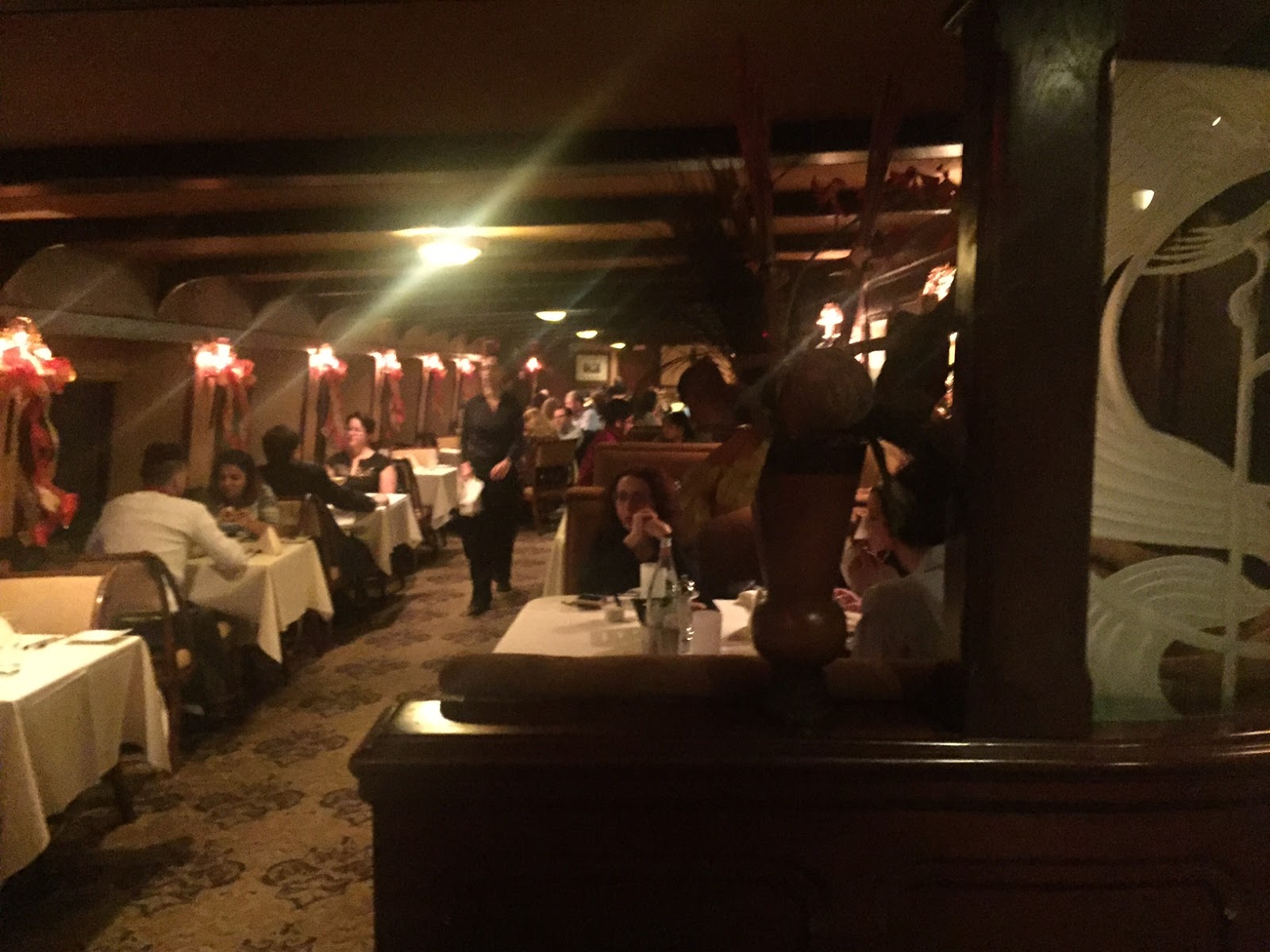
    There wasn’t an easy way to get a  good shot of this, but I wanted to try to capture the dining tables from the outside, which you can sort of see at the bottom of the above photo. Dan grabbed the shot below as we were leaving. The ceilings were low, it was sort of crowded, and hard to get a good shot. The food and service were great but we decided in the end it was overpriced. I would imagine there’s a fair amount of maintenance cost. The very first thing I noticed when we got on the ship was it wasn’t level; the floors sloped from the middle down on both sides. Like it was bowed.


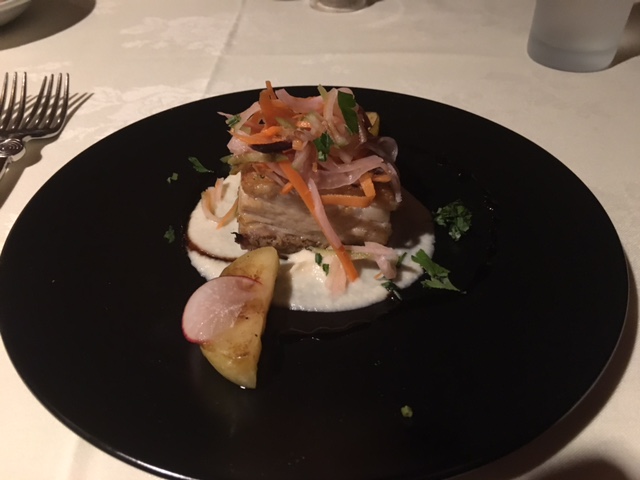
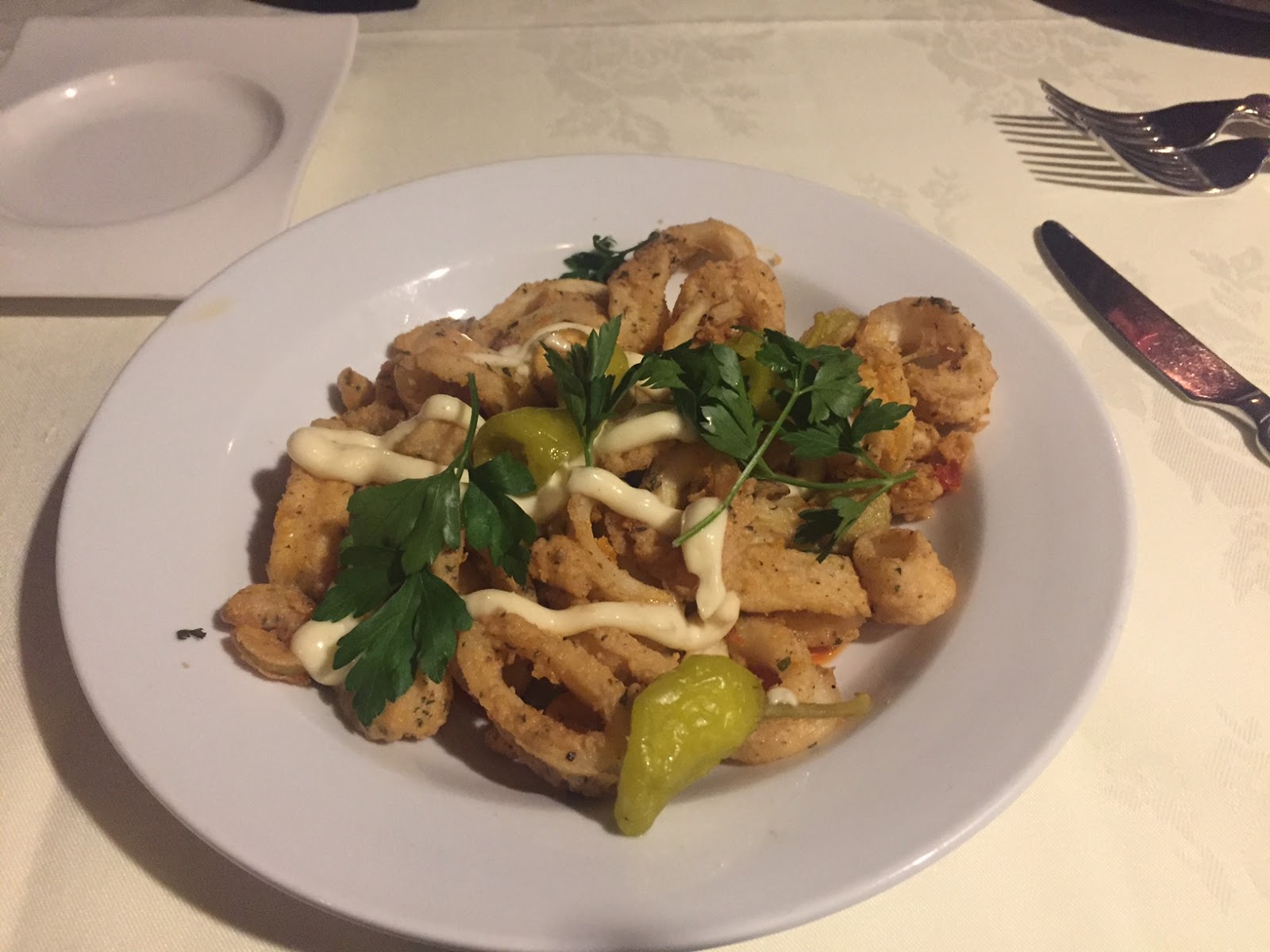
    This was a fixed price dinner with 3 courses. My appetizer above was a fried pork belly with an interesting slaw of fennel and apples. Dan had the calamari below, which was excellent.


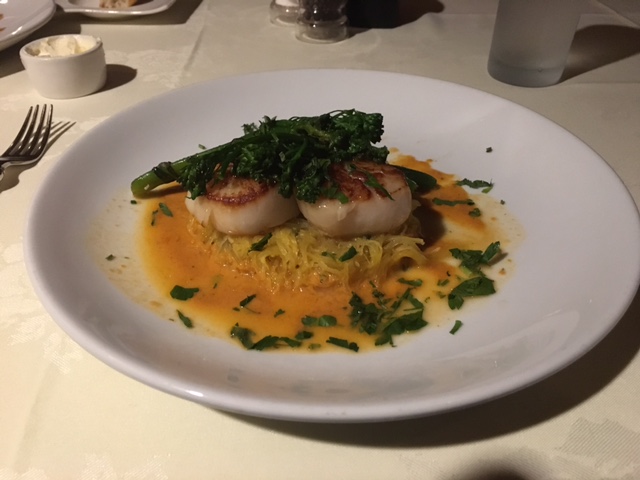
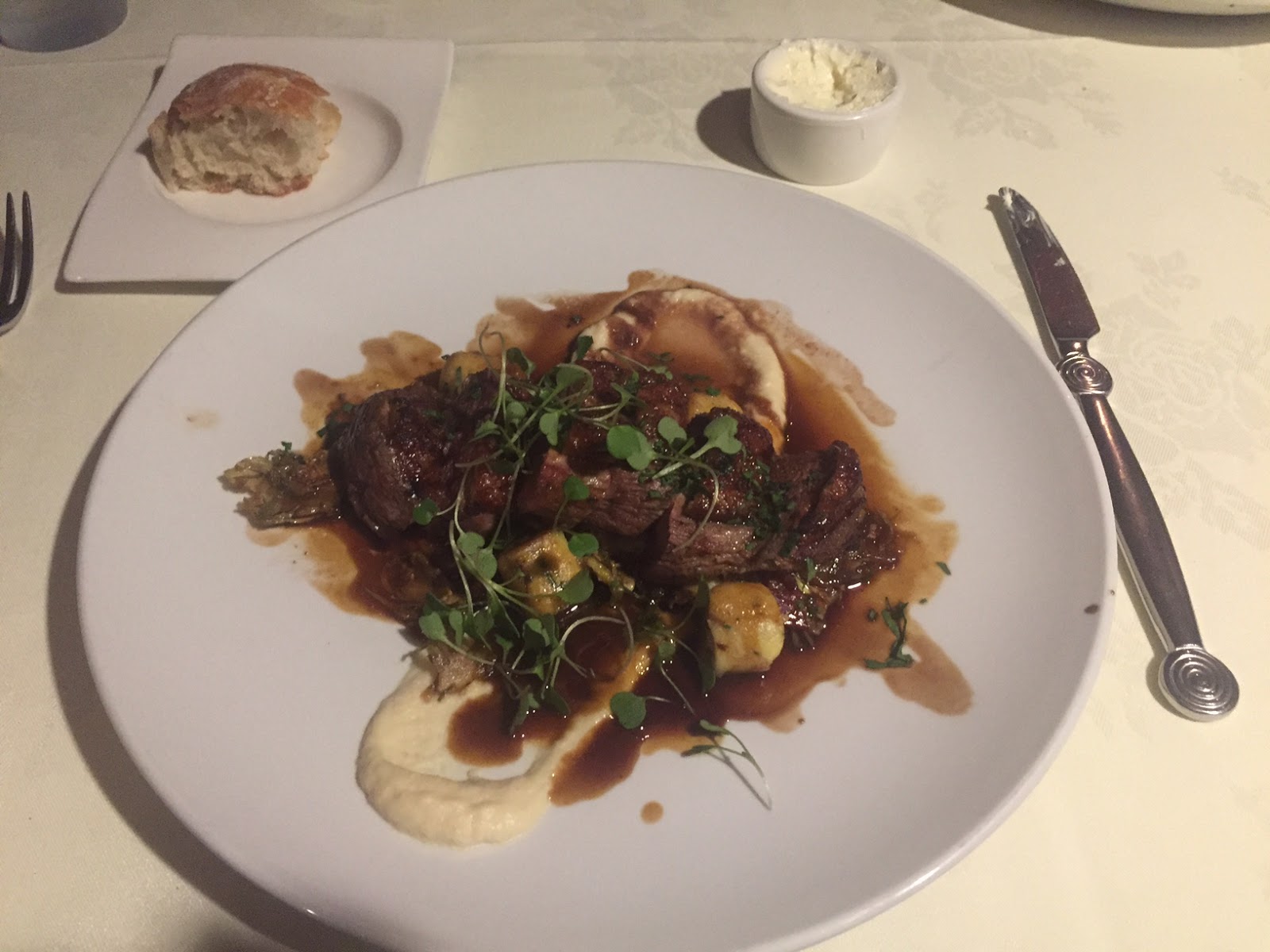
    I had the scallops, above, with spaghetti squash – which I love and you hardly ever see in a restaurant. Dan had the duck below.


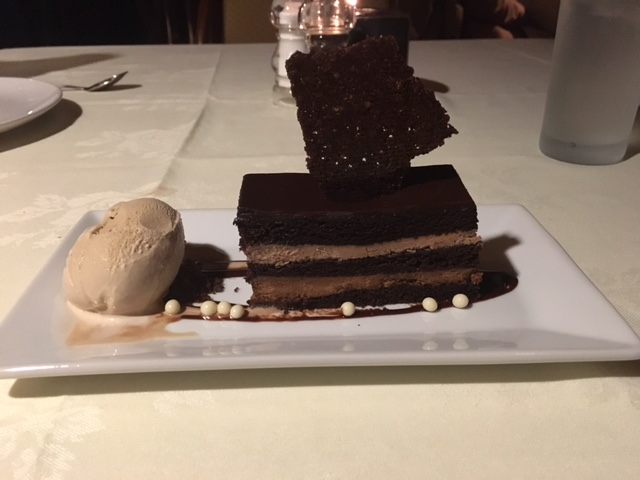
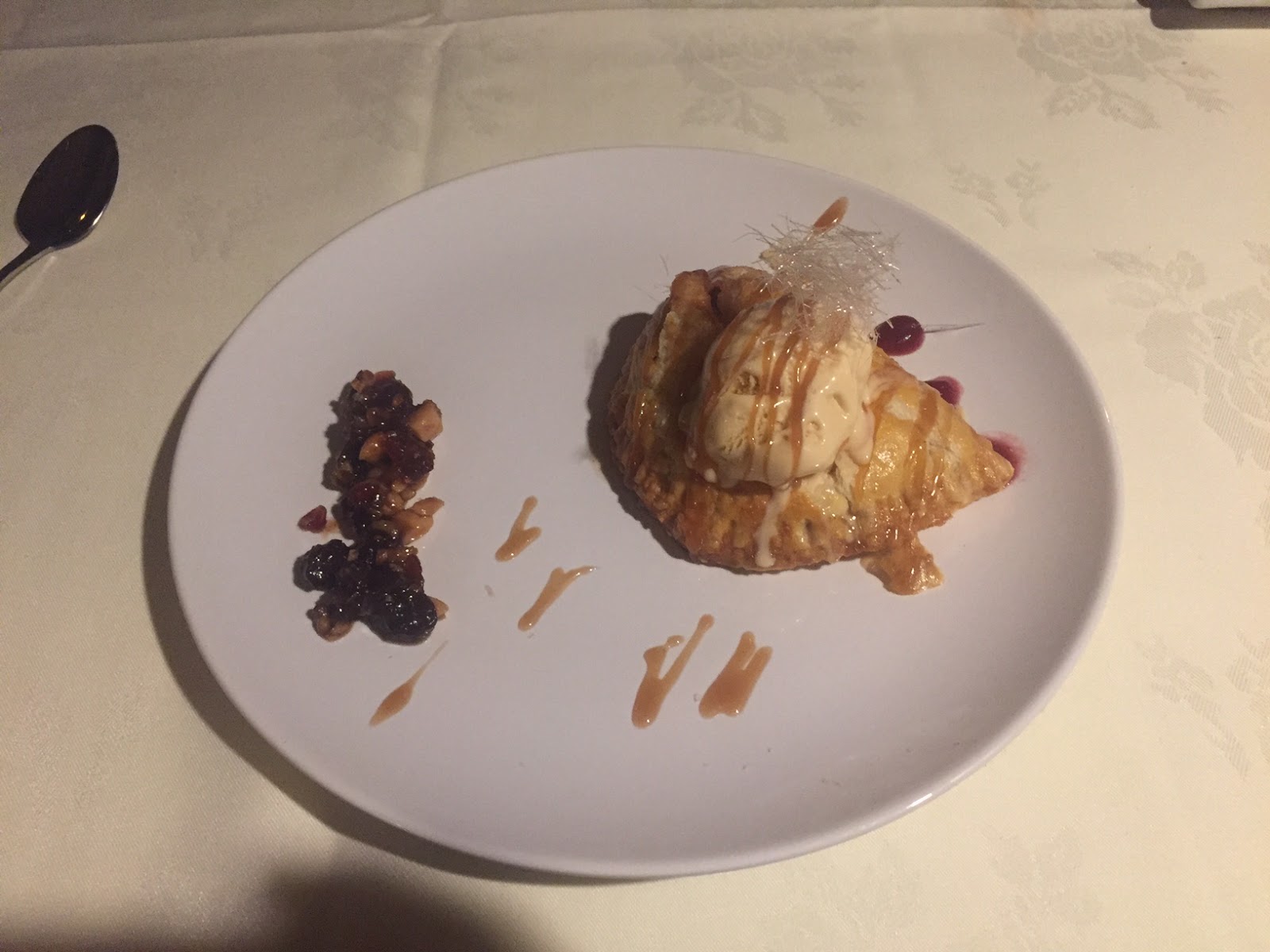
    Chocolate cake with coffee ice cream for me, and a warm apple turnover for Dan with vanilla ice cream.


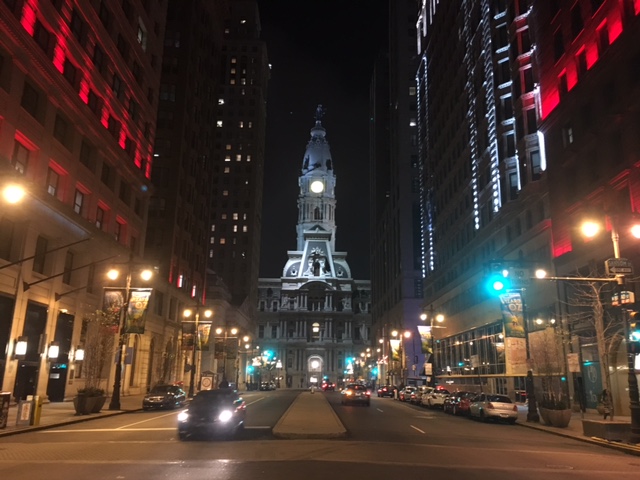
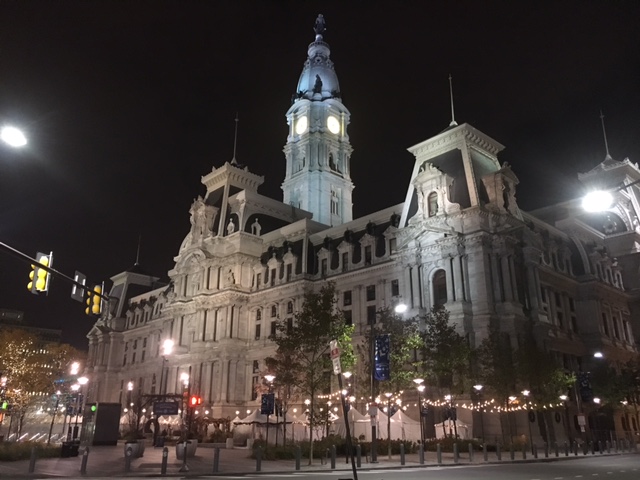
    We took the bus back to downtown and went walking around City Hall a bit to capture a couple of night shots.


    Overall it was a great day. This made up for last year’s Thanksgiving, which was spent in the air from LA to Raleigh, no rental car when we got there (an empty parking lot despite the reservation), a cab driver who took us the long way around to the hotel to jack up his fare, and room service that was an hour late. But apparently we got over it quickly, as it took us a minute to even remember what we did last year as we were thinking about it. Or maybe we just blocked it out :)

    We hope you had a great Thanksgiving as well!

  • Pre-Departure

    It hadn’t occurred to me to blog this trip until a couple of folks (one of them being Dan) asked somewhat expectantly if I was going to. When I paused, both responded with “you should.” And I remembered that, although it hadn’t occurred to me to blog when we traveled Memorial Day weekend, I regretted not doing it even as we were doing it. (We loved Richmond, VA, and blogging  would have helped me remember exactly why. As I’ve said many times, in the end I do this for me because, among other reasons, knowing I’m going to blog changes the way I go through the day and hugely influences what I pay attention to, and how I pay attention to it.)

    So here we are. Philadelphia for Thanksgiving. Huh? How did we come up with that? While we would have traveled for Thanksgiving anyway, I’ll use this as an opportunity to update whoever is reading on what’s going on with us.

    We started 2016 with Dan moving to Raleigh and the plan being I would join him sometime in 2017. That plan is now on hold because of a little deal Bayer is in the middle of with Monsanto. Without going into too much detail, if that deal goes through how long Dan will stay in Raleigh becomes questionable. While there are several possible outcomes for him, one is he gets moved to St. Louis. A couple of months ago I said to Dan “I’m struggling to get my head around changing jobs and moving to Raleigh in 2017, to have to do it again in 2018.” To which he responded “I know.” Good! Glad that’s not my imagination. A week later he upgraded that to “we probably shouldn’t make any decisions about you until maybe the summer [of 2017].” So all of that is just on hold until further notice. And then we immediately launched into a discussion about “where else in the country can we meet?”

    Which brings us to Philadelphia. Which, as I said, we were going to do even before above discussion. Dan went to school there (University of Pennsylvania) and hasn’t been back since he graduated, circa 1992. I have never been and am looking forward to seeing a part of the country I haven’t before. And of course lots of history there which we love. Staying true to our efforts to maximize the smaller number of days off I get compared to him, I’m not taking any additional time this week. So I leave 7:30pm Wednesday and arrive 7am Thanksgiving morning. Dan will get there from Raleigh about 8:30am, and we’ll get on with our day. It will be a quick trip: 2 days in Philadelphia, and a day trip to Harrisburg with a stop in Lancaster on the way back on Saturday. Then we both go home on Sunday.

    Other possibilities for future domestic travel as we extend are separation:
    Charleston, SC (which was the #2 option for this trip and I don’t want us to forget that!)
    DC
    Denver
    Phoenix
    Minneapolis
    Savannah, GA

    I’m sure we’ll come up with others. Who knows where we will end up….

  • Day 12, Sun 9/4: Going Home & Final Thoughts

    Day 12, Sun 9/4: Going Home & Final Thoughts

    [Started this Sunday morning in Berlin; finished it Monday morning at home.]

    Since we are going home to separate cities, we are of course on different flight schedules. Dan’s flight to London, then DC, then Raleigh, left at 7:05am. He left the hotel about 5am. For awhile I had planned on going with him and just hanging out in the airport lounge until it’s time for me to board mine. But mine doesn’t leave until 12:20, so that’s a serious hangout in the airport, even if it is the lounge. I still got up pretty much when he did – 4:30a – and started working on the blog. I went down to breakfast about 6:30. It’s now coming up on 9am and I’m going to finish up packing and head to the airport. Depending on security lines and all that, I’ll have about 2-2.5 hours before I board, much better than 5. The final day’s blog is taking awhile, as I knew it would. I finished the first section on the Berlin Wall, and still have 127 photos to sort through for the rest of the day.
    ———
    It’s exactly 10am Berlin time and I made it to the lounge. Dan had given me a heads up that it’s before security, which is fairly unusual. He didn’t know that so he missed it; would have been too much trouble to go out and get back in the short amount of time he had. Poor thing :( He really looks forward to his lounge experience. I sent him pictures instead :)

     Sat here because it’s easier to type with this height of table, and they are only along this wall. But I’m also in direct sun; it’s much cooler just a few steps away. So will see how long I stay here. .


     Food selection is pretty minimal. Good thing I ate at the hotel before I left. And there are no restrooms here in the lounge! You have to go into the airport to use the restroom. Savages I tell you.

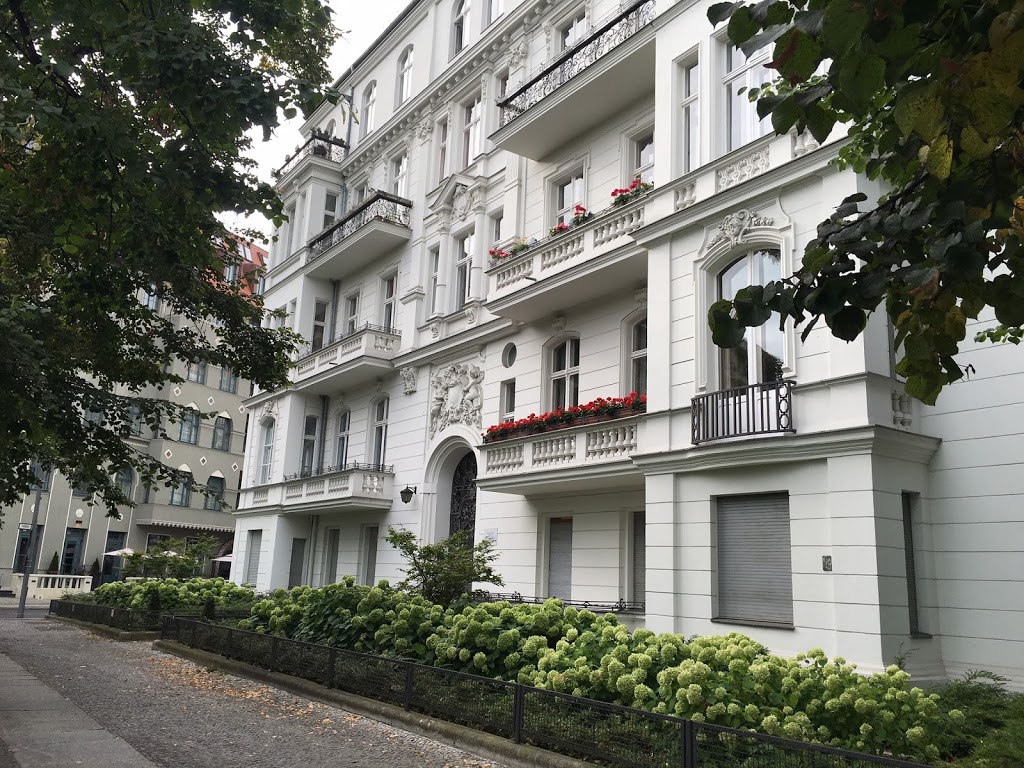
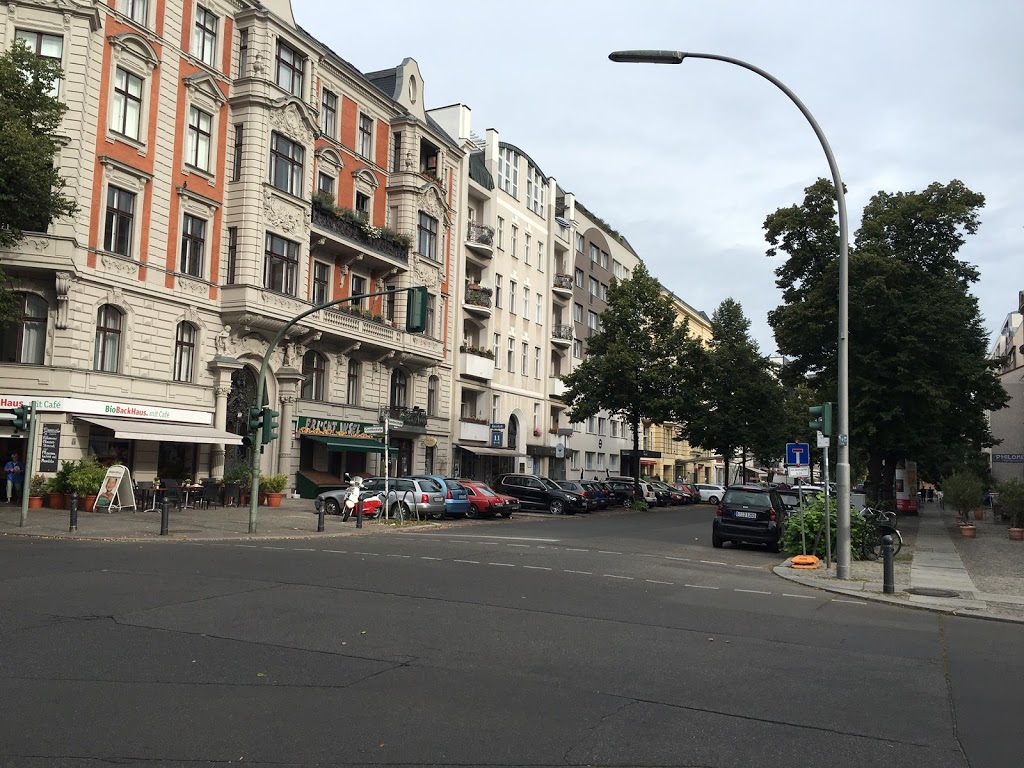
    Getting here was easy: a 10 minute walk to a bus stop and a 15 minute ride from there with only 4 stops. I couldn’t resist a couple of last Berlin photos along the way. We really enjoyed our stay in Berlin. It’s up there with Rome and London for us, maybe even Paris. We are most definitely city boys.


    Going to work on the Day 11 blog until they call the flight. The lounge attendant said she will give us enough time to get through security so I don’t have to worry about it until she calls it. My hope was that I could finish that entry and this one before I board. She’ll likely call it in about 90 minutes; don’t think it’s going to happen. One of these trips I’d like to finish the whole thing before I get home. It hasn’t happened yet.

    ————–
    It is now 2:24pm London time, which is one hour earlier than Berlin. Flight took off 30 minutes late but landed only about 15 minutes late. I have to say Berlin is the weirdest airport I’ve experienced. Security and passport check happened directly at each gate. Seems so inefficient. And then the gate areas themselves were tiny.

    I made it through Heathrow security and to the lounge in about 20 minutes probably – record time to be sure. It’s taken me as long as 2 hours before, especially when flying by myself economy. The business class ticket I have allows me to use Fast Track, and it’s also what gets me into the lounge. The biggest challenge was finding two plugs next to each other that both worked. Luxury problems to be sure. Back to yesterday’s blog. I’ll board in about 90 minutes….still probably won’t be done….
    —————

    It’s 9am Monday morning, home. The rest of the trip was mostly uneventful. The flight out of London was delayed and landed almost an hour later than scheduled. Dan was worried when I first told him I thought I only had an hour between landing from London and the Southwest connection I was taking for the final leg. He said customs at LAX can be a zoo. He was right. My original schedule provided me with 2 hours, but the delay resulted in it being one after all. And customs was ridiculously frustrating. I’m not sure why they don’t have their act together like SFO, which is very easy. It wasn’t just about the number of people. It was disorganized and there were 3 pieces to it, with long lines each time. At the second piece, another traveler graciously let me cut in line since I still had a connection to catch. Apparently familiar with LAX she said “I still don’t think you’re going to make it, but I hope it helps.” It did. I literally ran from the international terminal on the outside past terminals 3, 2 and then 1, the Southwest terminal. As I was going through security at 9:15 for a 9:30 flight, Southwest paged me. “The flight is completely boarded and ready for takeoff.” IOW: hurry your ass up if you’re here. I was the last person to board and was So Happy I didn’t have to spend an unexpected night in LA.

    I Uber’ed home and got here about 11:30. I was oddly wired – considering it was 8:30am Berlin time and I hadn’t gotten much sleep in the prior 28 hours, maybe 2 hours tops. I unpacked and even went to Safeway to get a few things for breakfast so I wouldn’t have to leave the house today maybe.

    Before I forget, I watched 5 movies on the way home, each very enjoyable, and each very different from the next. I would recommend all of them if you haven’t seen them: 10 Cloverfield Lane, Deadpool, Eye in the Sky, Joy, Money Monster.

    As is our tradition, we finish with final thoughts.

    1. One of the reasons we love to travel is the history we come across. This trip may have surpassed all others on that front. In addition to the great stuff we got on the last day, I really appreciated all of the oddly personal connections I was able to make at the beginning of the trip between Bohemia, Moravia and Silesia – those regions that showed up in the Pre-Departure entry related to my heritage. I didn’t find any long lost relatives; still, it was satisfying to get a better sense of all of that, and to learn how important those areas were in the years from 1000-1900. And to learn that by present boundaries my heritage is like 75% Czech! Dan thinks I should now describe my background exactly as written: most of my people come from Bohemia, Moravia, Silesia, and Bavaria. Since none of those exist anymore as entities, it’s an opportunity to tell the story when people go “I’ve never heard of any of those places.”

    2. The palaces on this trip were mostly “meh” although Schonbrunn in Vienna has its place. Do Versailles as some point in your life and you really never need to do any others. (At least based on the last 5 trips! We will still check them out in future trips to see if anything comes close…)

    3. The cathedrals and their endless varieties continue to fascinate us. St. Vitus in the Prague Castle complex was the most impressive of this trip, and goes into our top favorites.

    4. As always, language was not a barrier. And as always, Google Maps is our best tool.

    5. More as always: lots of smokers and heavy cologne wearers in Europe. And on this trip, add body odor. We’ve always noticed, but somehow it seemed more predominant this time.

    So beyond the history, this trip much the same as others, which is oddly reassuring. Probably because we’ve stuck to the same continent so far, things feel more and more familiar. Germany in particular this time, even different from Austria, felt like we were coming home as soon as we got off the train in Dresden. It is by far the country we’ve seen the most of, no accident since it’s the home of Bayer.

    It may also be prescient that in Dresden and Berlin we got glimpses of Turkish history that we hadn’t gotten before, because since the Italy trip in January we’ve been talking about Istanbul as part of the next one. Now we’re even more sure of it, but of course will continue to monitor the political situation over there to see if that has any impact on our decision. While we won’t do anything reckless, for the most part our sense of things is “if we let terrorists keep us at home, they win.” So we’ll be going somewhere for sure again, perhaps in May sometime.

    So we’re thinking either something like Istanbul, Athens and Budapest (which we realize now we should have done on this trip instead of Berlin – would have complemented the others cities we did historically so much more effectively) OR something completely different like rent a car in the UK and drive through the countryside, doing things like Bath, Cardiff, Southampton, maybe Cambridge and/or up to the Scottish Highlands. That 2nd one has been on our list for awhile, it’s just a matter of when. Dan is excited to take advantage of the drop in the British pound since Brexit before it recovers too much :)

    And a lot may happen between now and then. If things go well, I will be living with Dan in Raleigh by the next trip. Lots of moving parts on that front so will have to wait and see how it all unfolds.

    No matter what, we will continue to blog. Especially on the last day of our trip, I thought a lot about how the blog influences how we capture what we do. And I say it every time and it’s still true: we do it for us, because it helps preserve the trip in our minds in ways that wouldn’t happen if we were just going through our day without thinking about documenting it. And I really enjoy re-reading them later, and do it probably more than I should. But it’s always fun to have you come along, and we are grateful for the feedback we get when we know you’re enjoying it to.

    Hope to see you next time!


  • Day 11, Sat 9/3: Berlin, Part 2

    Day 11, Sat 9/3: Berlin, Part 2

    What a day. We packed a lot in and were pretty happy with it by the time we were done. The photo editing though is going to take awhile so who knows when this will go up! [I started at 10:50pm Berlin time Saturday night; continued in the morning at the hotel before, during and after breakfast, in the lounges at the airport at both Berlin and London before boarding. I finally finished Monday morning.] Between the 2 of us we took 184 photos today; that’s about 60 more than the record which was 125 at St. Peter’s and the Vatican in January. Many of those 184 are pictures of text explanations at exhibits to help with the blog narrative so many of them won’t actually make it in. But that means a lot of history is coming, so if history ain’t your thing, so sorry :) We are both definitely history nerds; today was our Disneyland.

    We were both very tired at the end of Friday and slept very well that night; Dan at least 7.5 hours, me about 9. So woke up pretty refreshed and ready to go.  And a good thing because we put together a very ambitious agenda for our last day. We did breakfast in the hotel as usual and were on our way about 9:45.

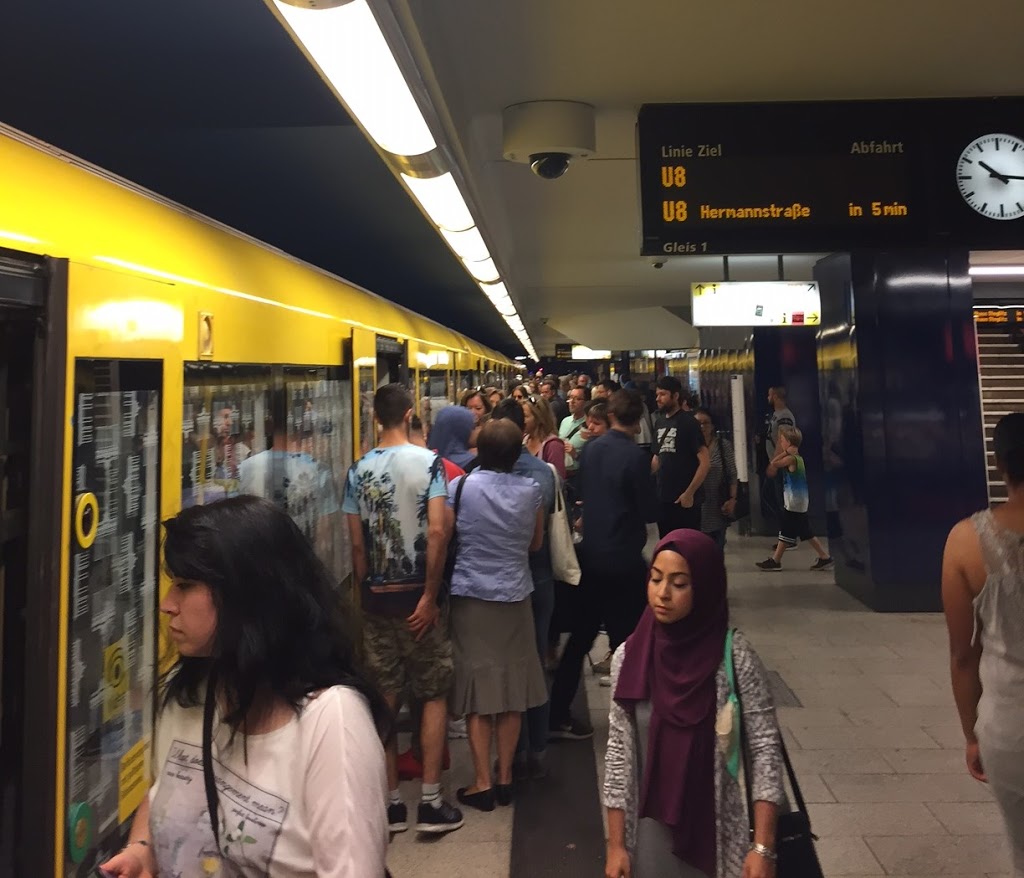
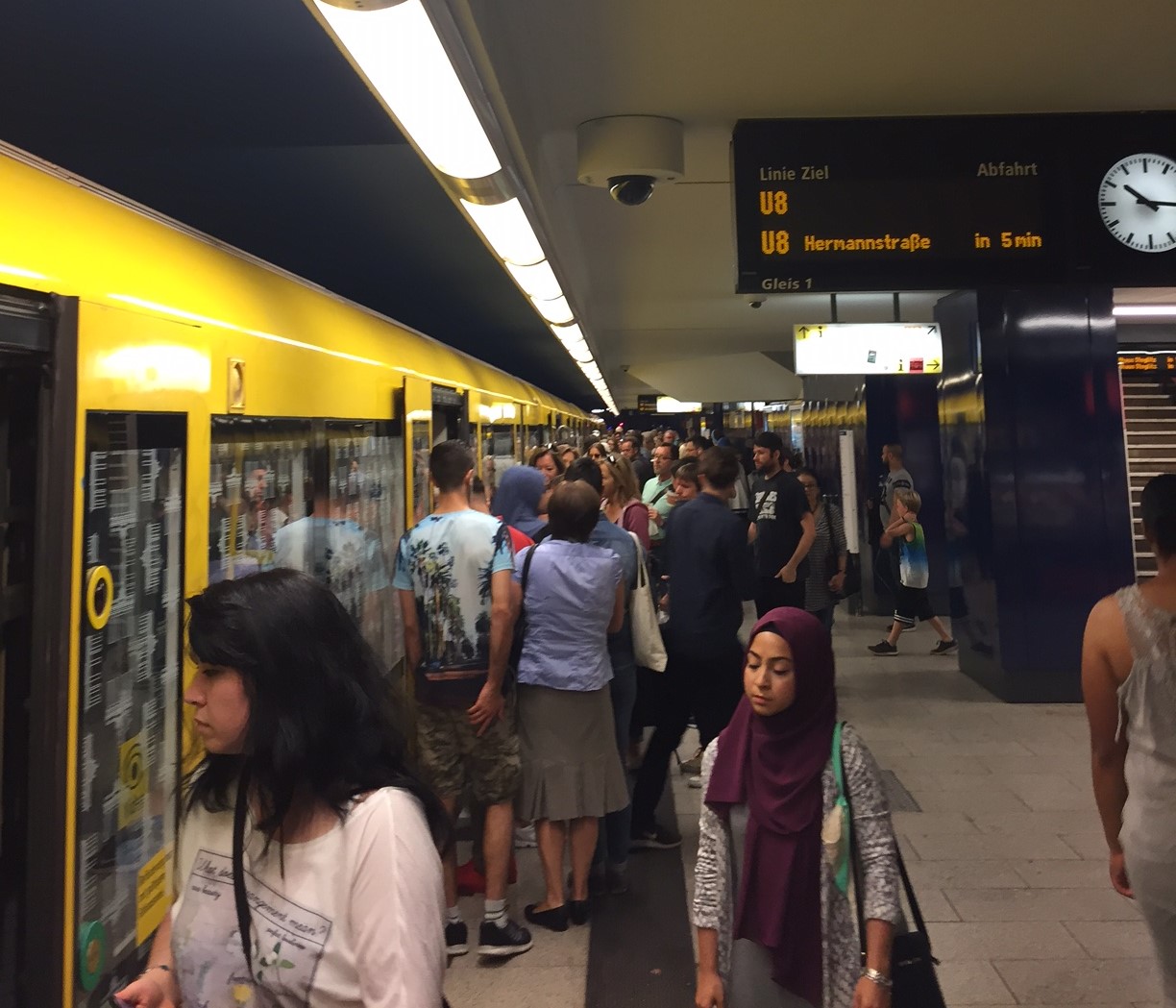
     We took the subway a block from our hotel and had a transfer on this route. It was a busy Saturday morning on the subway.

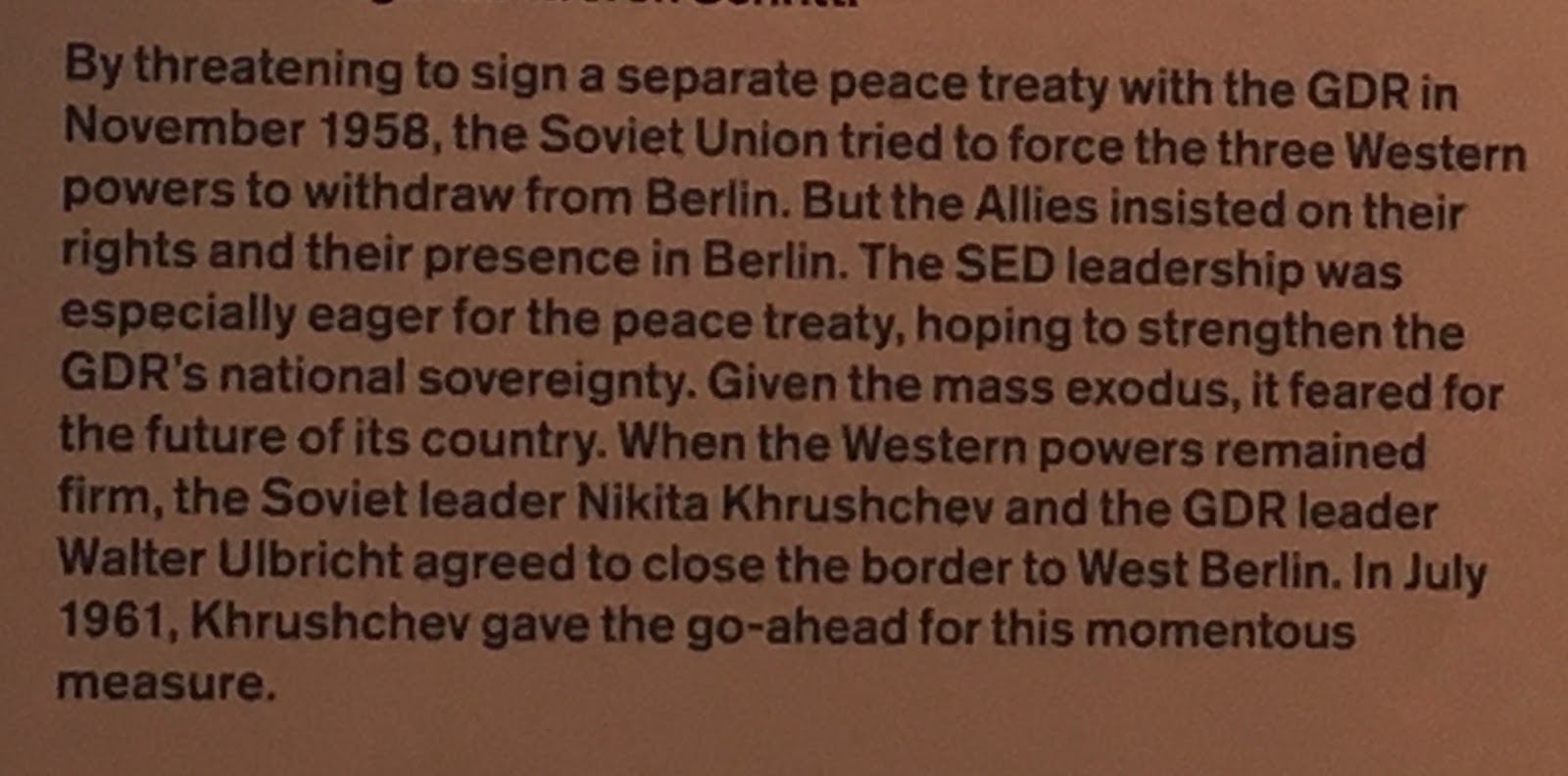
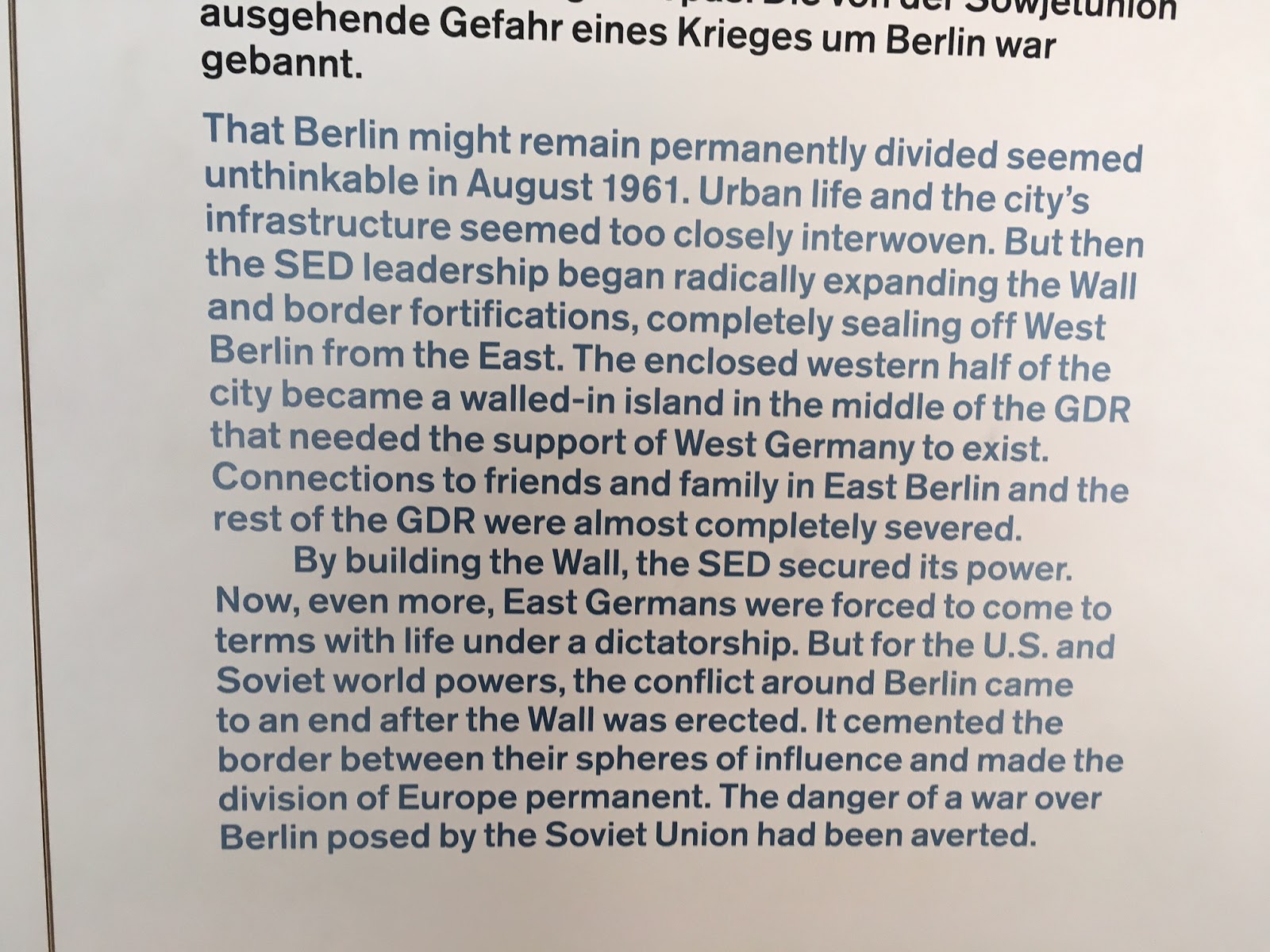
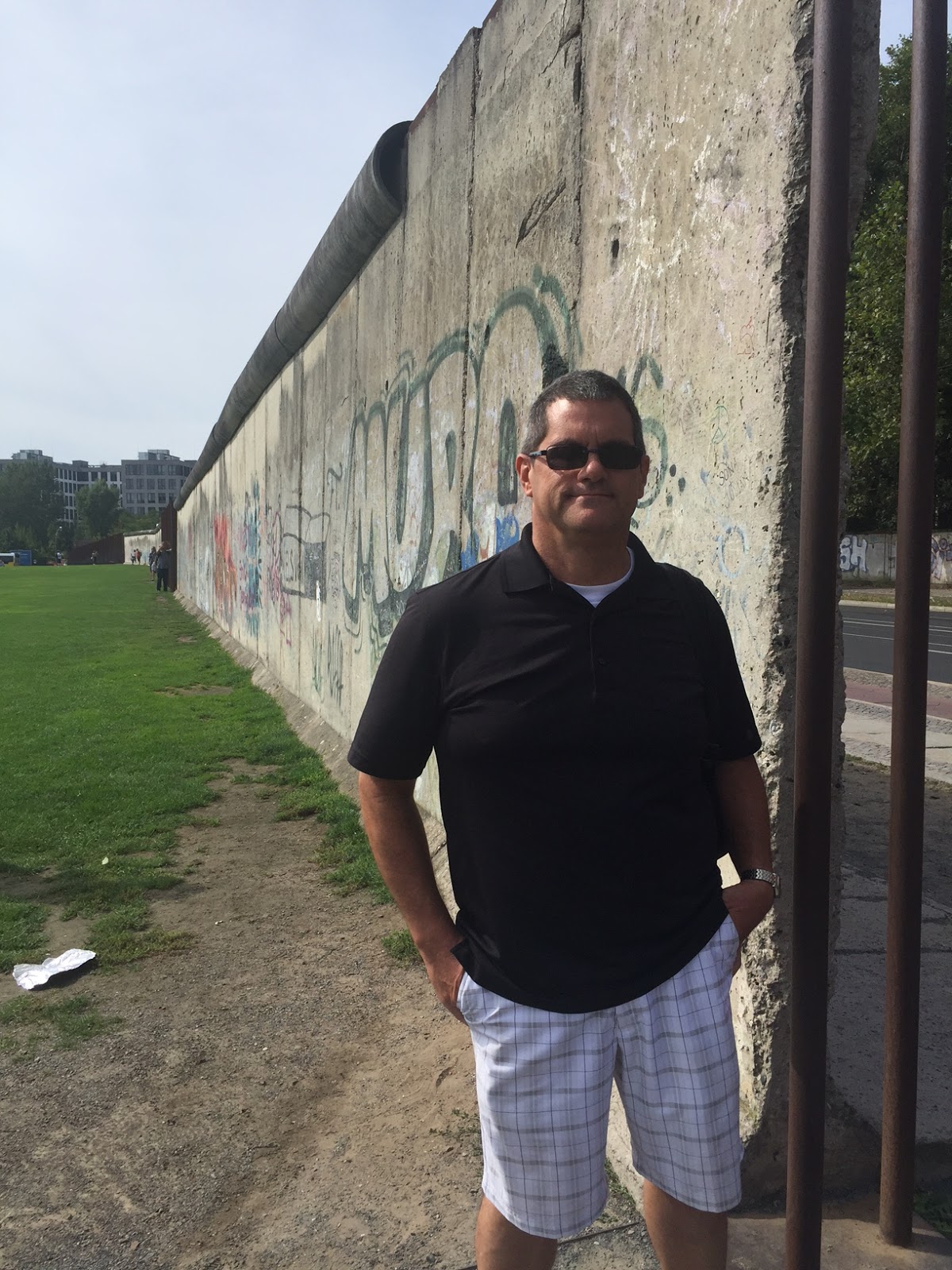
    Our first stop was the Berlin Wall Memorial. This was the item of the entire trip I was looking forward to the most, and I was not disappointed. Similar to my experience at the Anne Frank House in Amsterdam, I got choked up as soon as we walked on the grounds and stayed that way the entire time we were there. Our initial plan was to only stay 30 minutes because of the aggressive agenda we had for the day. We were there 2 hours. Fifty of the 184 photos were took today were just here. I’m going to include some of the text explanations directly because it will be both easier and in some cases more poignant.

    I love the things I learn on these trips. Dan is always amazed at some of the things I didn’t know – like how East Berlin and West Berlin came to be in the first place, which I finally learned here – and that I should keep that to myself :). I always assure him that I’m the norm and he’s the exception when it comes to history (and geography), so feel free to comment on that if you learn something, especially in this next couple of paragraphs:

    Ever since my early fascination with the Olympics starting in 1976, the whole East Germany vs. West Germany thing had always been of interest to me because of the way the sports commentators would reference the differences, but a mystery as to how it had all come about. Maybe this was covered in school and I just don’t remember. But I didn’t get clear on it until 2014 when I went to the German Museum of Contemporary History in Bonn: Once the Allies took over German in May of 1945, they divided the country into 4 sectors, one to be controlled by each – USA, Britain, France, and the Soviet Union. From the beginning, the first 3 approached it in a united fashion and worked to create a capitalist society; Stalin of course did not play. By 1949, things had progressed along that route where it became necessary to split the country in two: West Germany was formed from the 3 unified sectors, East Germany was formed from Stalin’s, and East Germany became one of the many Eastern Bloc states of the Soviet Union, along with the Czechoslovakia, the Baltic States of Estonia, Latvia and Lithuania, and others.

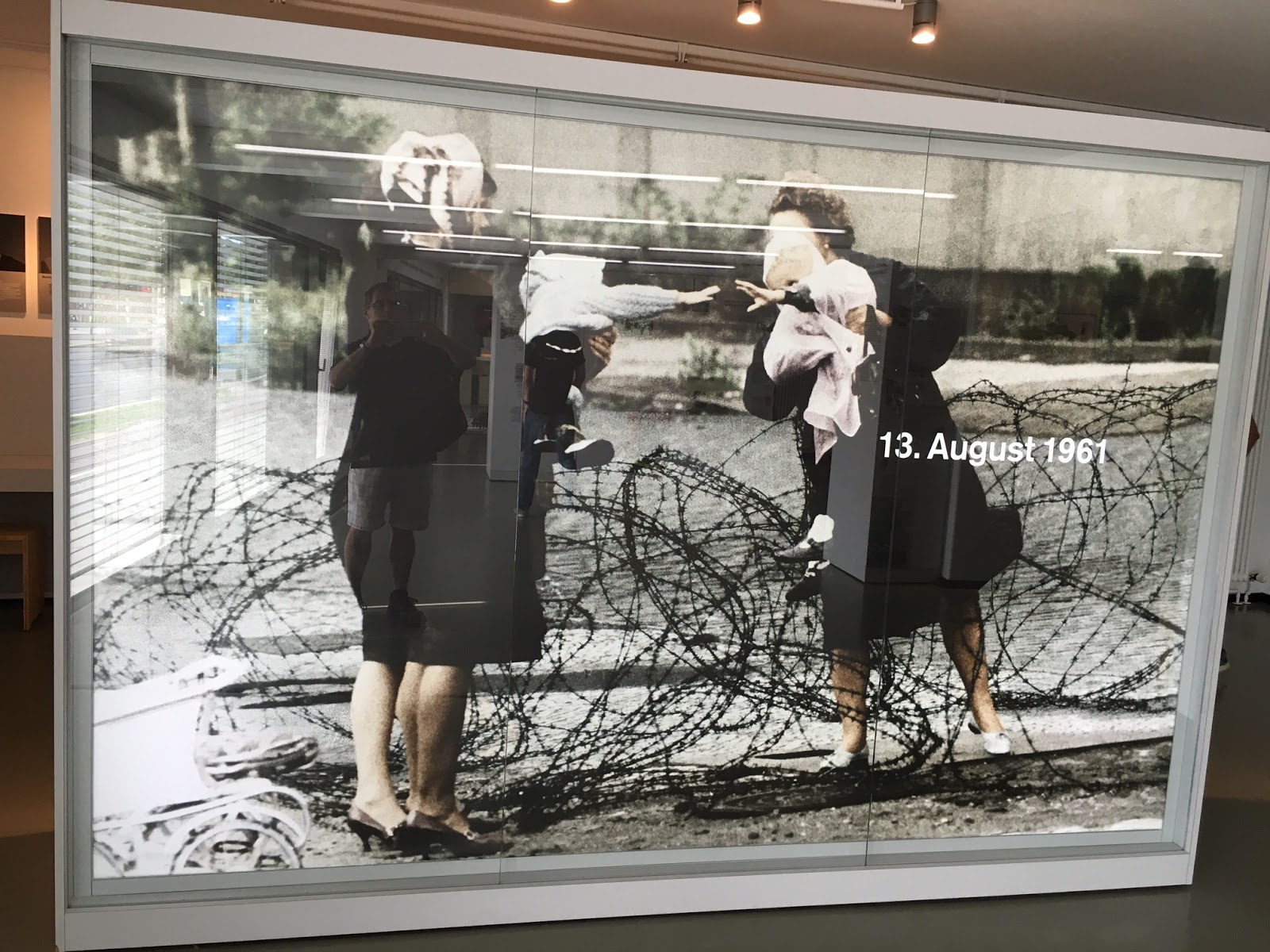
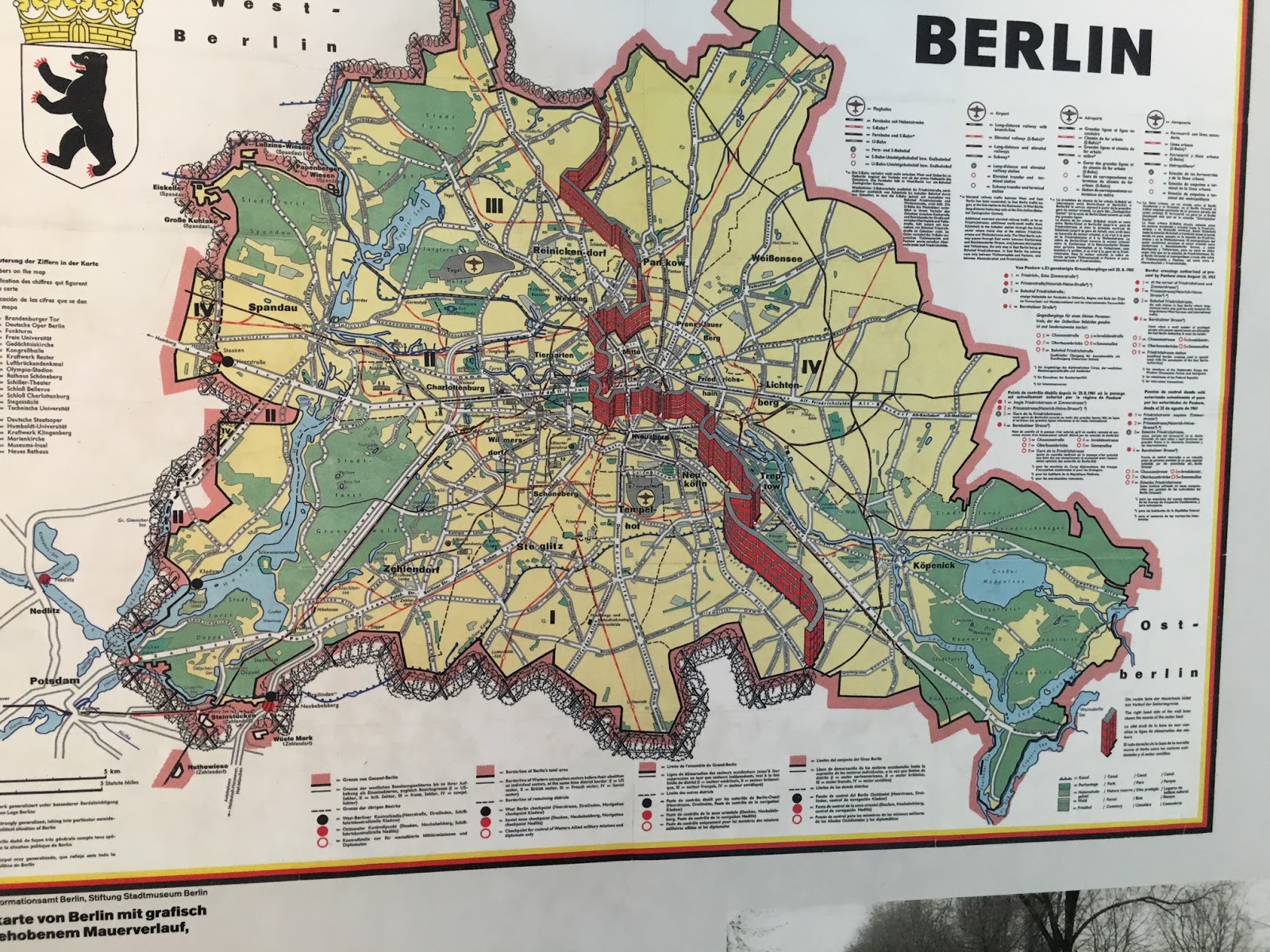
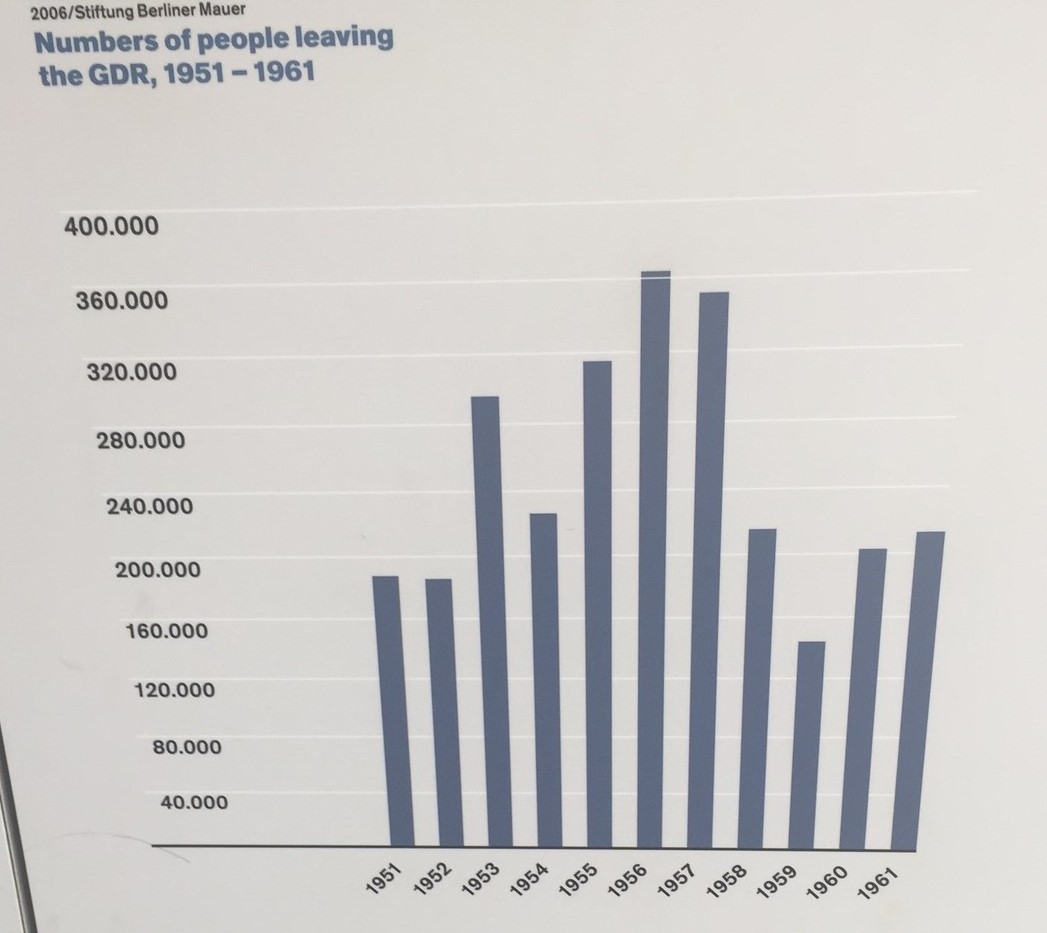
    So that finally cleared that up, but I was still confused about East Berlin vs. West Berlin. For longer than I should admit, I always assumed that the border between East Germany and West Germany ran through Berlin, and that’s what created the two cities. I don’t remember now when I learned that wasn’t the case: that West Berlin was essentially a free democratic zone within a communist state, completely surrounded, and to leave citizens had to fly or take a train into West Germany, or some other democratic area. And what I learned here is how that came about: when the Allied powers split up the country into 4 zones, they also split up the capitol, Berlin, the same way: East Berlin was the 4th sector under Stalin, the other 3 became West Berlin. And for the first 12 years, it worked. Sort of, and depending on who you asked. Although there were border crossings surrounding West Berlin, citizens of both could come and go between the two pretty easily. People had jobs, families, friends, etc., across the border and going back and forth wasn’t a huge deal. The problem for the East was that it became too easy for communist citizens to escape to the West in general through West Berlin: easy to get to, easy to get out of. The problem for the West – and by West in this context I mean political – is that the tension between East and West Berlin was at the core of what started the Cold War. West Berlin was a conspicuously capitalist city in the middle of Soviet territory and Nikita Kruschchev said it “stuck like a bone in the Soviet throat.” The Wall went up in August of 1961, put up by the party called SED (the Socialist party that ruled GDR or East Germany; GDR ironically stands for German Democratic Republic). Politically, it was a success because it eased the tension between to political powers: 1000s of people a year were no longer able to flee the East as had been happening; over 3 million over the course of the decade. And the Wall eased some of the tension between the two sides: President Kennedy said “a wall is a hell of a lot better than a war.” 


    But for the citizens it was a disaster. Their lives literally changed overnight, in many cases separated from families, friends and jobs by the Wall. This memorial tells the story of the impact on the people. There was a lot of information here, both technical and human; we tried to pick out the things that would complete the picture without overwhelming.

    The Wall 
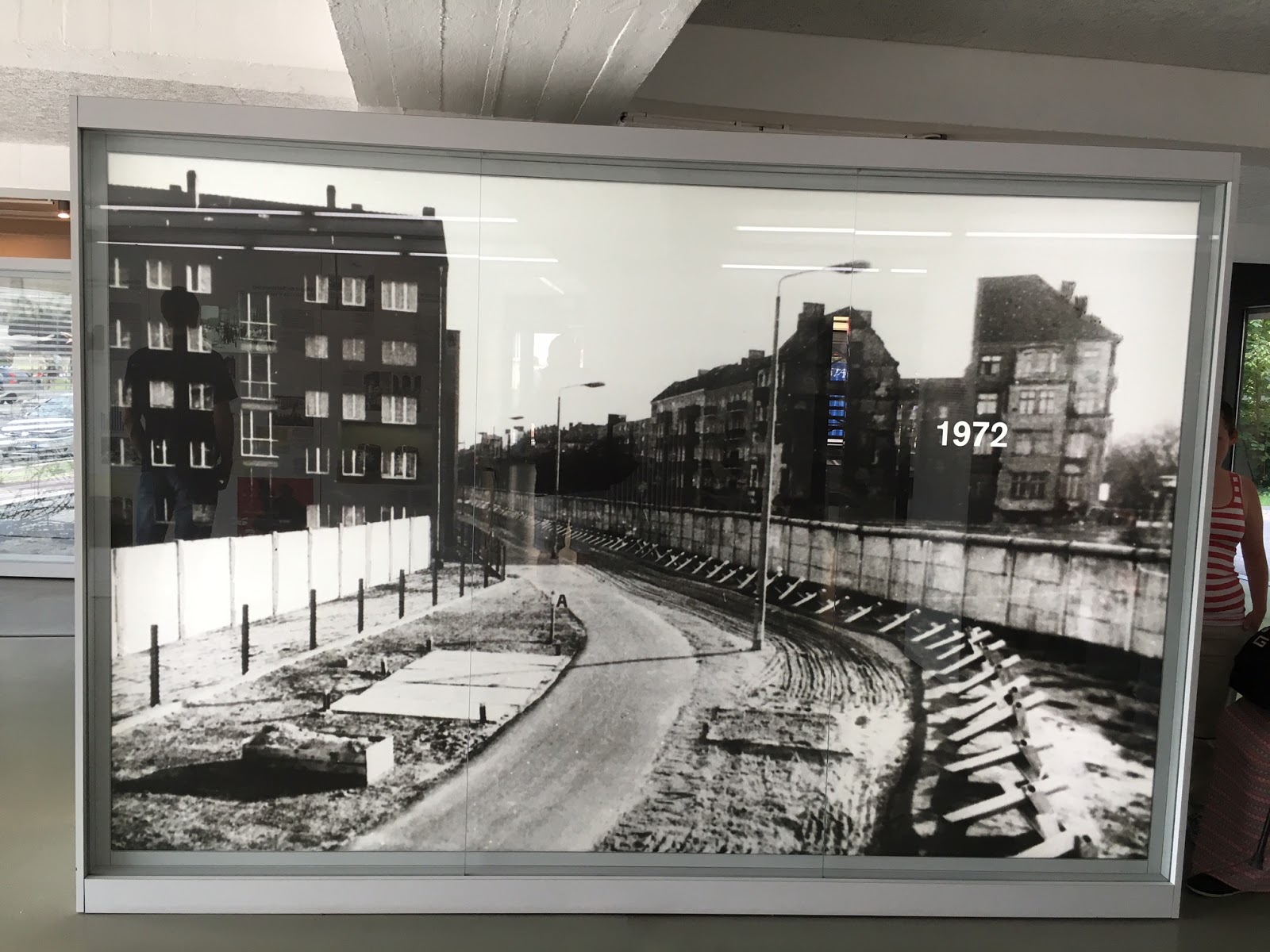
    Here are various photos of the wall itself. Note that at first it was just barbed wire and then very shortly became a literal wall, then progressed to being an area with several layers of barricades with a patrol road and towers in between.

     This was right after it went up. For the first couple of weeks, people would make “wave dates” at the Wall to see loved ones and friends they had been suddenly torn from.

     West on the left, East on the right.

    In this photo, East is on the left, West on the right.
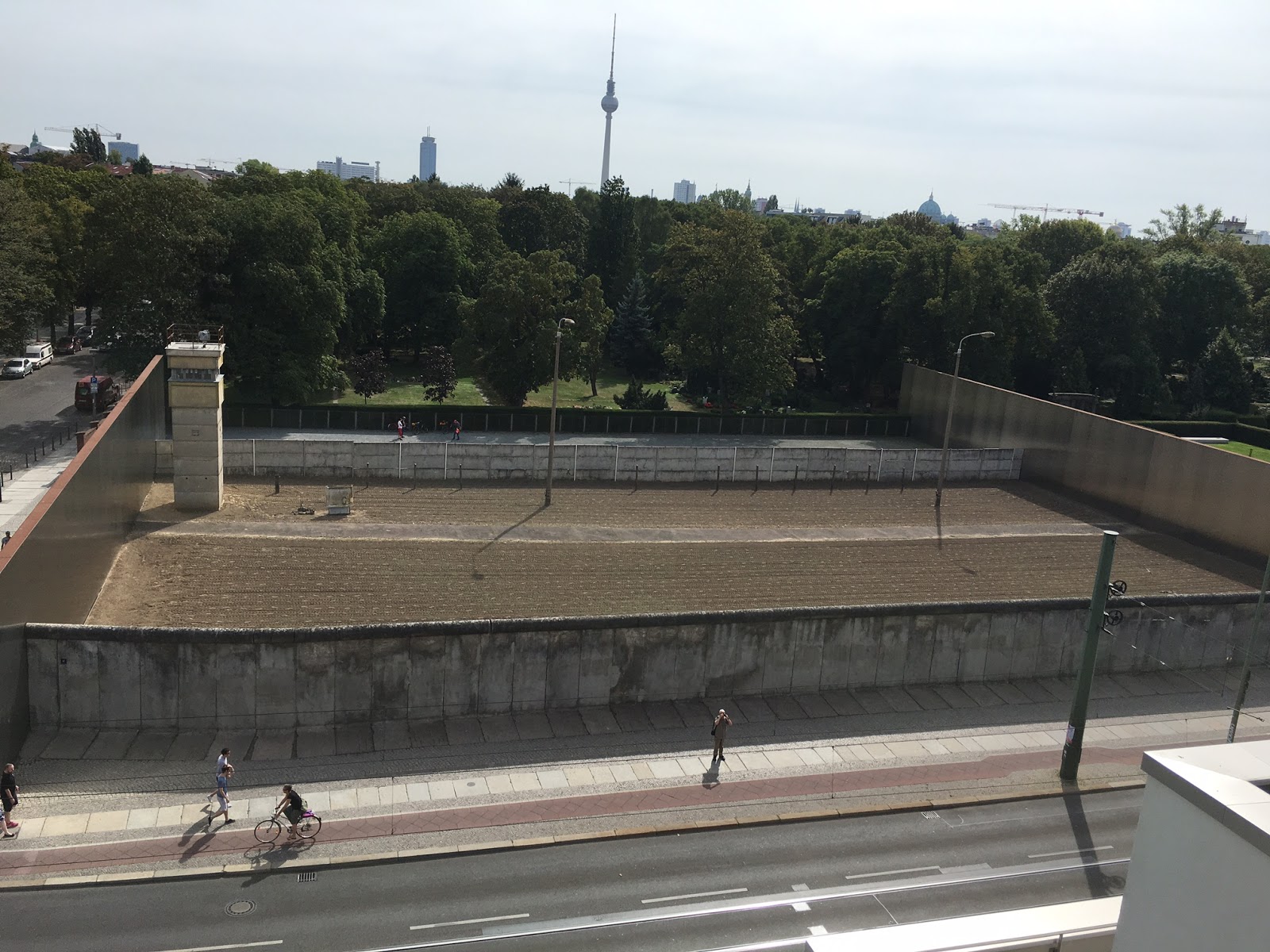
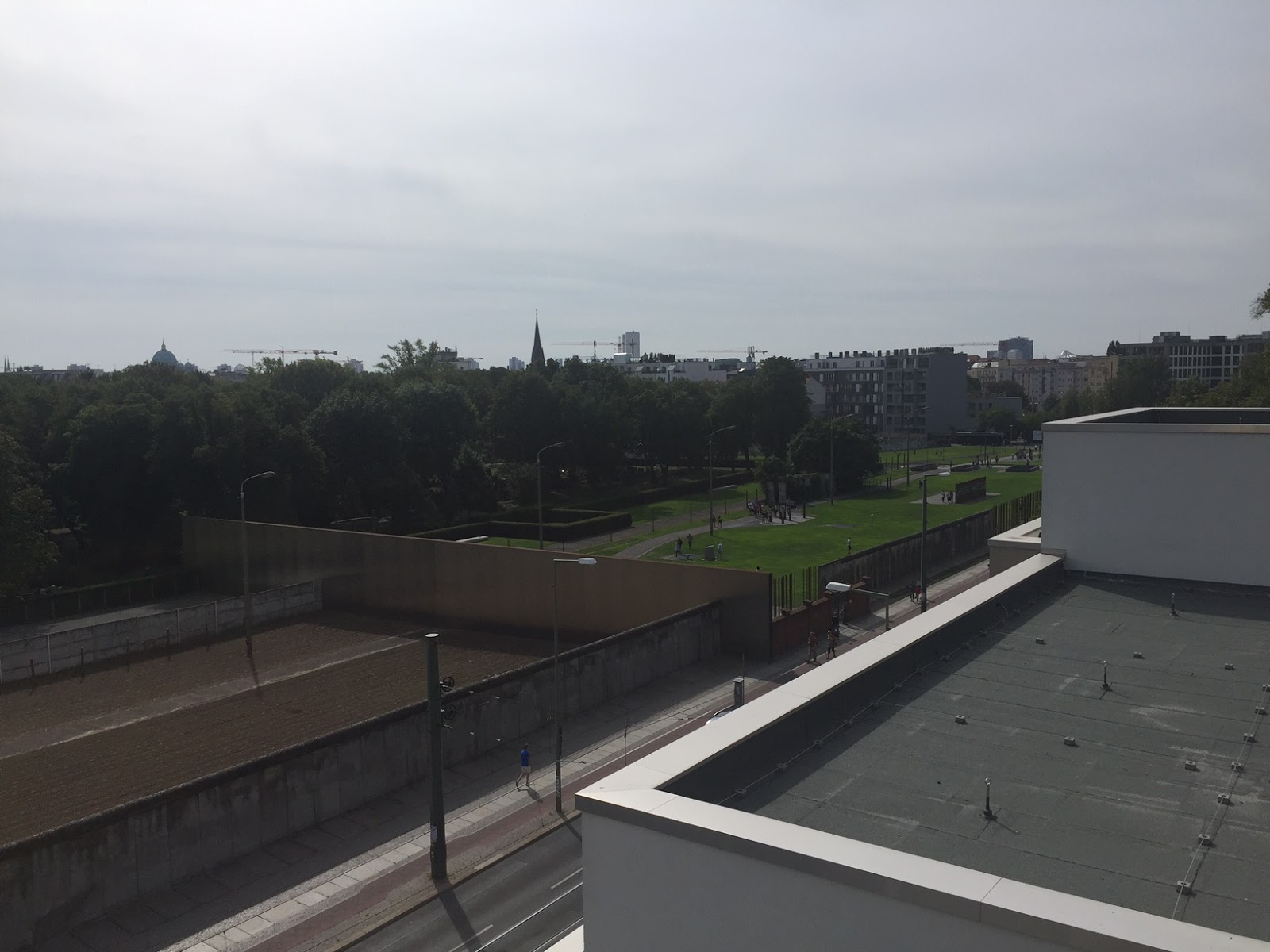
    From the observation deck at the memorial, some of it has been preserved. This is from the West side. Notice the TV tower in the background from our first day in Berlin (Day 9). Most of today’s central area was on the East side.
     The memorial stretched on both sides of this preserved section of the Wall. The upcoming blog section on Bernauer Strabe and the Reconciliation Church was all on the other/left side of this.


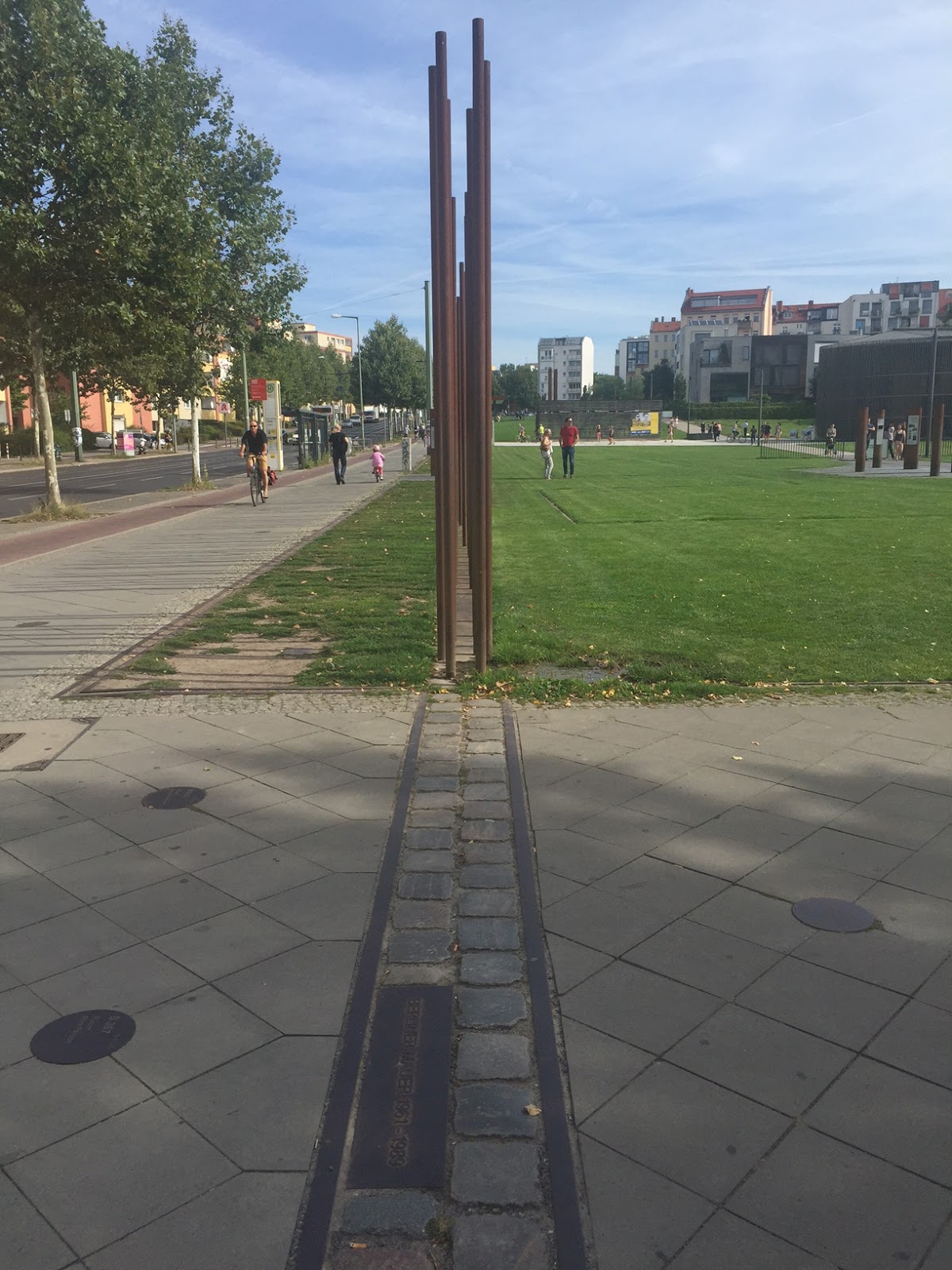
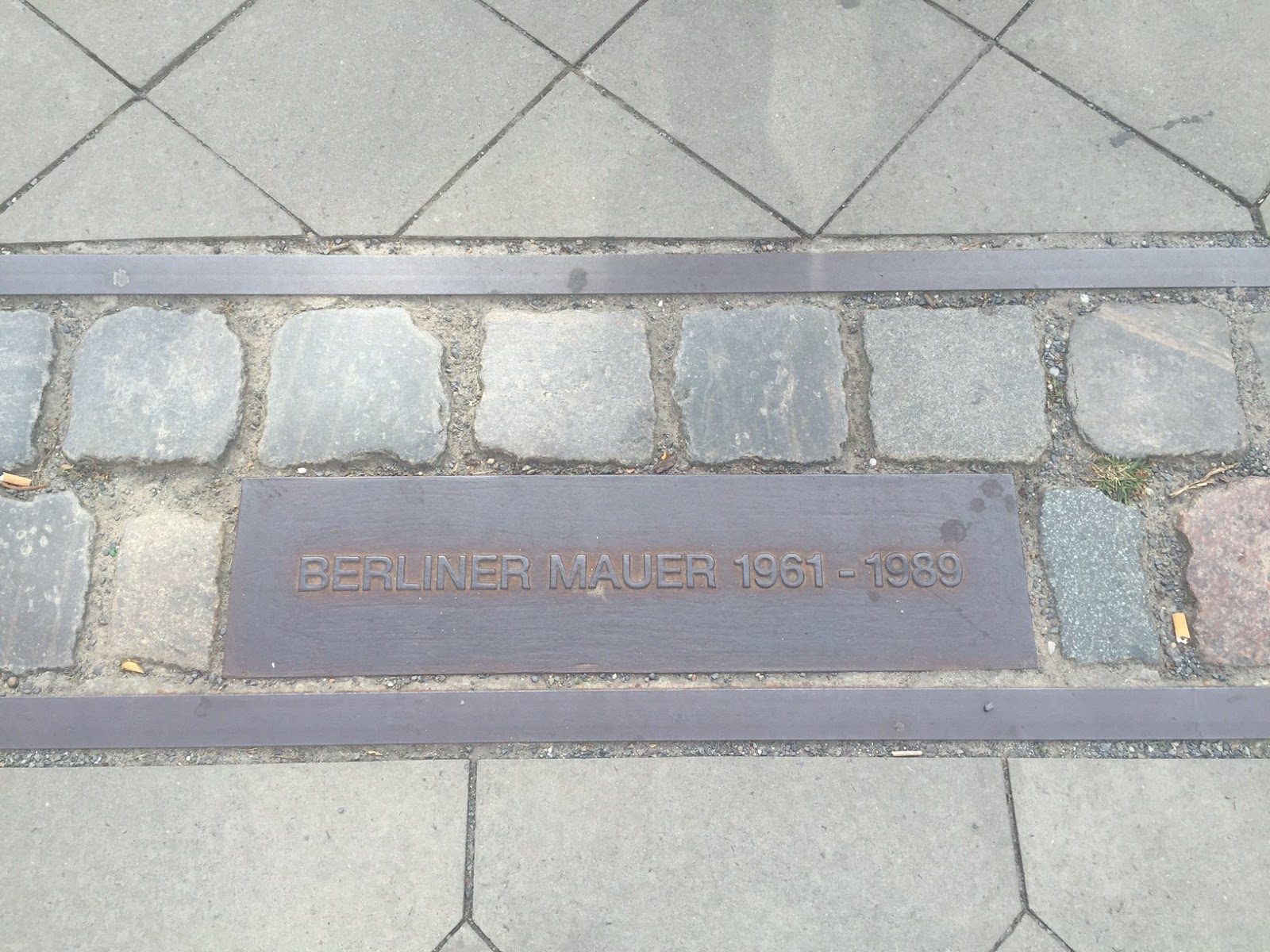
     Much of the memorial is bordered by these iron posts representing the wall. West on the left, East on the right. The photo below is the plaque in the ground above.
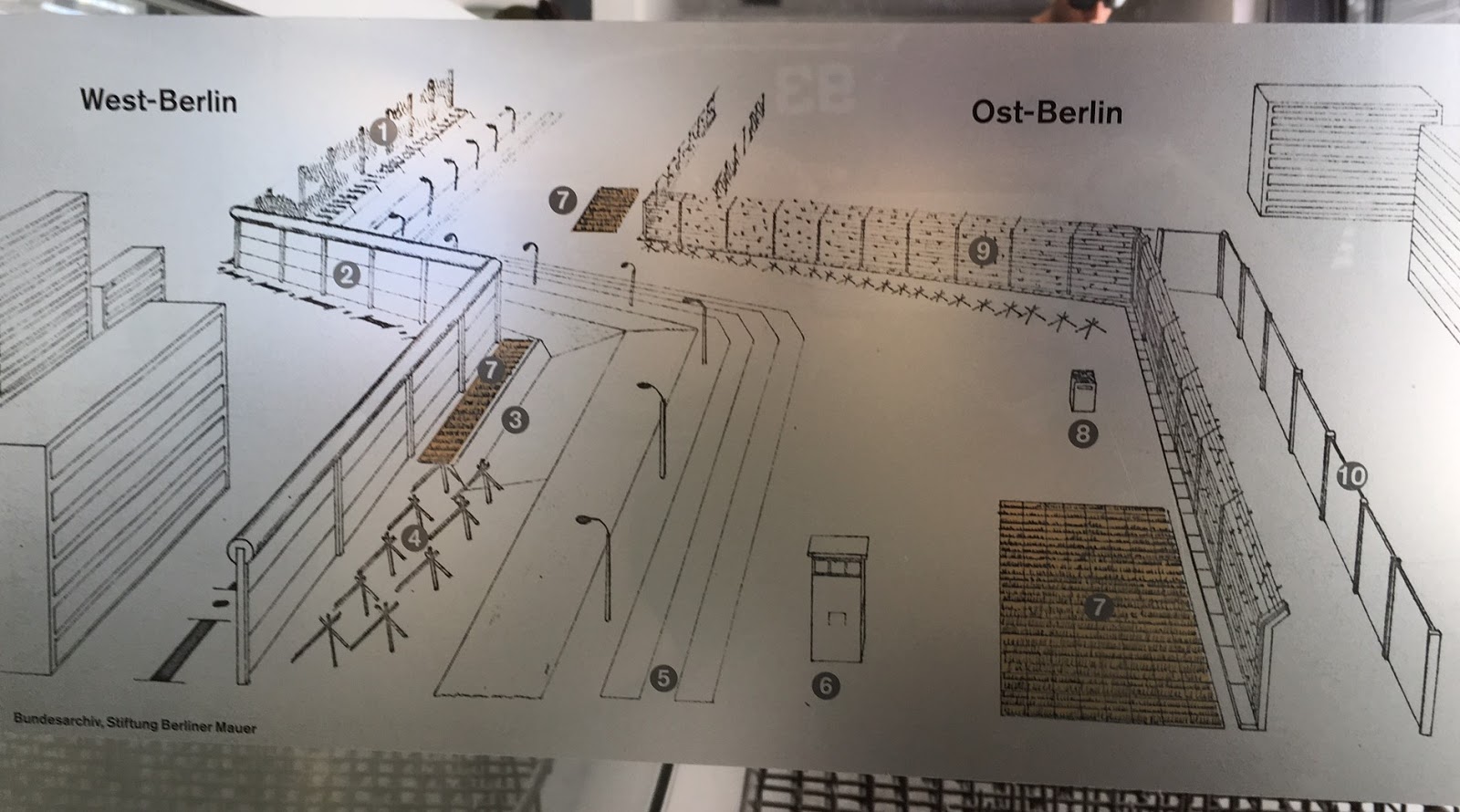
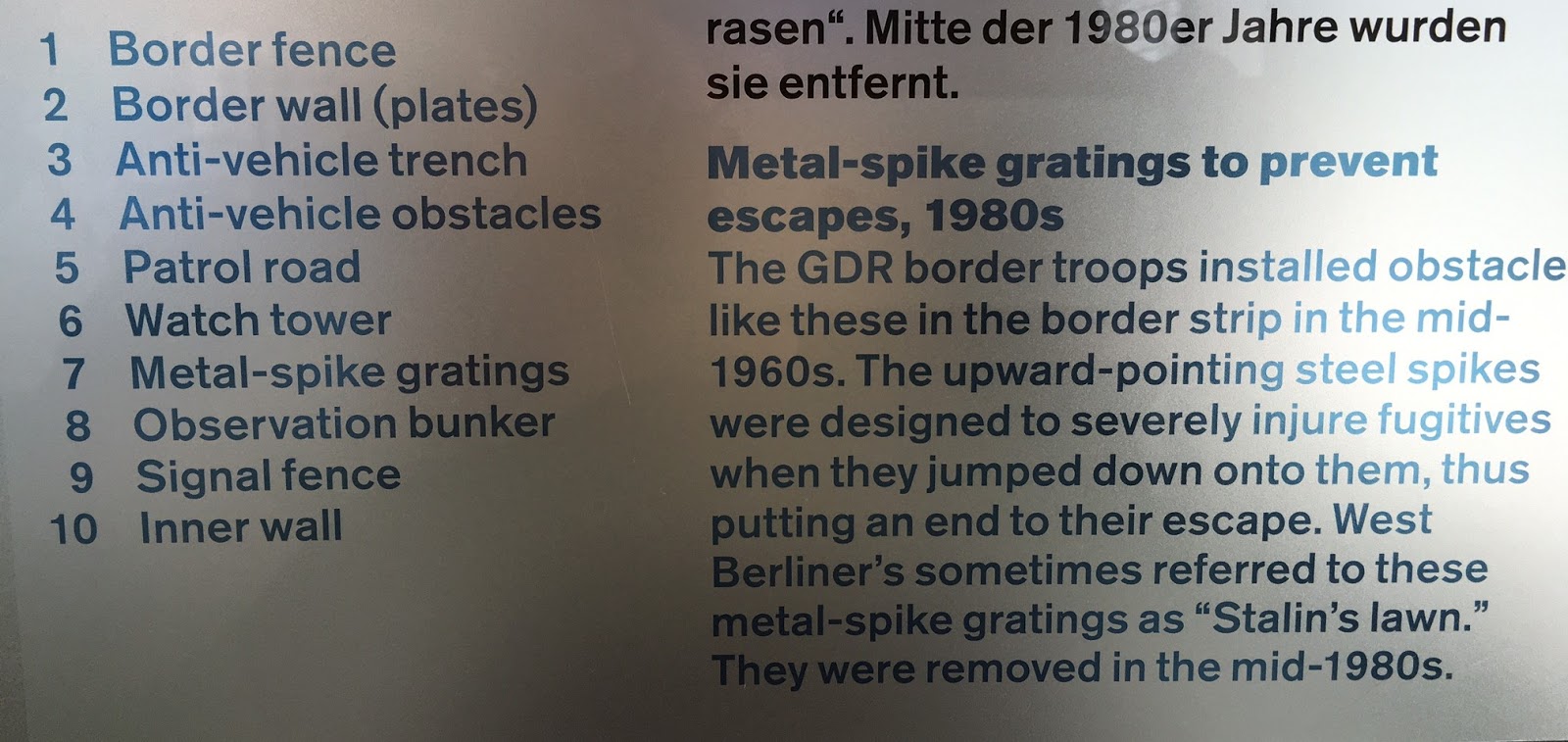
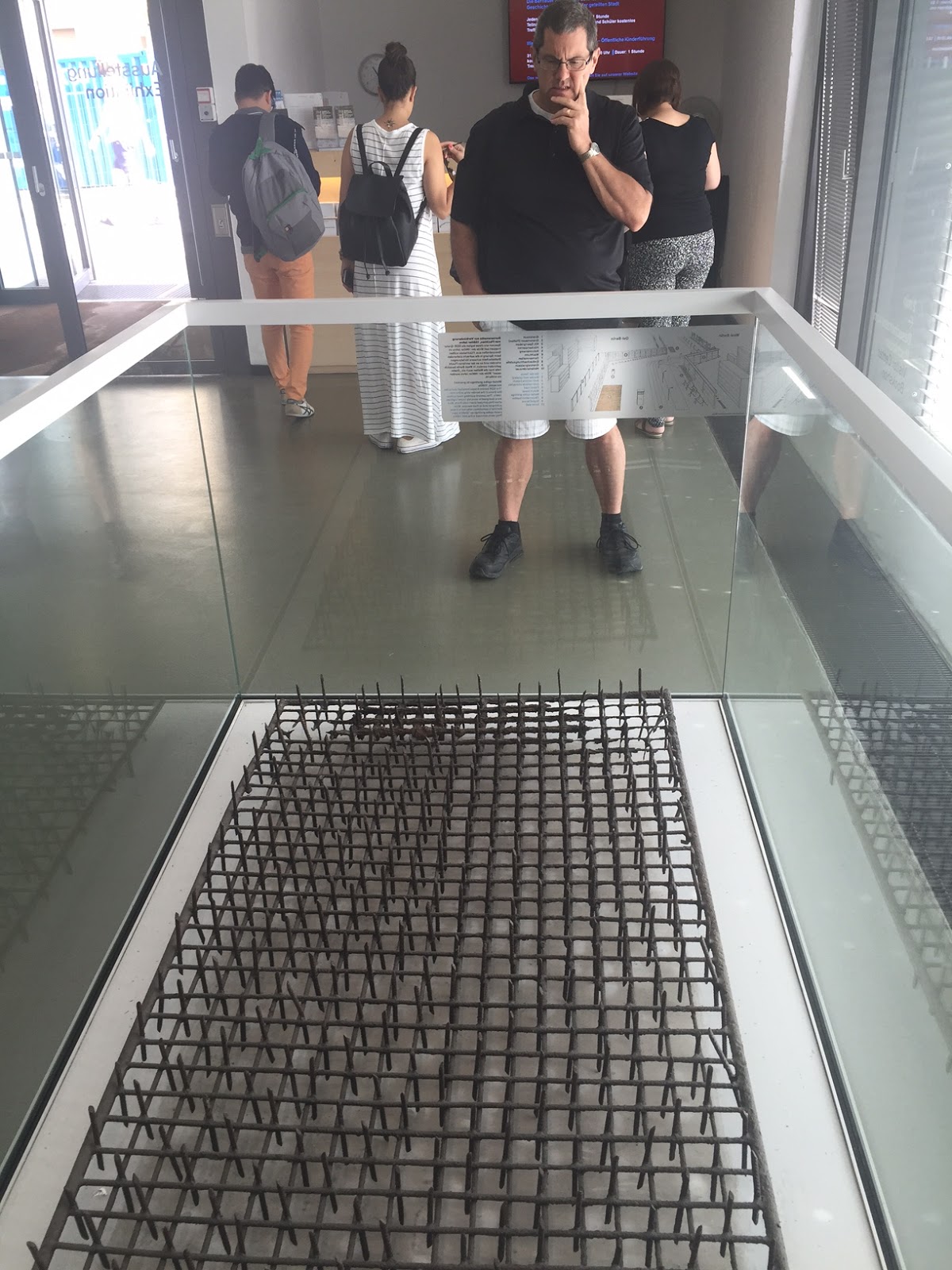
    These next 3 photos show the detail about how the Wall was constructed, all the pieces and parts, with an example of “Stalin’s Lawn.”


    Bernauer Strabe and the Reconciliation Church

    The Berlin Wall Memorial is located at the site of two adjacent locales that best represent the entire story of the Wall.

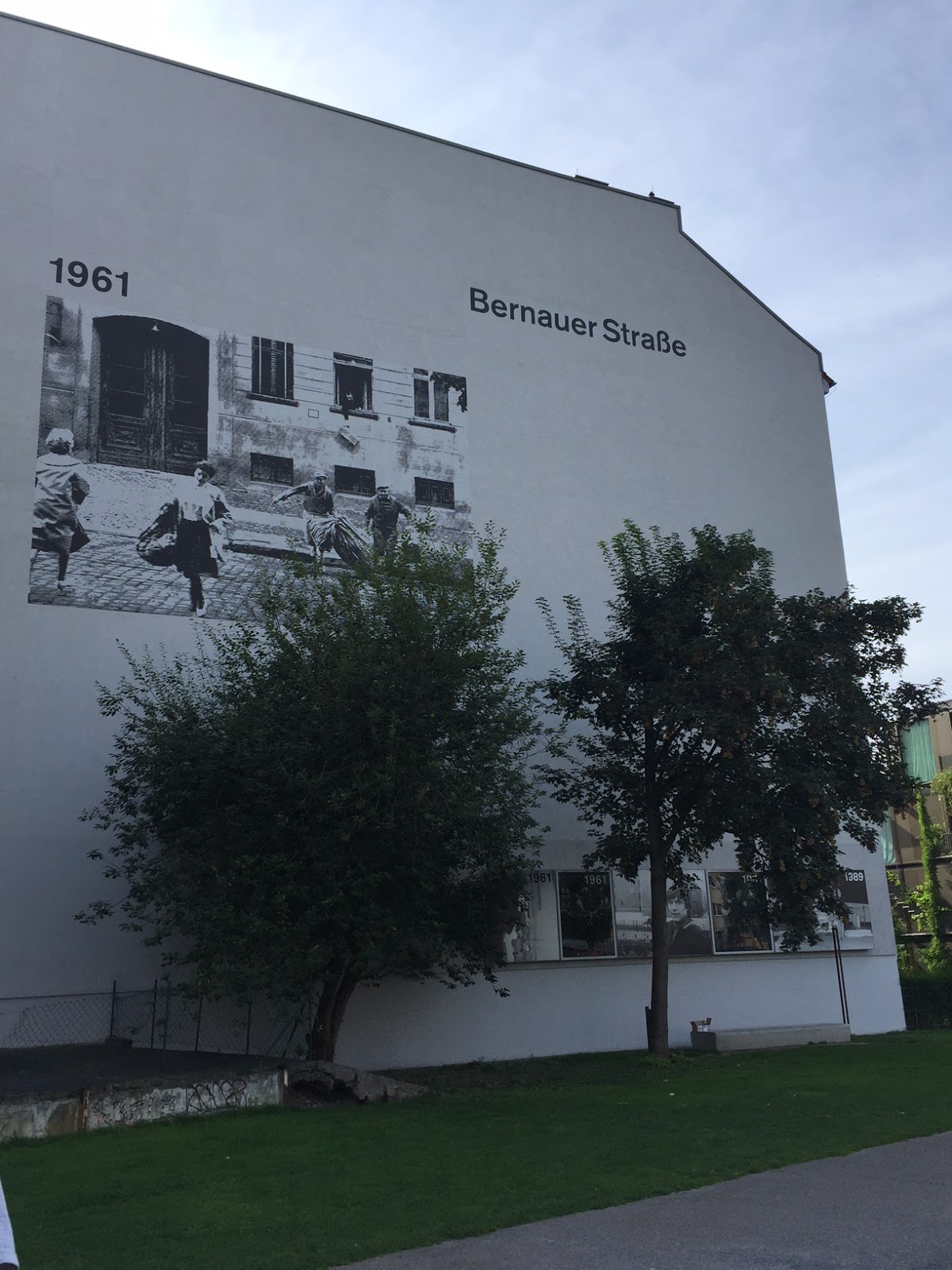
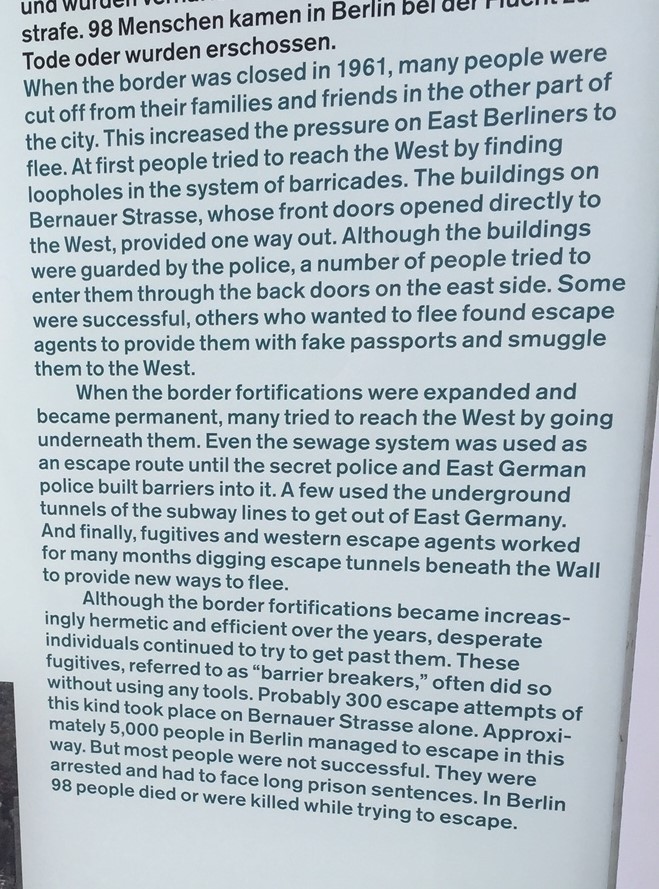
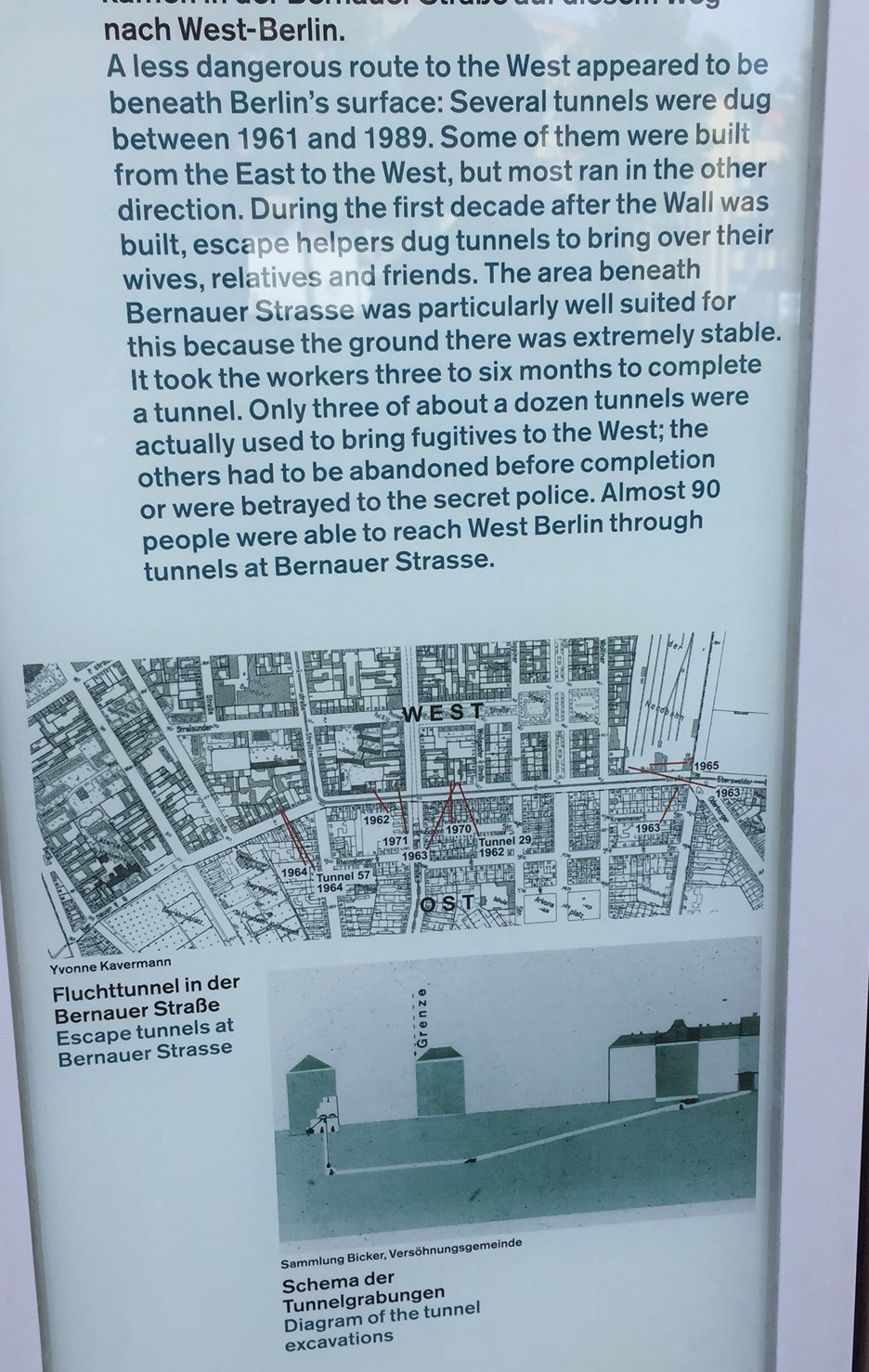
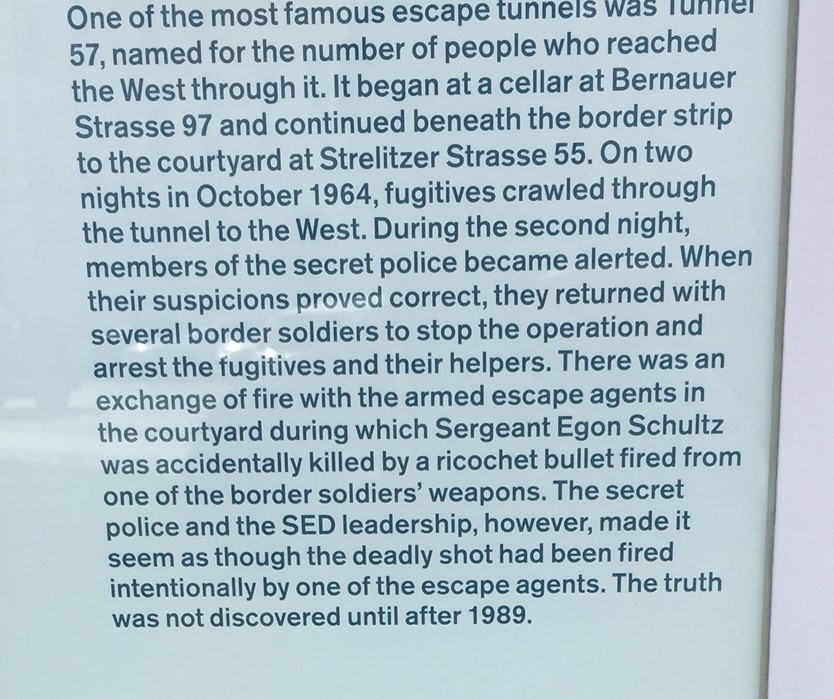
    On Bernauer Strabe (street) there was what were referred to as “border houses” which literally sat on the border between East and West: so much so that their front doors opened to the West, back doors to the East. In the first few weeks of going up, word quickly spread that this was a way out for those wishing to escape the East. Over time, the SED forced residents out of these houses and boarded them up to stop the incidents. This ground in this area was also very stable, and turned out to be a good place to build tunnels, usually started on the west side.

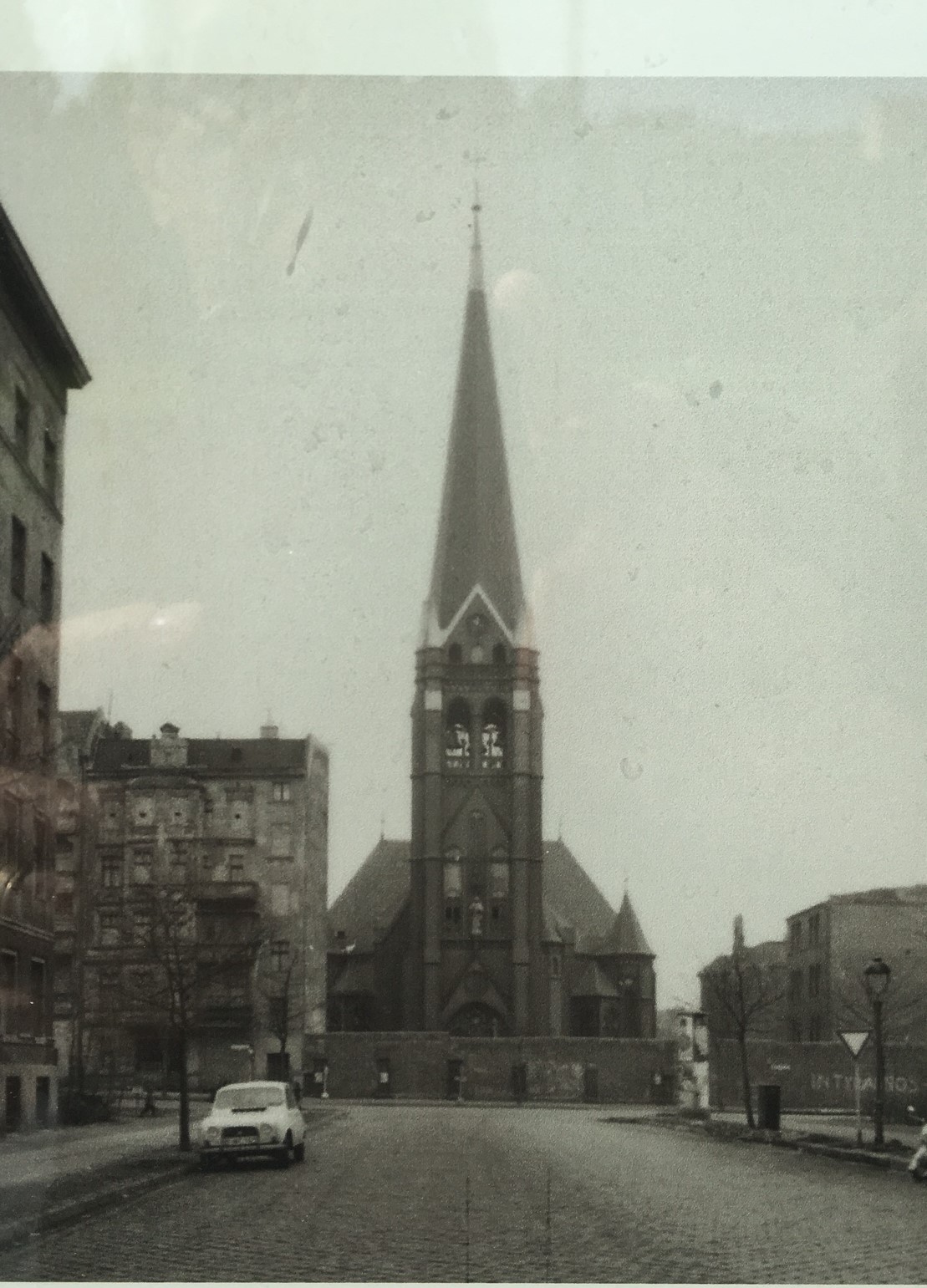
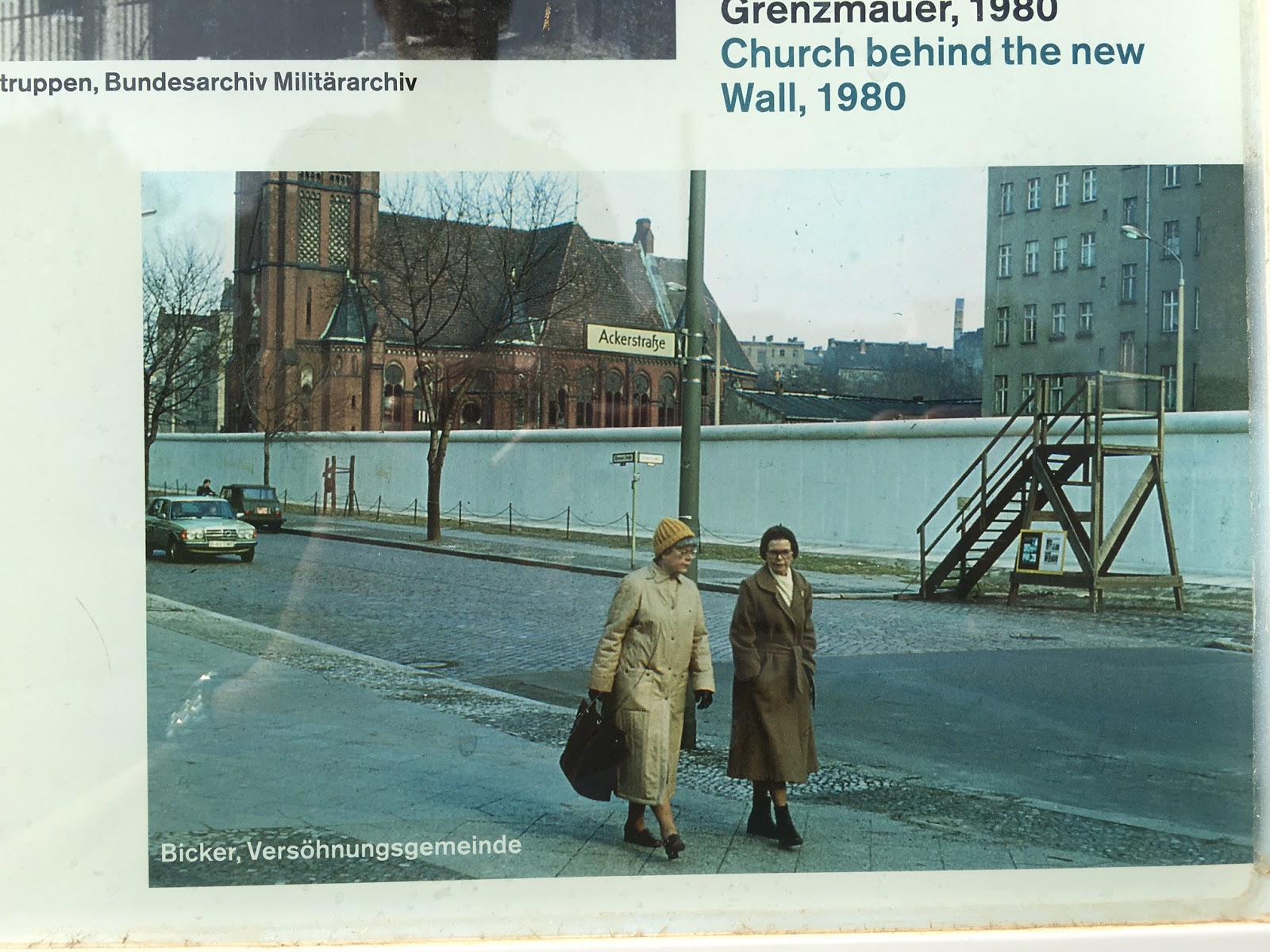
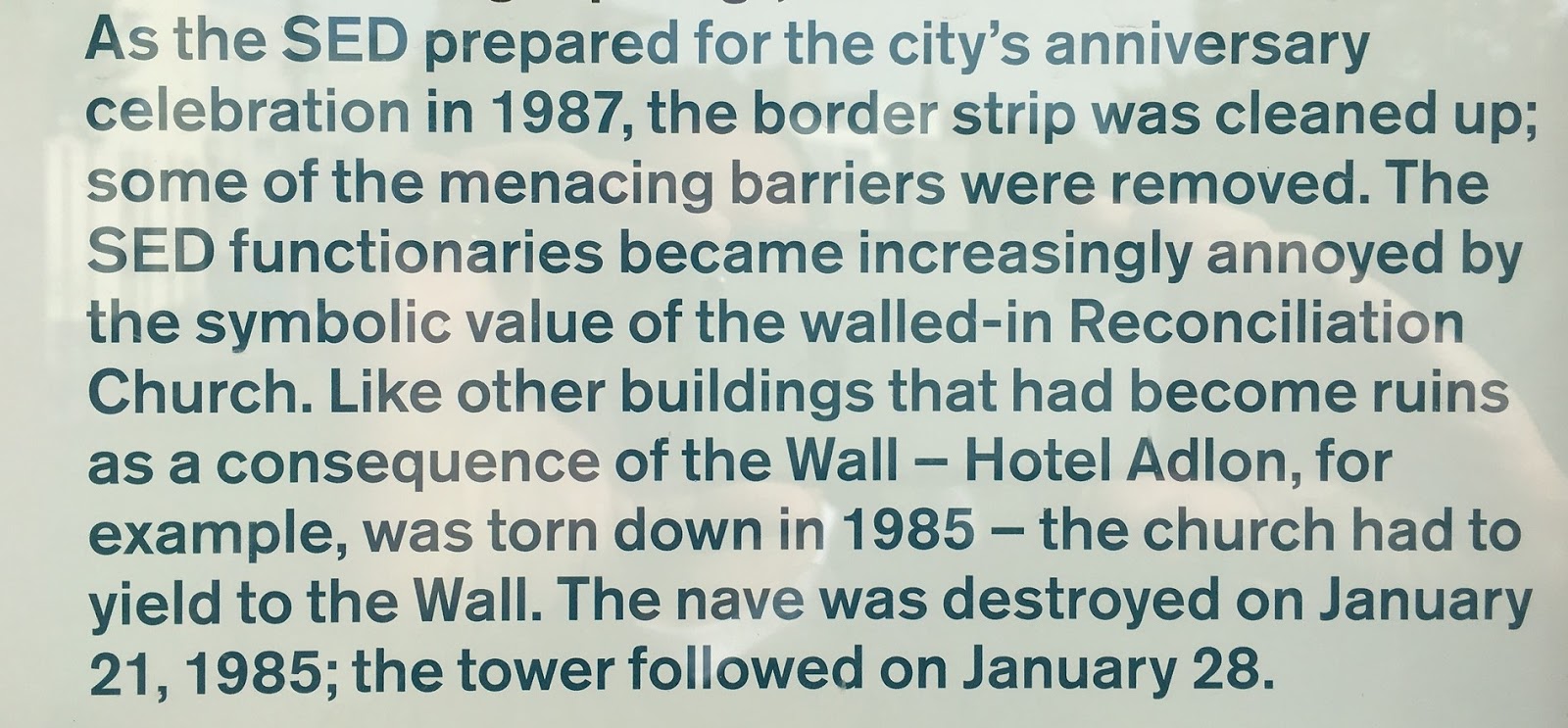
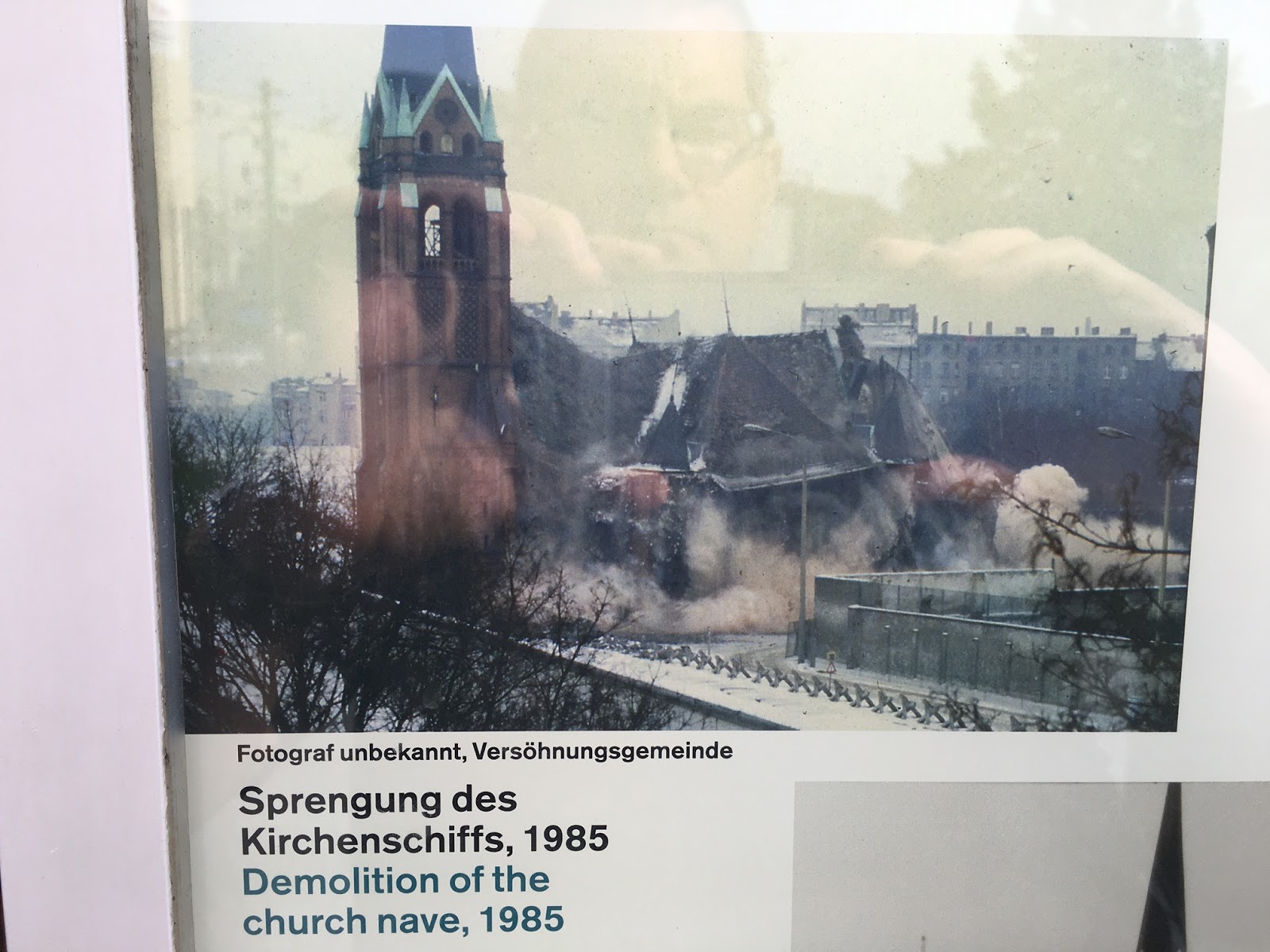
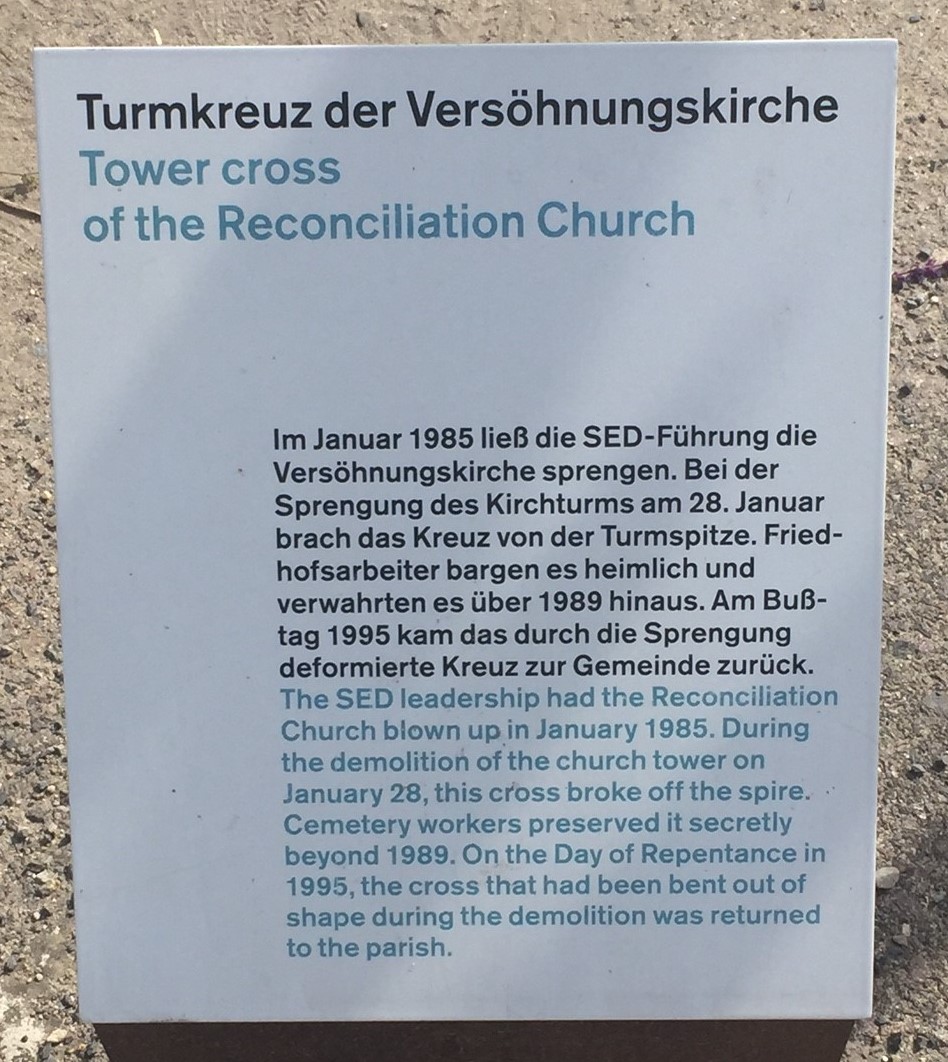
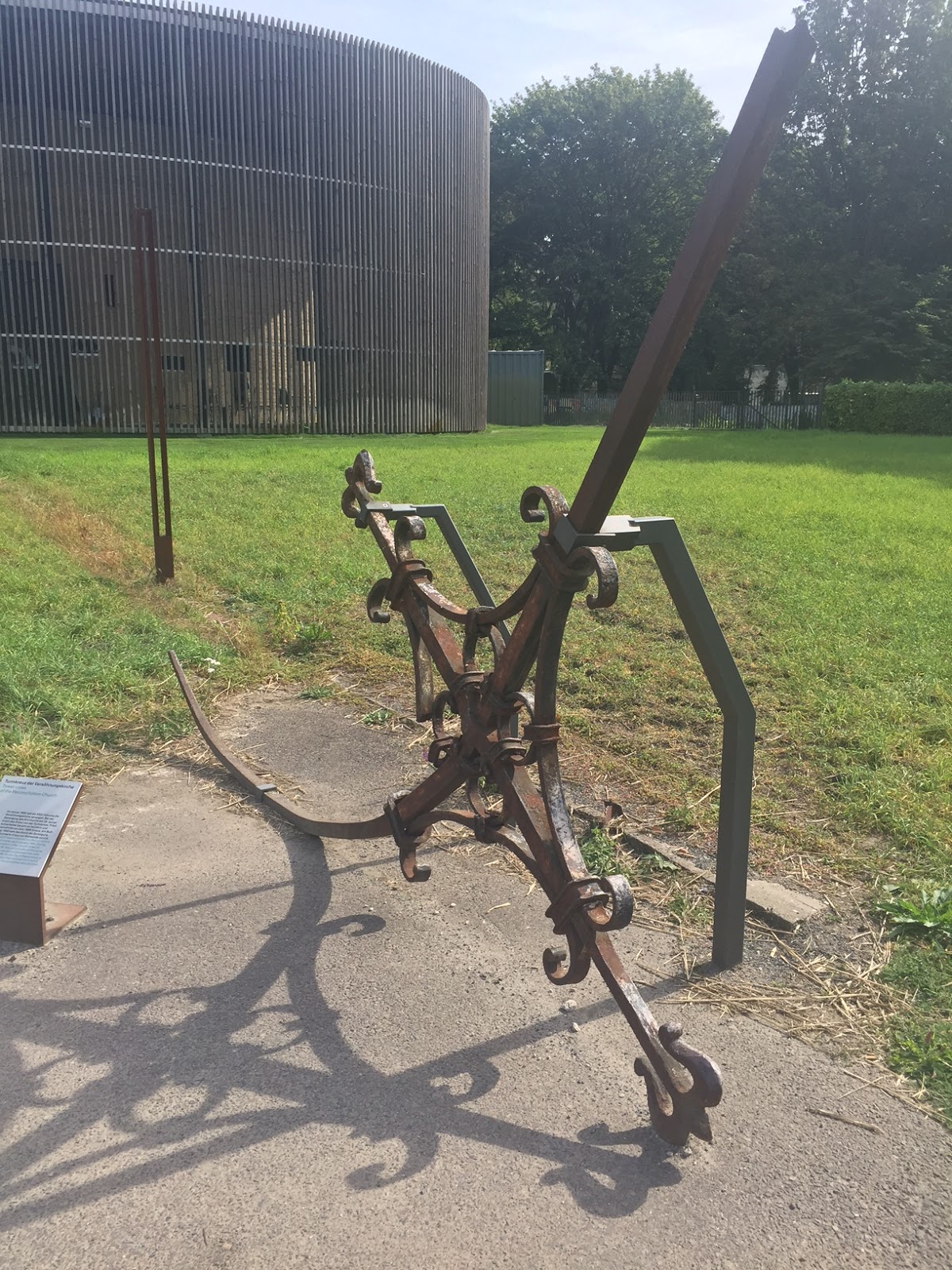
    Reconciliation Church had been a congregation since the late 1800’s. Most of its members lived in the West. On Bernauer Strabe, the entrance to the grounds were in the West, but the church itself was in the East. After the Wall went up, the majority of the congregation were forced to build another church. The SED ended up using the church tower as a patrol tower. In 1985, the SED demolished the church, simply because they got tired of it being a symbol of division.

    The wall of this building has photographs of people escaping in the earliest days of the Wall.


    These steps showed the path of the tunnel from the East side to the West opening on Bernauer Strabe.
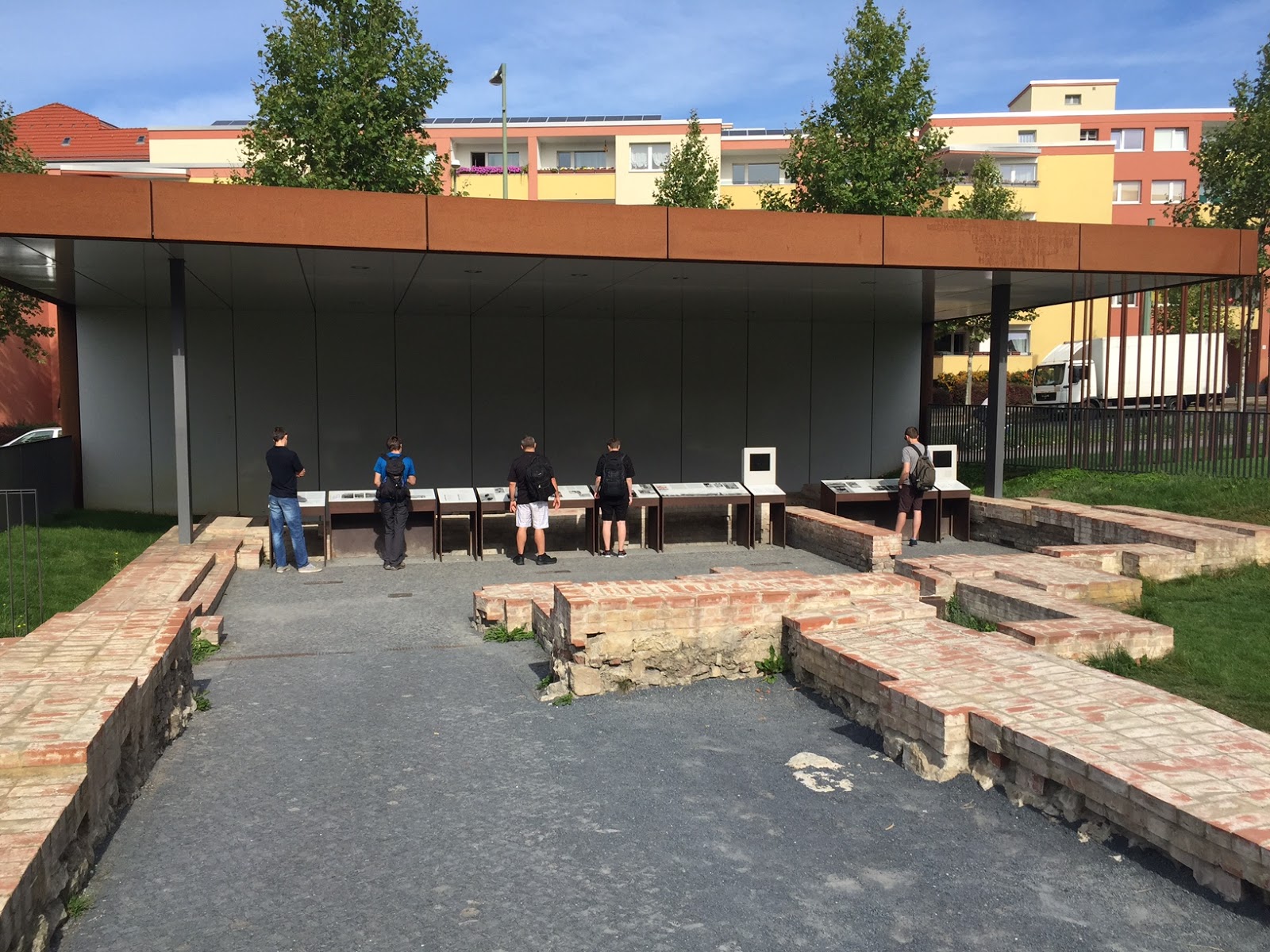
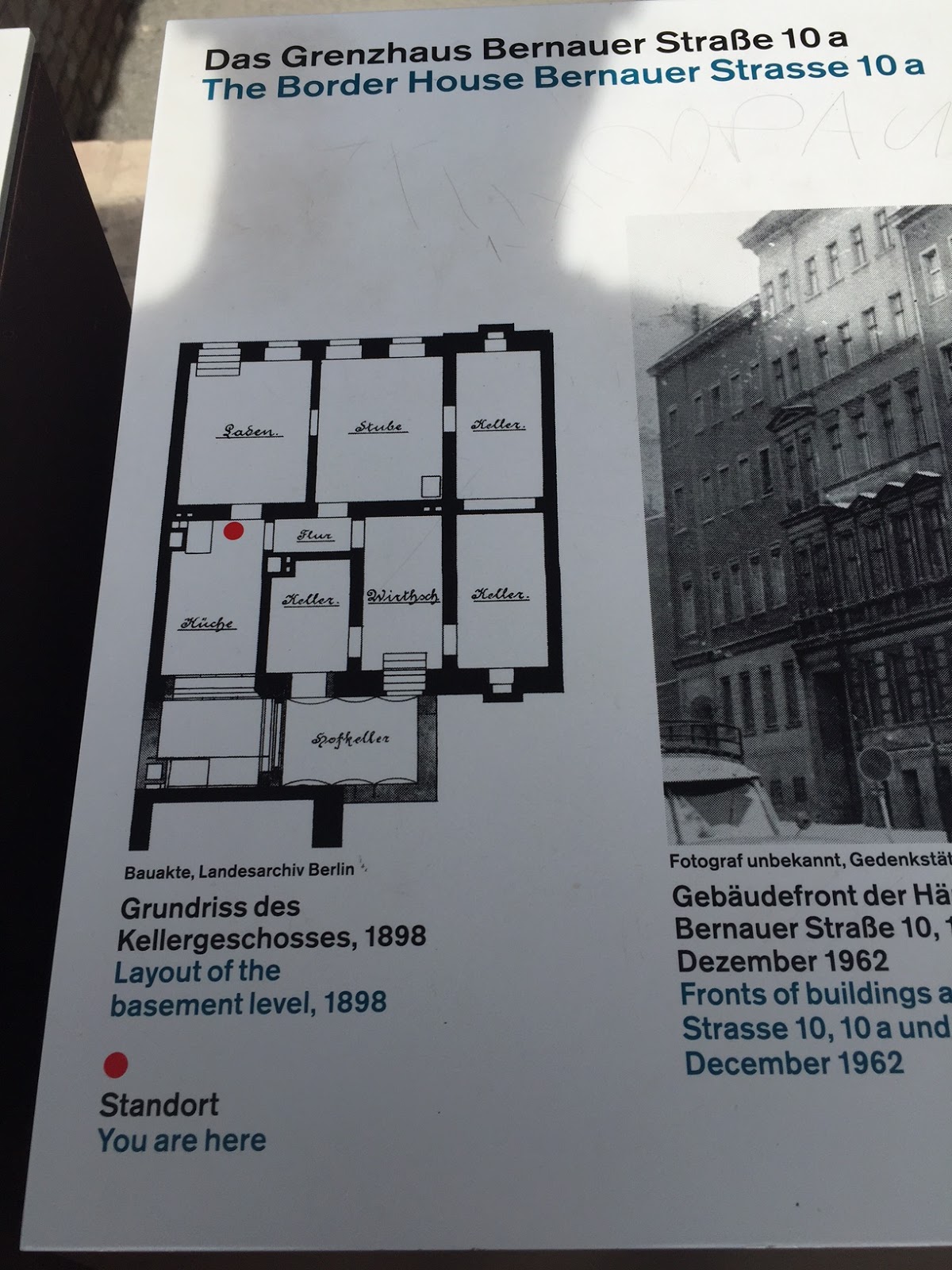
    Foundation remains of one of those border houses.
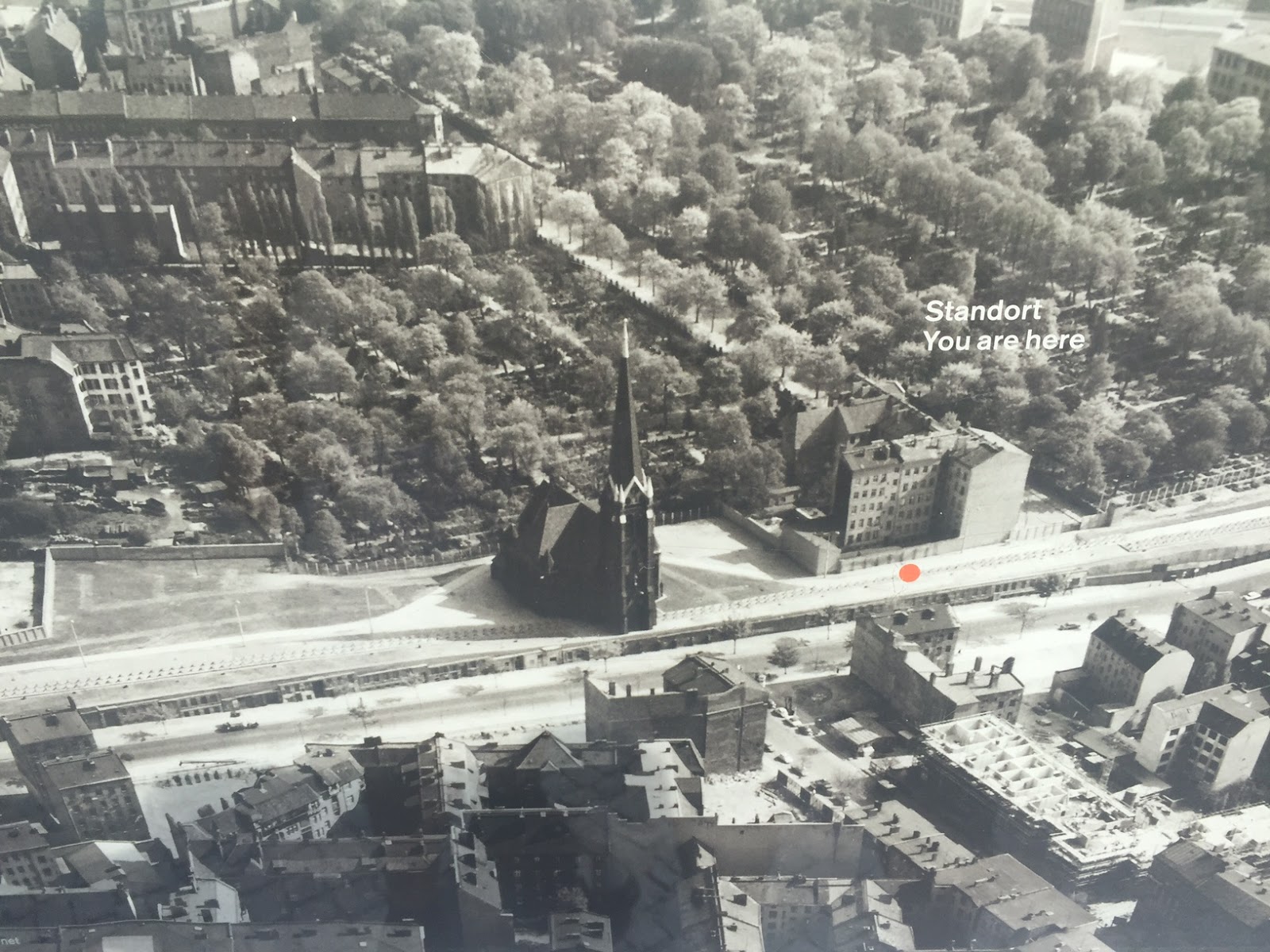
    Over time, all that was left of the border houses on Bernauer Strabe were facades, which you can barely make out in the aerial photo below, which shows the entire fence area around the Reconciliation Church.


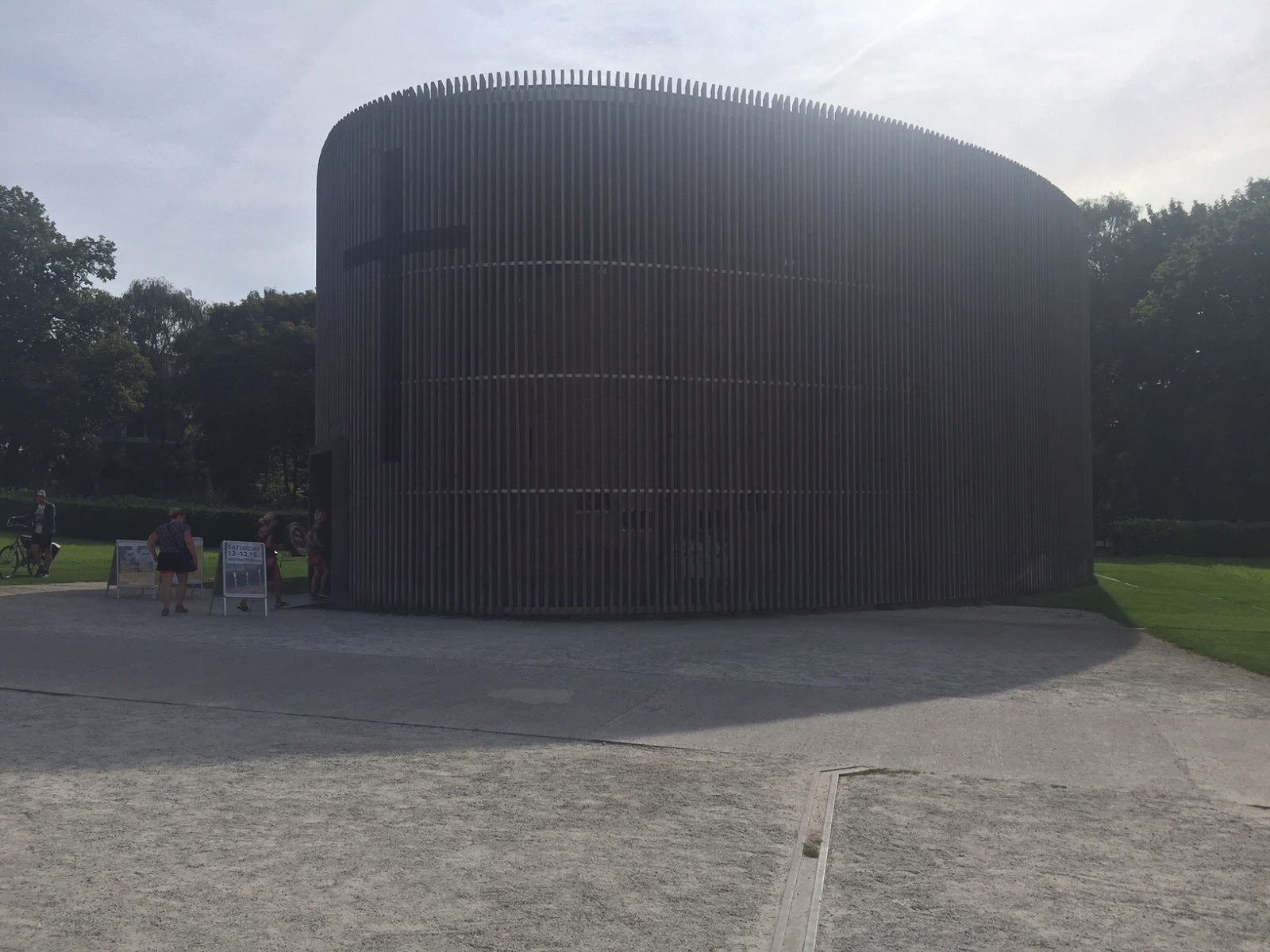
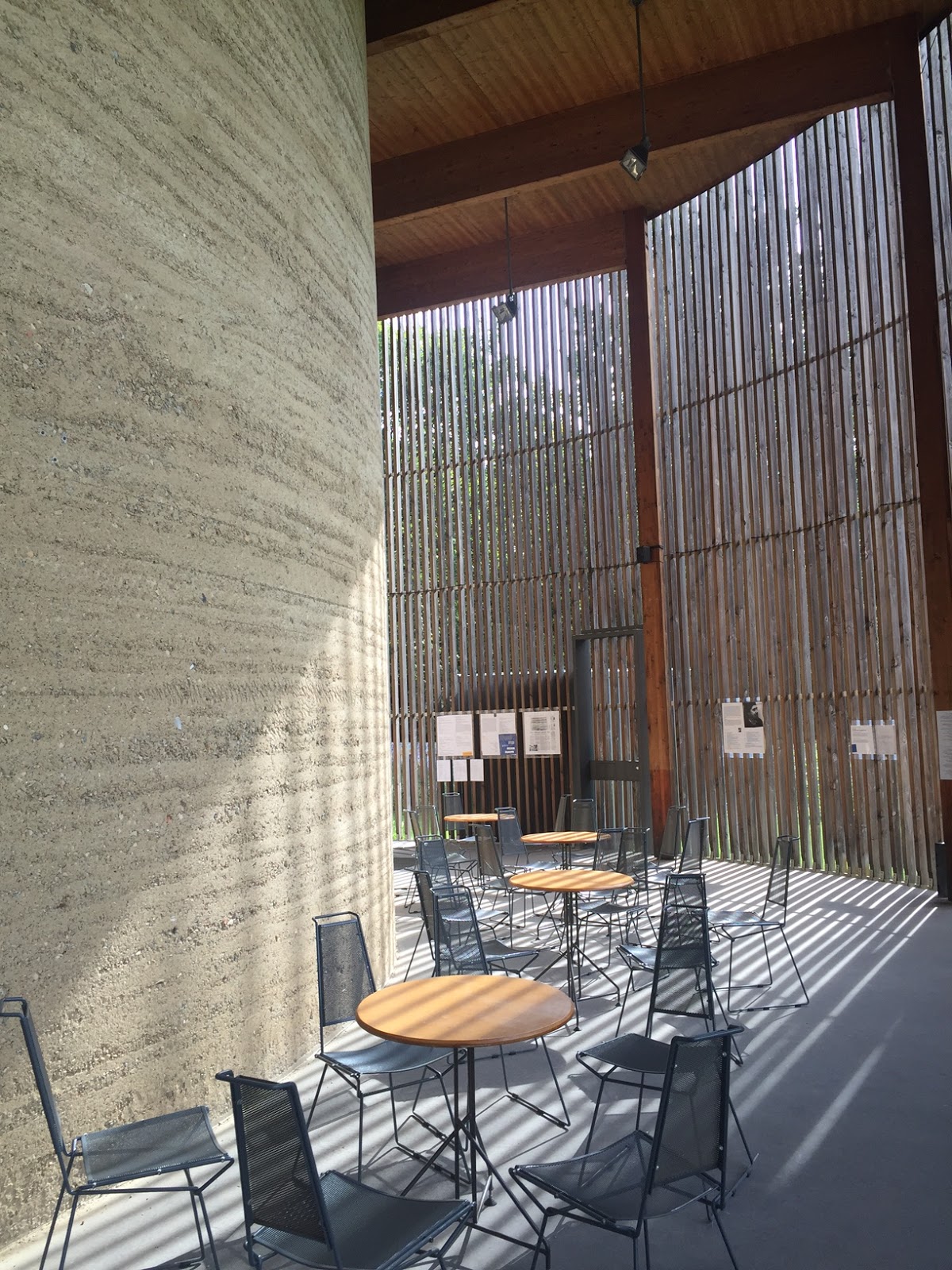
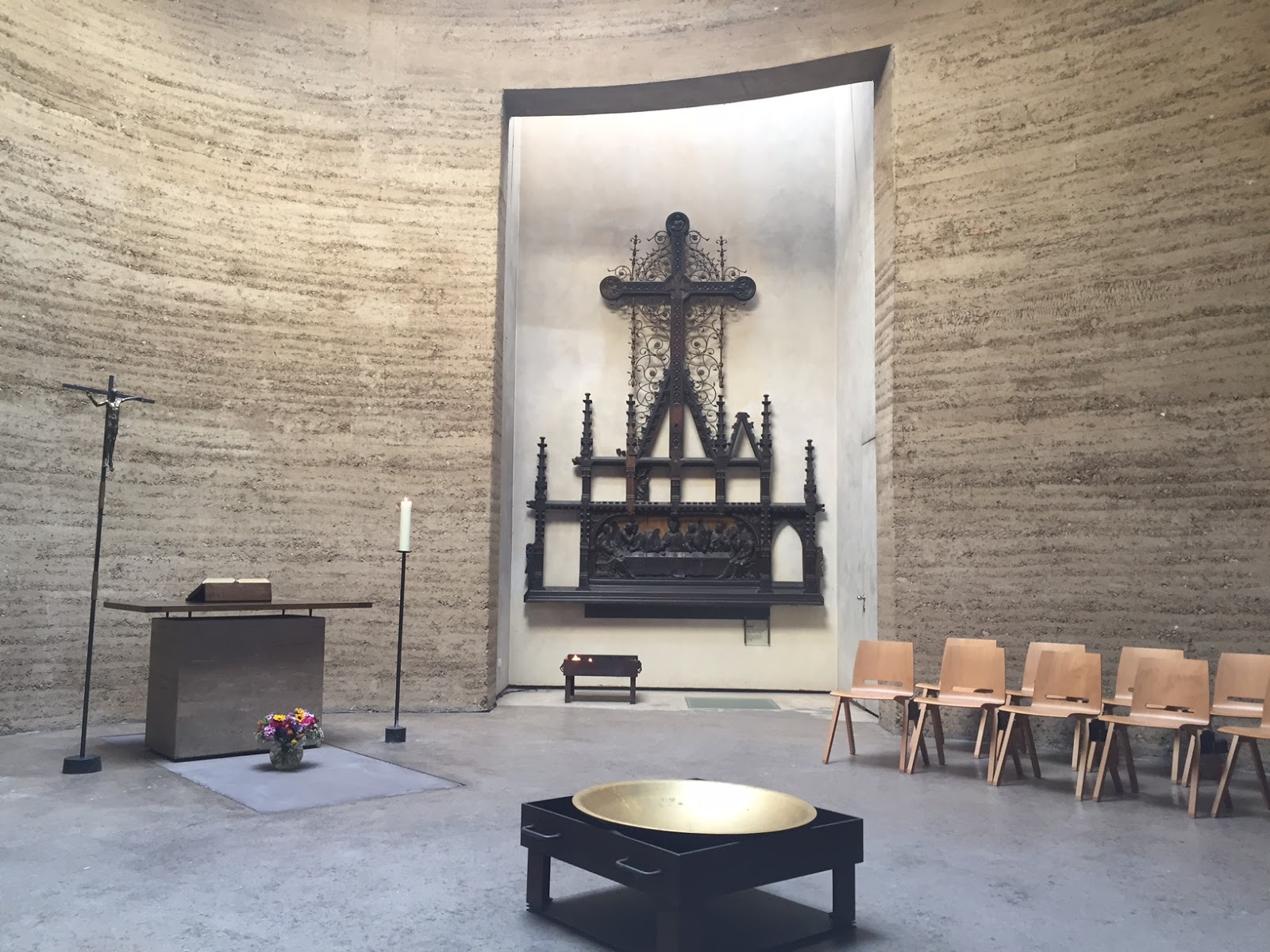
    A new church has been built on the site of the old one since the Wall fell. Although it is part of the Wall Memorial, it is also a functioning church with a small congregation that attends regular services.


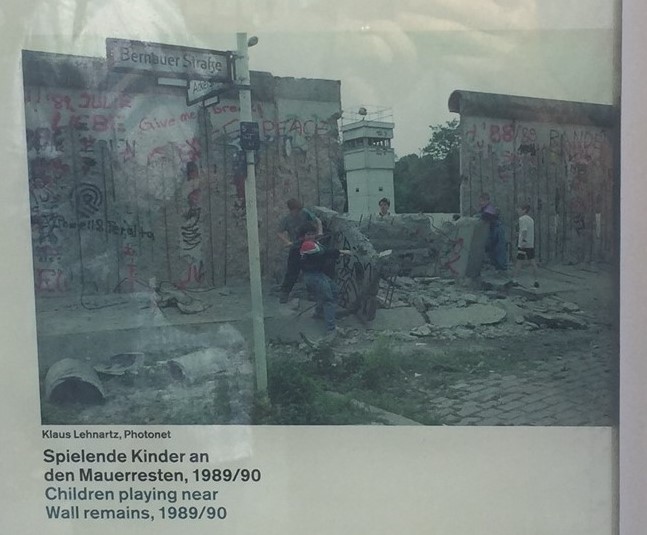
    And finally….notice the street sign…

    We left feeling odd combinations of melancholy, uplifted and energized. I don’t think it’s just me; I think most Americans don’t really understand the impact of WWII in general and the communist regime that followed in much of Europe after. I get a more real sense of it every time we take one of these trips; it’s always the thing I look forward to the most. For me at least it’s important to understand the level of human suffering that occurred here. While certainly Americans suffer in many ways, and many in the military have given their lives to various democratic causes around the globe, there’s something about delving into the everyday life of those who lived it day in and day out that’s humbling, maddening and petrifying all at the same time. And the current level of uneducated, non-civil discourse that’s been going on in American politics for well into two decades now just makes me that much more crazy. As you see here and will see later, using labels like “communist” and “Nazi” to describe things happening in America is ridiculous when you deeply take in what really happened here. We’ve never experienced anything like this. (OK, I’ll try to make that the only diatribe on that topic for the rest of the blog…)

    Next we went to Neues Museum. Along with the Pergamon, it’s famous for it’s collection on ancient civilizations. Our intention was to stay only 1 hour because there was really only one thing we wanted to see.

    We made excellent use of our transportation passes in Berlin, at some point taking trains, buses, subways and, above, trams. (This one was full when we got on!) We love cities with great public transportation systems and Berlin is one of them. And Google Maps makes using them So Simple.
    The “Mona Lisa of the Neues” if you will is a 3300 year old bust of Nefertiti, discovered one of the the many digs Germany did in the early part of the last century funded by James Simon. Photos weren’t allowed of that exhibit and others here and there throughout the museum. Here’s one I stole off the internet. My guess is you’ve seen it before.
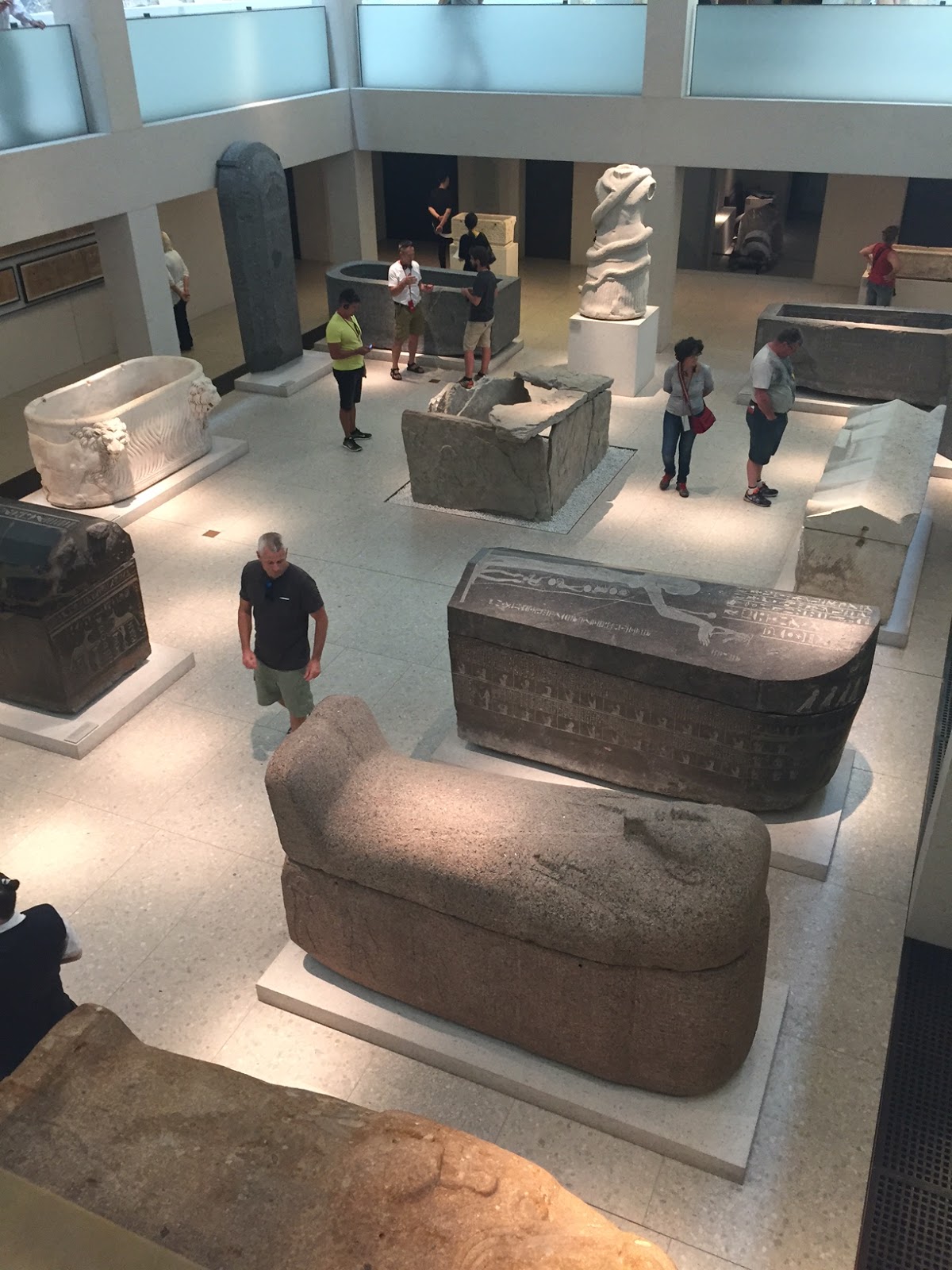
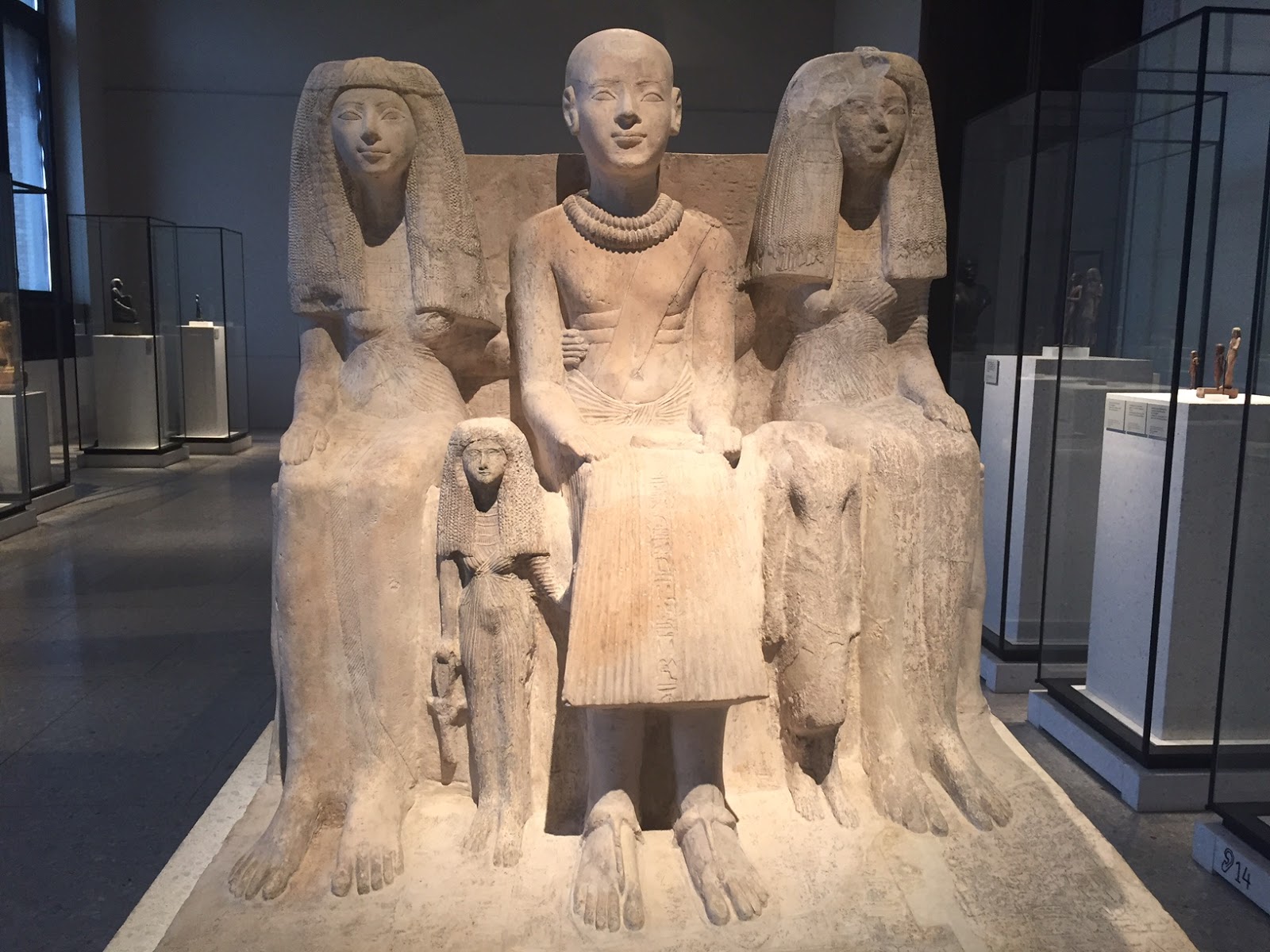
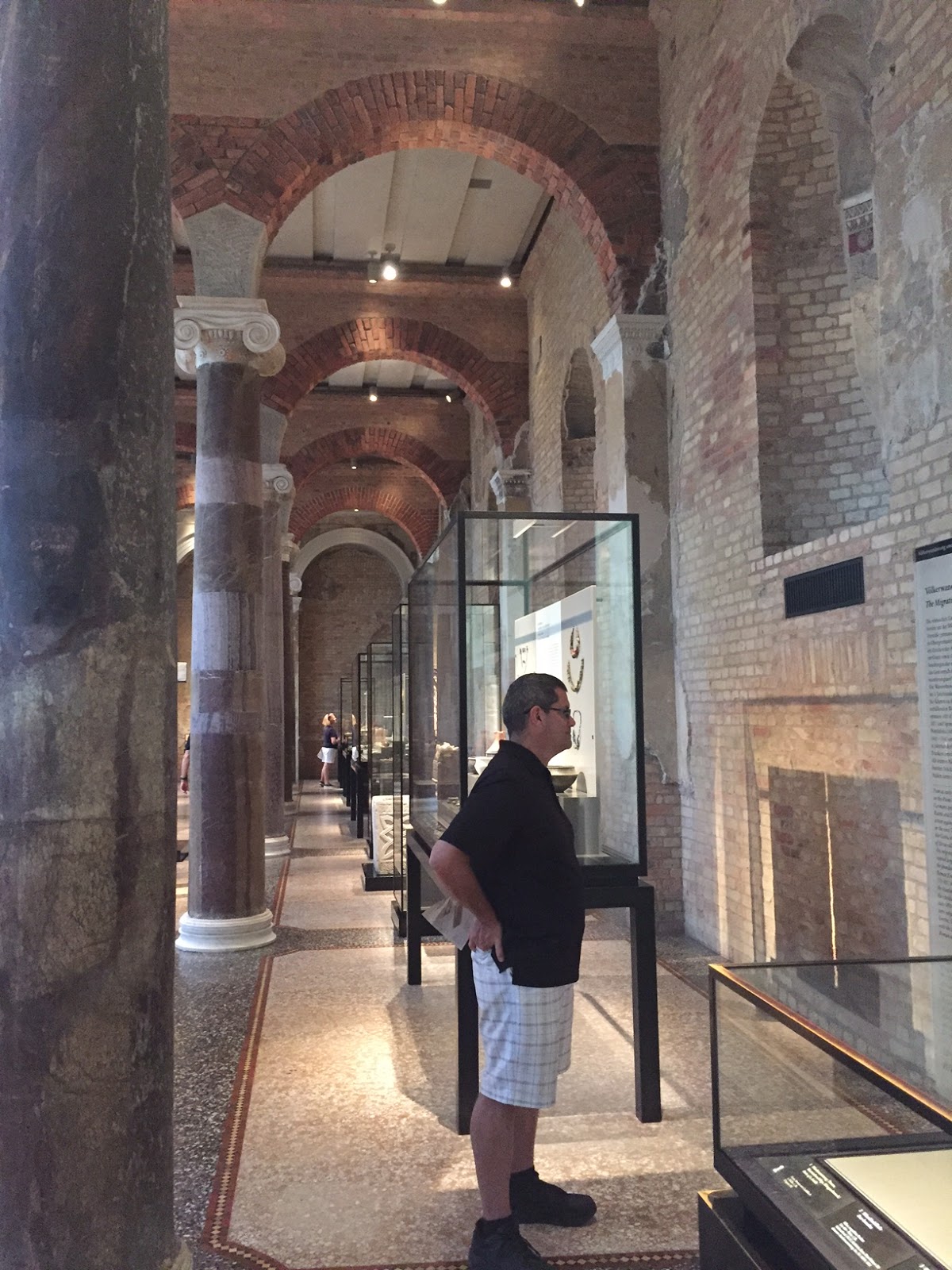
    Here are some other shots of the museum in general:


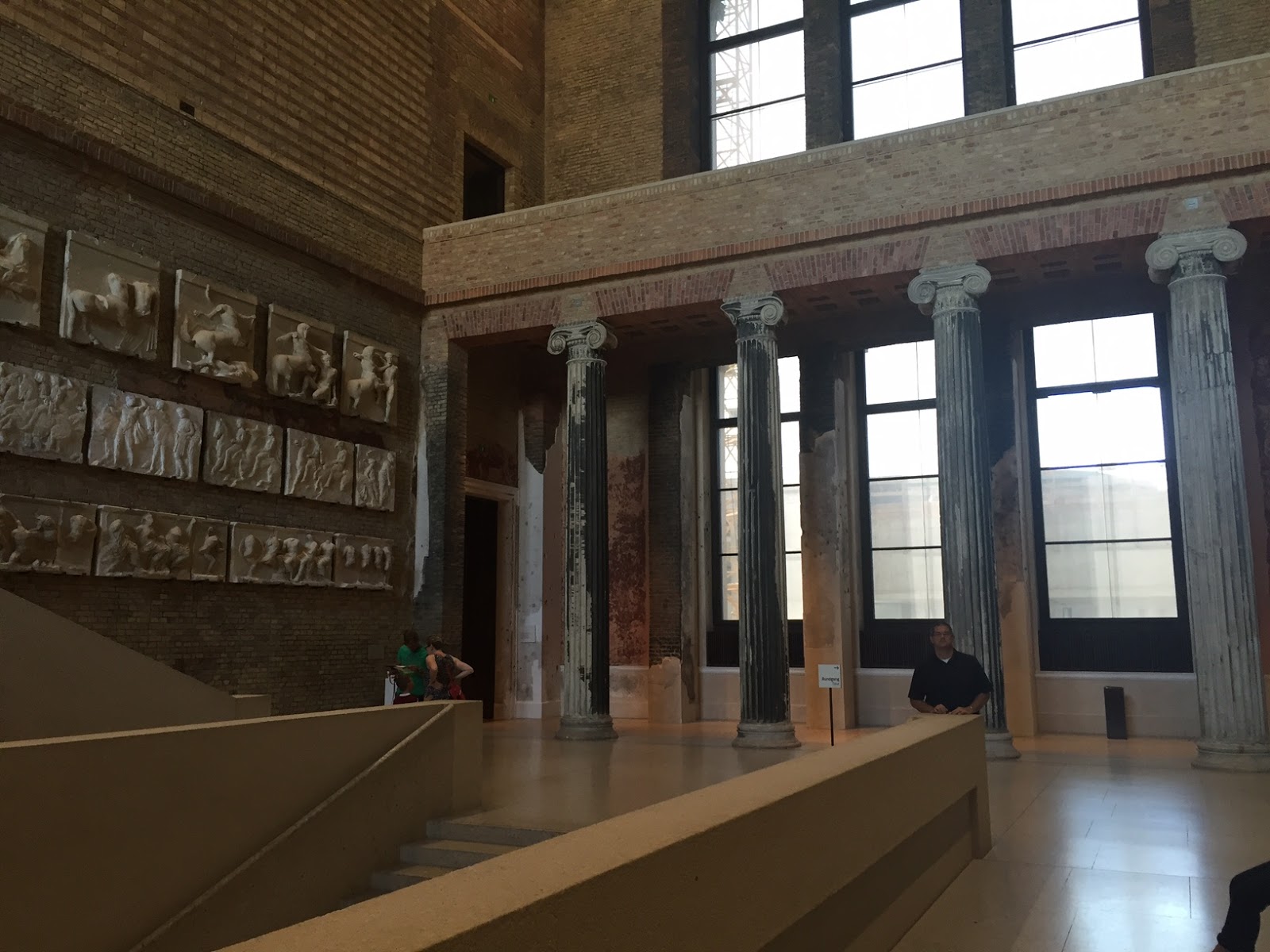
     I loved these ginormous halls and staircases built with remnants of ancient digs throughout; gives you a feel of being in an Egyptian temple.


     I swear I never know half of what he’s taking until I put this together.


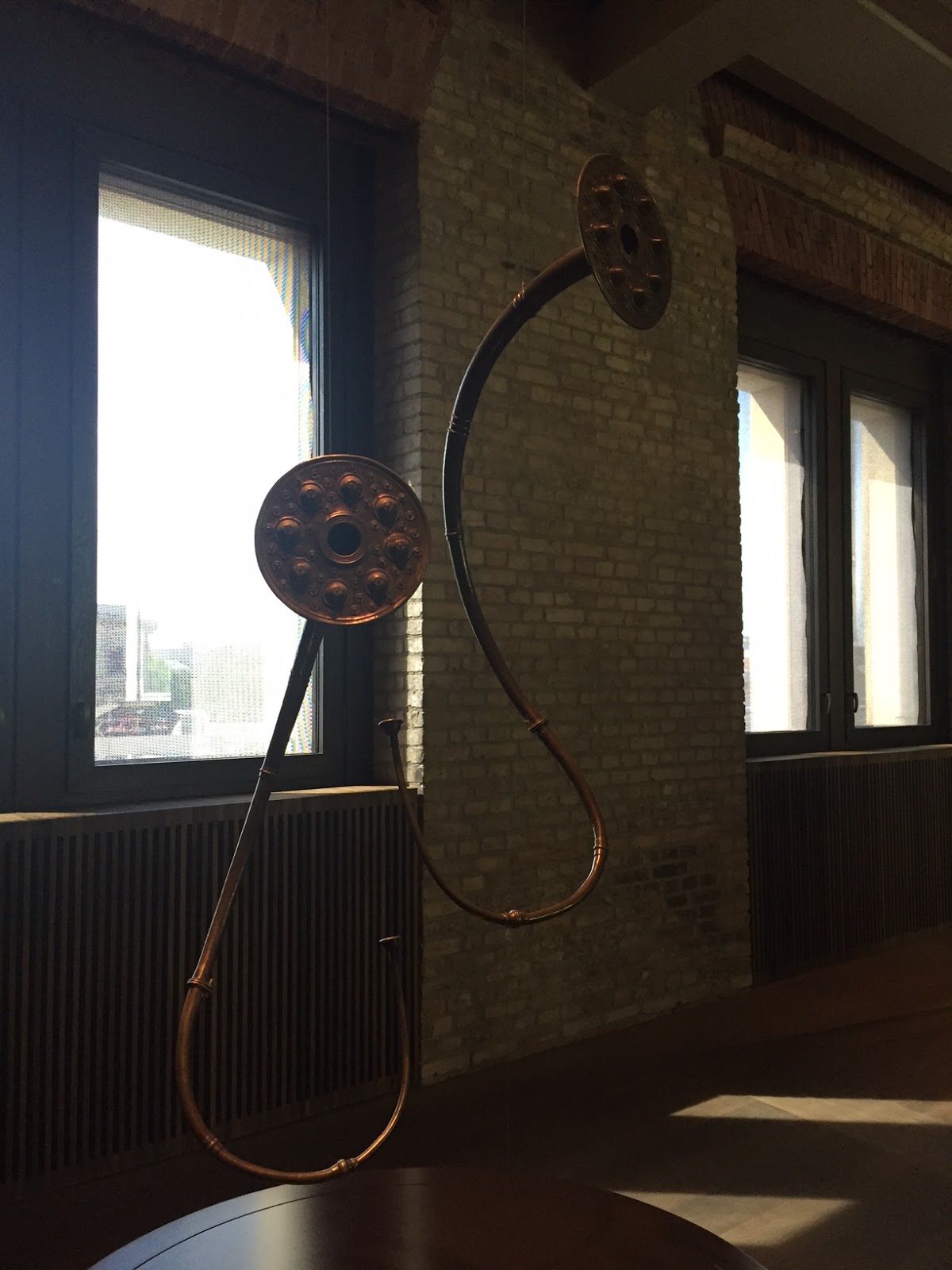
     A replica of a horn from the Bronze Age.


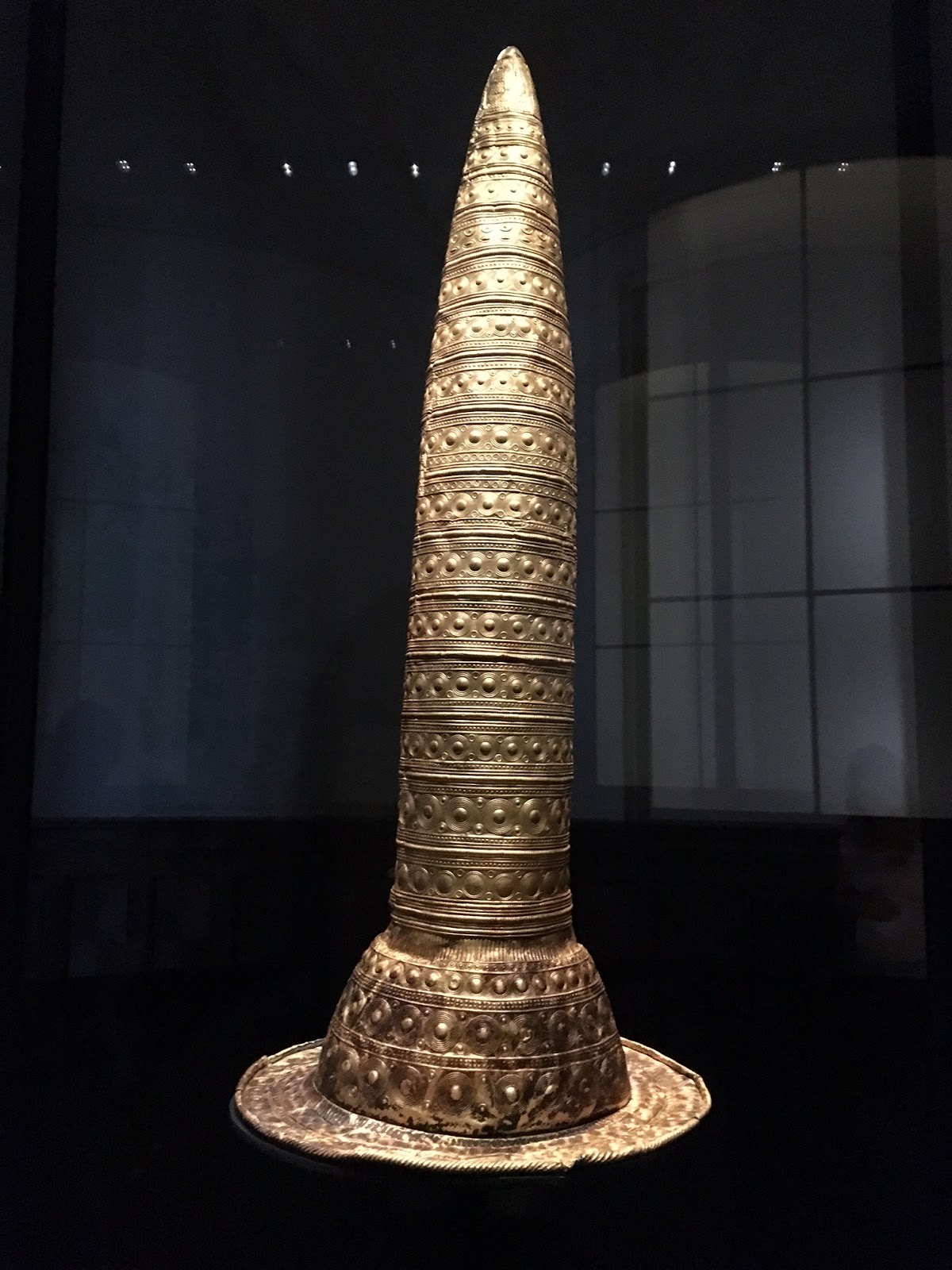
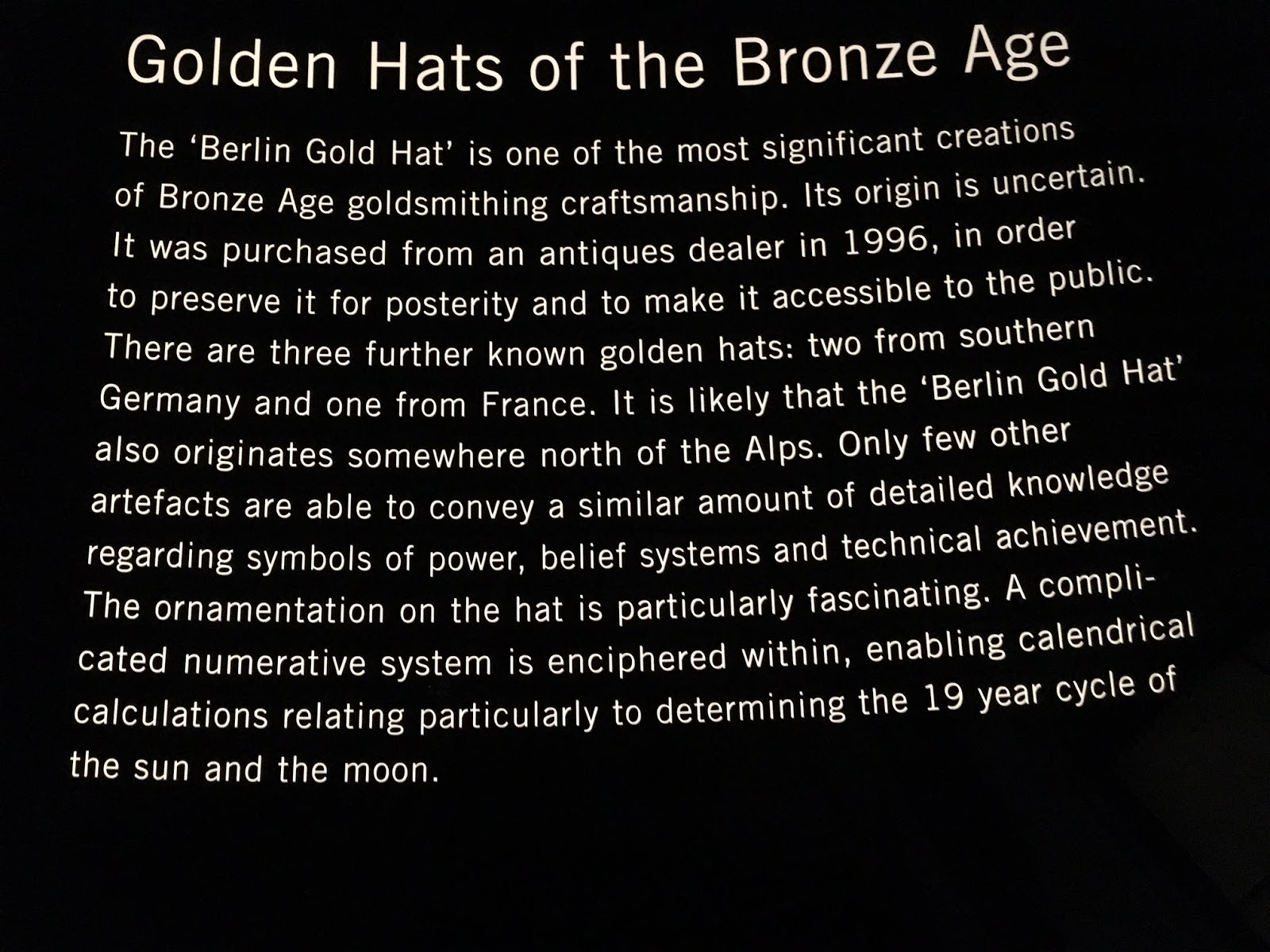
     Also from the Bronze Age, this was the other item the museum was very proud of: the Golden Hat. That base sits on a man’s head then goes up maybe 3 feet from there.

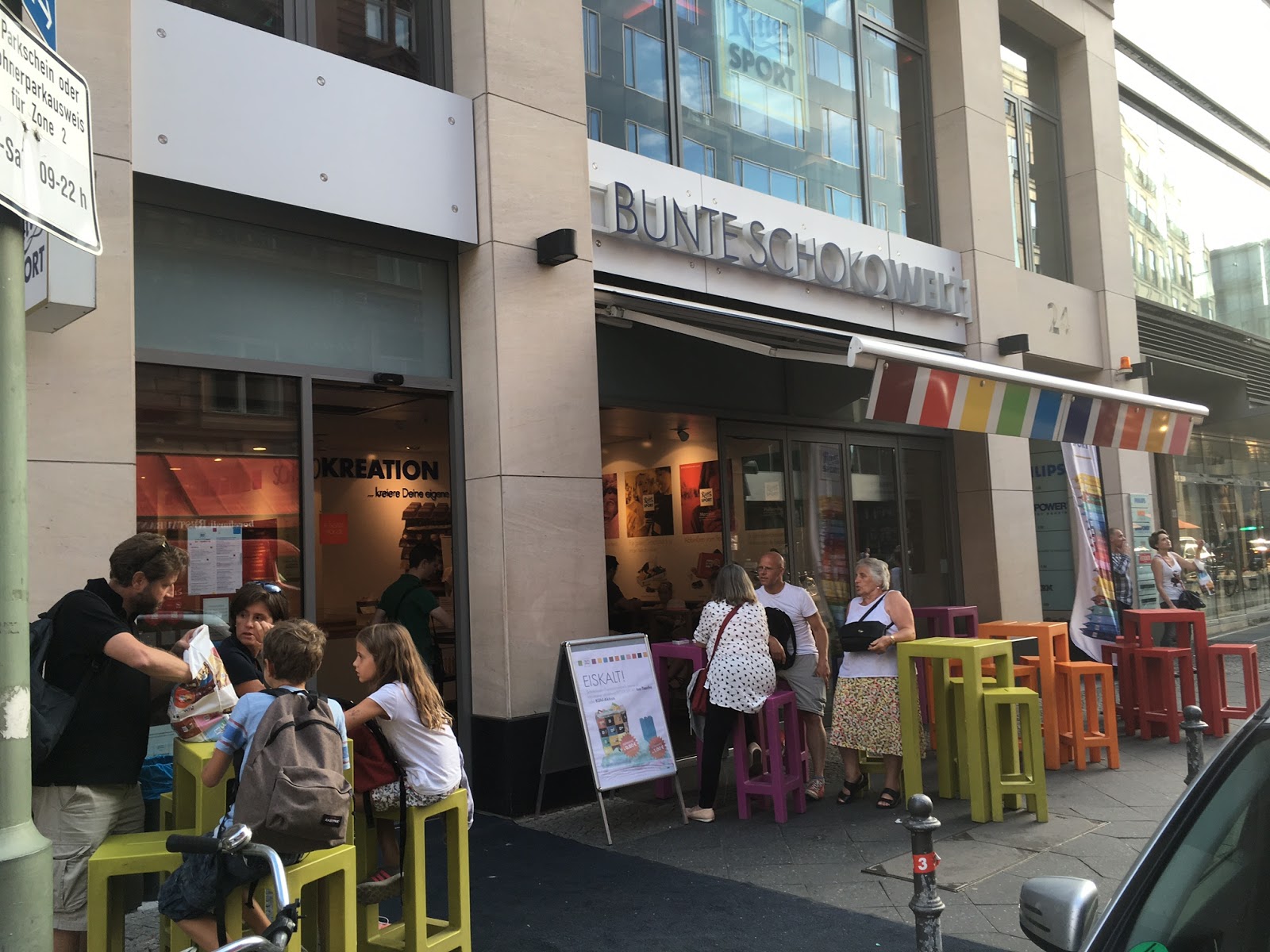
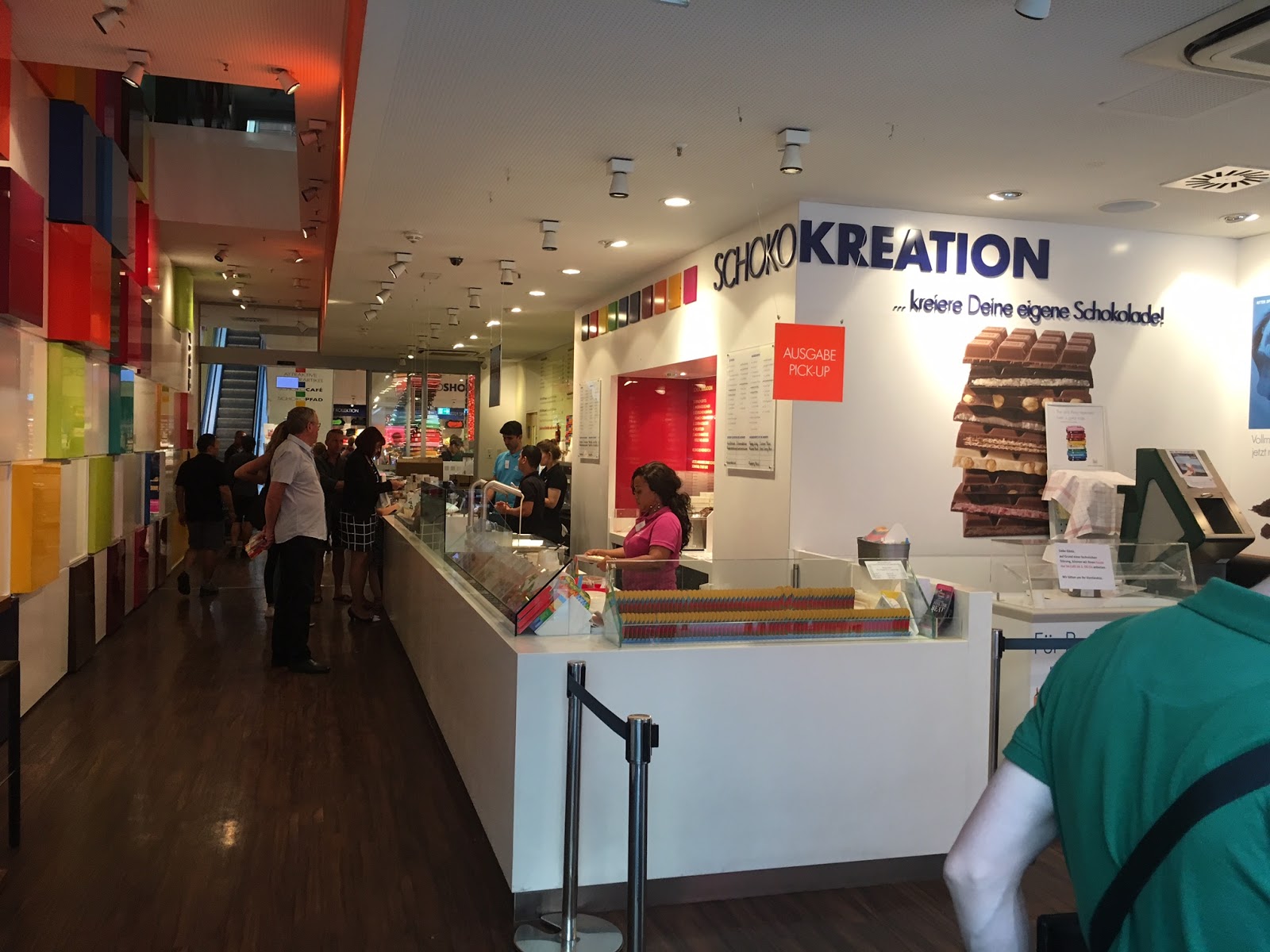
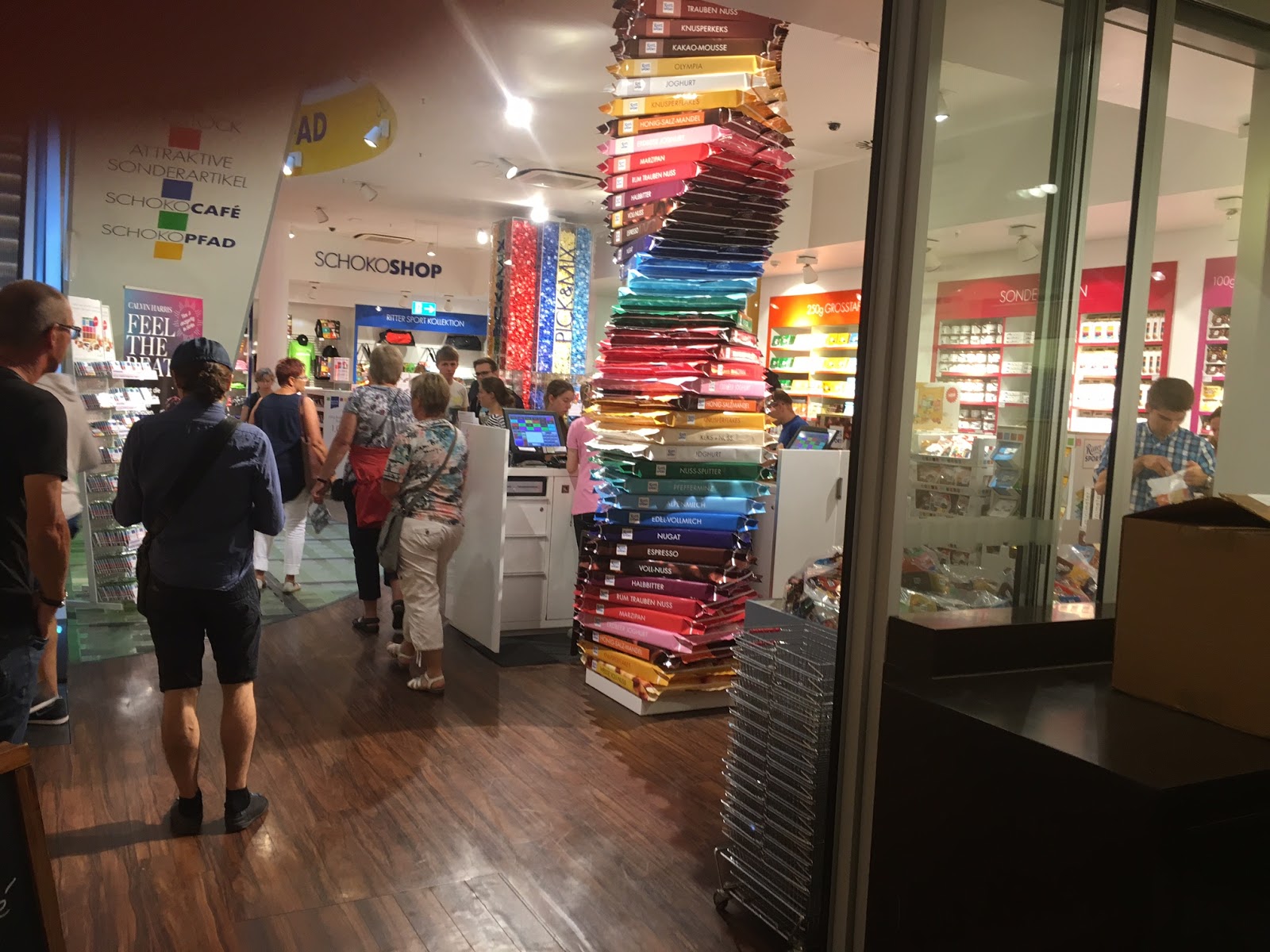
    We stuck to our hour and left at 1:30. It was lunch time. We’d decided on Thursday we were having lunch at the Ritter Sport restaurant to made our way in that direction, walking this time.


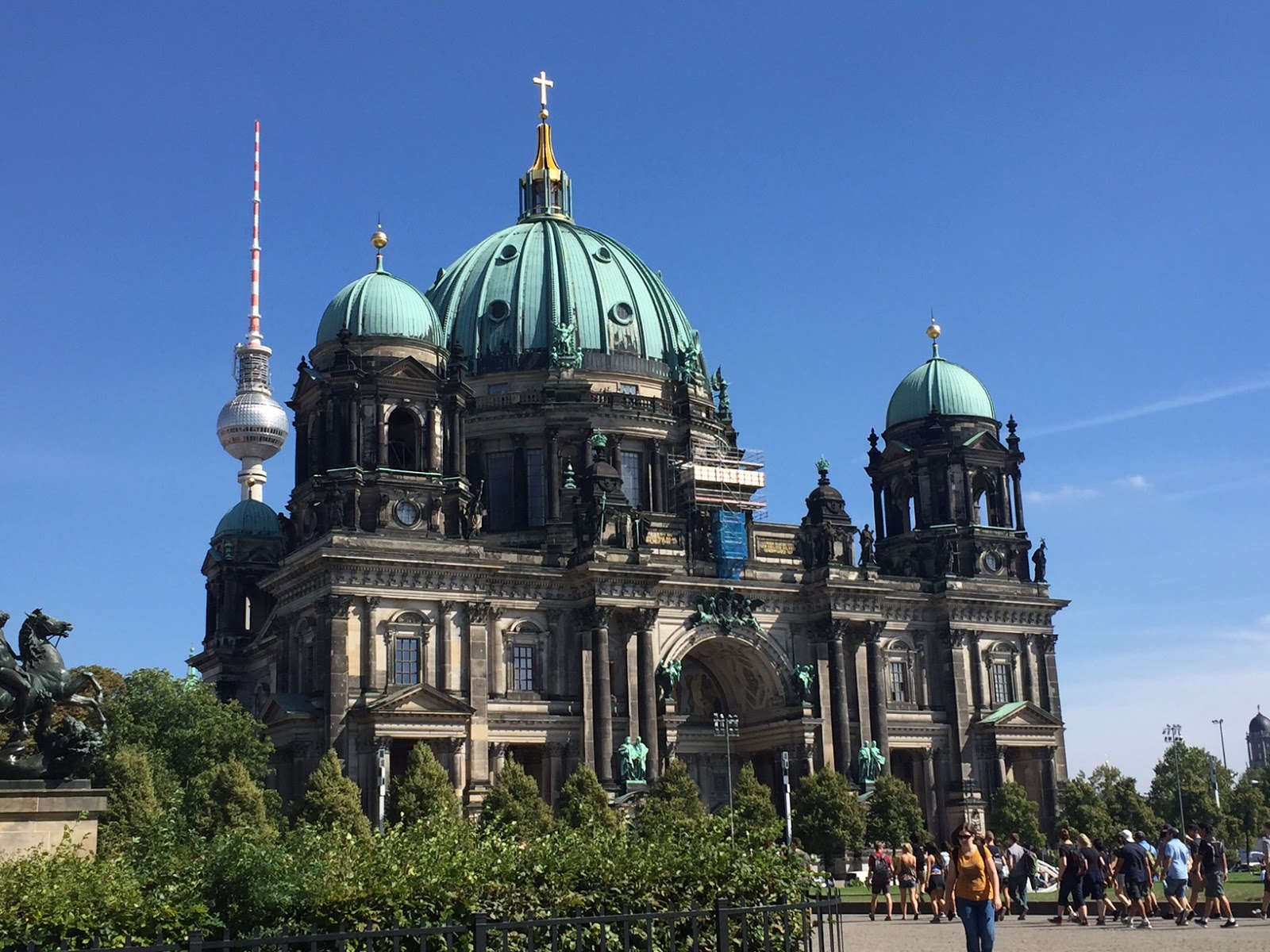
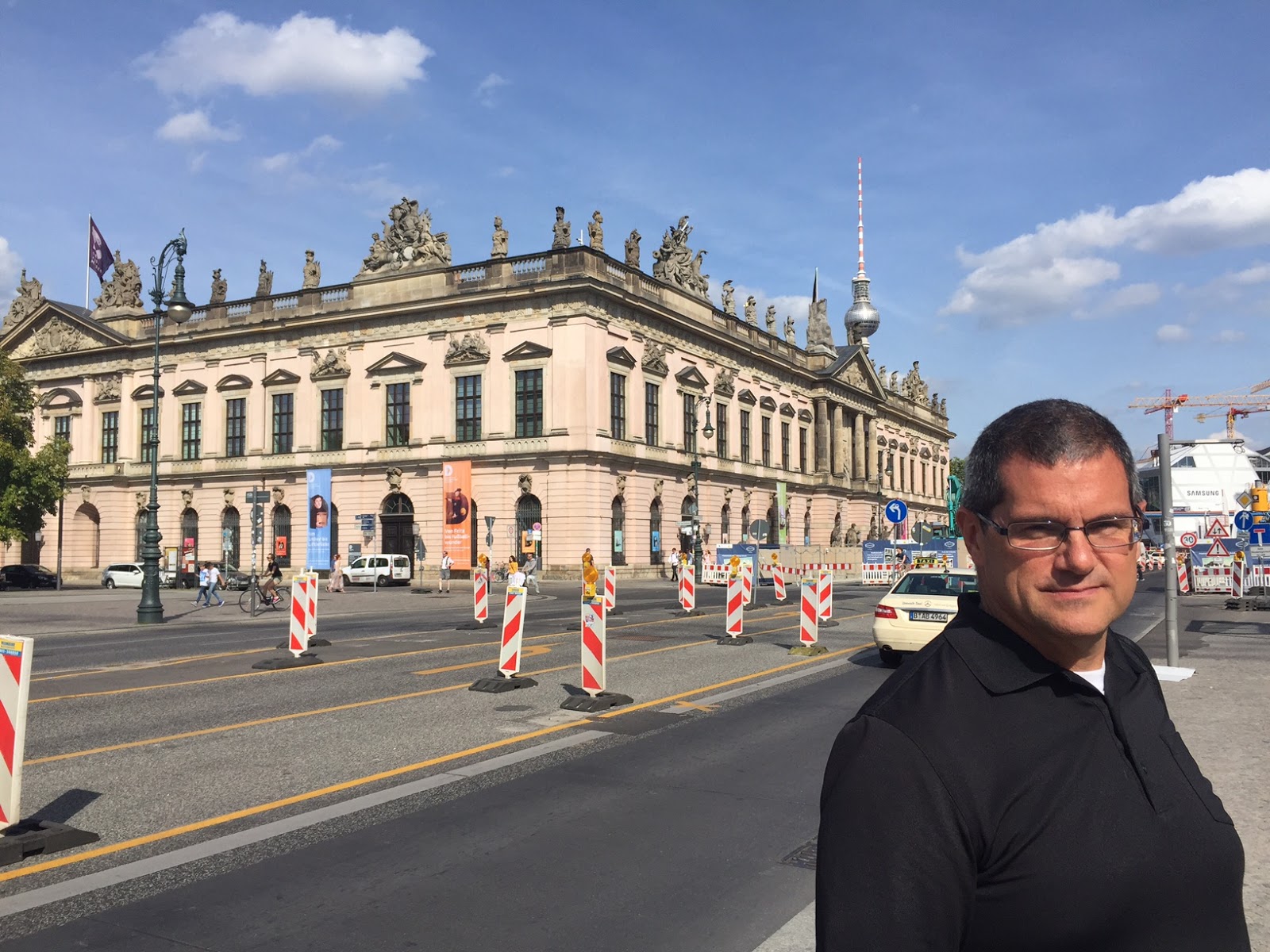
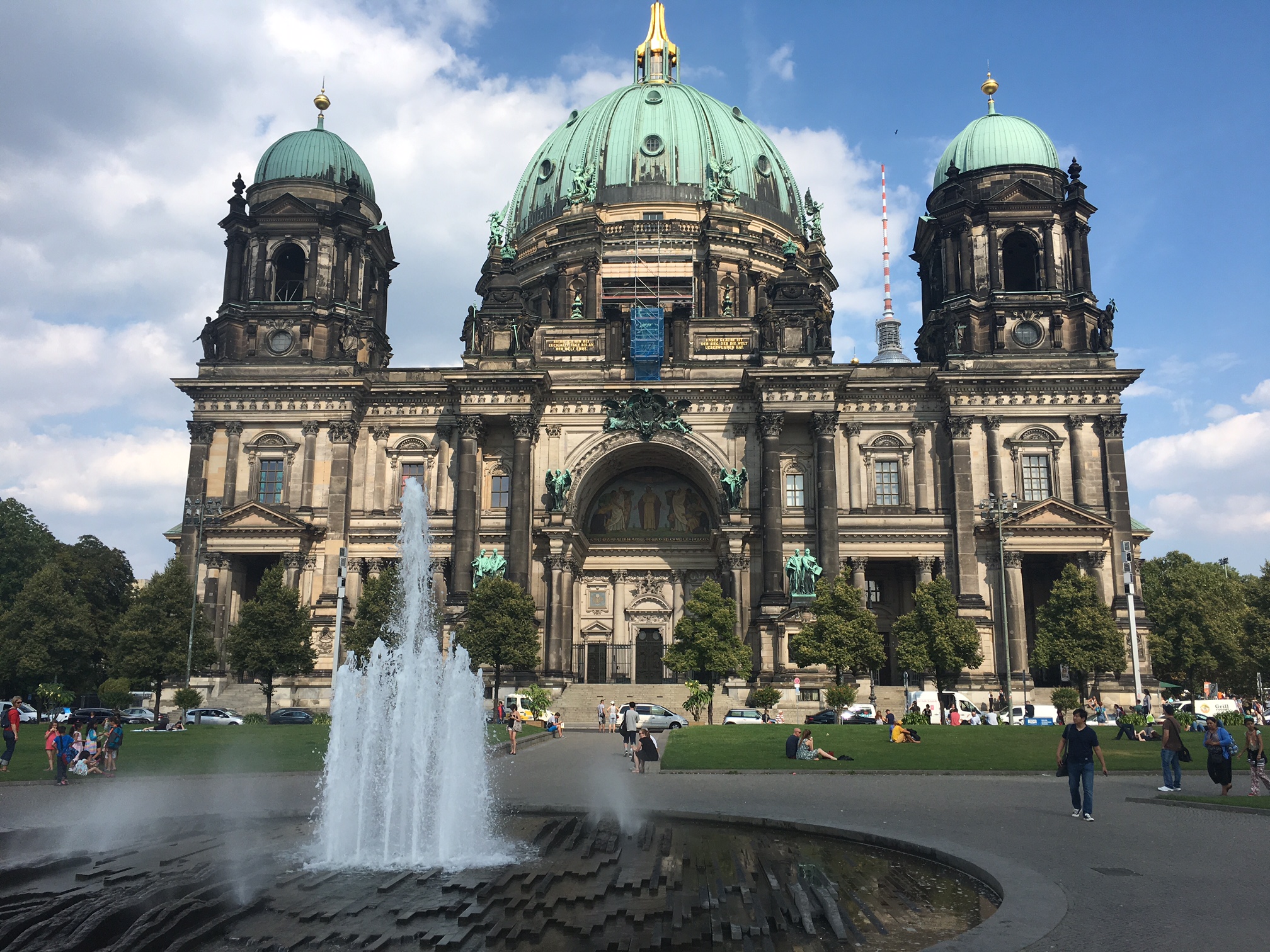
    You saw this in Thursday’s blog: Berliner Dom. We passed it again; loved the park in front of it and how many people were out enjoying it. Dan liked this particular shot because it catches the TV Tower in the left background.

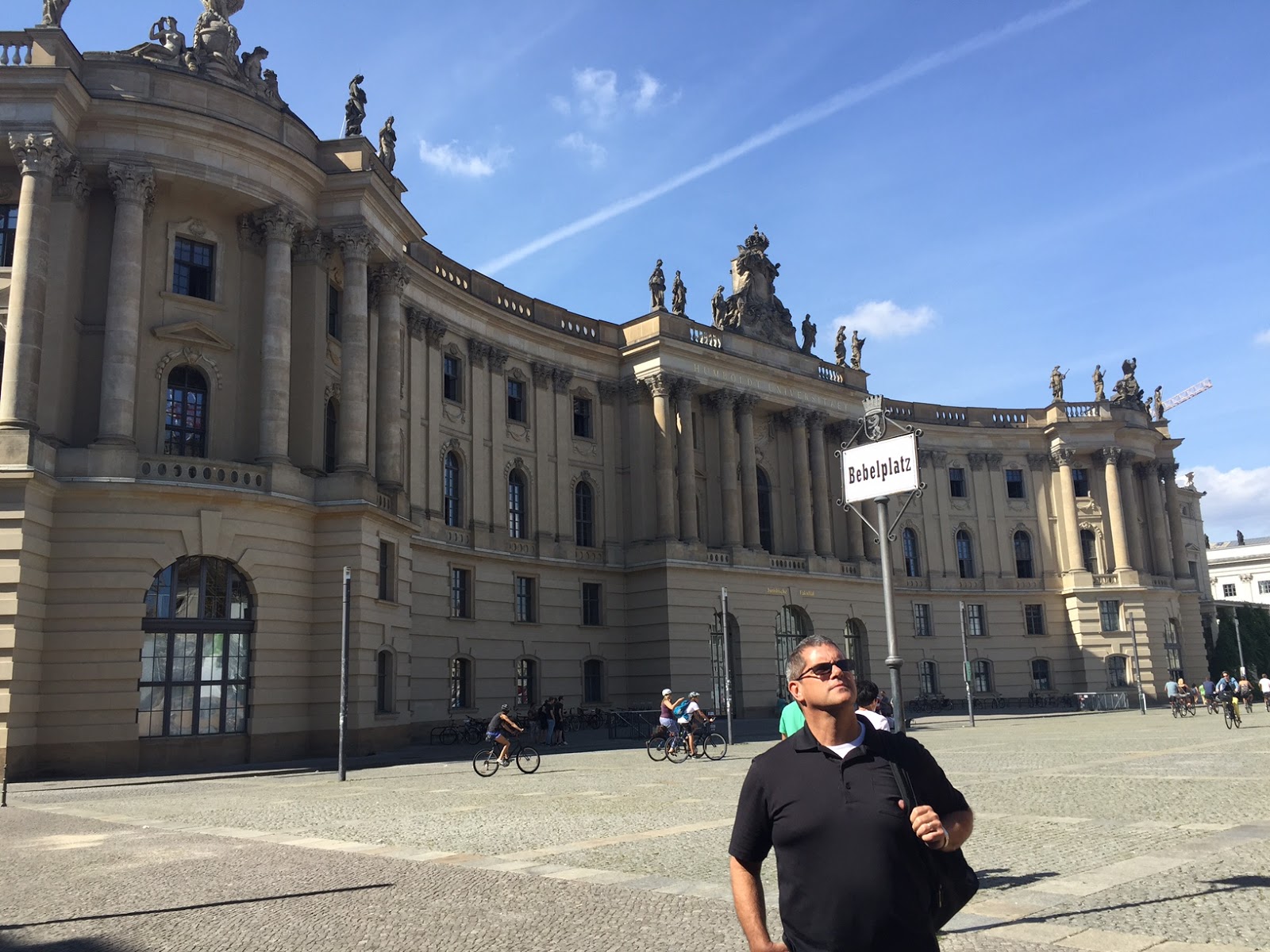
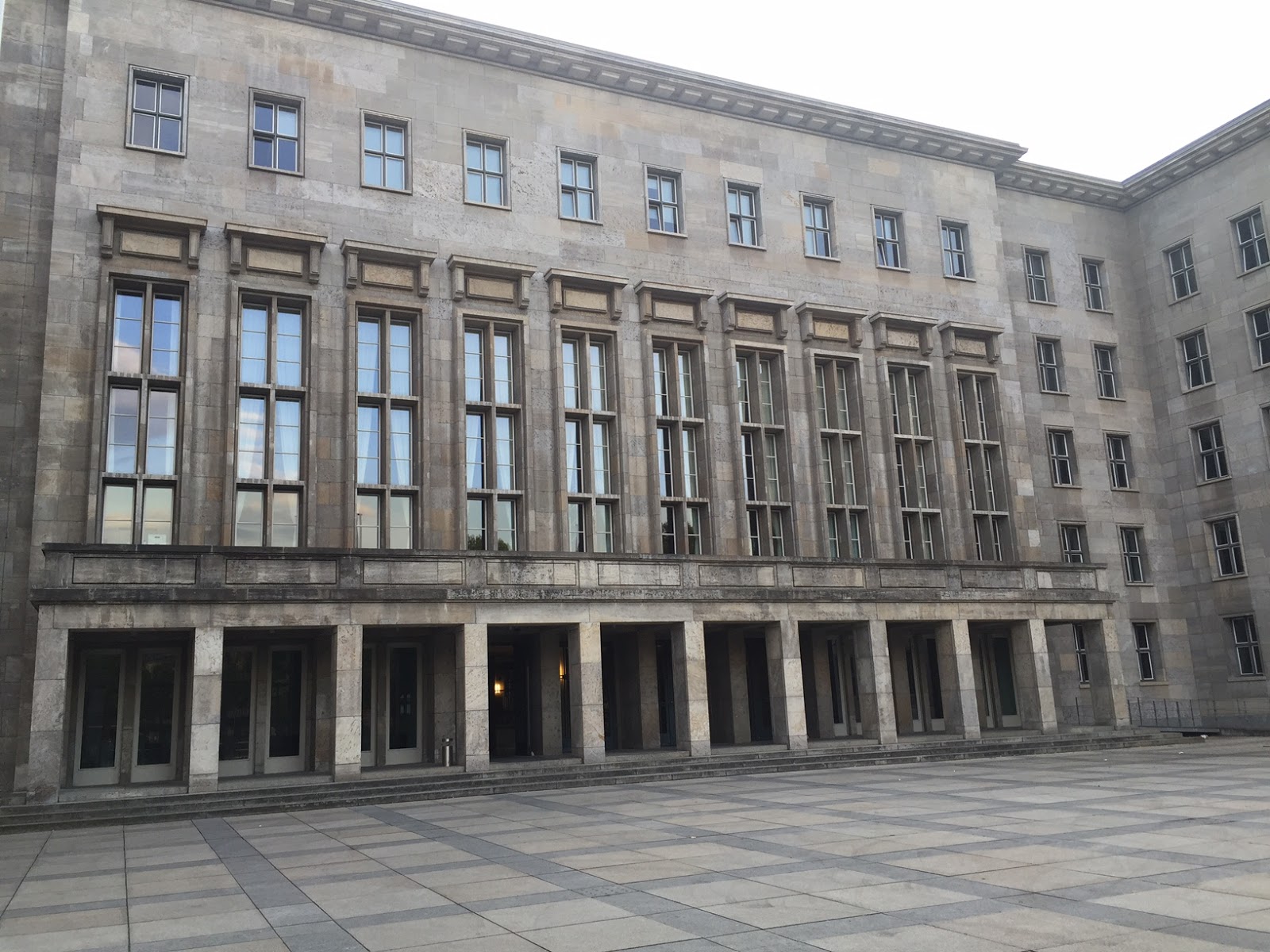
    This is Humboldt University. The square in front of it is Bebelplatz, where books were burned for being “un-German” during the early days of the Nazi regime.

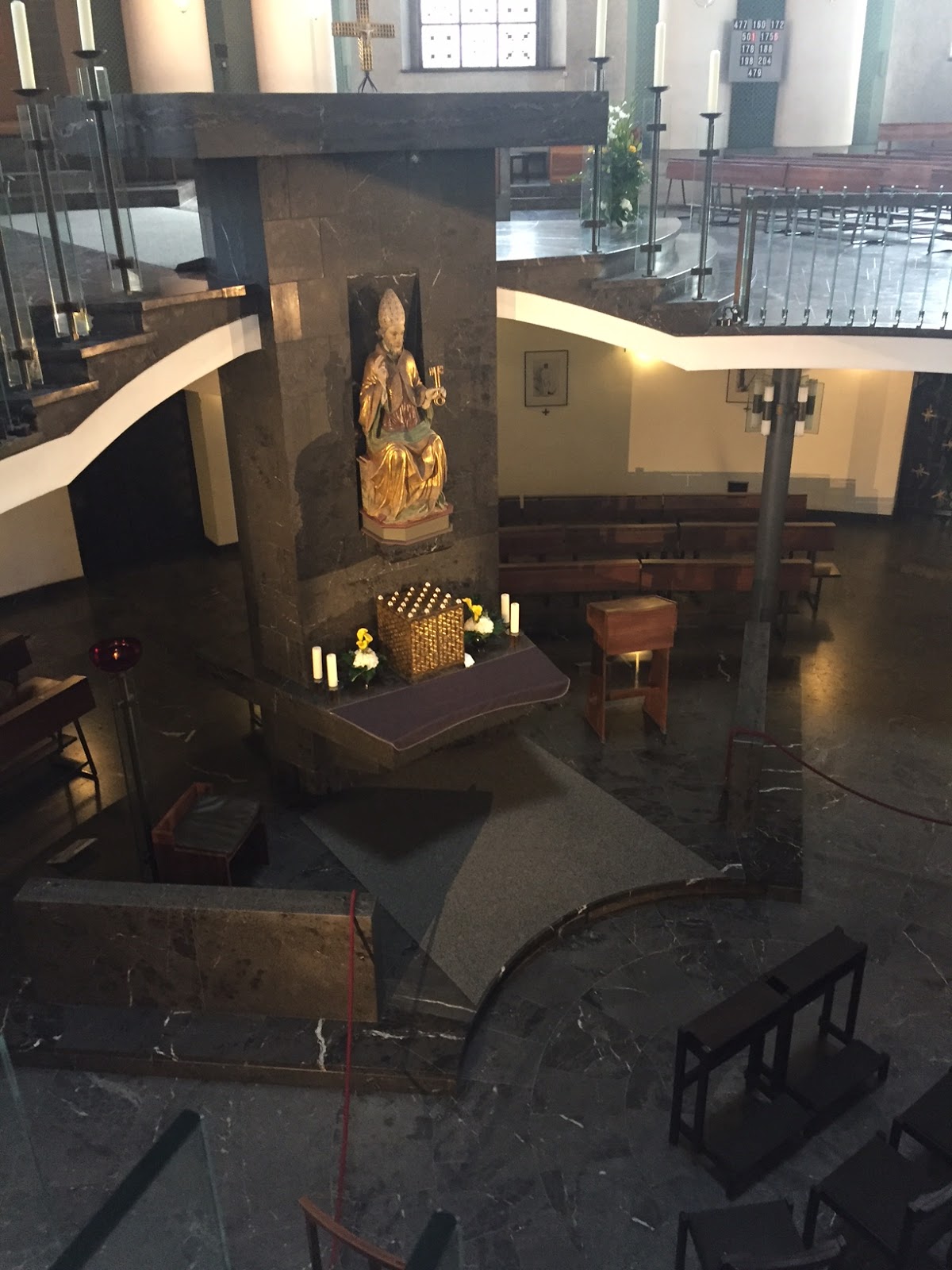
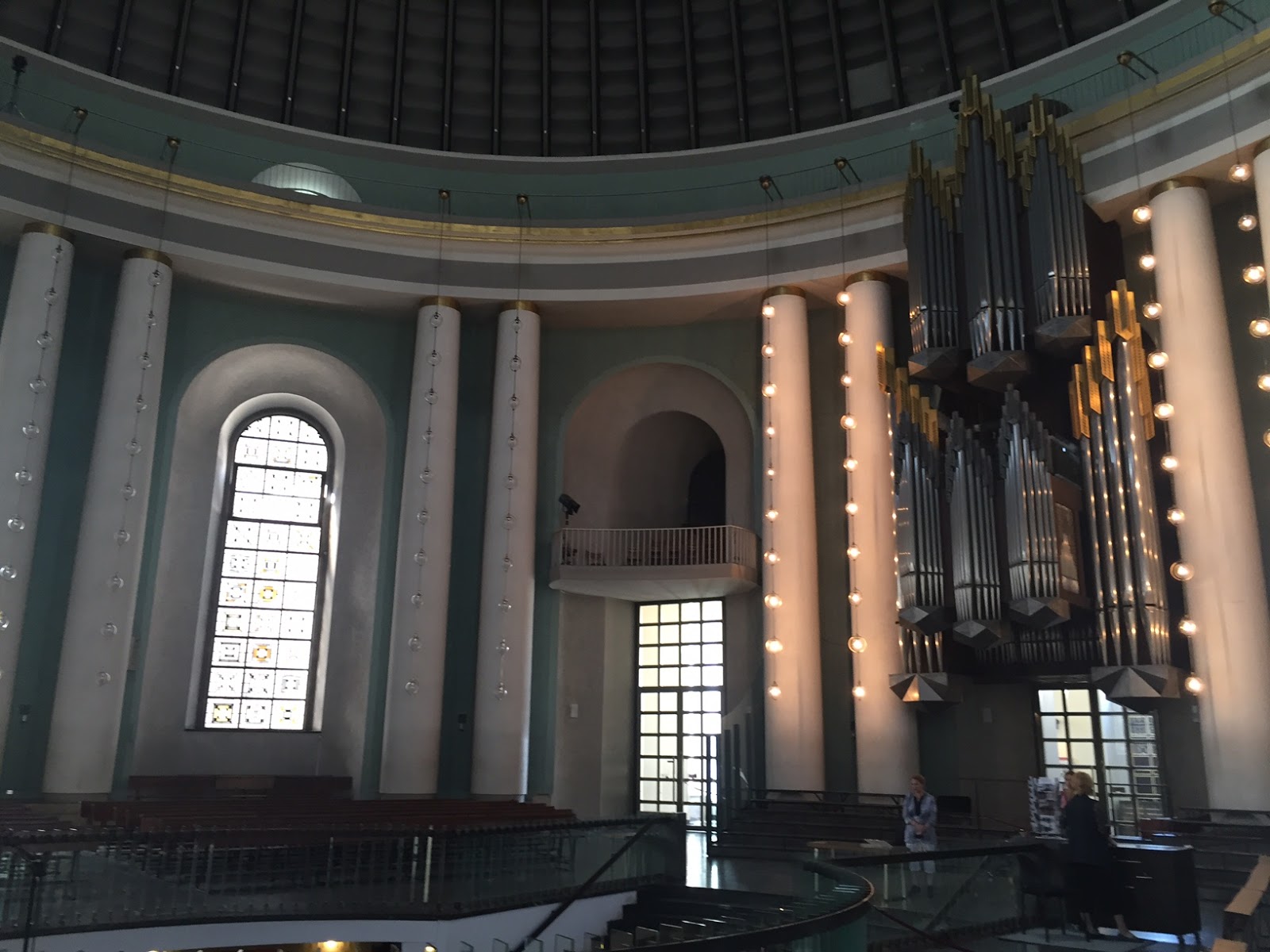
     This is me realizing that the building behind Dan is the Catholic Cathedral, so we popped in and took the photos that follow.


     The altar was on a lower floor than most of the pews; never seen that before.

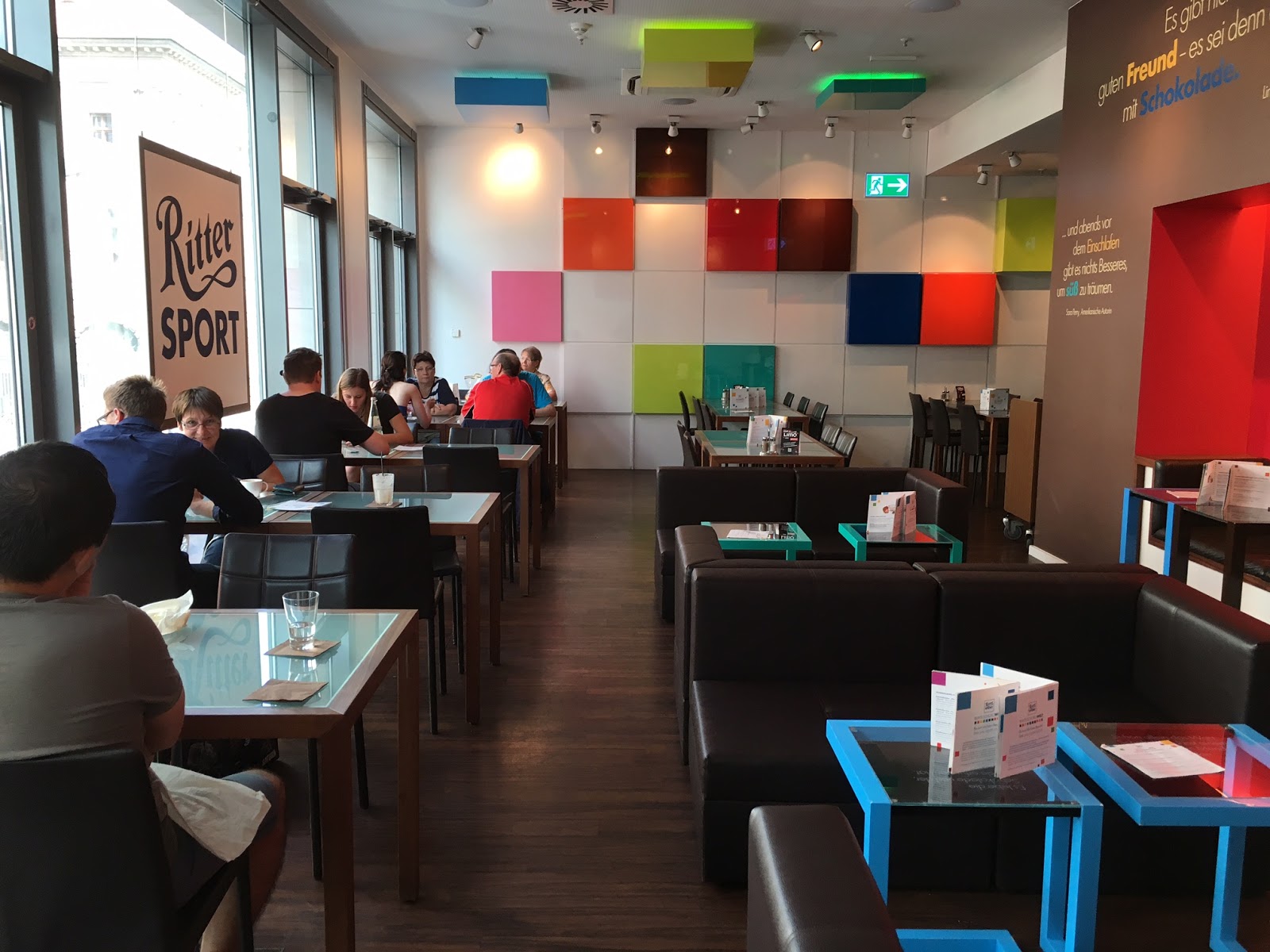
    We had planned to come back to Ritter Sport to get some chocolate to bring home, and to have lunch and take advantage of something we saw on the menu we hardly ever get to do.

    It was very colorful. The restaurant was on the 2nd floor. We sat by the windows (that’s Dan’s back bottom left.)
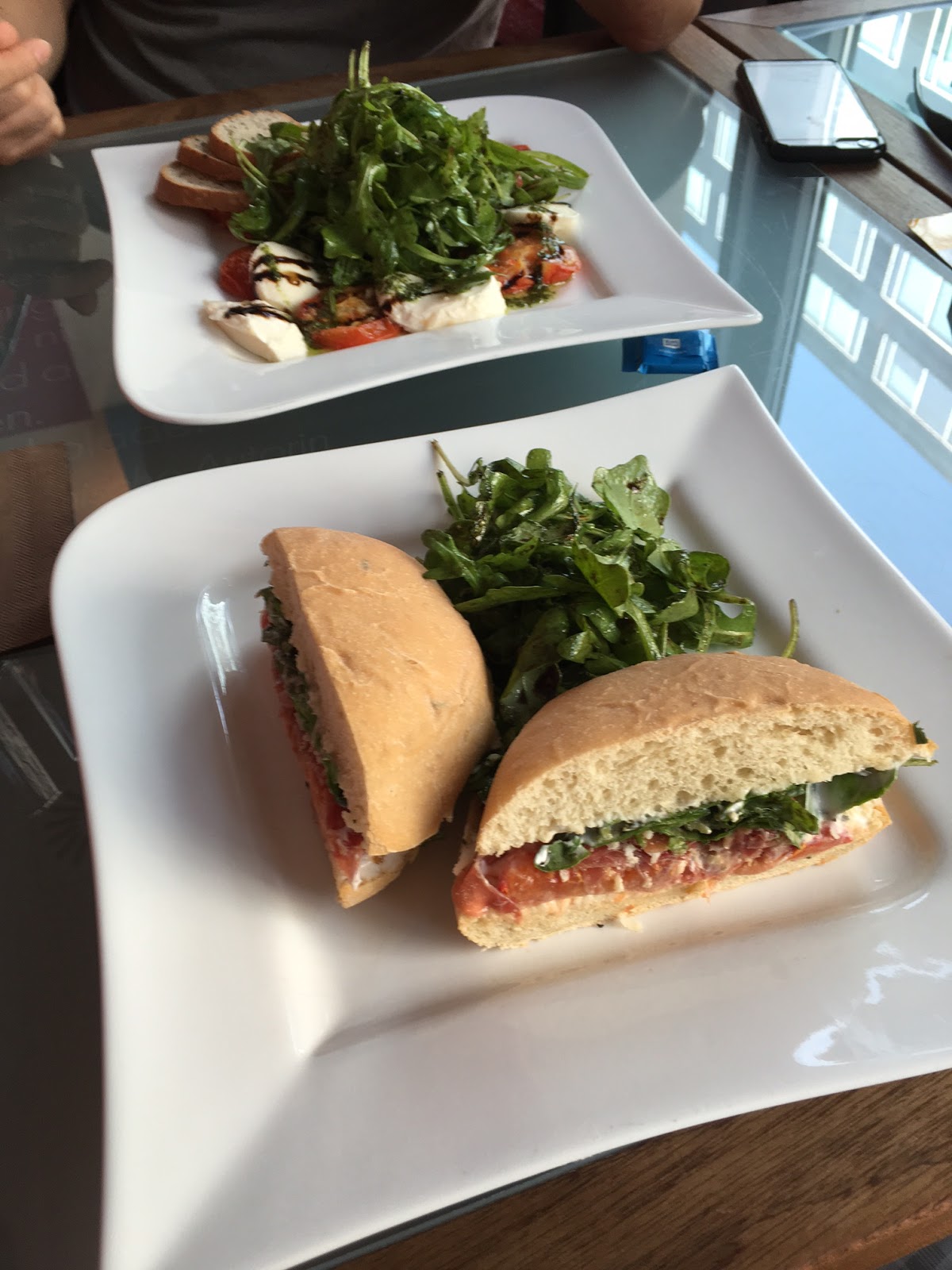
    We split a caprese salad (above) and a ham sandwich on foccacia (below). We needed a little substance to provide our stomachs with a foundation for what was coming next.


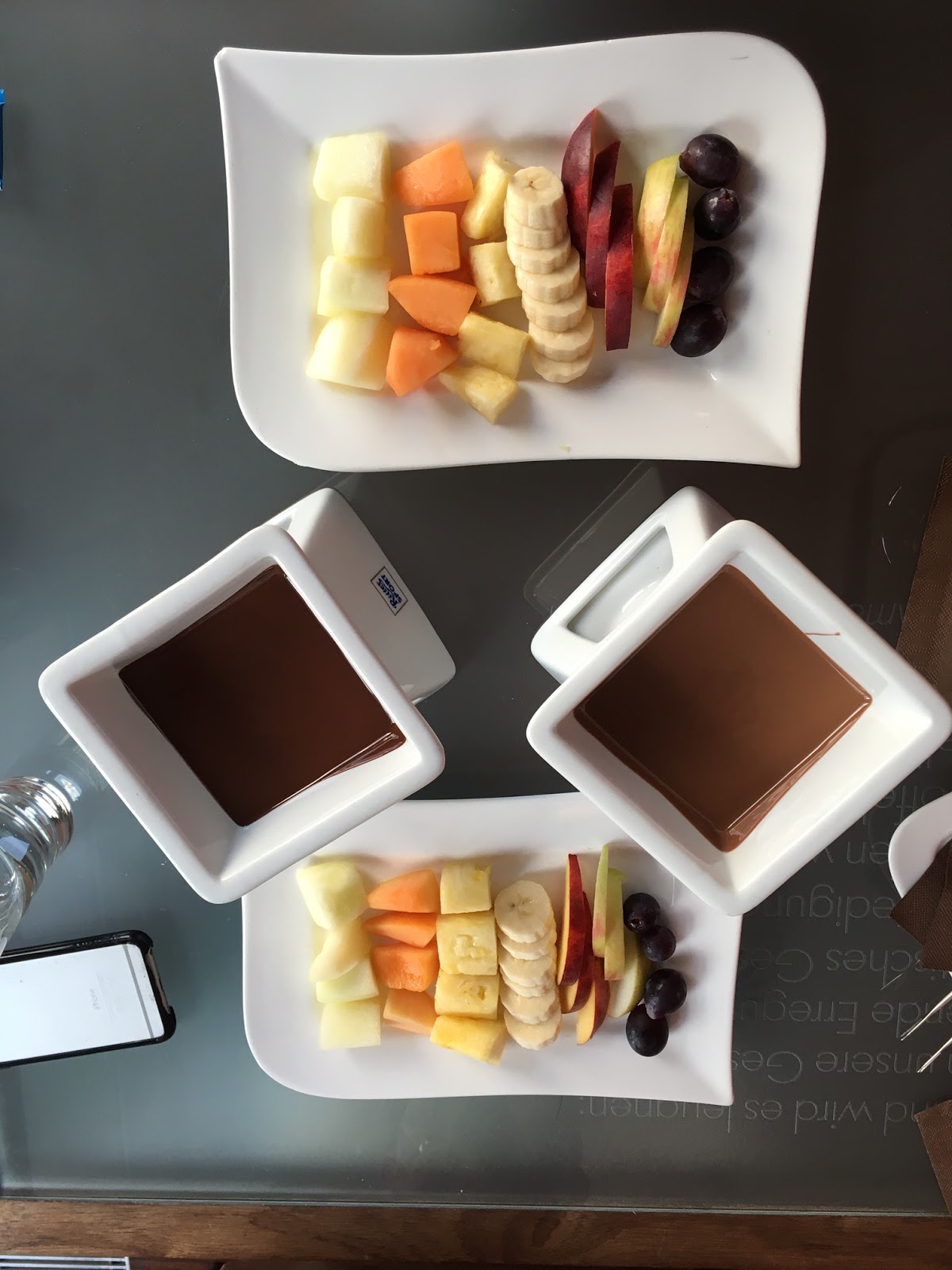
     The reason we came: Chocolate fondue – one dark, one milk, with a healthy serving of 7 kinds of fruit to dip into it: honey dew melon, cantaloupe, pineapple, banana, nectarine, apple, and grapes. It was worth every calorie.
    Next was the German History Museum. German history prior to 1871 has always been both fascinating and confusing to me and I was hoping this could clear up some of the mystery. And it did. German people have been around since the late Middle Ages but Germany as a single entity didn’t exist until 1871. How does that happen? This museum tied together a lot of what we’d learned in Vienna, Bratislava, and Prague as well.


    The front of the museum. This was definitely a history museum. It’s collection of artifacts was vast and varied, and the permanent exhibition was well structured and easy to follow. But huge. And the collection was noteworthy from a historical perspective, not really an art perspective. So we didn’t take that many photos. Following is a simple list of the main historical points we got to help fill in the blanks of our Germany history knowledge:

    • Historians generally agree that German history starts with Charlemagne. who became King of the Franks in 768, King of Italy in 774, and was crowned the first Holy Roman Emperor by Pope Leo in 800, the first Roman Emperor since the fall of the Roman Empire 300 years before. Similar to the exhibit we saw in Bratislava, this museum follows the theme that, because of Charlemagne, German history and European history are one and the same. For the next thousand years or so, references to what we know of today as Germany is referred to as the Holy Roman Empire because of Charlemagne.
    • The Northern section of his empire eventually became Belgium and the Netherlands.
    • The Western section became France, and broke off relatively early.
    • The Eastern section remained the Holy Roman Empire and eventually became Germany; when the German label was used it was Deutsch and was calling out those who spoke the language more than the people as a whole
    • Germany makes an impact on world history with inventing the mechanical clock in the 1300’s – like the ones we saw in Prague and Dresden. Prior to that, society still counted out 12 hours in a day between sunrise and sunset, but because that interval changed based on the time of year, it was horribly uneven. The clock allowed for regulation of time, a disciplined approach to gatherings at church and other social necessities, etc, for the first time, and became a “fundamental condition of middle-class life.”
    • Another significant contribution about this time was Guttenberg inventing the printing press in 1448 in Mainz (my very first European city in 2013!); the Bible was the first book printed. Both sides of the coming Reformation saw this advance as a gift from God, since it for the first time enabled many to read the word of God themselves.
    • In 1522, Martin Luther translated the Bible into simpler German to make it more accessible to the lay public, with illustrations provided by Lucas Cranach (whose work we met in Dresden). “The translation was of as decisive and fundamental importance to the Reformation as it was to the development of the modern German written language” because of its clarity and overwhelming sales success.
    • Short version of the next 400 years: war, war and more war. Lots of mentions of empires we’d been hearing about the entire trip, especially the Habsburgs and Napoleon. The big 5 powers were England, France, Germany but known as Prussia then, Austria, and Russia. Dan and I found it interesting that, with the exception of Austria, not much has changed compared to today.
    • The Holy Roman Empire ended in 1806 after Napoleon’s victory across the content. Germany was united again in 1871 under Wilhelm the First.
    • The other common theme was revolutions by the people against monarchies and/or authoritarian rule, much of it fueled by the success of America’s independence, which swept the continent between 1789 and 1850 (some with more success than others). Austria and Germany were the last to fall, the result of losing WW1.

    For the sake of brevity, I’m going to leave much of the rest out with the exception of a few particular items.

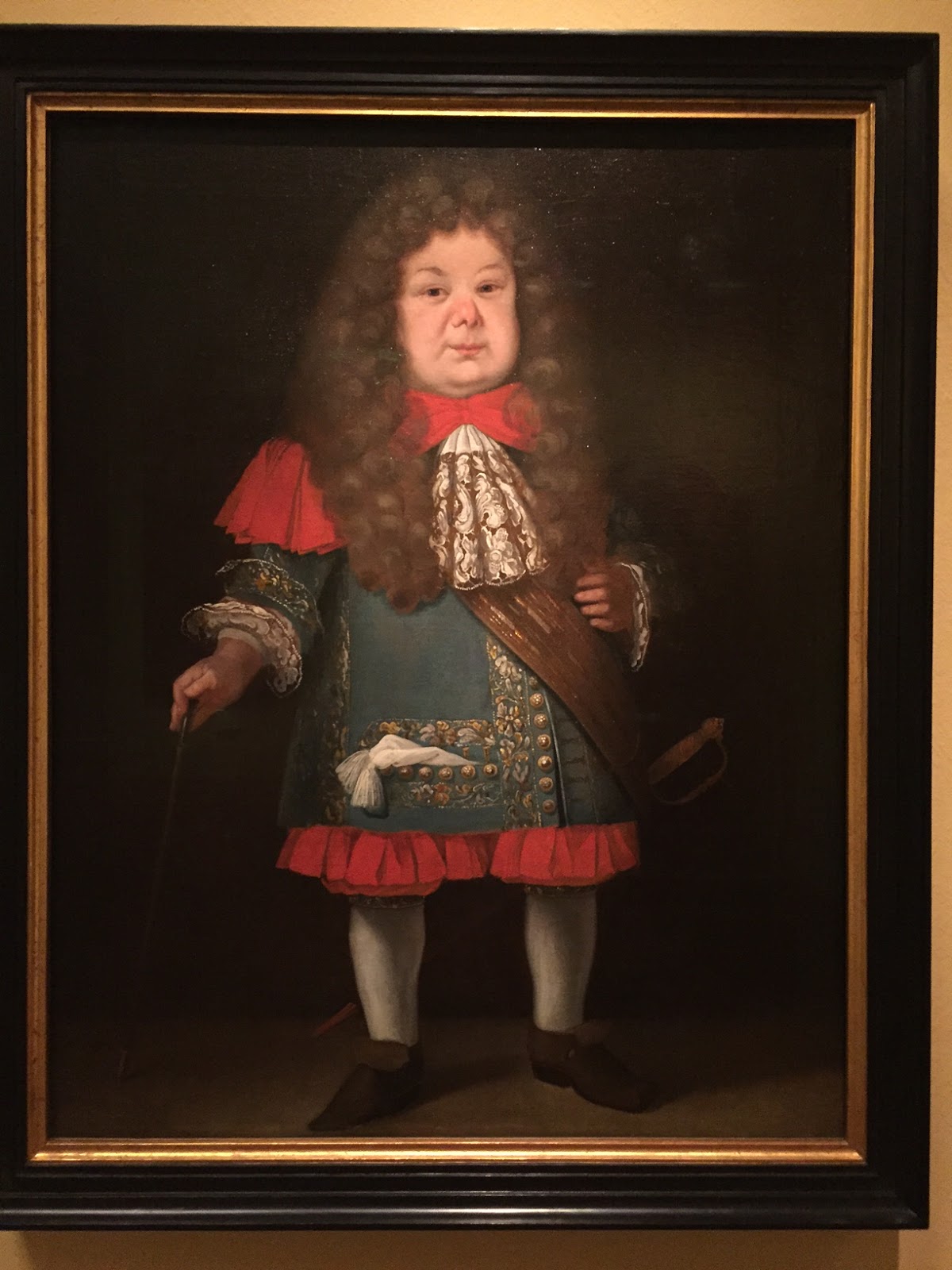
    While it probably wouldn’t go over well today, apparently having a dwarf as a part of ones court in the Baroque period was encouraged due to a “delight in the unusual and bizarre.”

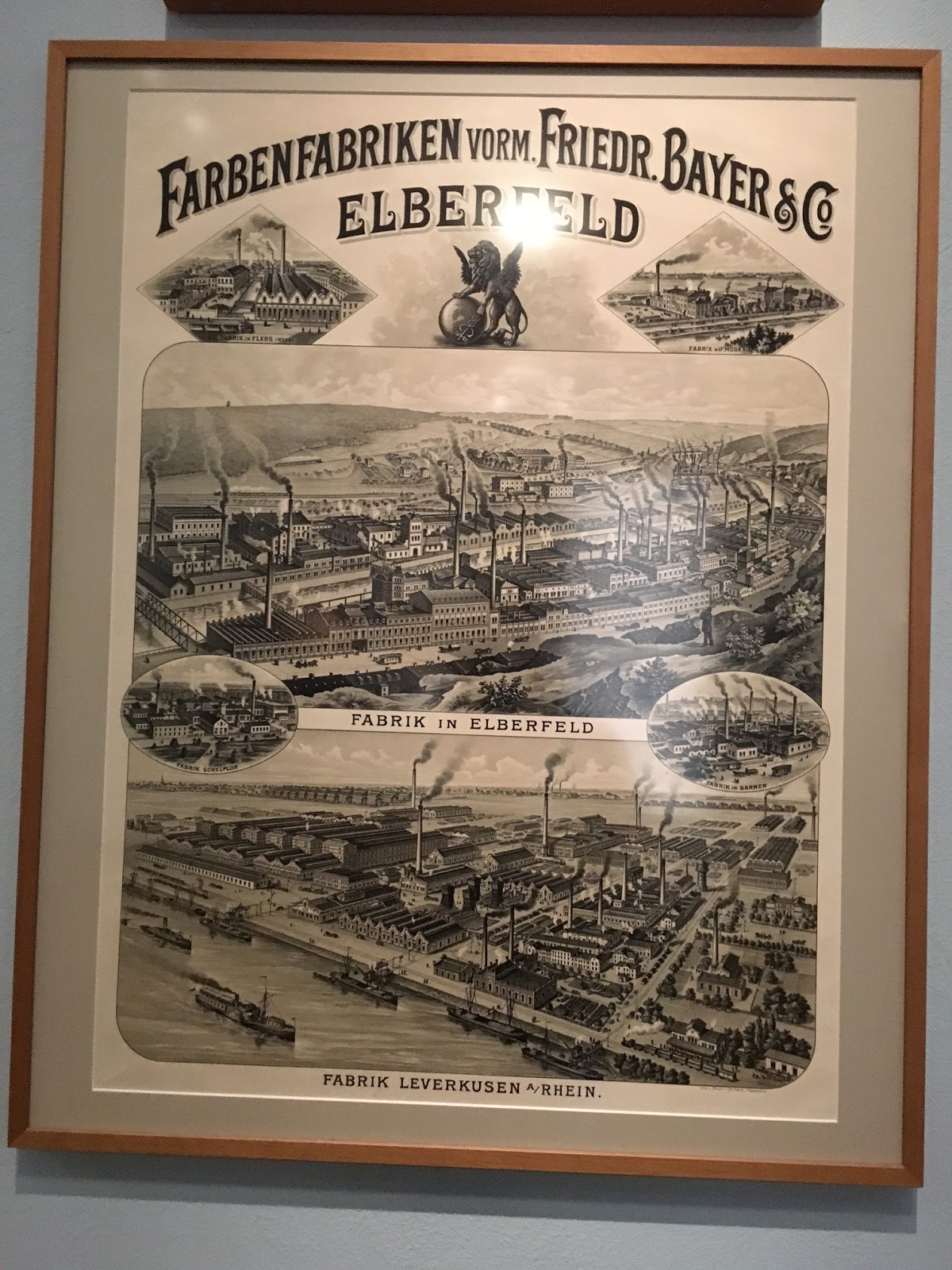
    This museum covered history from the Dark Ages up until 1918, the end of WW1. A couple of sections in the 1800’s touched on the industrial revolution. One of the entries for the last half of the century was on Bayer under a heading on innovative industries.


     This piece covered the move of its corporate headquarters to Leverkusen (roughly between Cologne and Dusseldorf) where it still is today.
    Are you tired yet?
    We spent 2 hours in this museum and agreed later we should have done it much faster, because it didn’t leave much time for the two other things we really wanted to see.
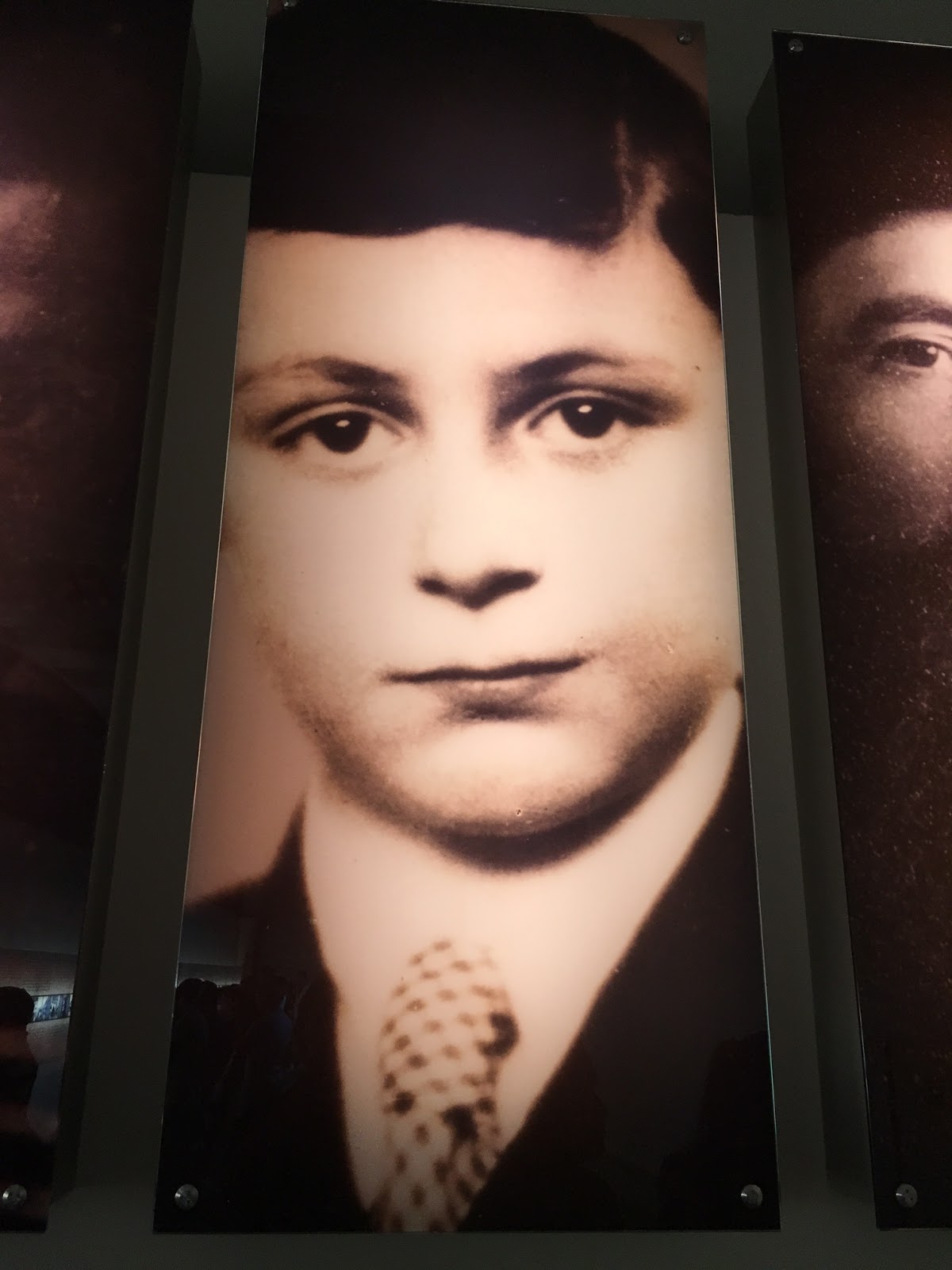
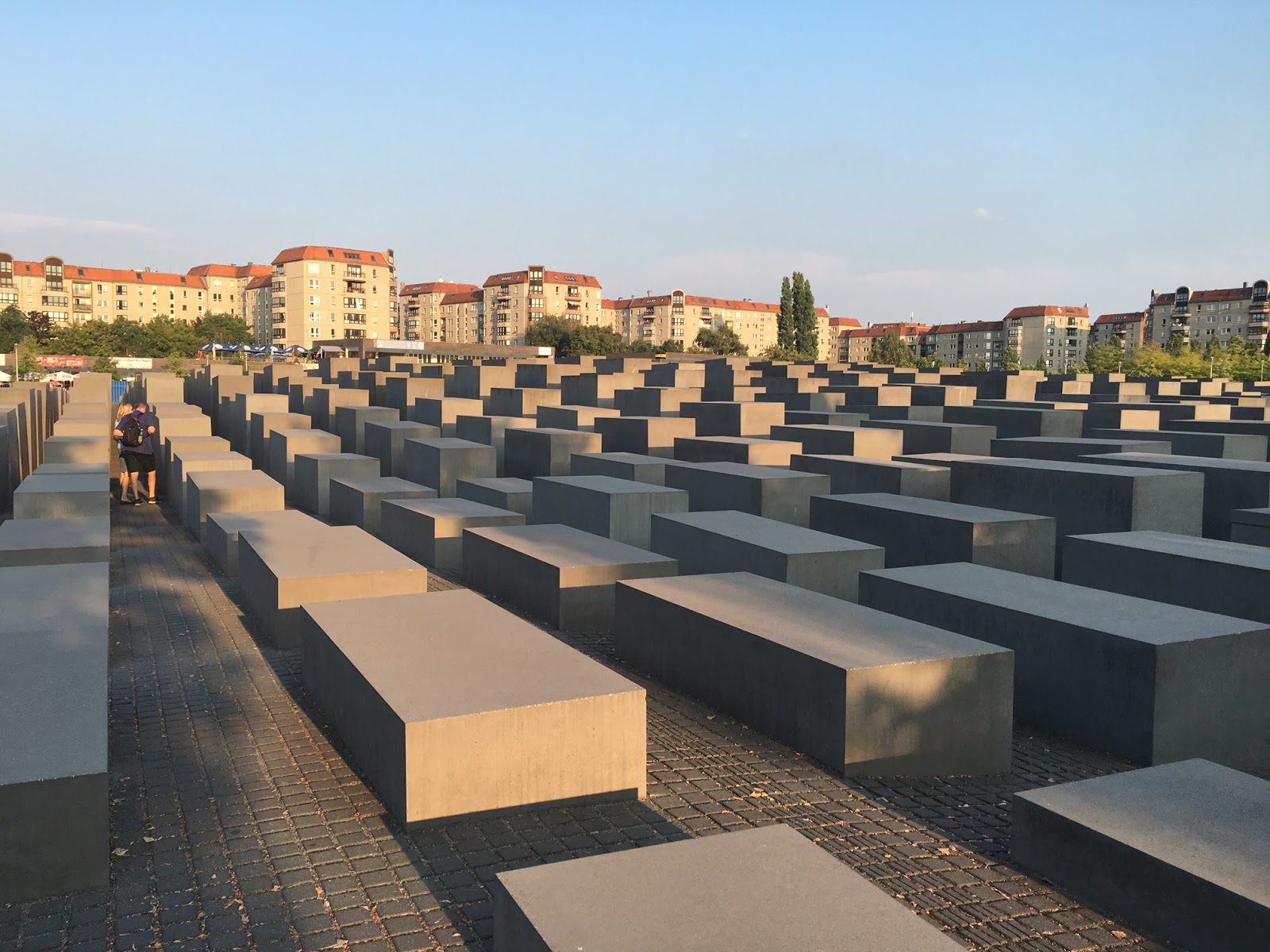
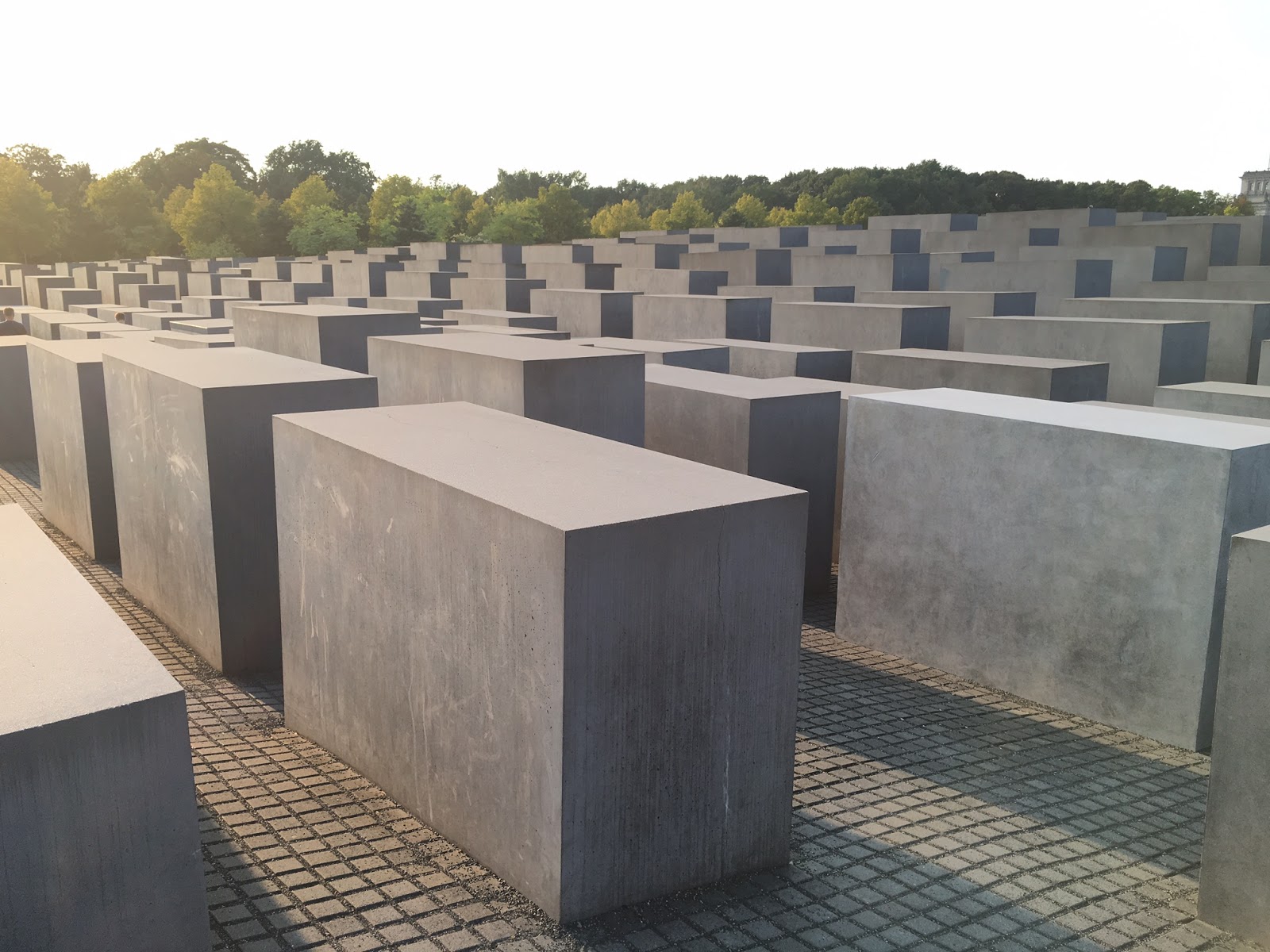
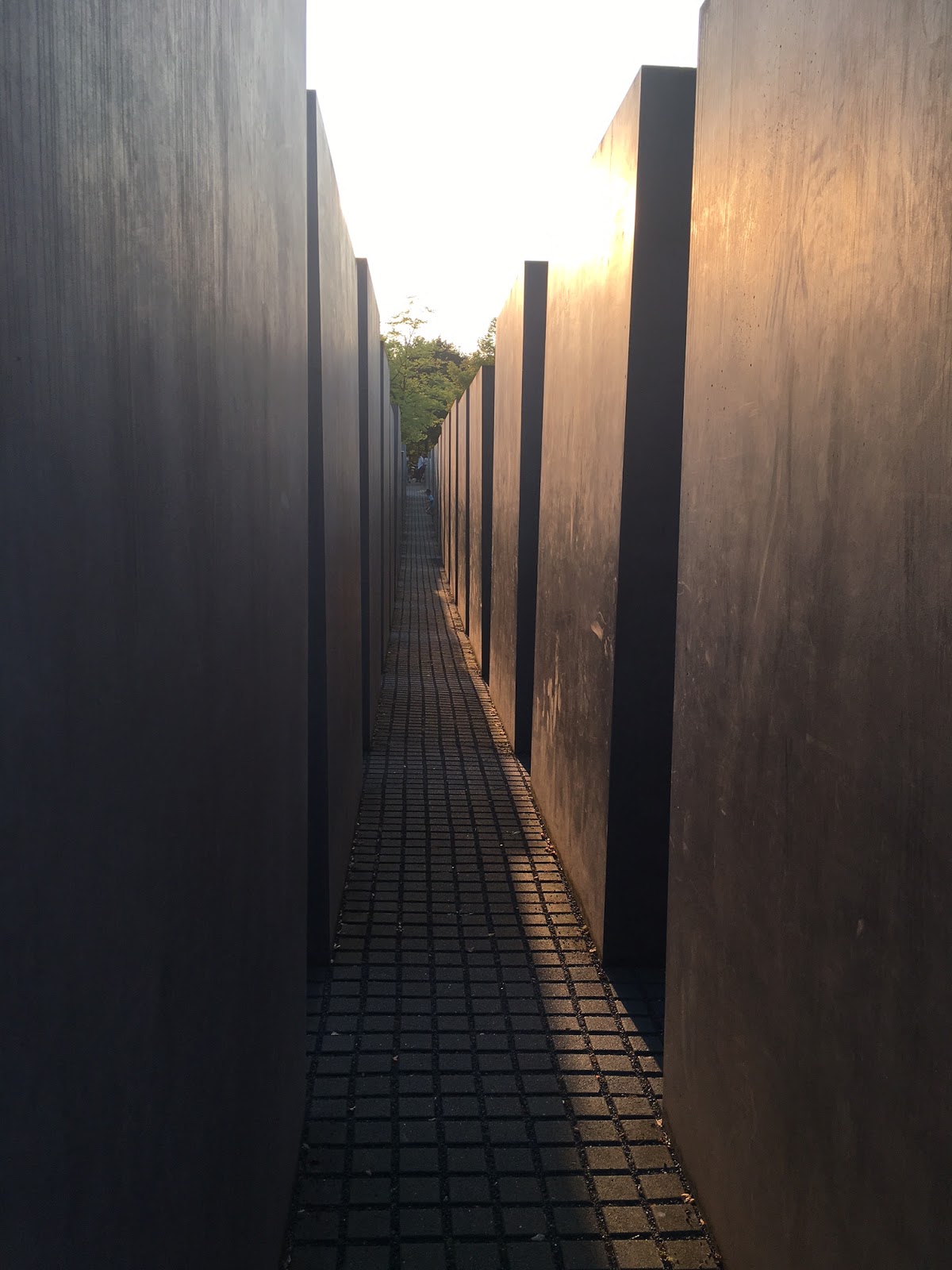
    Next was the Holocaust Memorial, again. If you recall from Thursday, we only saw the top because we got there too late to get in. (We think – turns out we may have just been using the wrong entrance! Oops.) At any rate, we went back to see the exhibit underground. And it was well worth it. The following attempts to capture what we experienced there. This was a well done memorial, focused primarily on personal stories and there were lots of them, and presented with photos, letters, recordings.


    The exhibit underground was designed to mirror the concrete blocks above. Including another shot from Thursday below.
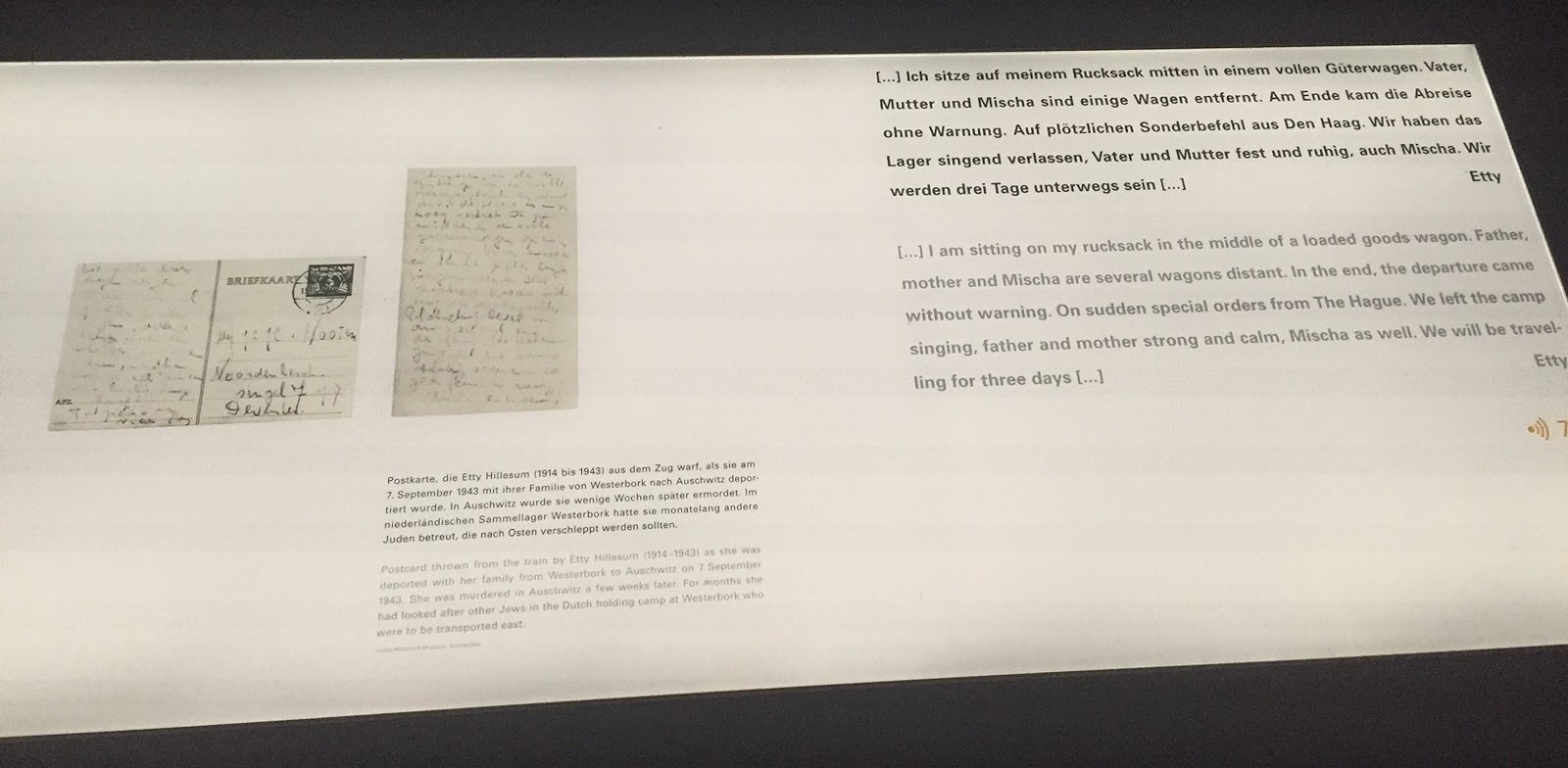
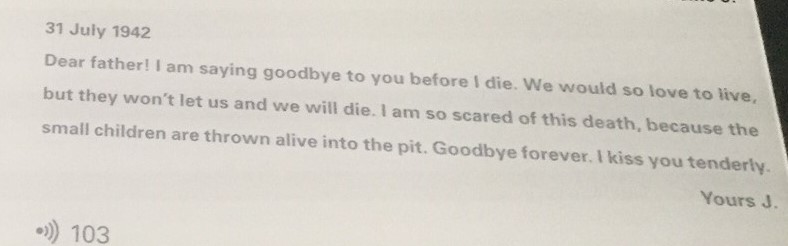
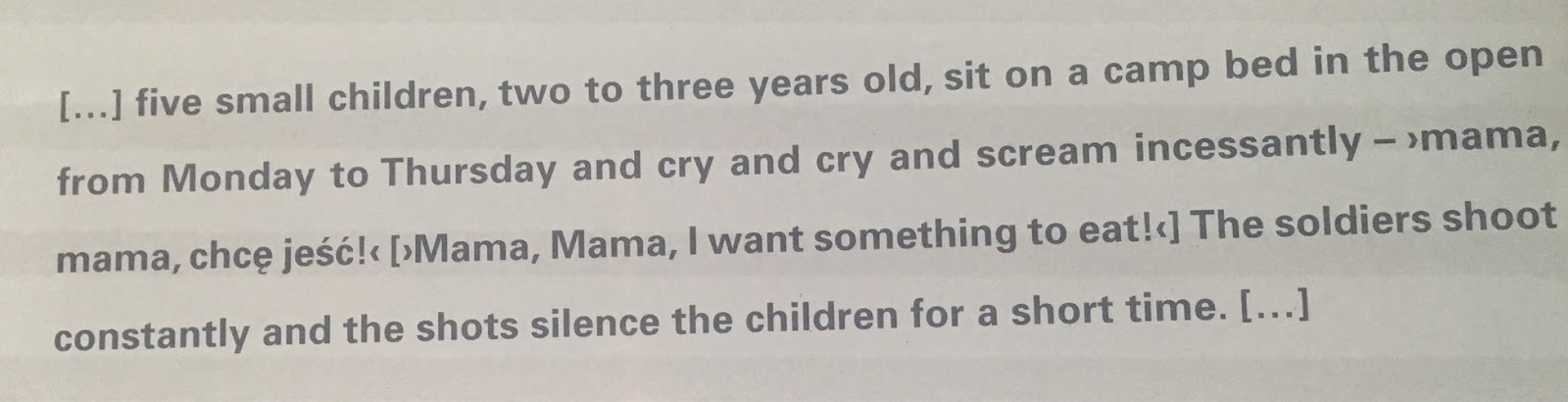
    This is a close-up of the individual floor exhibits from the room above. Each one had letters, postcards, etc., from captives as shown the below. The photos that follow this one include just the translated messages which were in the bottom right side.


    We only stayed an hour. It would have been easy to stay longer, but we wanted to get to the final item which was still 15 minutes away and closed at 8pm. We left here a little before 7pm. The final destination: an exhibit (also free) called The Topography of Terror. This was my 2nd most anticipated item of the trip, after the Berlin Wall. It is located in a section of the city that housed many if not most of the administration offices for the Nazi regime and details what life was like during their rule. Dan took a couple of photos along the way.


    We only had 45 minutes here and wished we had longer. The level of detail was highly impactful. The one thing that stuck out was that the Nazis were a nasty bunch from the beginning. I’d had the impression before that they were more subtle. For example, in Amsterdam, we definitely got the impression that when they first got there in 1940, very little changed. They initially played well with others and got people to go along with things like national identification systems. It wasn’t until the Jews started being rounded up in 1942 that people really started to panic.

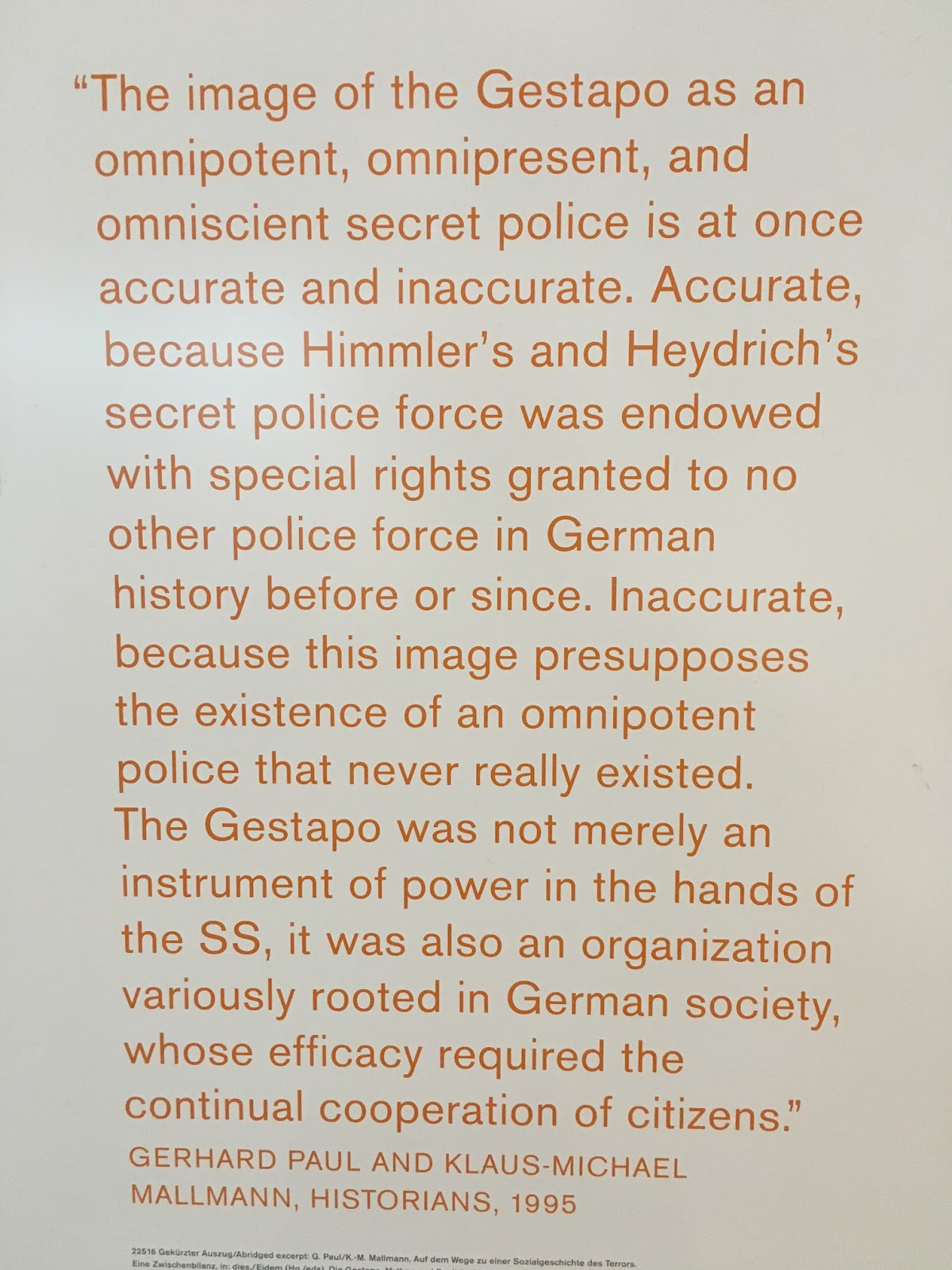
    This exhibit showed how in Germany, it was pretty clear from the beginning where things were headed for anyone paying attention. The problem was that Hitler was seen as a savior, bringing the country out of a depression – both financially and emotionally – that it had been in since losing WW1. So many believed that they were benefiting from his actions that they chose to look the other way on the other stuff, if they were aware of it at all. What Dan and I found most refreshing about this exhibit, as well as the Wall and the Holocaust exhibits, is how unflinchingly honest the Germans have been in documenting and portraying what really happened. They want to keep talking about it to help ensure that it never happens again.This was very much not true immediately after the war; that generation had so much shame about their complicity that it wasn’t talked about at all until the 60’s.

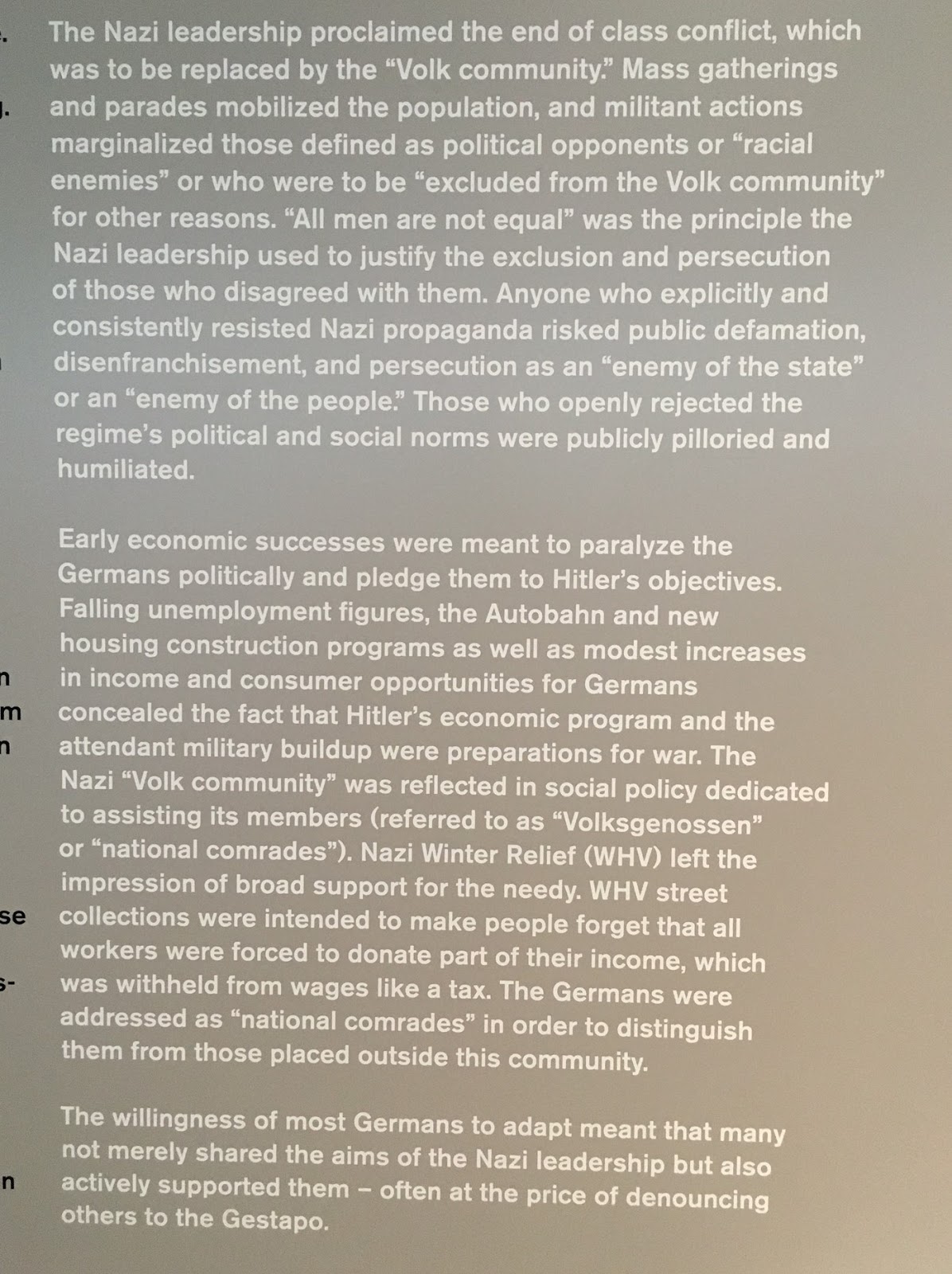
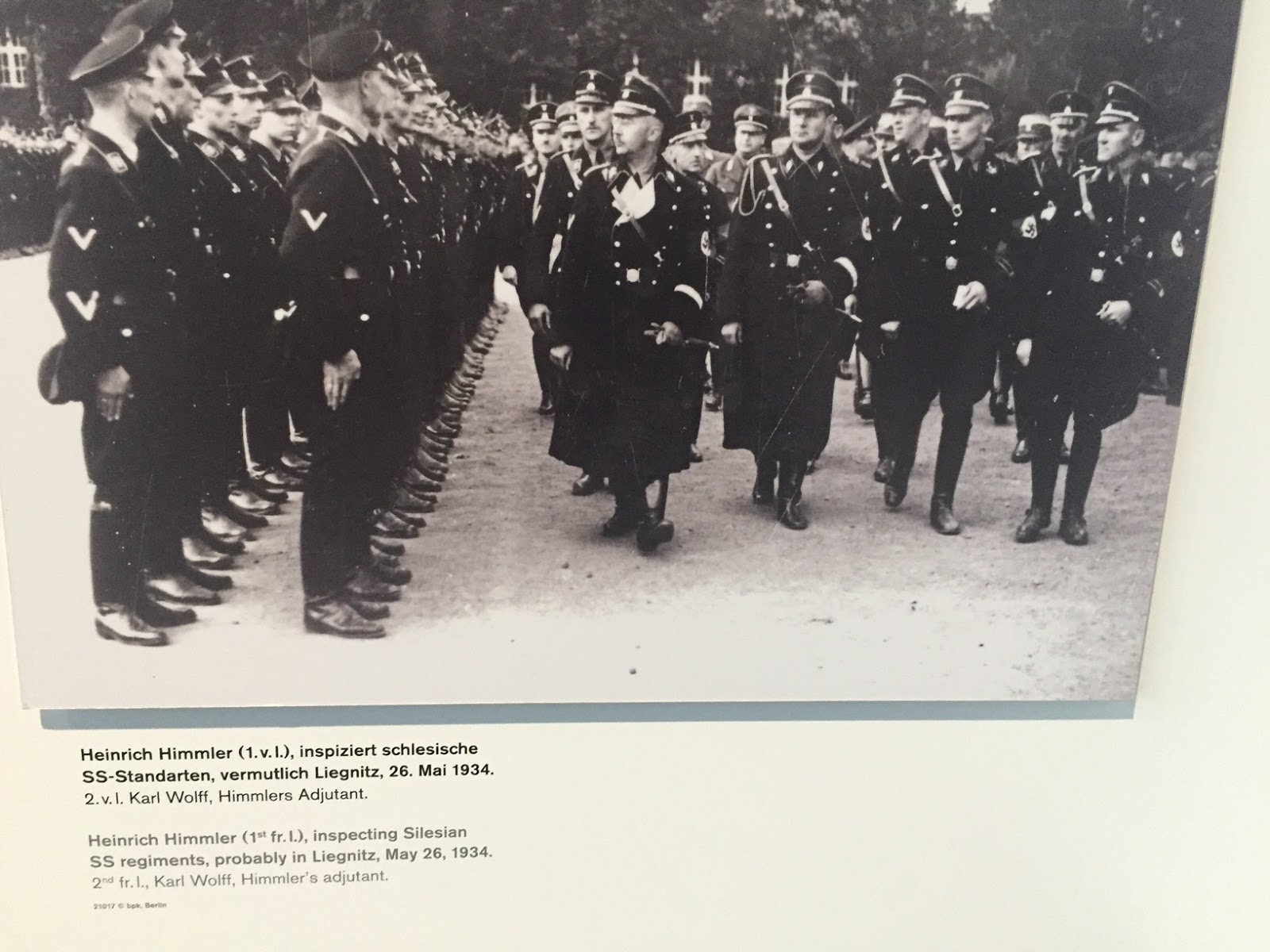
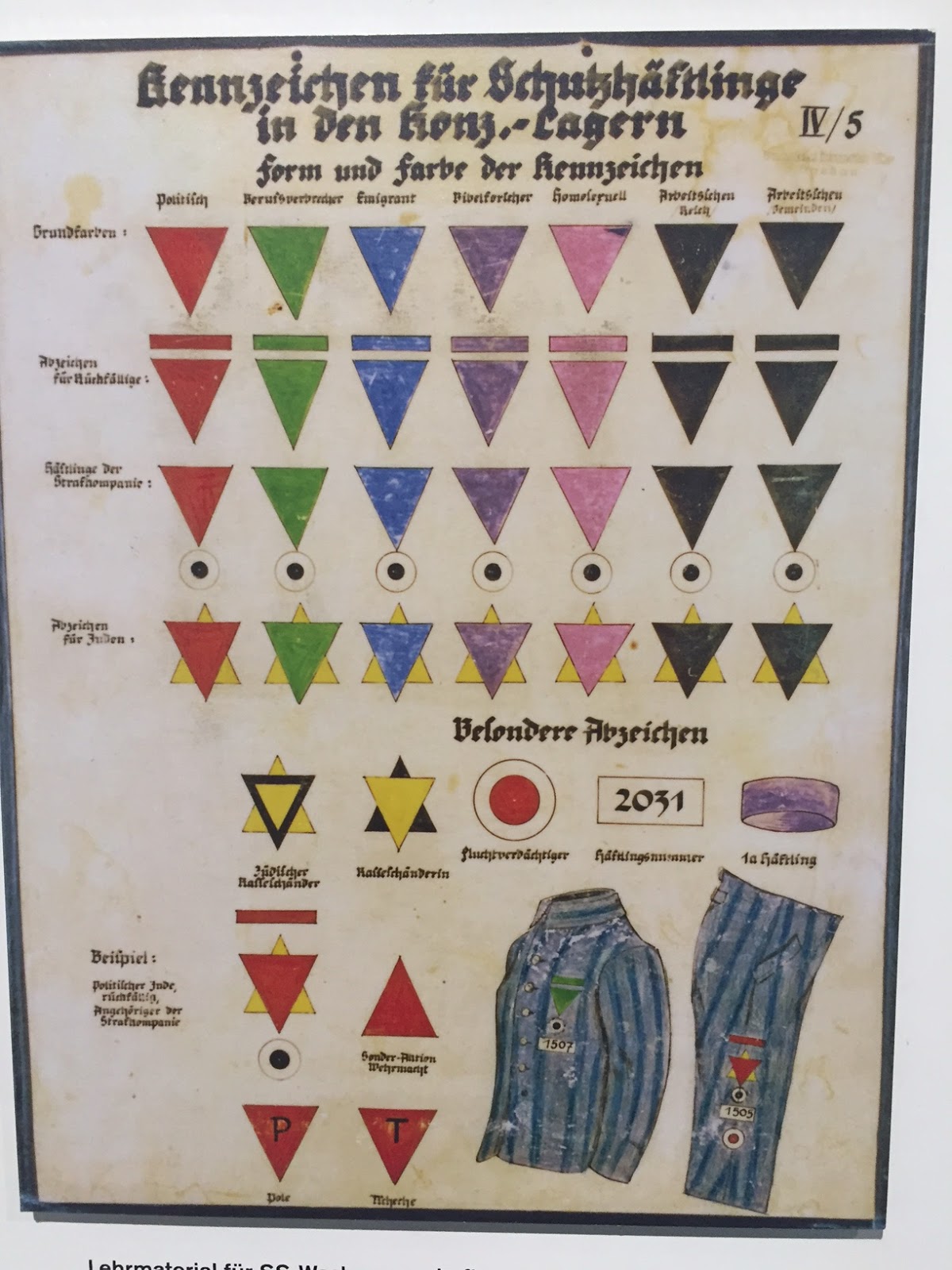
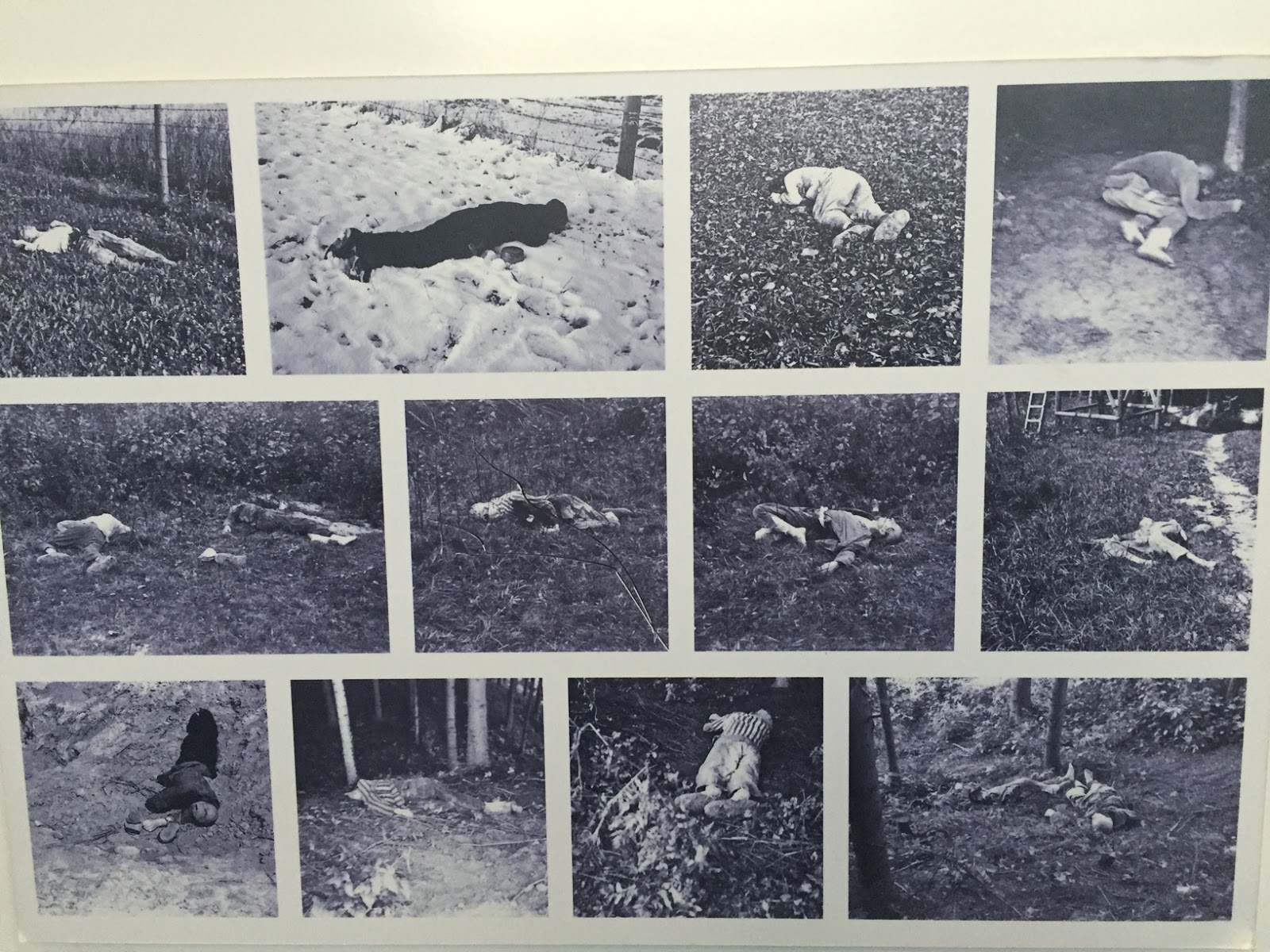
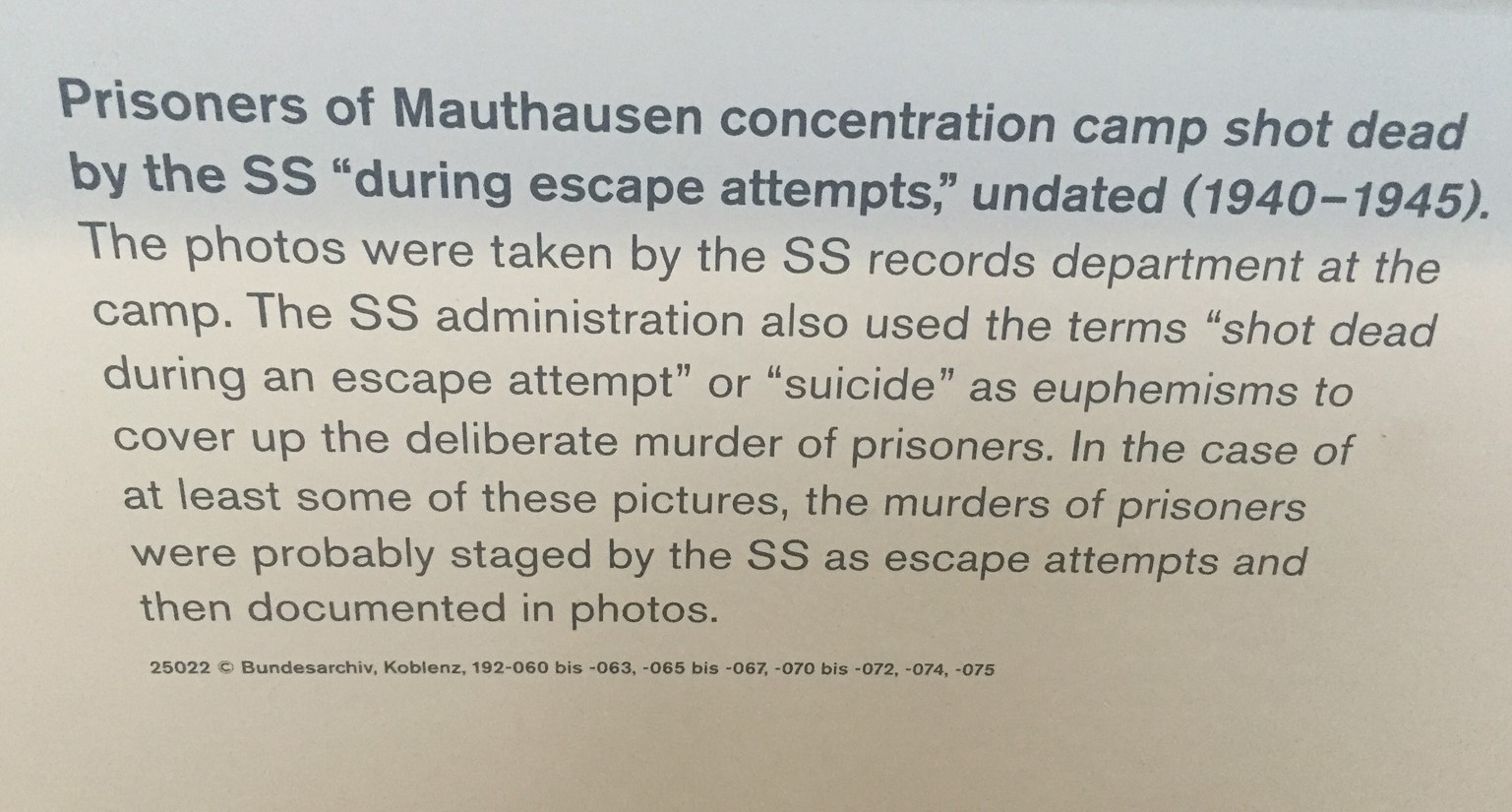
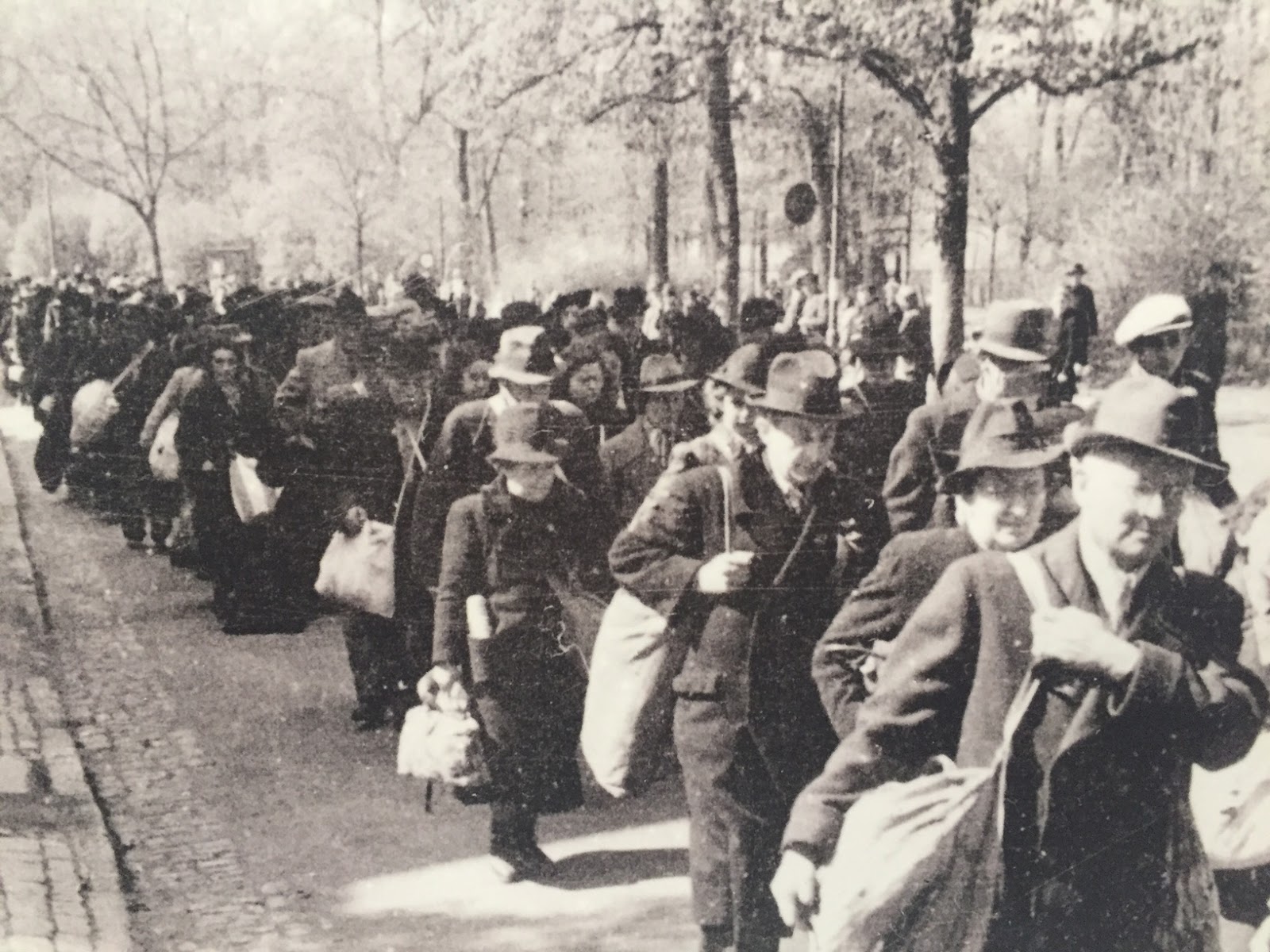
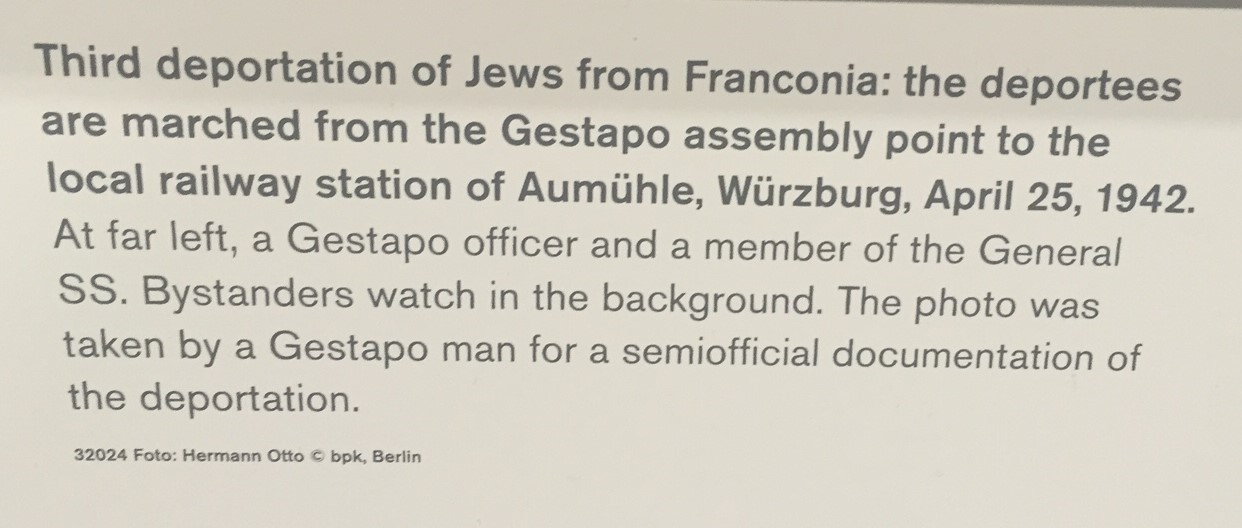
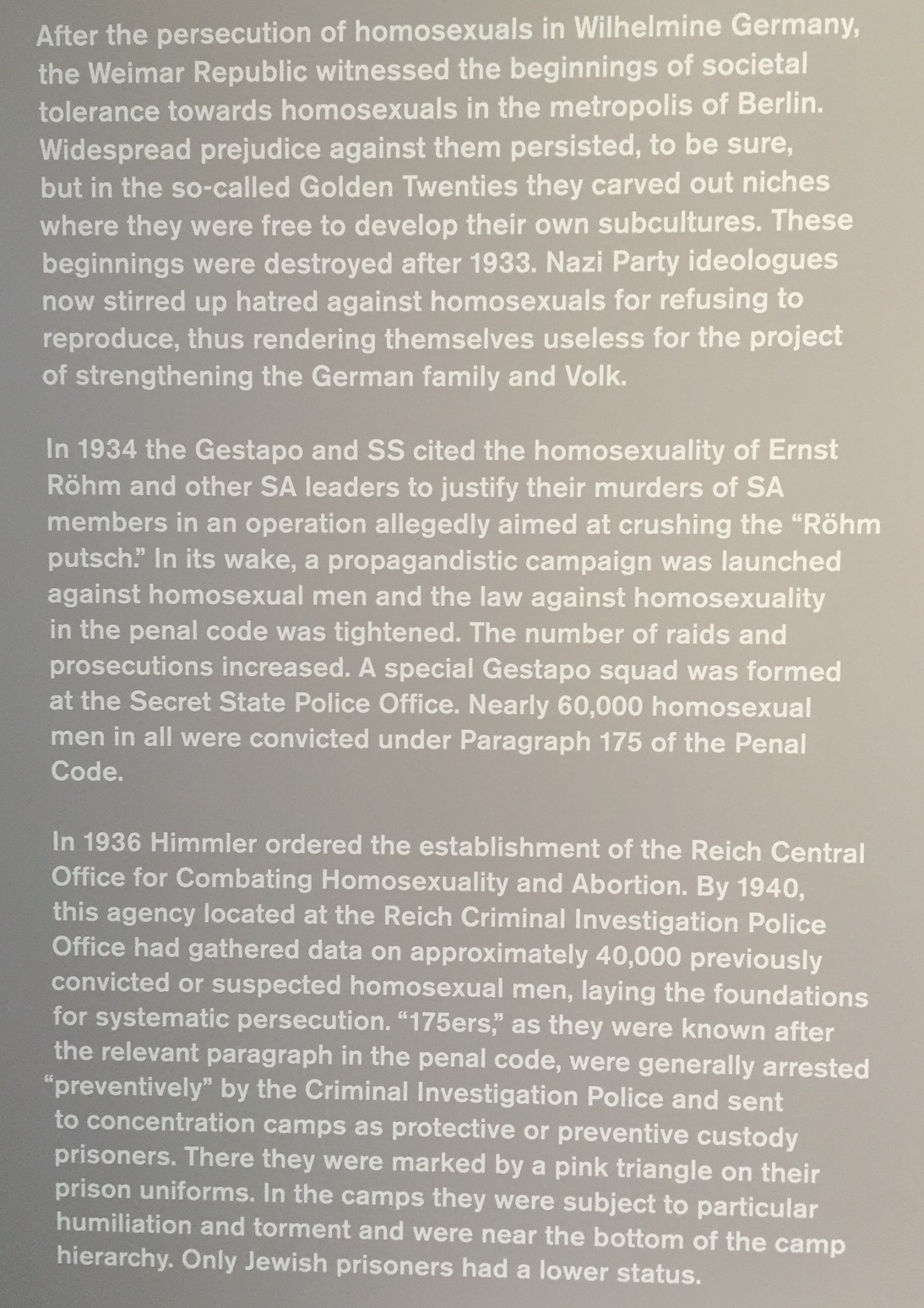
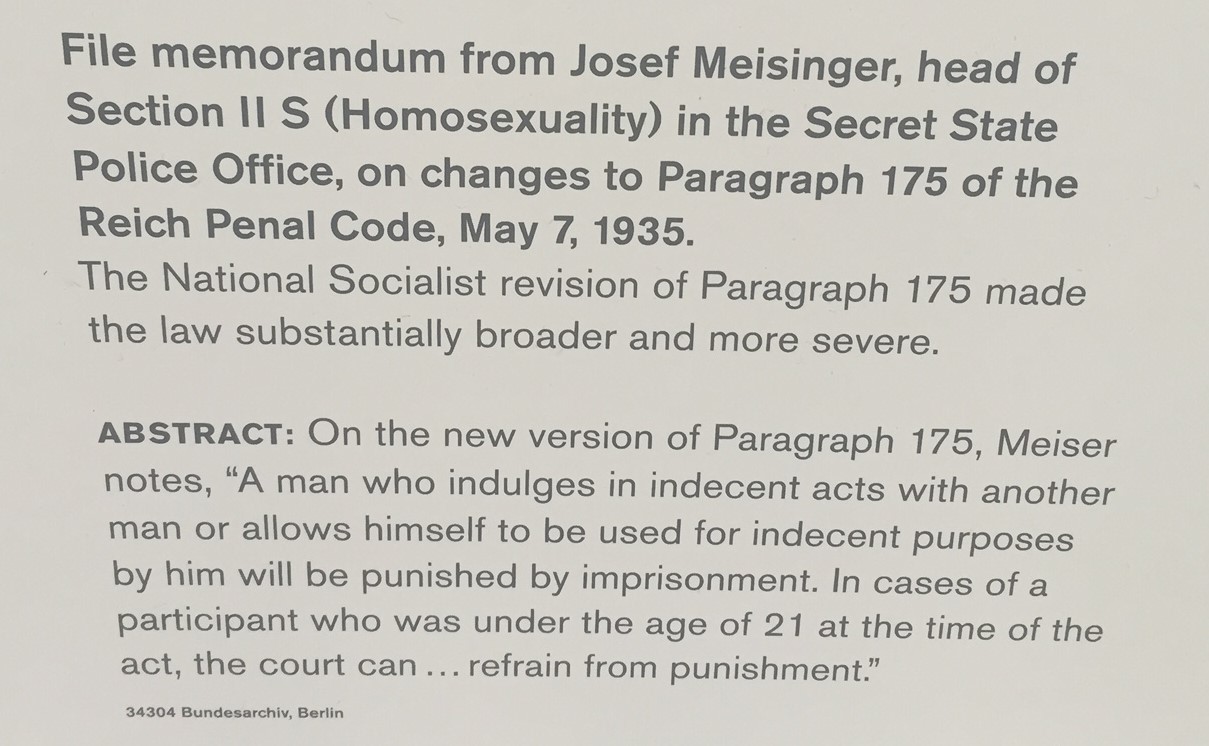
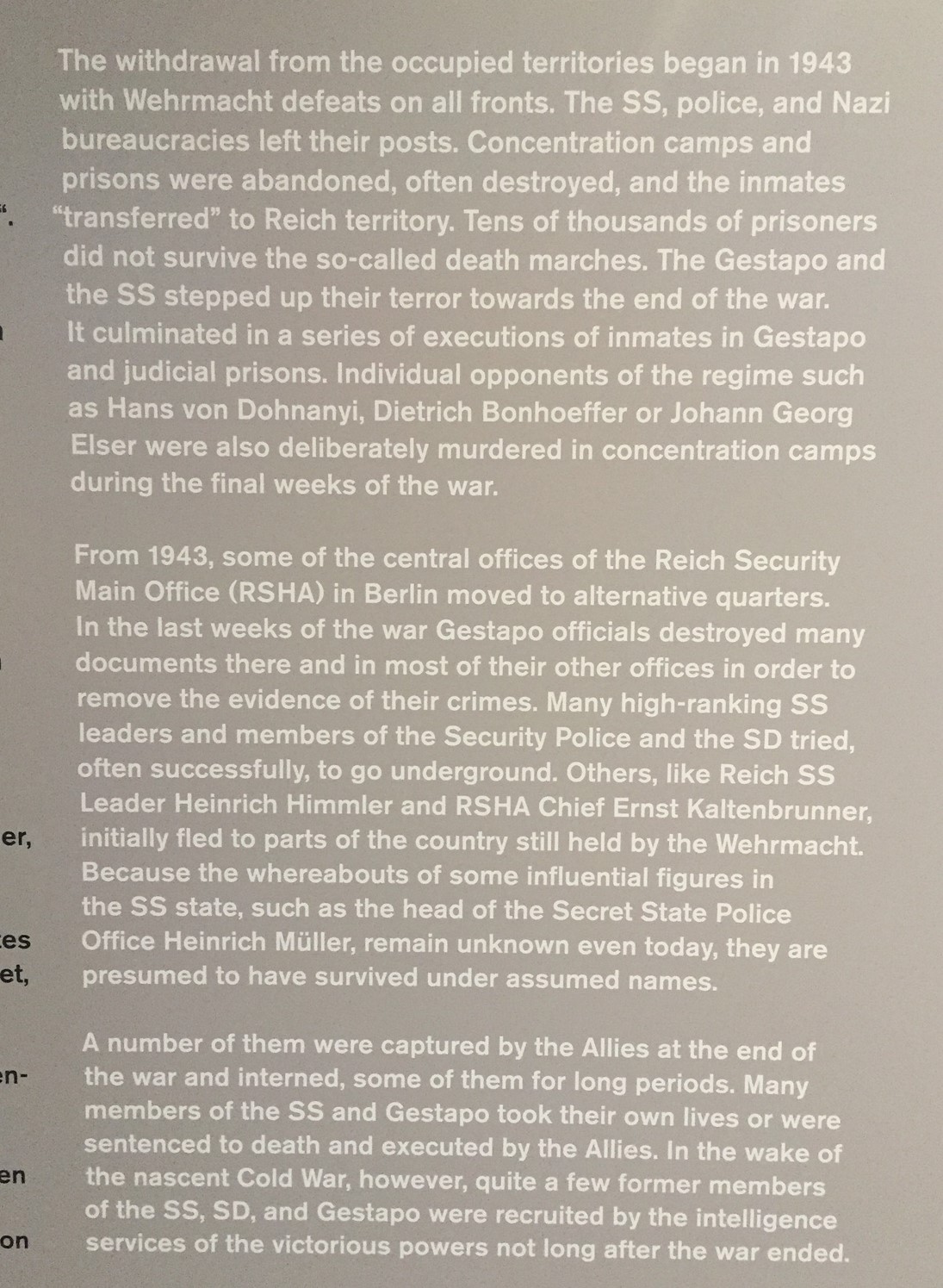
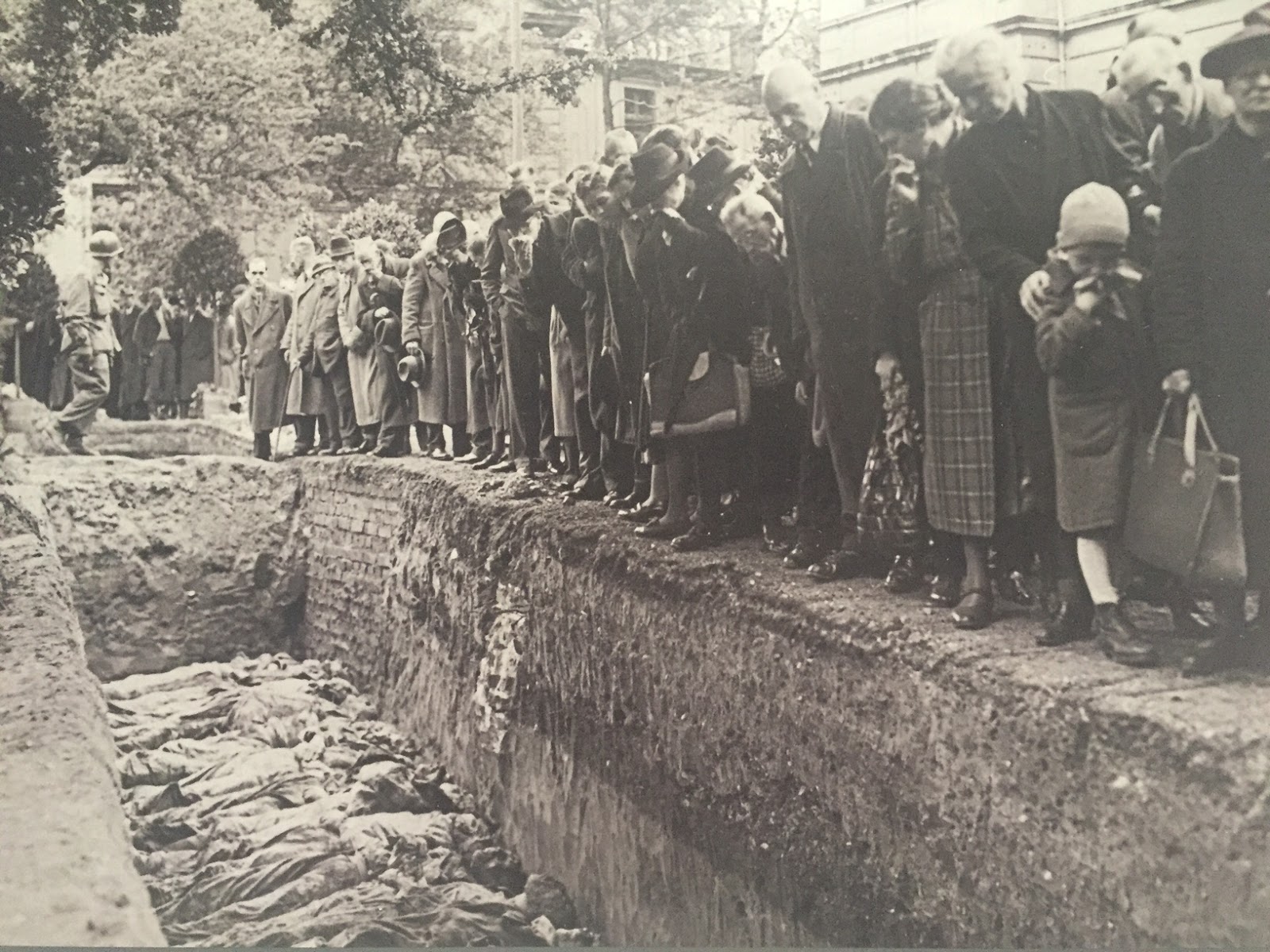
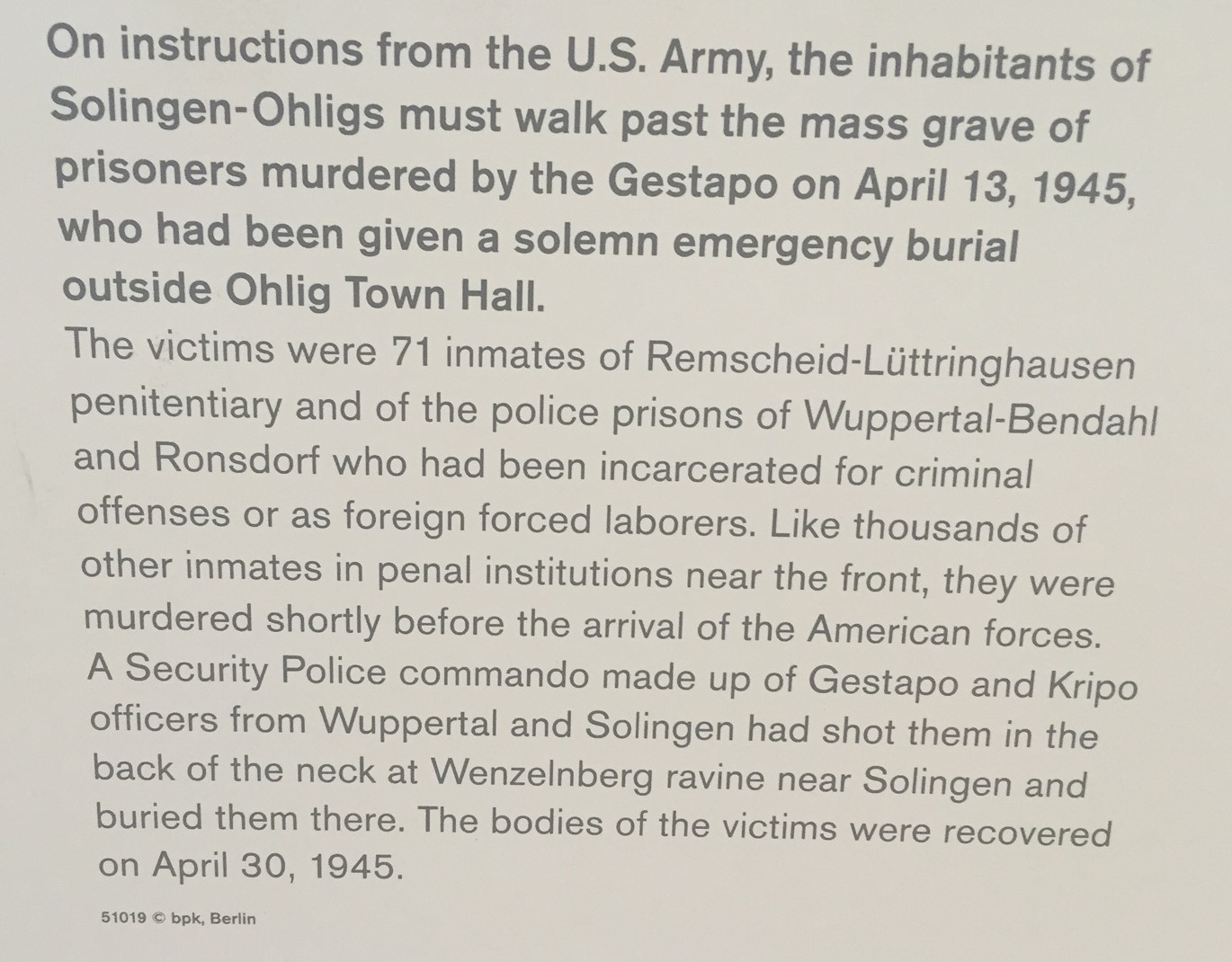
    There are 36 images following. We included the text directly because there was no point in recreating the wheel, and I was afraid something would be lost in summarizing.

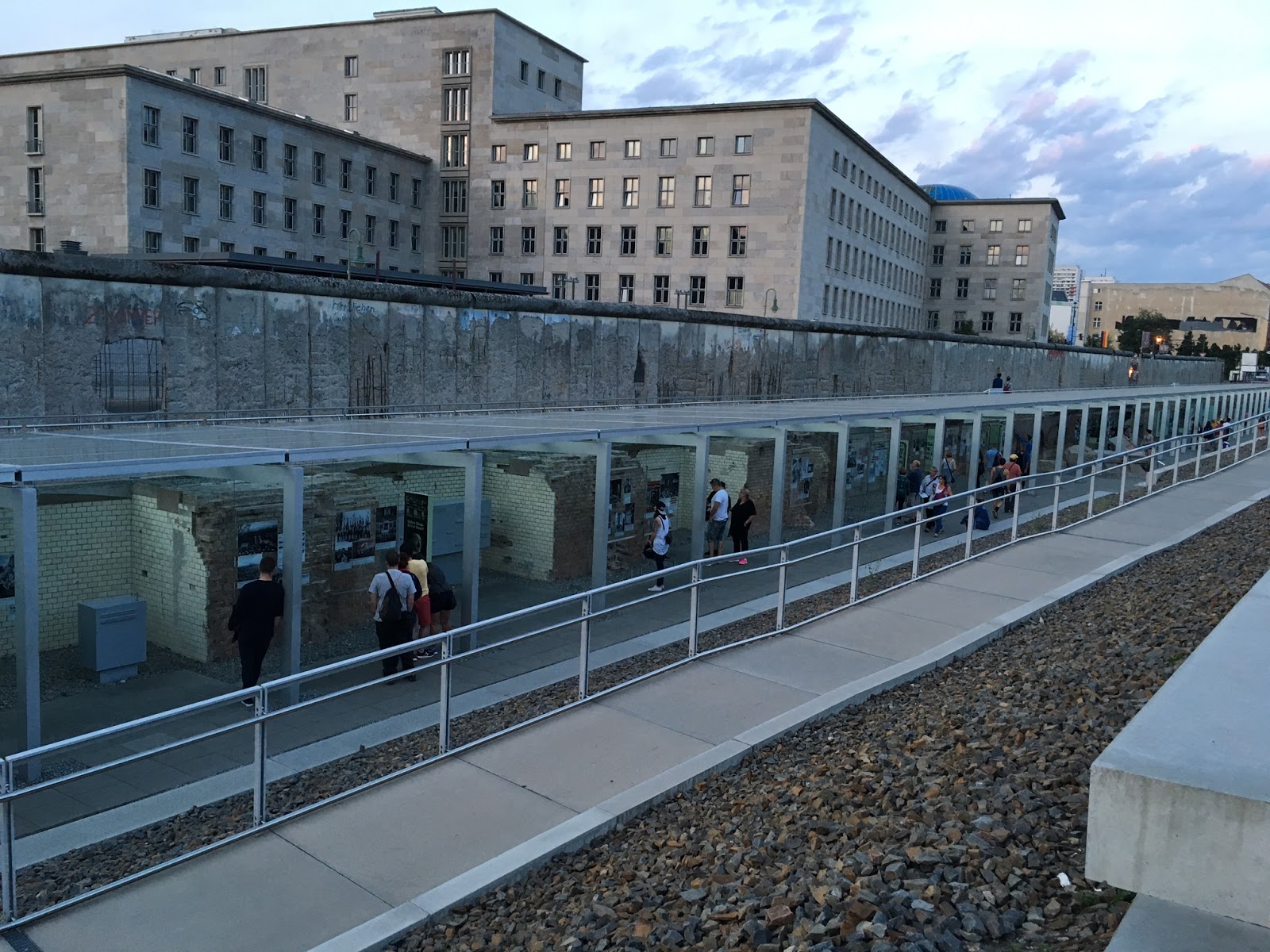
     There was an inside and outside exhibit, although very similar in content. This is a section of the outside exhibit, which is next to a preserved section of the Berlin Wall. All of the photos that follow were taken from the inside exhibit.


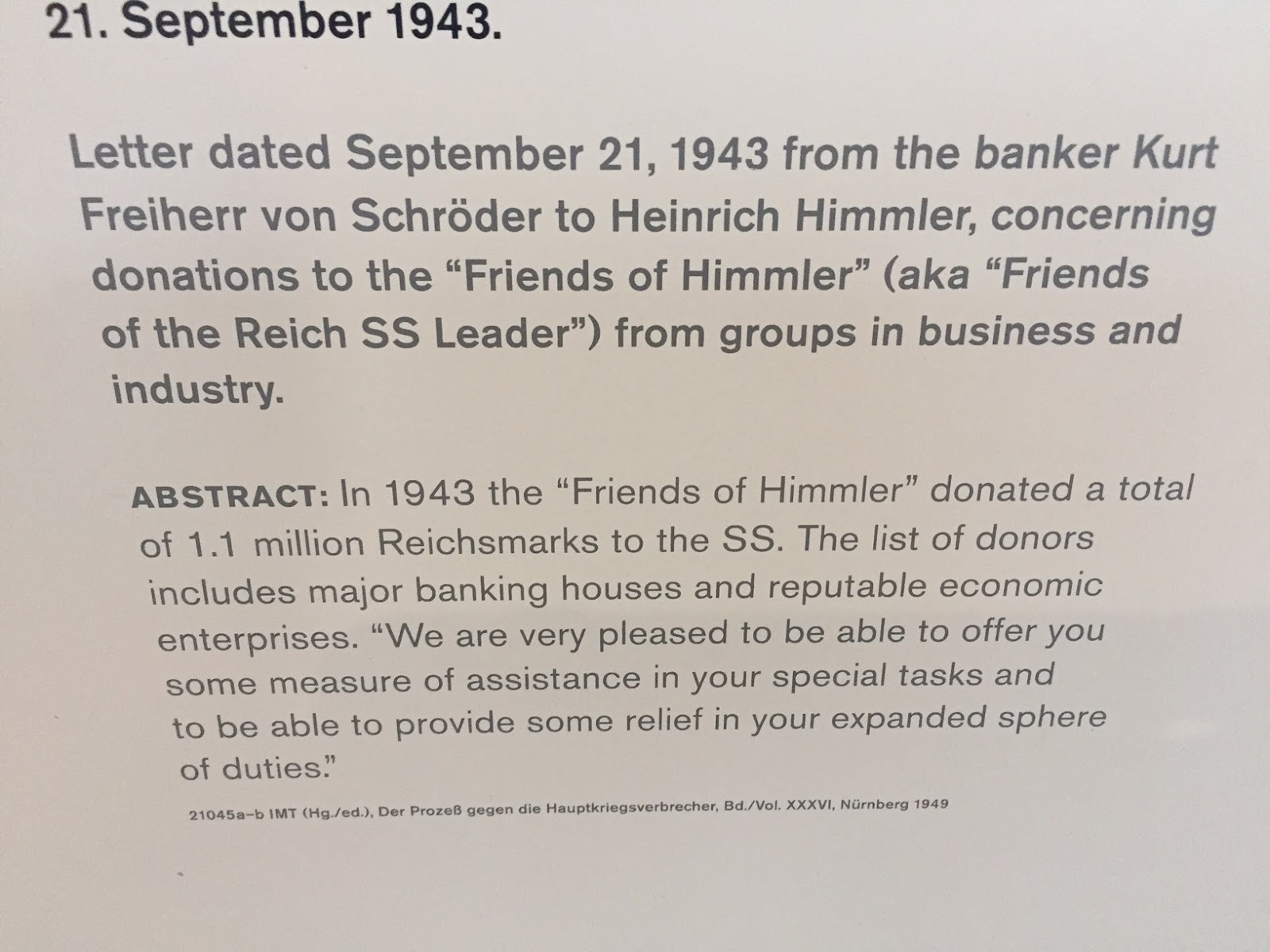
     Above and below describe contributions to the Nazi party from major business.


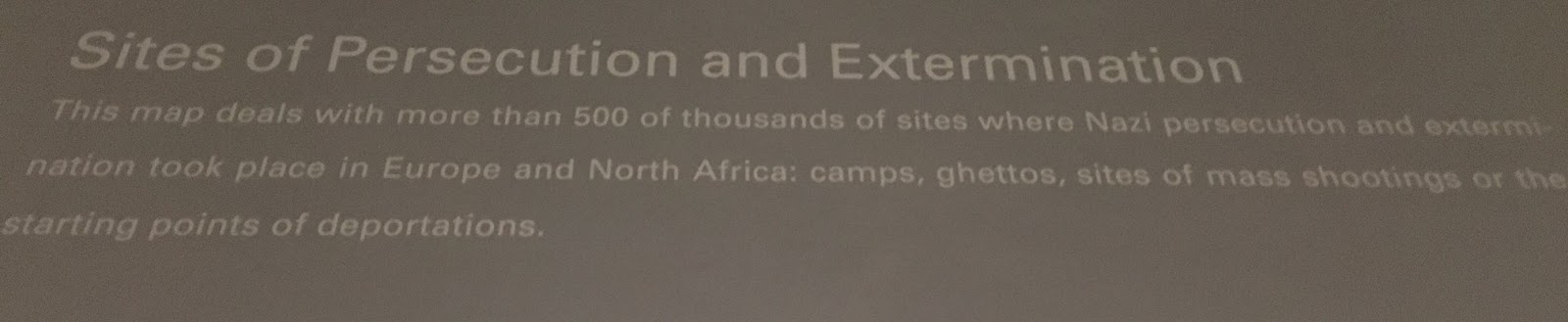
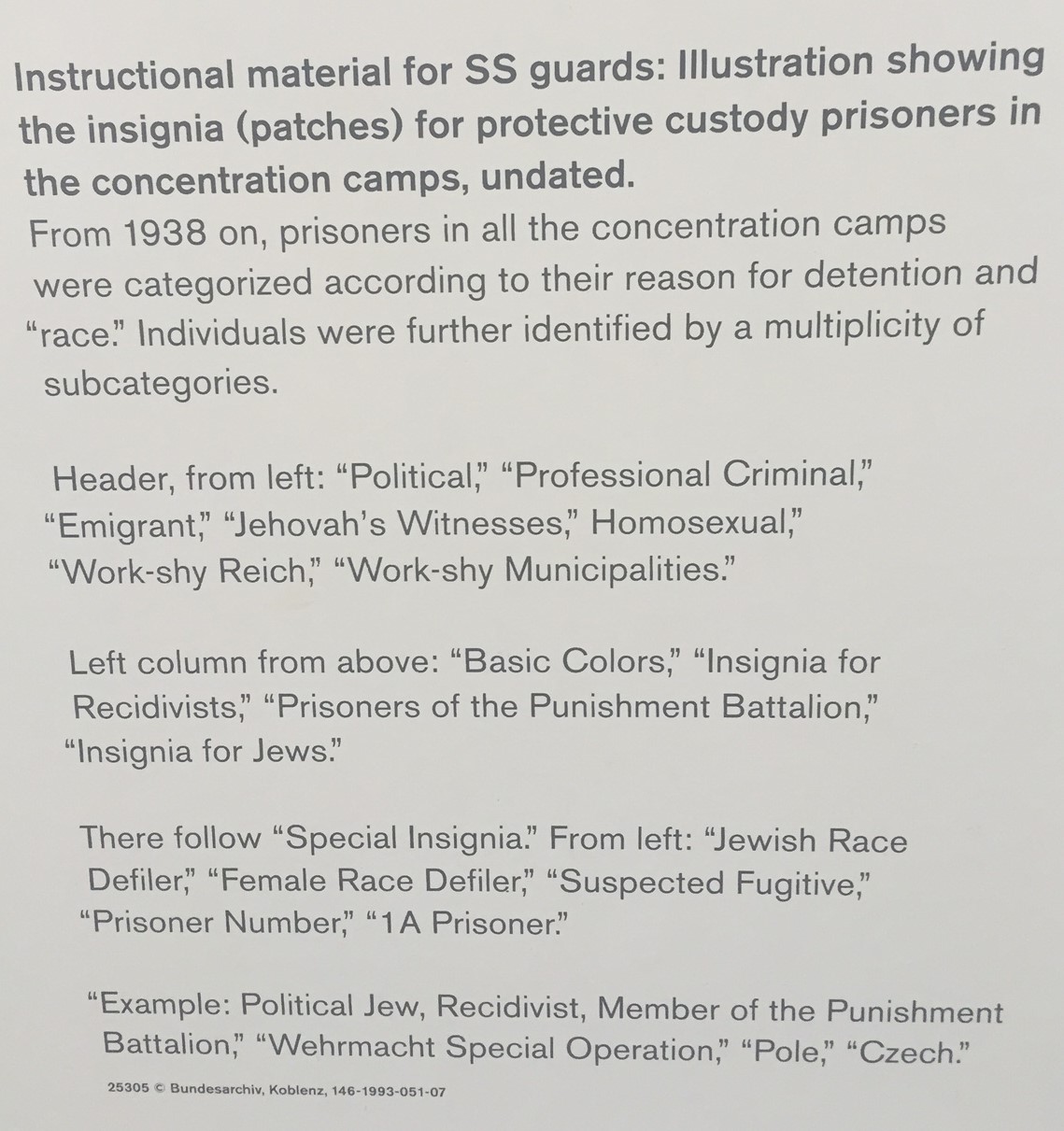
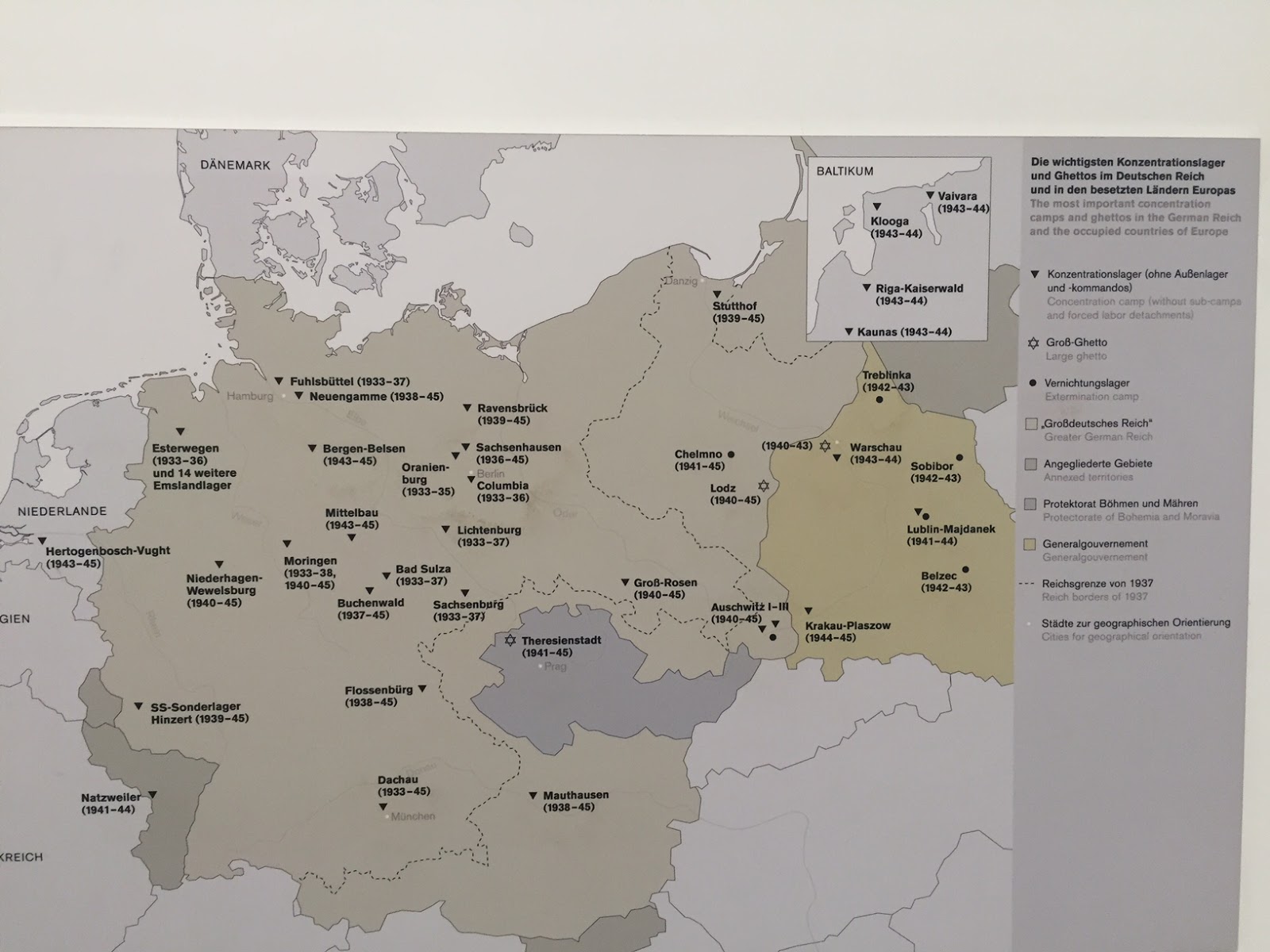
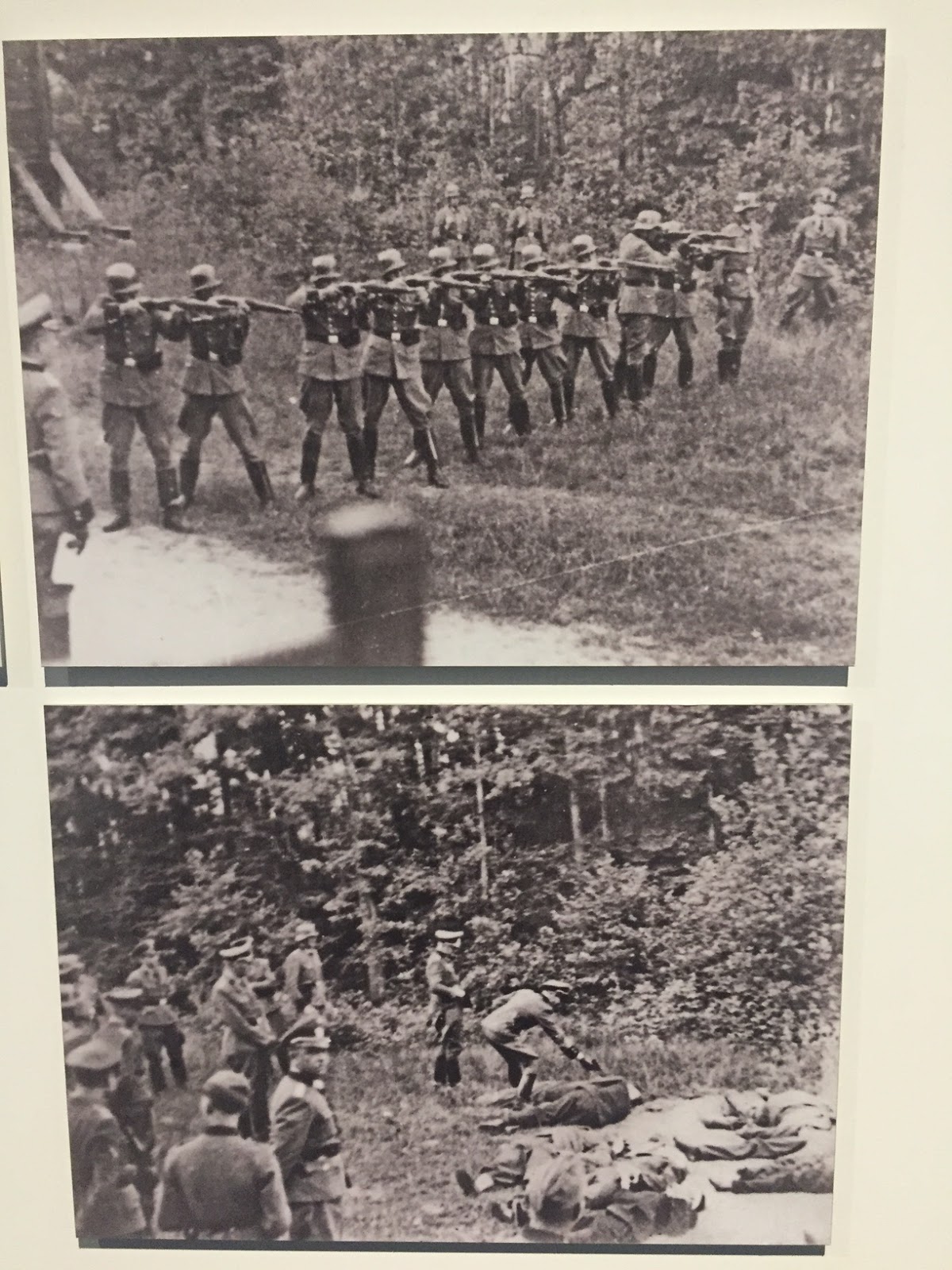
     Just concentration camps. The earlier map from the Holocaust exhibit were “all” sites including labor camps, prisons, etc.


    They shooed us out right at 8pm. We took a bus directly to a restaurant that the hotel clerk from our first day had recommended, right by the hotel. It was Italian and called 12 Apostels.

     This was located in an alley. There was a ton of outside seating, but all was taken. This place was hopping for close to 9pm at night. On both nights we were walking around late, we noticed there was a ton of restaurant activity way later than we’re certainly used to.
     Dan always says “you closed your eyes again.” My response is always the same: they’re open all the time from my perspective! Apparently, he says, my lids stay closed longer than others when I blink. Who knows. This is me attempting to remedy that.
     Dan had a chicken and vegetable dish, I had a pizza.


    As we always do, we discussed our favorite aspects of the trip and logistical details of going home the following day. Some of that will be in the next and final entry. We got back to the hotel some time after 10pm. It was a long day but was definitely our favorite of the trip. We hope you enjoyed it, too, and didn’t find it too depressing. This is the stuff we travel for. Granted, I haven’t been to any of the major holocaust museums in the US, but my guess is they wouldn’t be quite the same. There’s something special about getting it first hand, on the very ground where it all happened.


  • Day 10, Fri 9/2: Potsdam and a bit of Berlin

    Day 10, Fri 9/2: Potsdam and a bit of Berlin

    Today was pretty light. We were both pretty tired and feeling the full effects of the prior 9 days. It’s shocking to me now to think that our first couple of trips were both 17+ days. It will be a long while before we do that again. Two weeks is definitely a good amount.

    We had two solid days planned for Berlin, what we did yesterday and one other, which we’ll do tomorrow. The third day had several options: more stuff in Berlin, a concentration camp about an hour away, or Potsdam about 20 minutes away. We decided on Potsdam and chose today as the day based on the recommendation of that gal at the visitors center yesterday.

    If you have heard of Potsdam, it could be from the Potsdam Conference which was held there towards the end of WWII with Truman, Stalin and Atlee, the PM who replaced Churchill. Otherwise Potsdam is known as a place where Prussian Kings built palaces, which was what we went to see today. It is part of the Berlin metro area and on its own has a population of about 170,000.

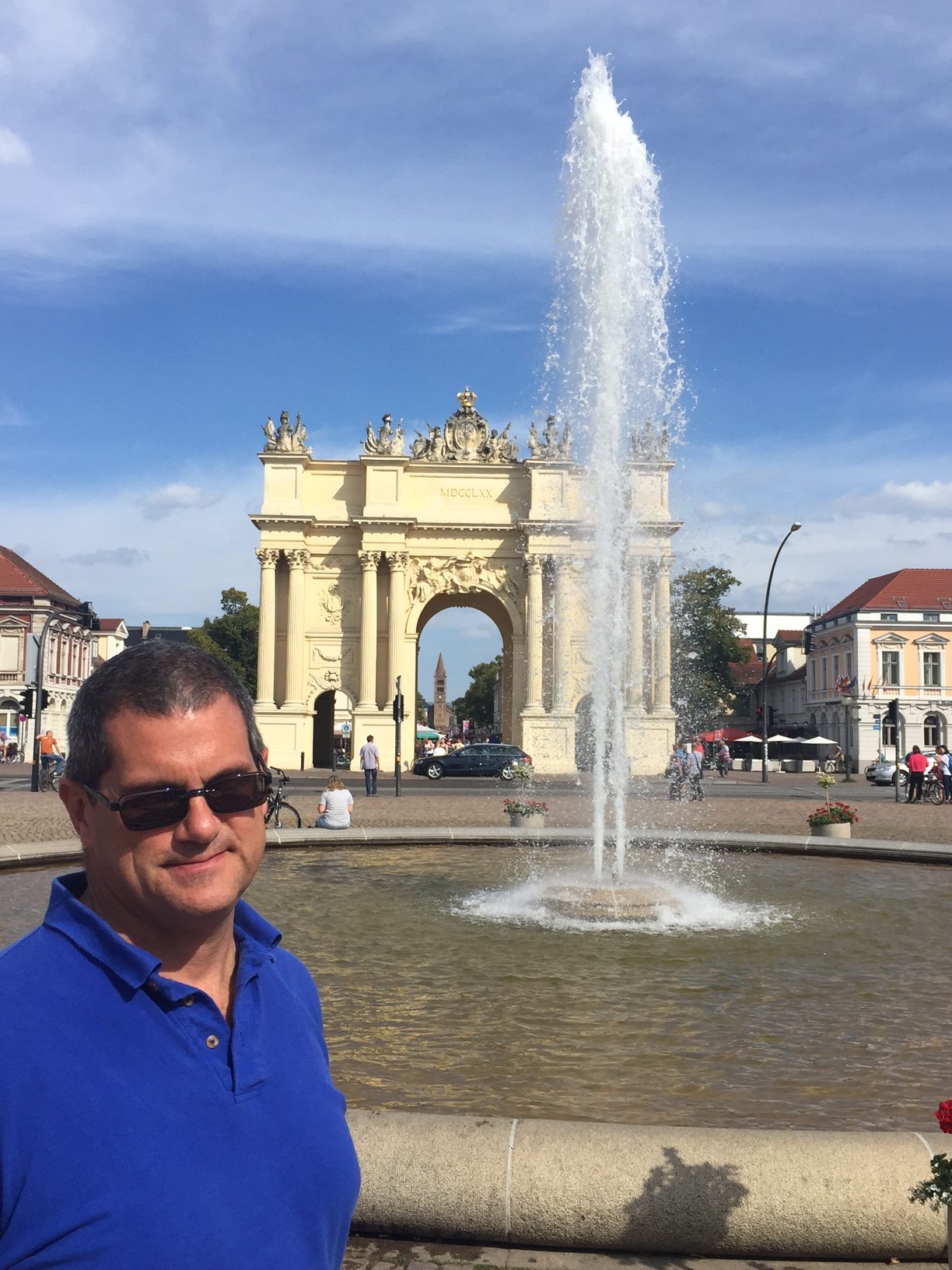
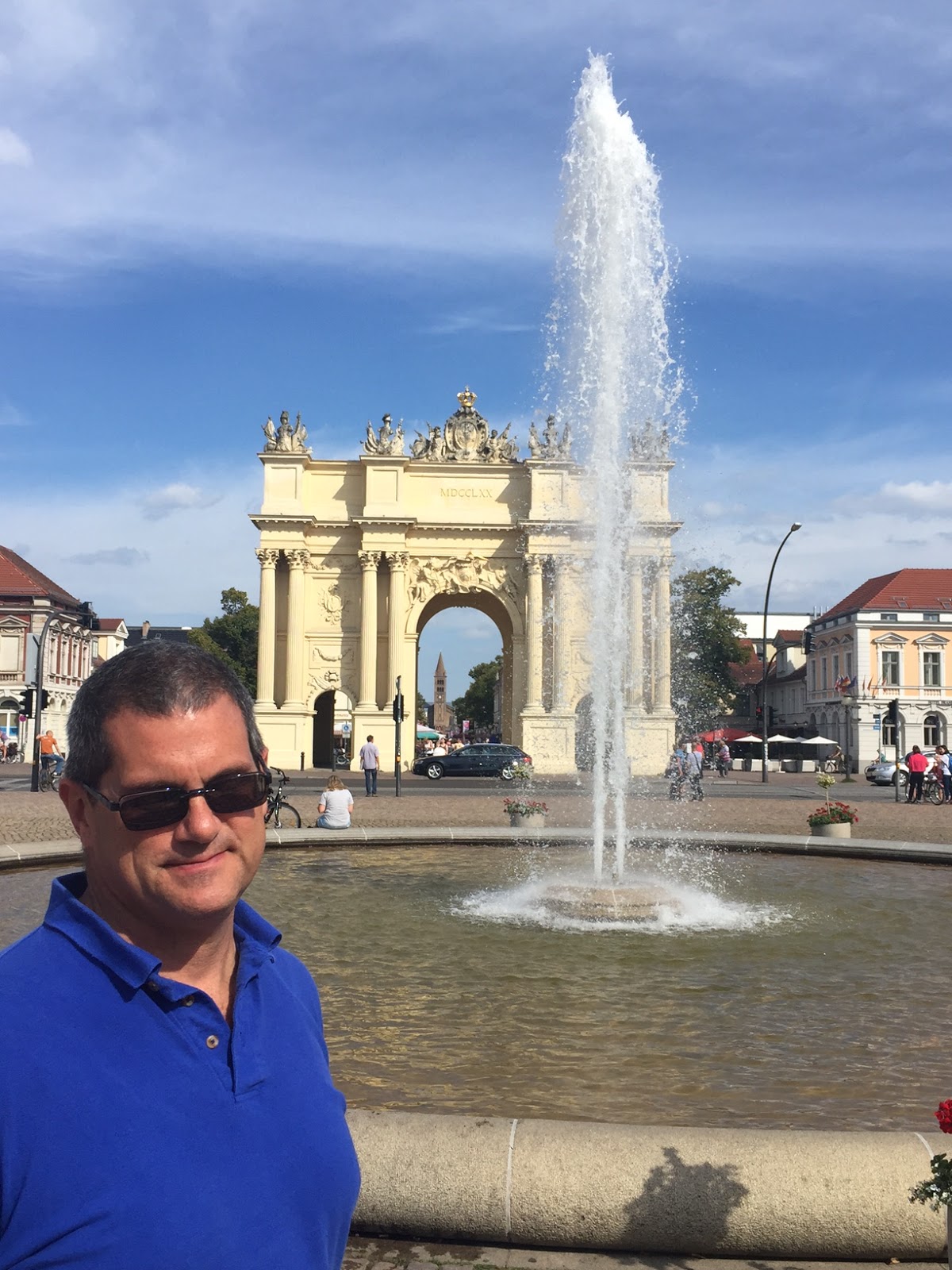
     It’s own little Brandenburg gate as you enter the centrum. And that’s no accident: Potsdam is the capital of the German state called Brandenburg.
    We took a train from Berlin to the Potsdam central station, then took a tram to the centrum. This was the first thing we saw getting off the tram from the main train station.
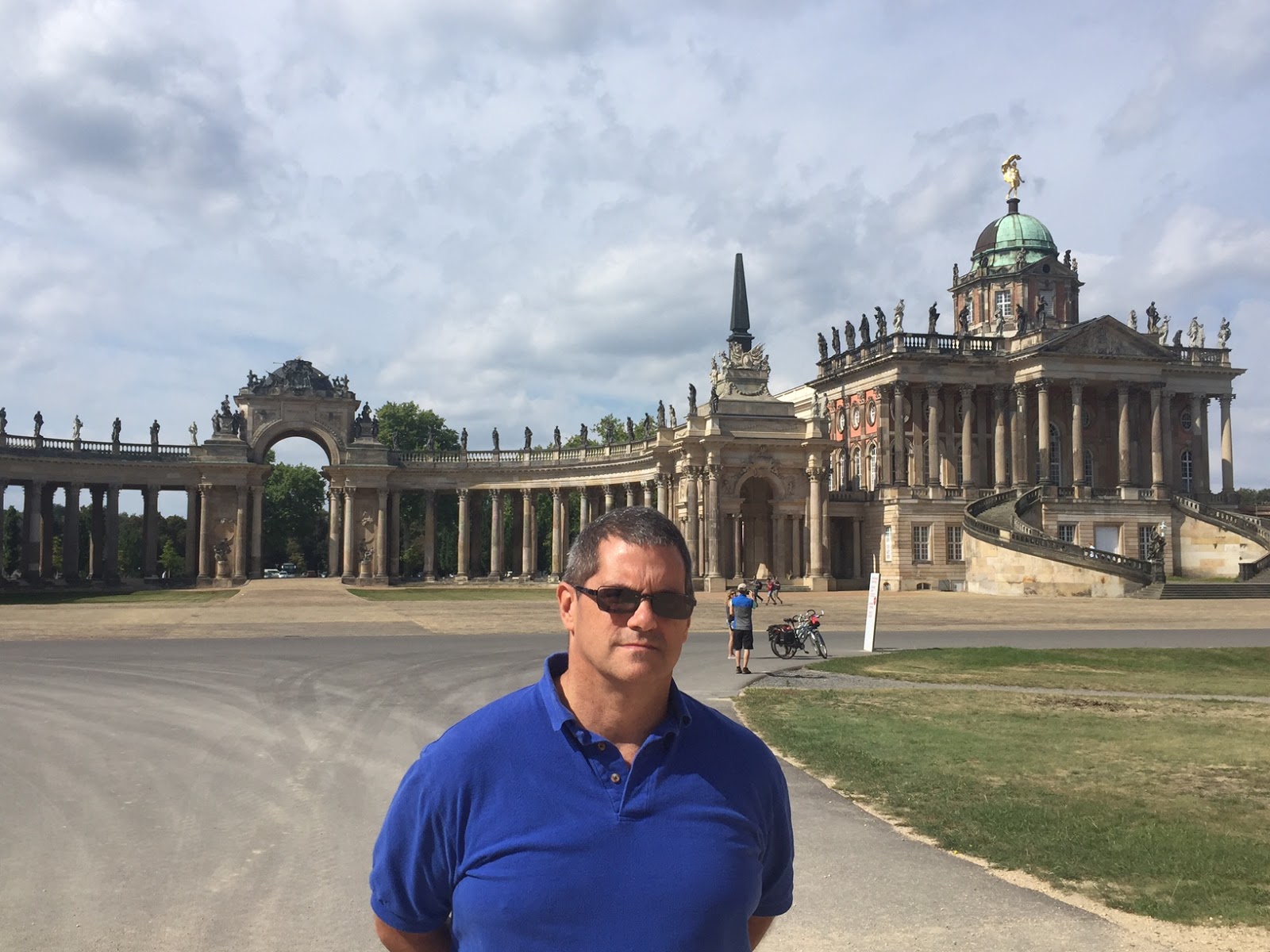
     Our destination was Sanssouci Park, a UNESCO World Heritage Site (which, by the way, we’ve seen a bunch of on this trip, I’ve just been negligent in pointing it out as I have in prior blogs; the central areas of Dresden and Prague for example). The park contains the palaces and gardens of the Prussian Monarchy built from the 1700’s onward, and where they lived including the German Kaiser until WW1 ended in 1918.


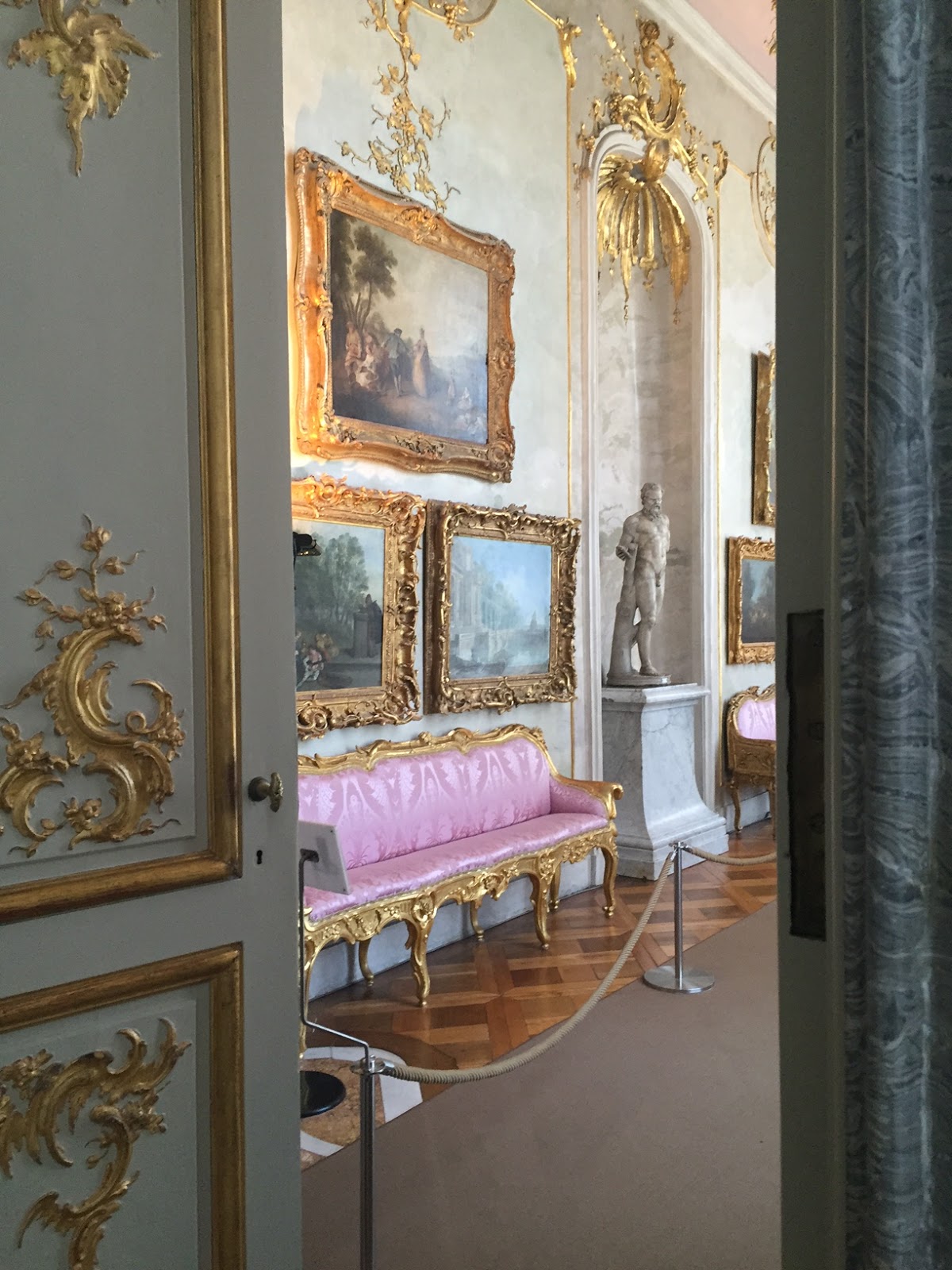
    This was the smaller “summer palace” Sanssouci after which the park was named; it was the first built here by King Frederick the Great in 1744, and translates to “without worries” in French. He was big on French culture, gardens and vineyards and built the palace accordingly. Voltaire was a frequent visitor here as one of his friends and advisors.


     Dan got this one photo in when he learned there were none allowed; then snuck in the in 2nd one below but that was it. As palaces go, we weren’t very impressed so that ended up being OK.


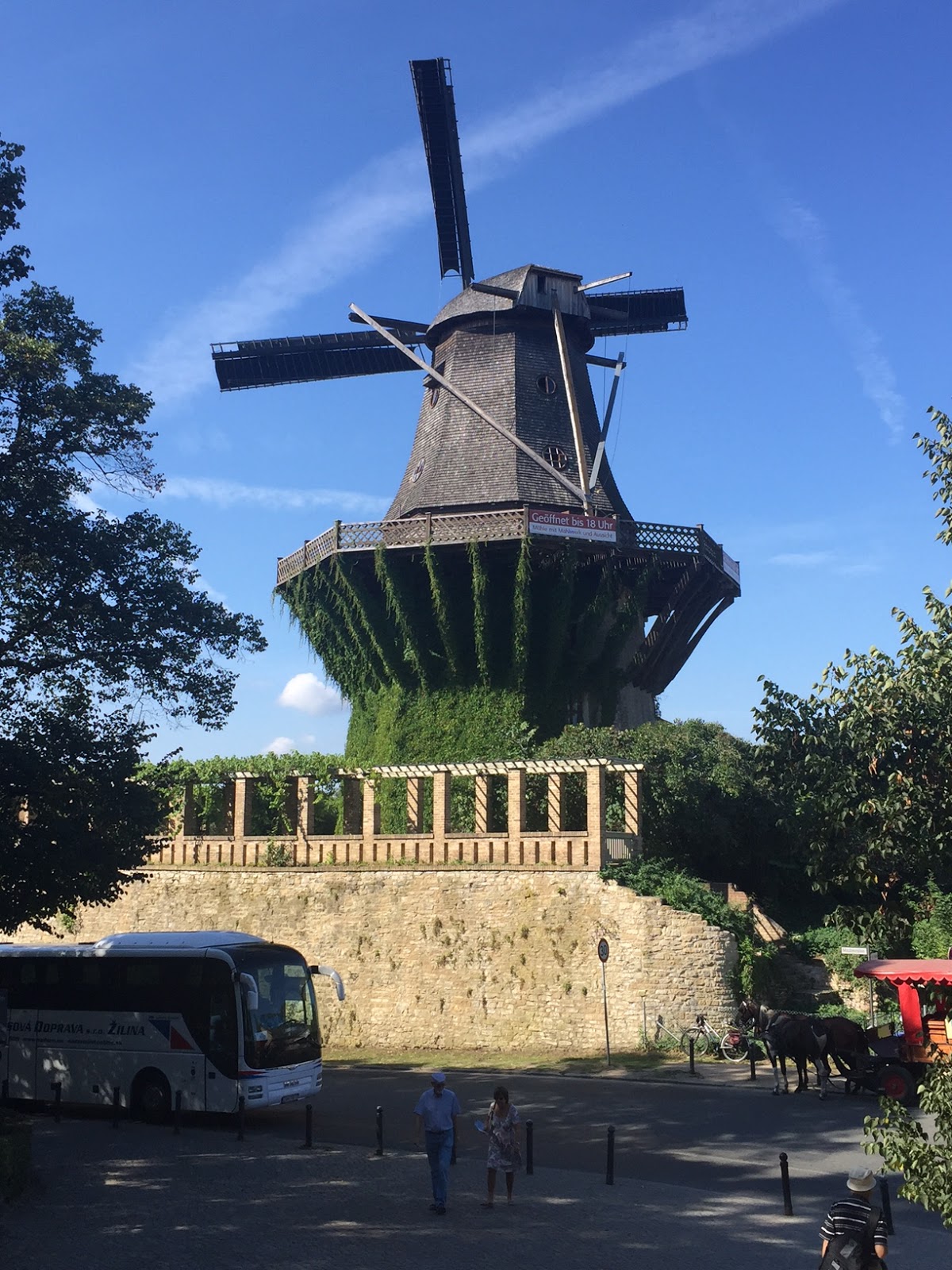
     An antique windmill in the park on the way to the next thing.

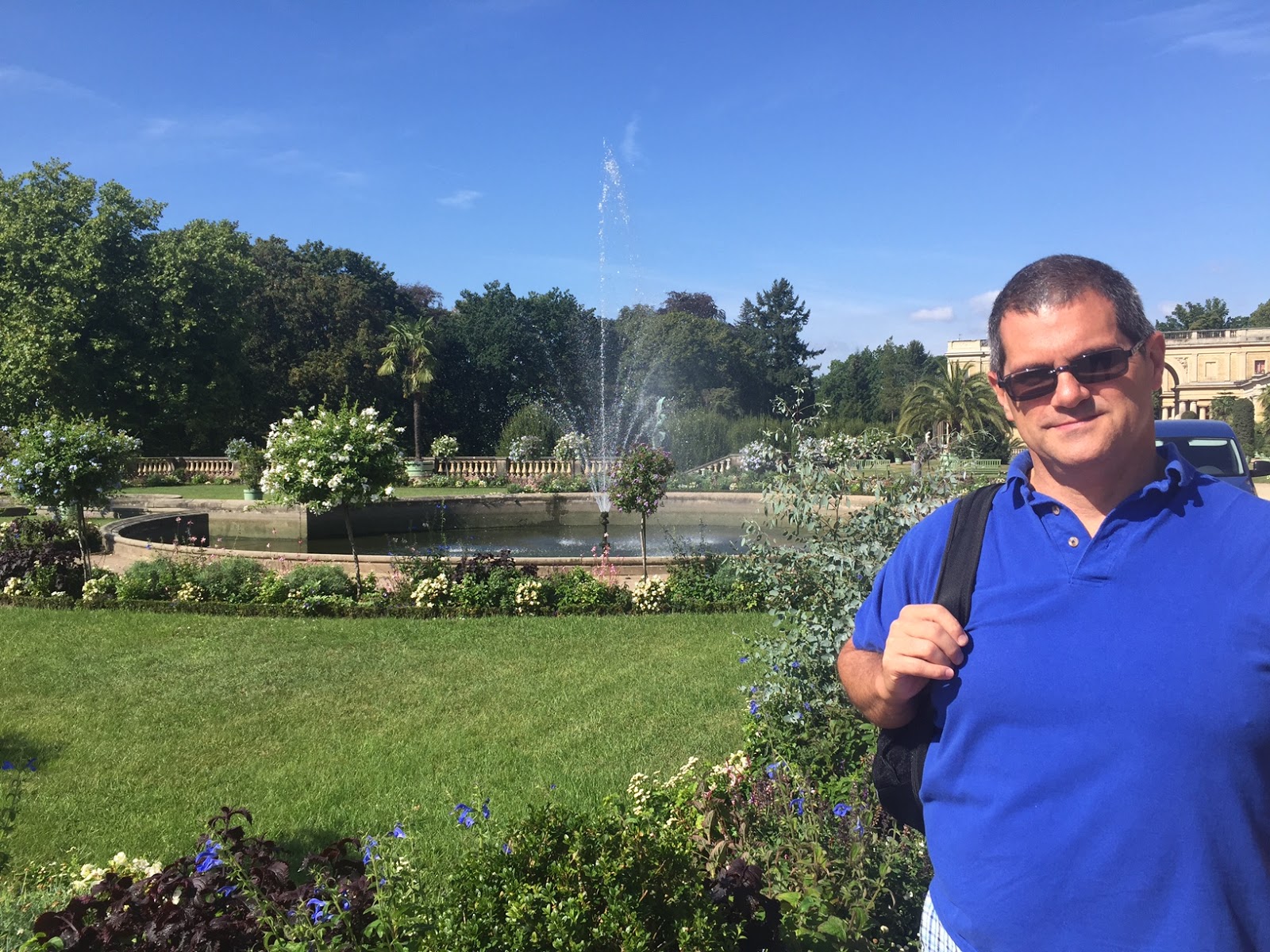
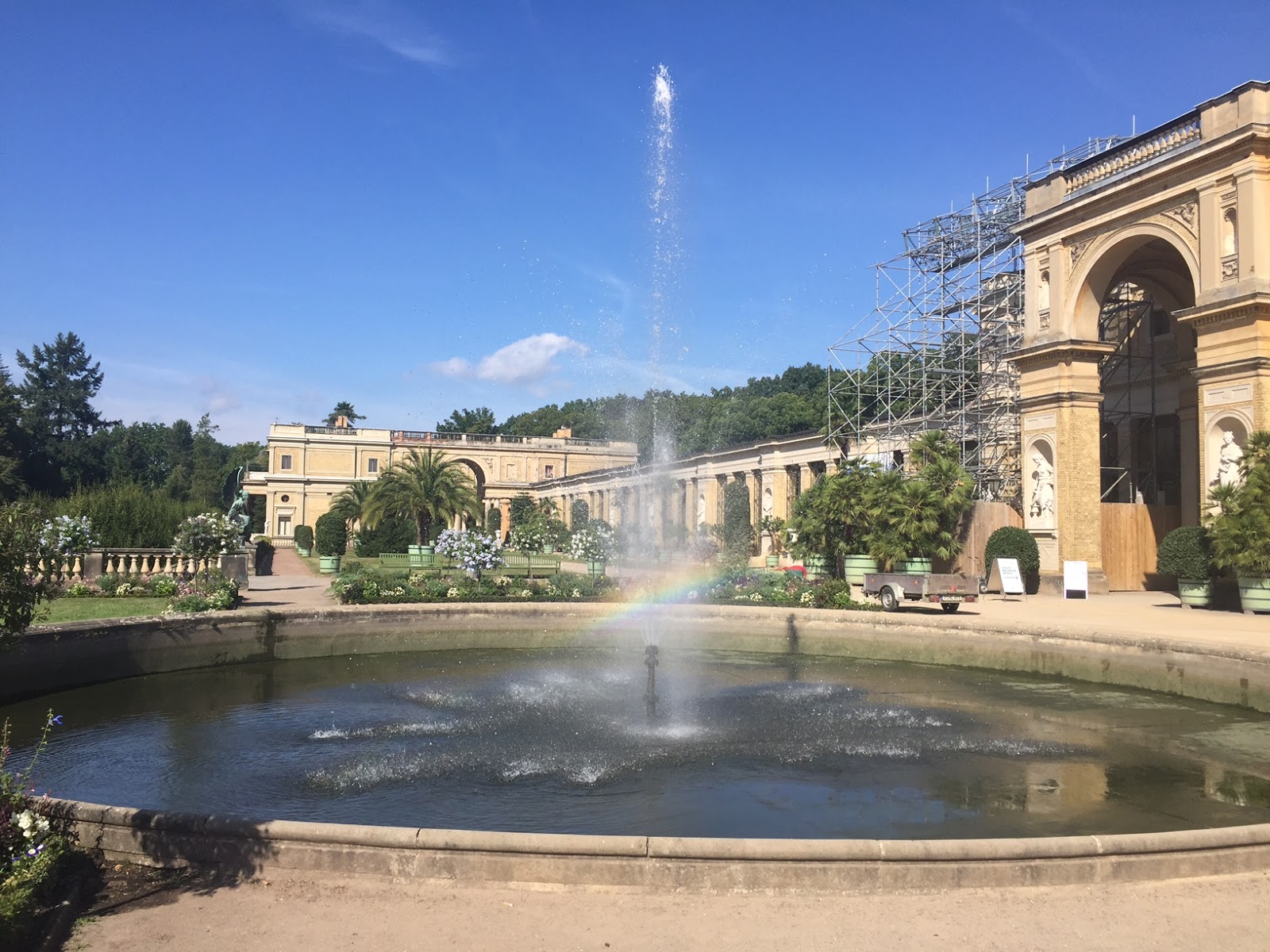
    This photo and the two below were taken at the gardens at Orangery, another palace in the park built to hold, as the name implies, a greenhouse. This was a term we picked up in Vienna; Schonbrunn had one but it wasn’t in operation and not much to see. This one apparently was, but it was only available as a tour and it was only in German so we passed (despite their token offer for the text that went along with it; it was minimal).


    The park itself was beautiful and made for a nice walk in great weather; the high today was 76.


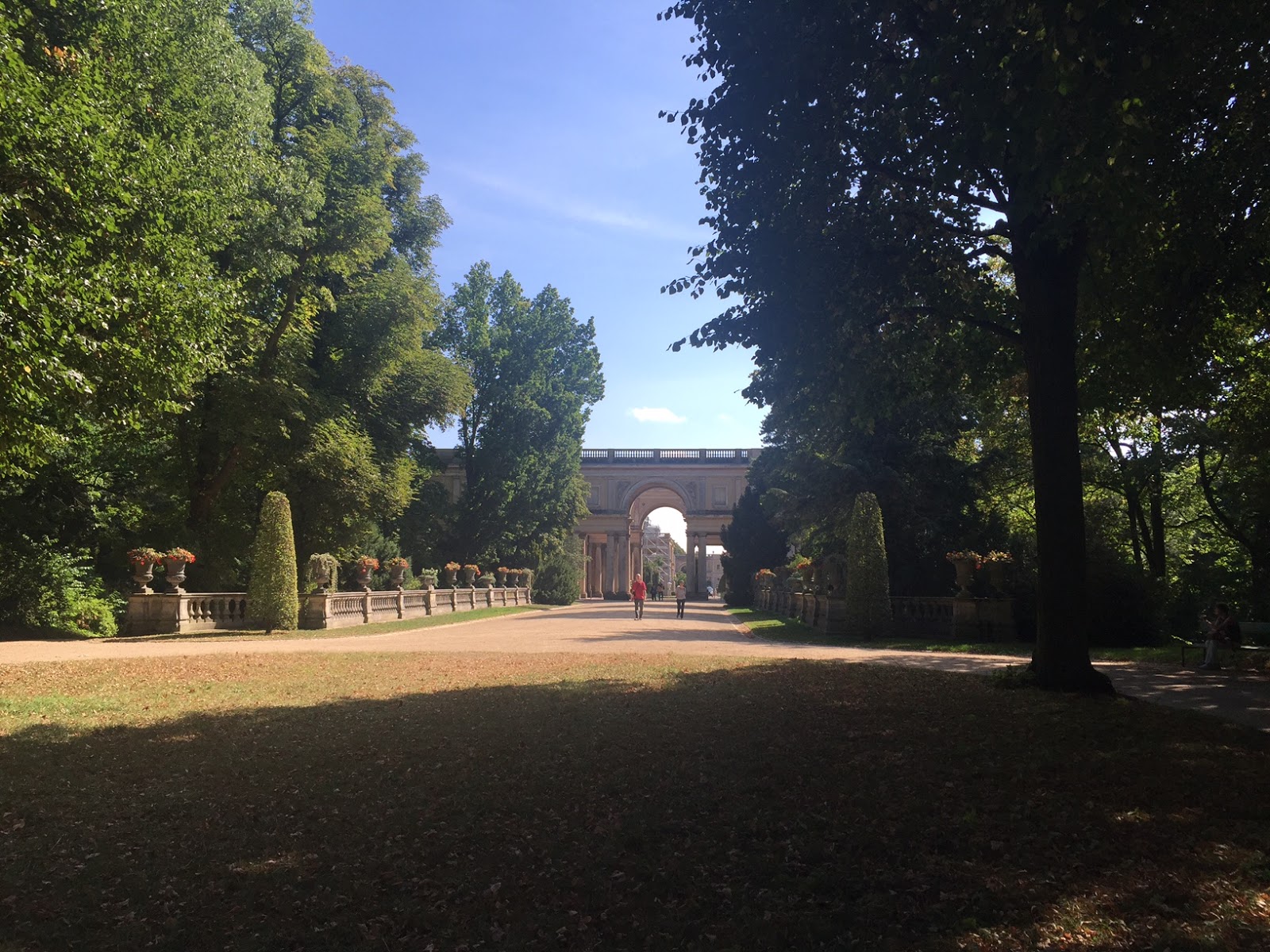
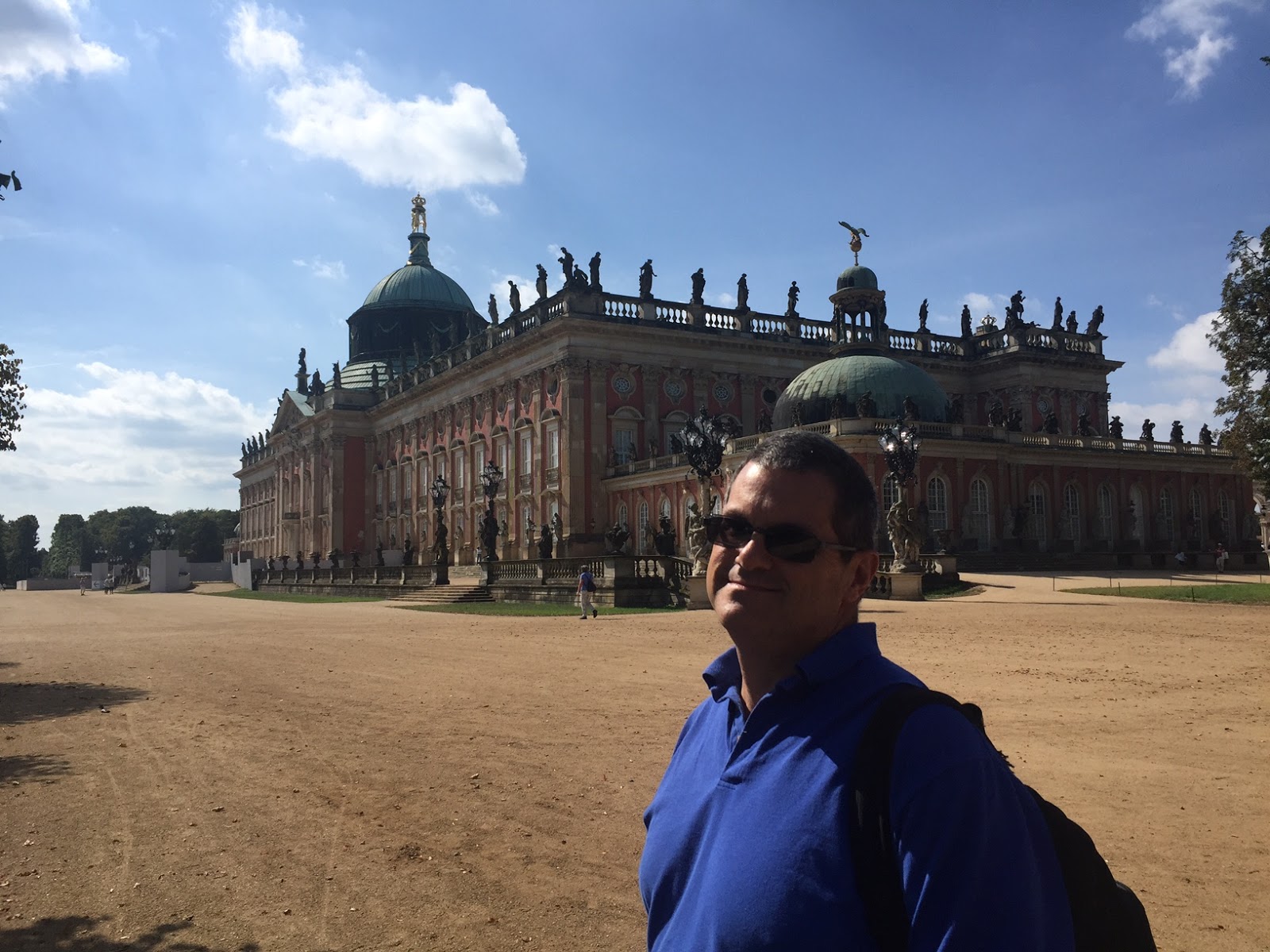
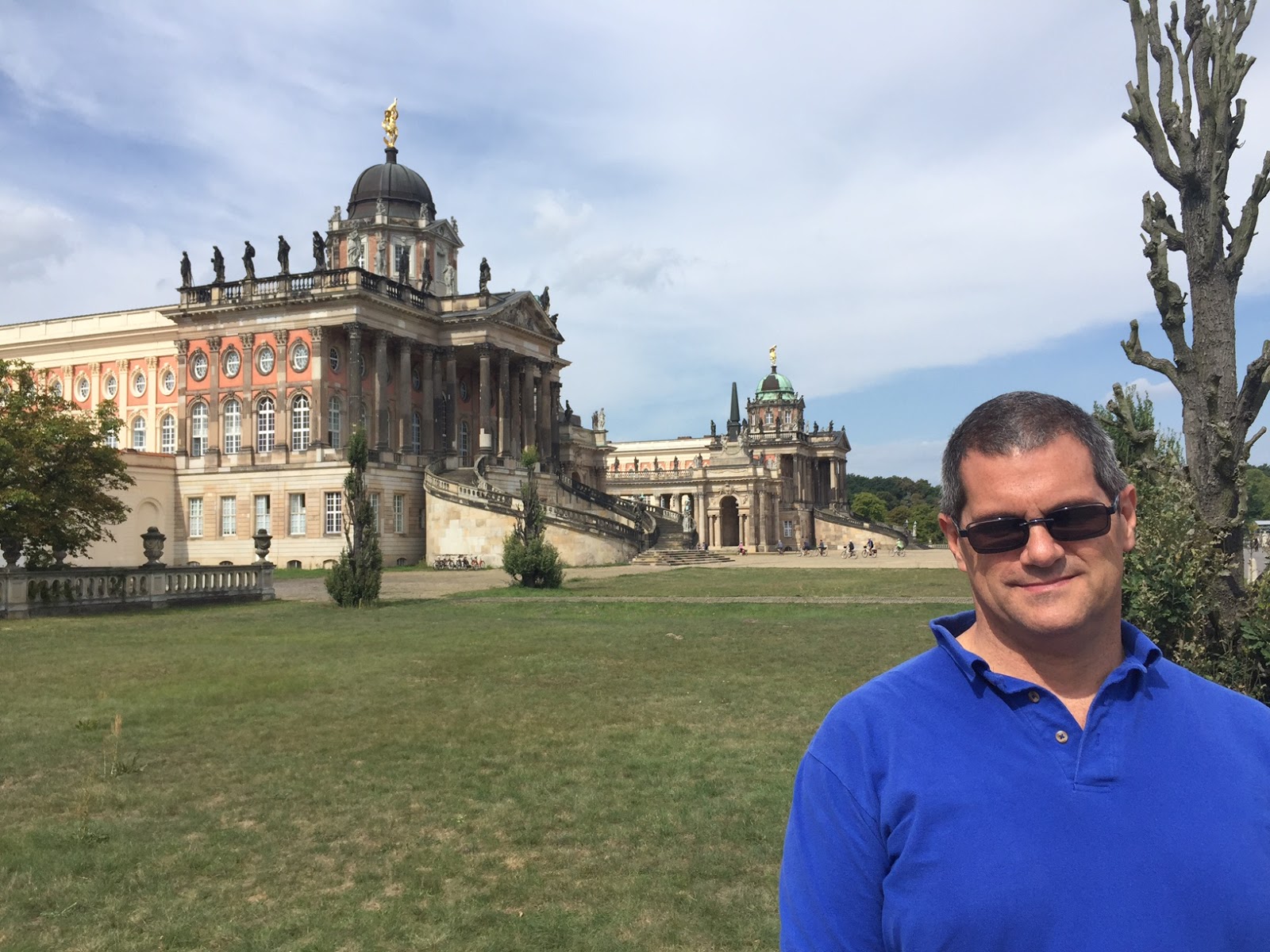
    This is the “New Palace” but like most things in Europe called “new” it’s still pretty old, completed in 1769. It is the last great Prussian baroque palace built. From the front it looked more impressive than Schonbrunn. It was occupied by Prussian and German leaders from 1769 to 1918. It’s where the Kaiser signed the war documents in 1914 while having breakfast in one of the rooms here.
    There were two identical buildings in the back that looked pretty cool in their own right. Come to find out they were service buildings, where among other things the kitchens were.
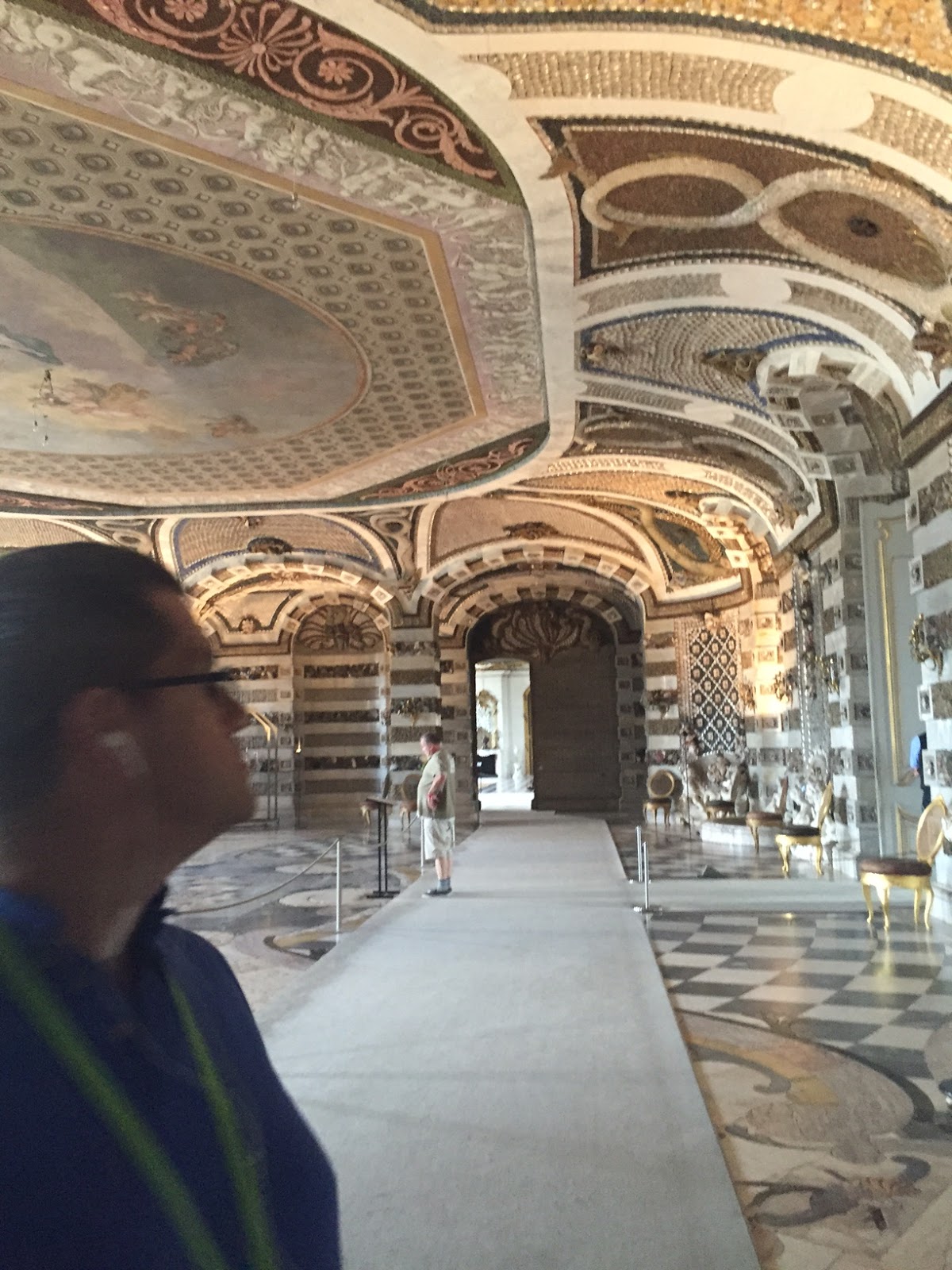
    Unfortunately, photos were not allowed here either, otherwise we would have gotten a bunch of this room. It’s been awhile since we’ve seen something truly unique and this was it; none of the regular words like amazing or stunning are enough. It was called The Grotto and was intended to create an atmosphere of relaxing at the sea. Everything in this room was done in a shell motif. And just not images, actual shells, of every imaginable kind, size and shape, put together to make wall paper, animals, flowers, you name it. It was completely impressive.
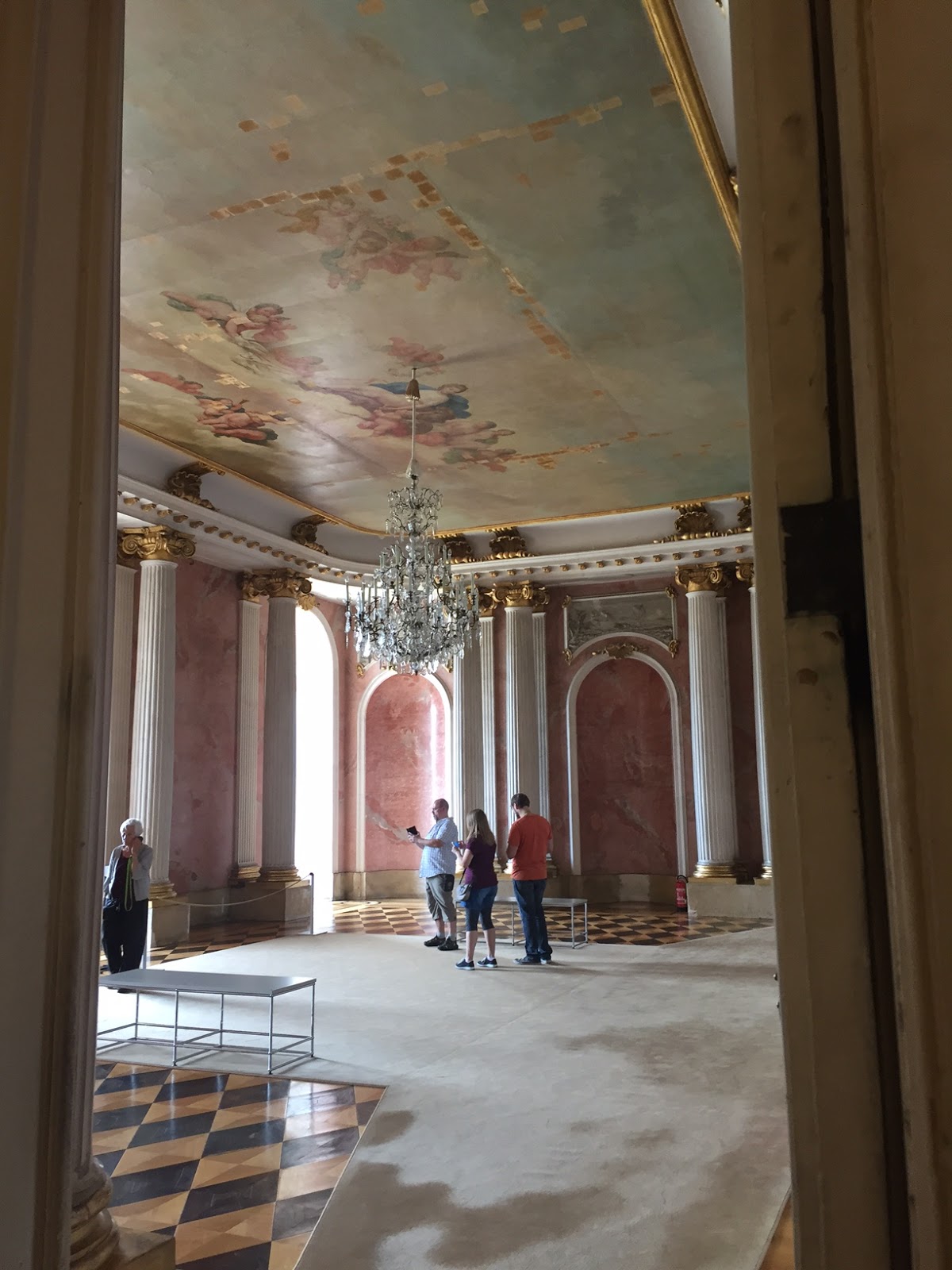
     The was the only other photo Dan got; the other impressive room in the place was the one right before this, the Marble Room. It was directly above the Grotto. Much of the palace was shut off from visitors due to major restoration going on.
     The two service buildings I mentioned earlier.

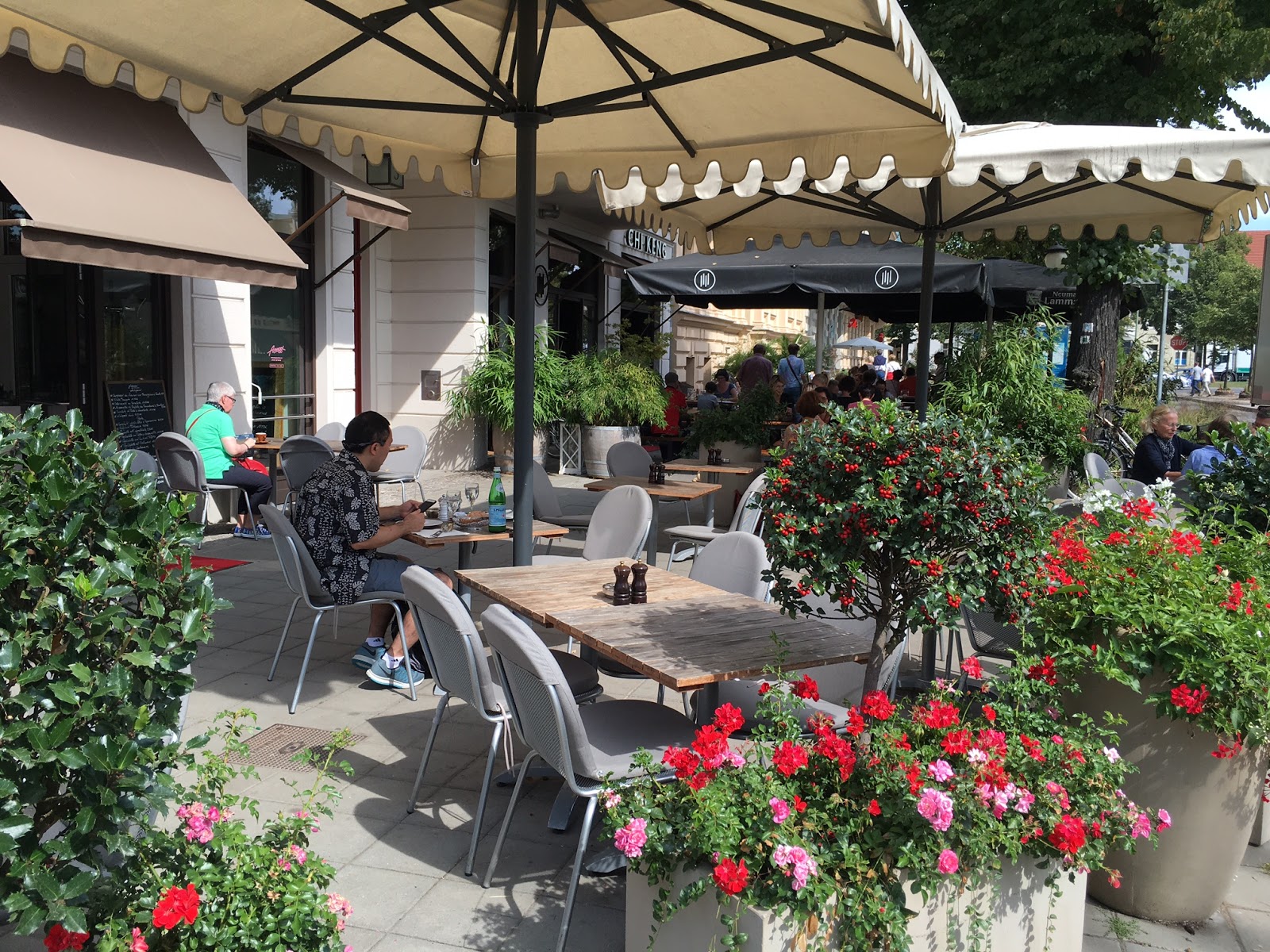
    We had gotten to the first palace around 10:10; it was now 1:30 and we were ready for lunch. We headed into town and ate a the #2 place in Potsdam according to TripAdvisor. It was Italian and we hadn’t had it yet on this trip which is pretty unusual for us.

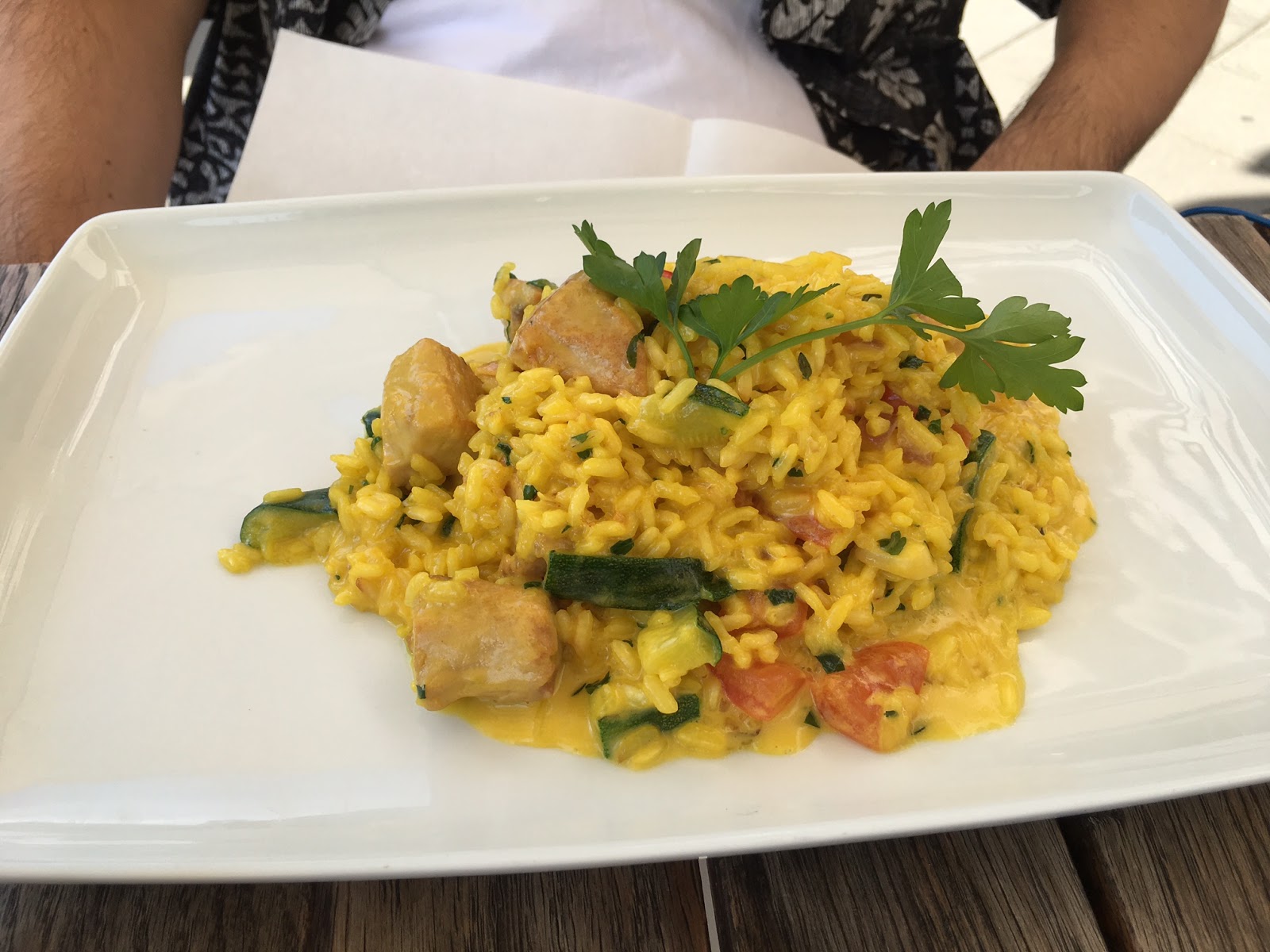
     Dan had the risotto which was amazing. Those chunks of meat are tuna.
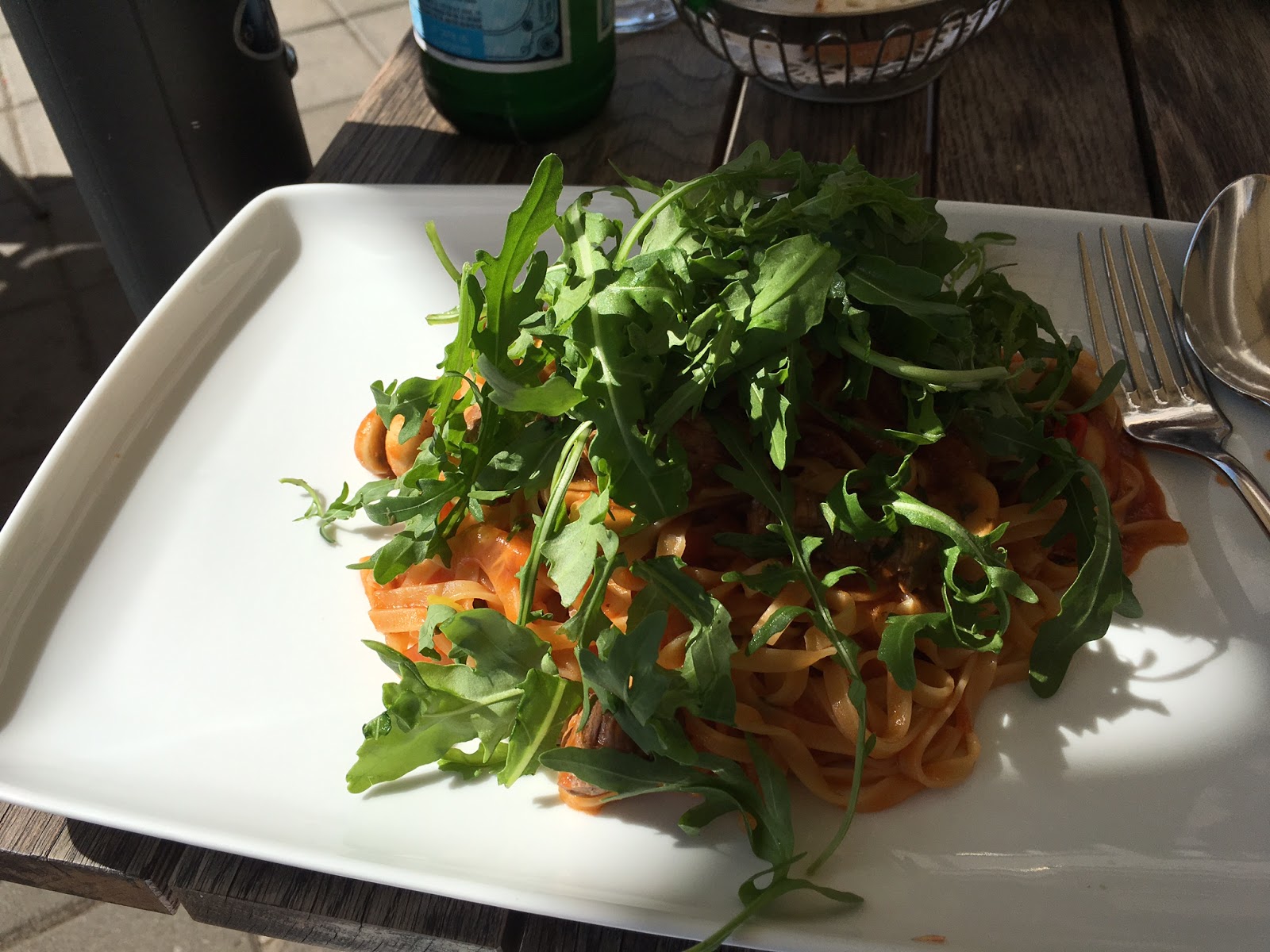
     I linguine with beef, mushroom and arugula. Pretty good.
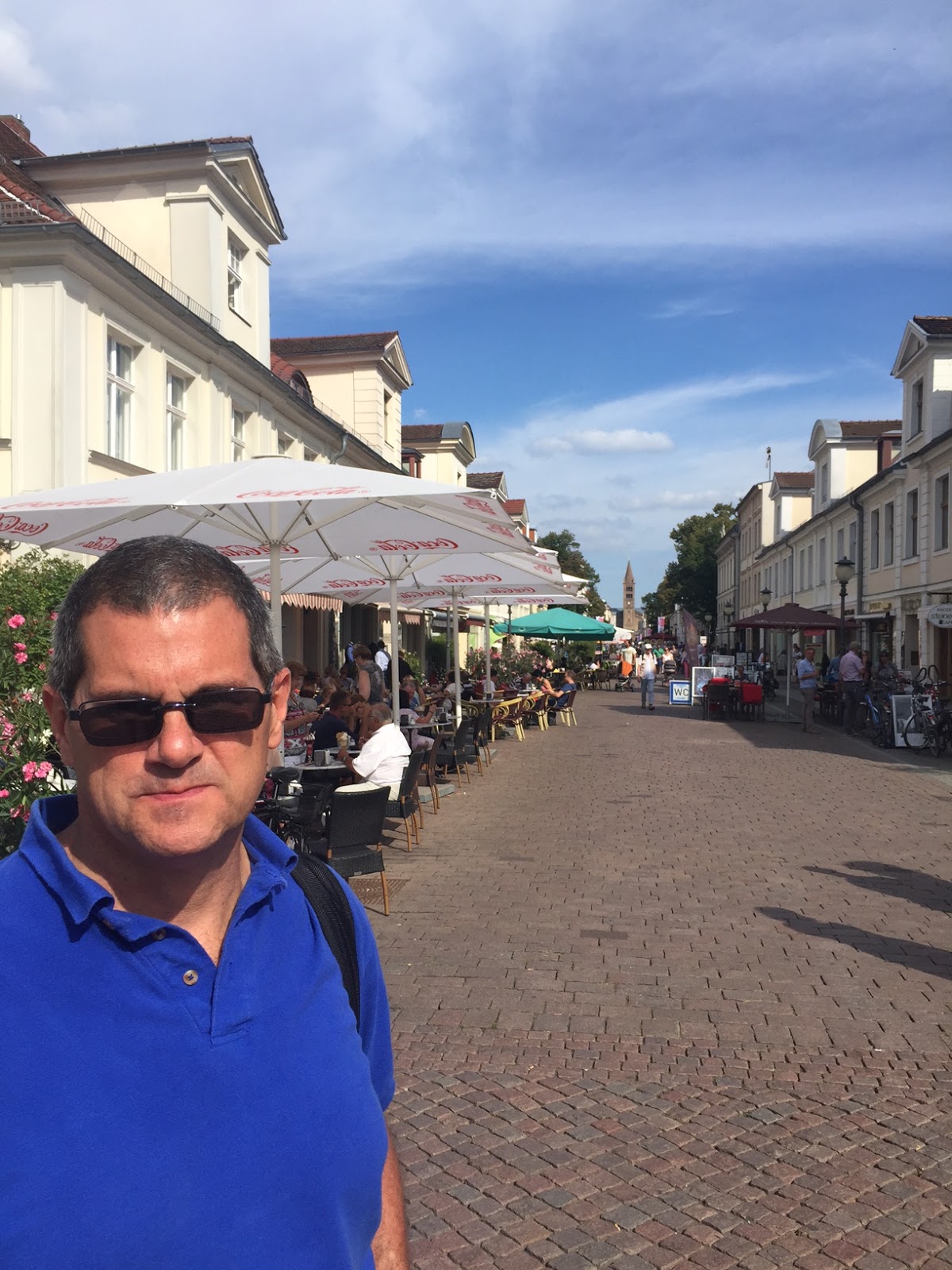
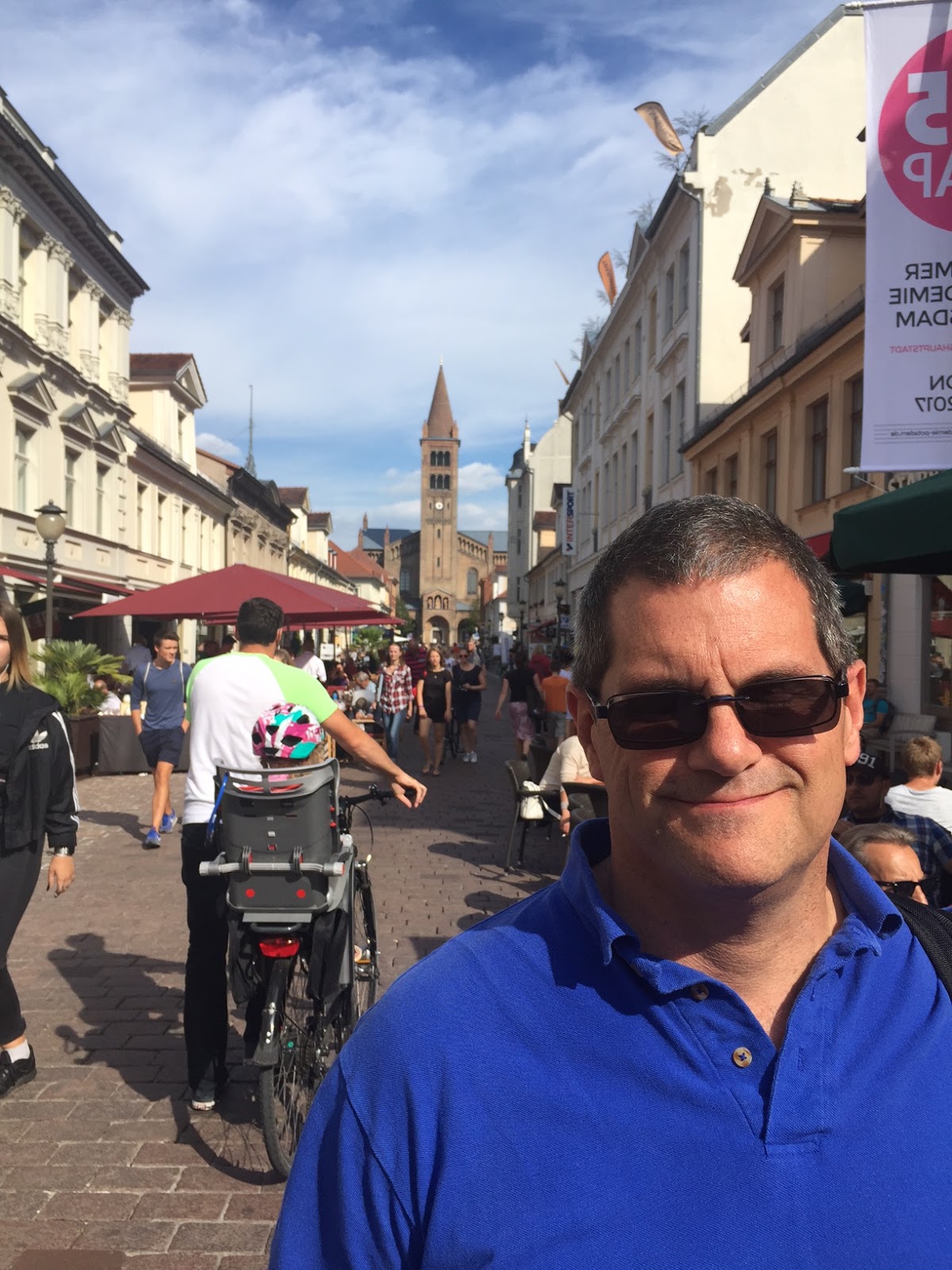
     This is the main drag in town with a cute little church at the end. We meandered from shop to shop, just browsing. We are generally fond of this large towns / small cities and we liked this one.
    It was pretty busy for a random Friday afternoon.
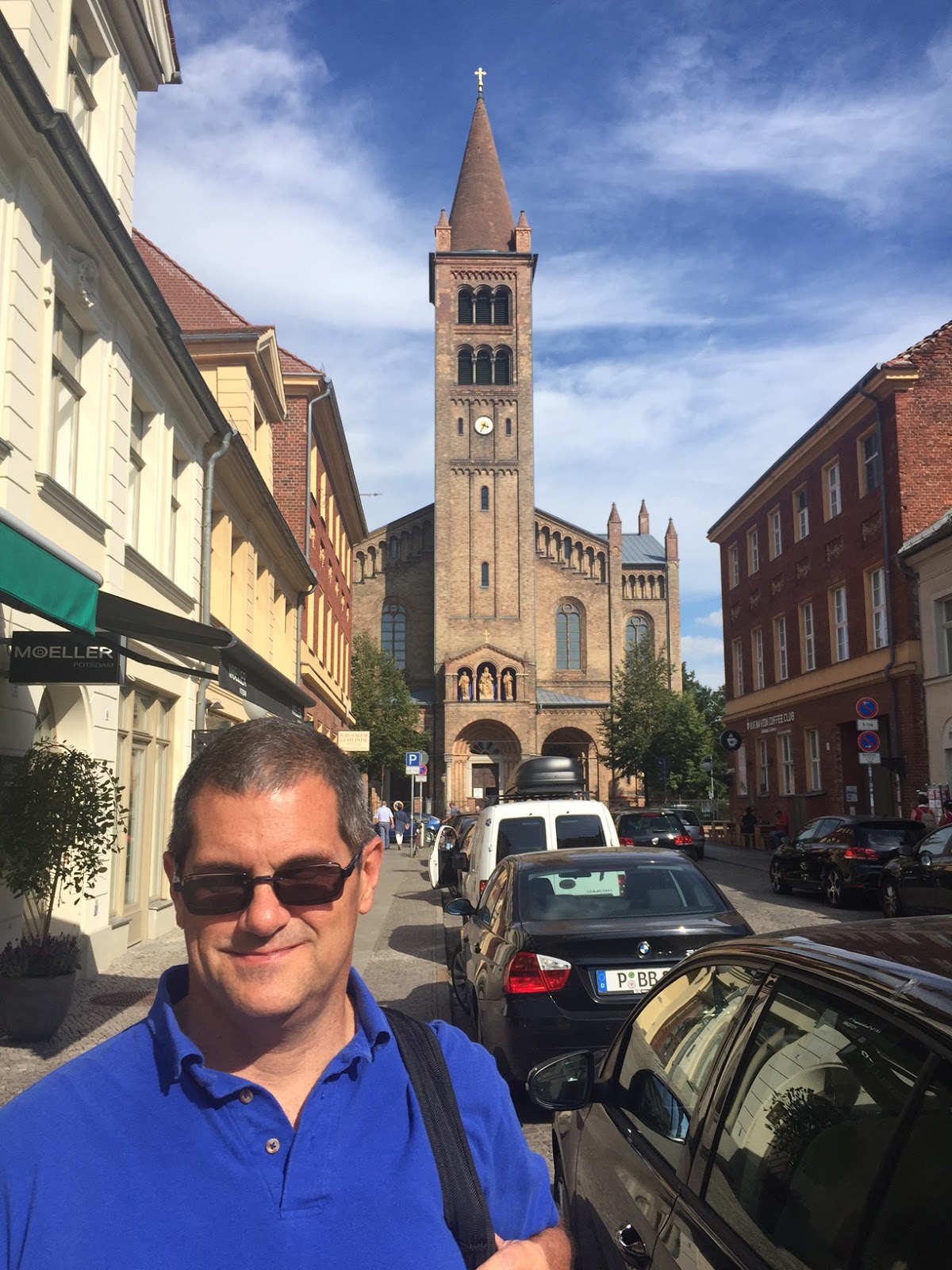
      It was a Catholic church, St. Peter & St. Paul.


     We took this for the sign at the bottom, something I say to Dan frequently.
    It was just approaching 4pm but we were both pretty tired and went back to our room, getting there about 4:45. I crashed for about an hour and Dan slept some too then worked out the final plan for tomorrow and found a place for dinner.
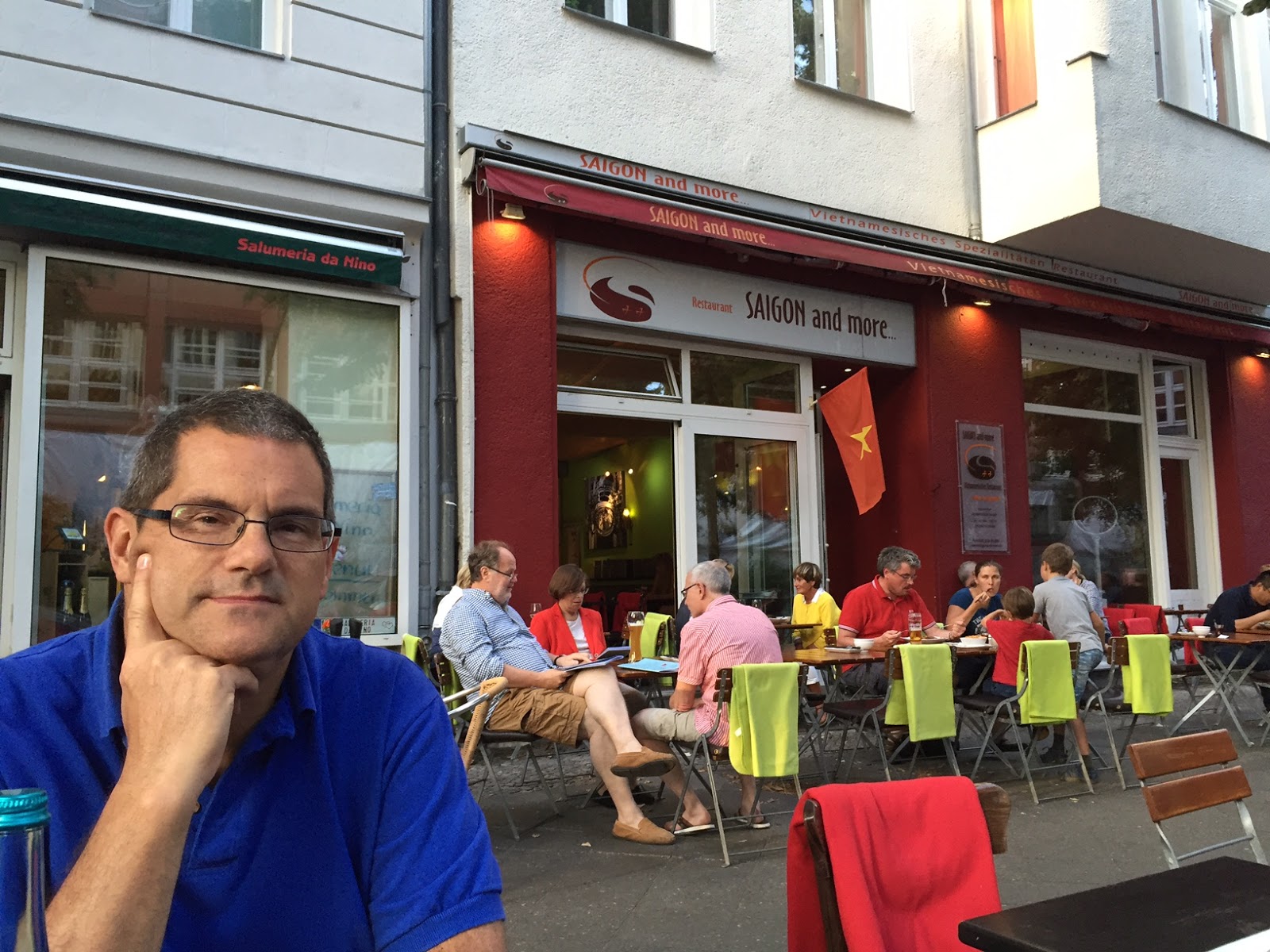
    This was in a cute neighborhood a couple of subway stops away: a Vietnamese restaurant run by a very friendly Turkish guy and his Mexican wife. And the food tasted more like Thai to us. But it was good. It was clearly a popular neighborhood spot and the guy knew many of the customers and passers-by it seemed.
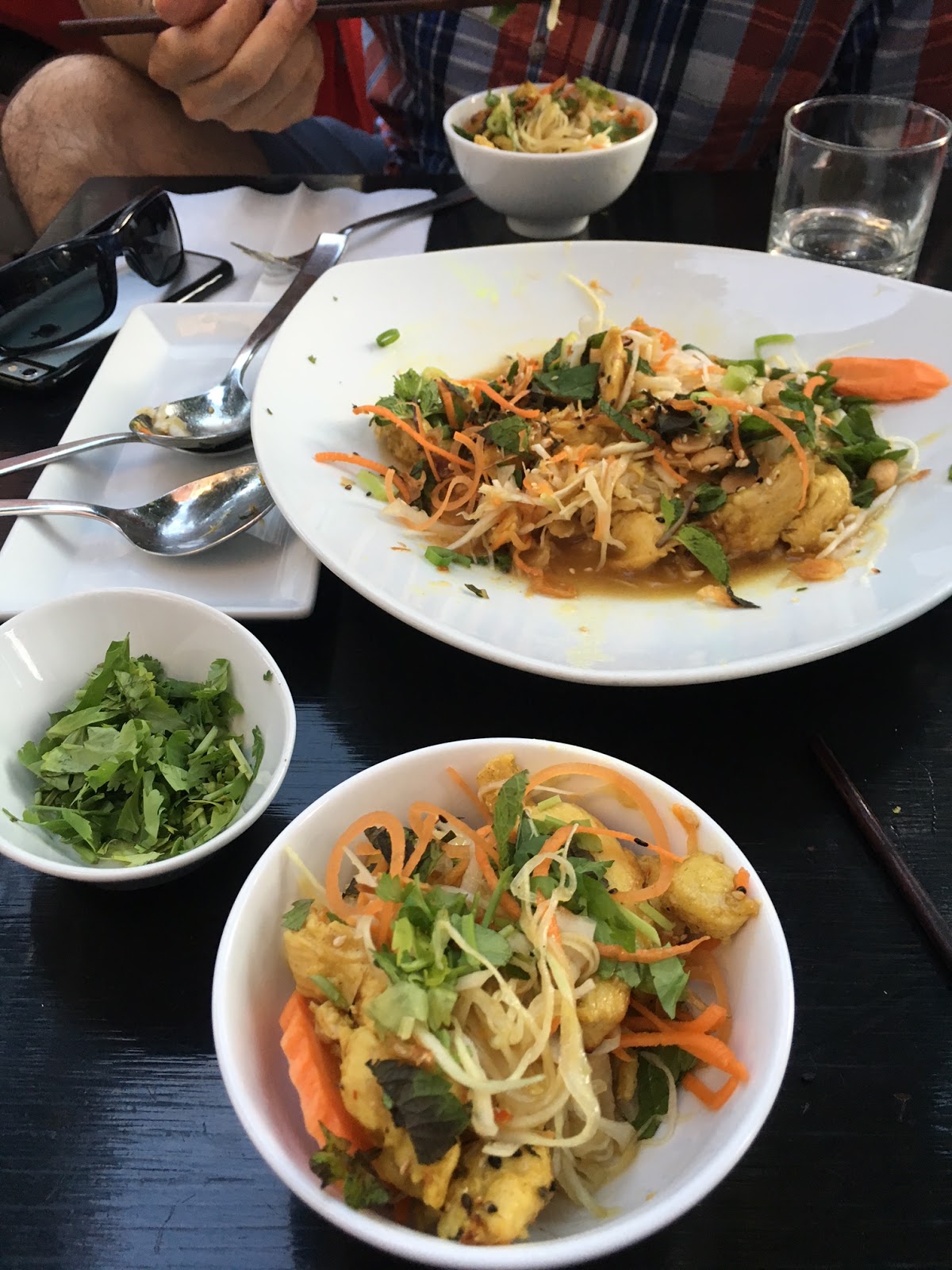
     We split a warm chicken salad for an appetizer. It had a kick to it and was excellent.
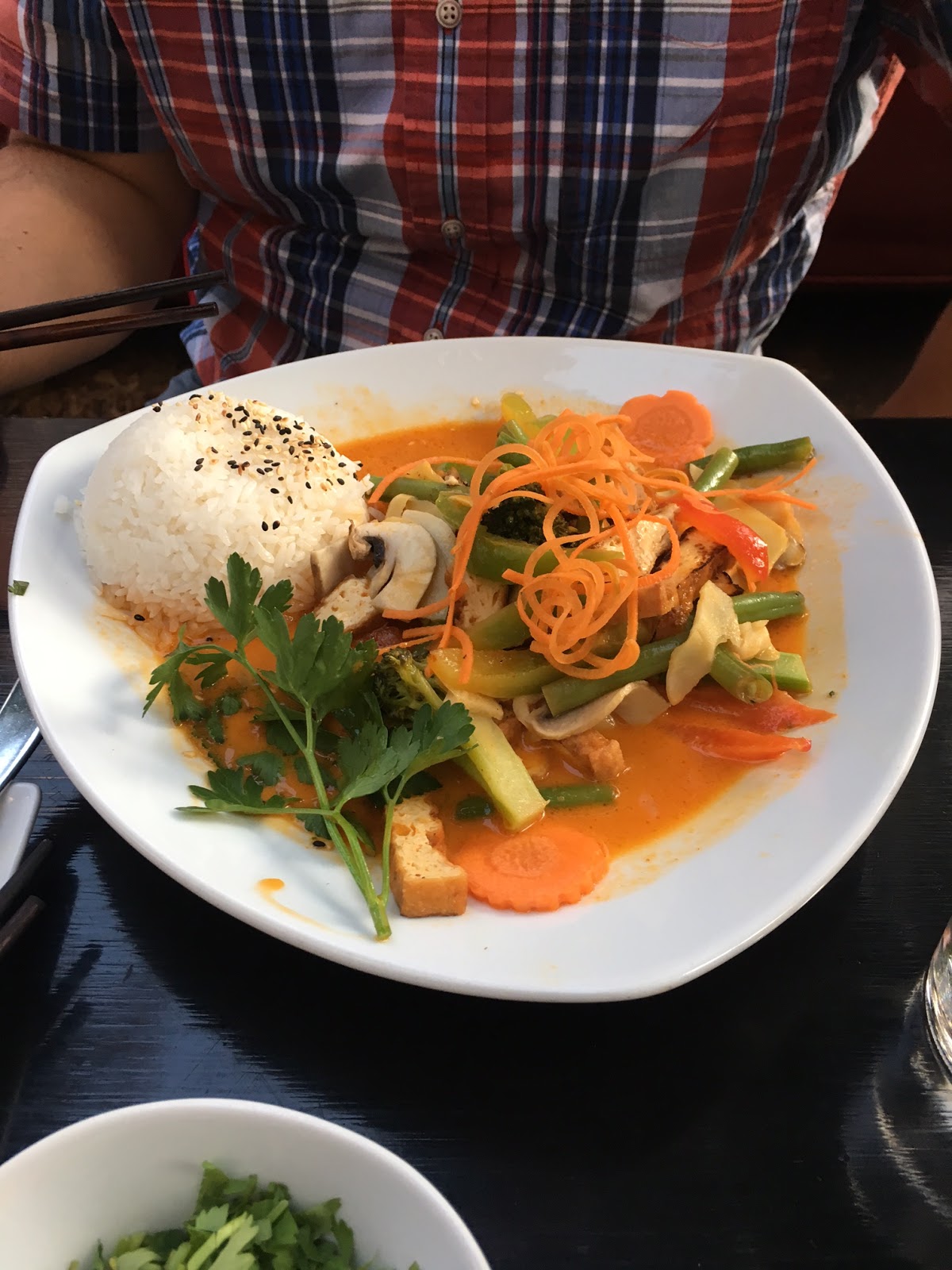
     Dan had a red curry with tofu.
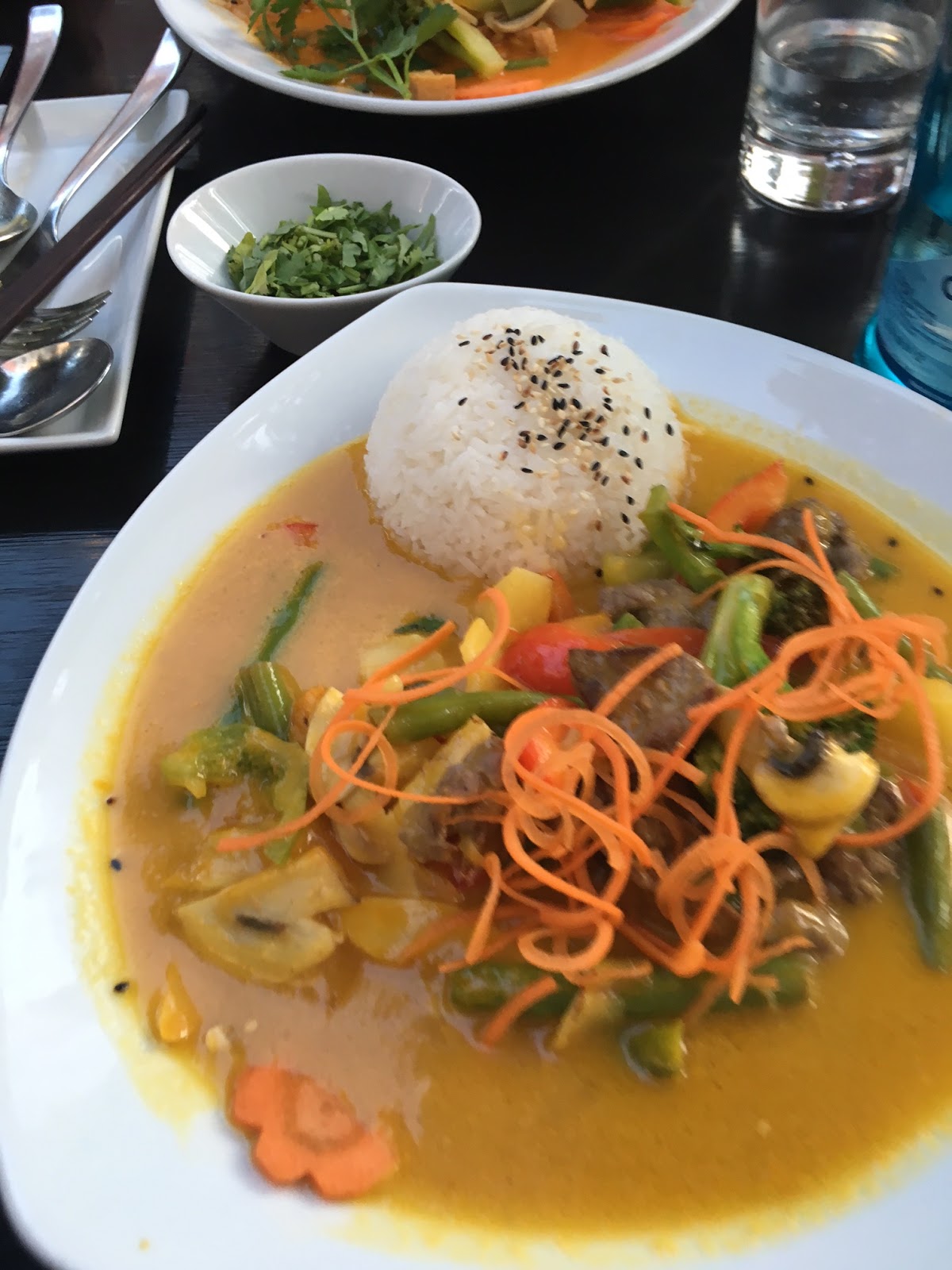
     An interesting mixture of beef, mango, mushrooms, green beans and other vegetables. I really liked it.
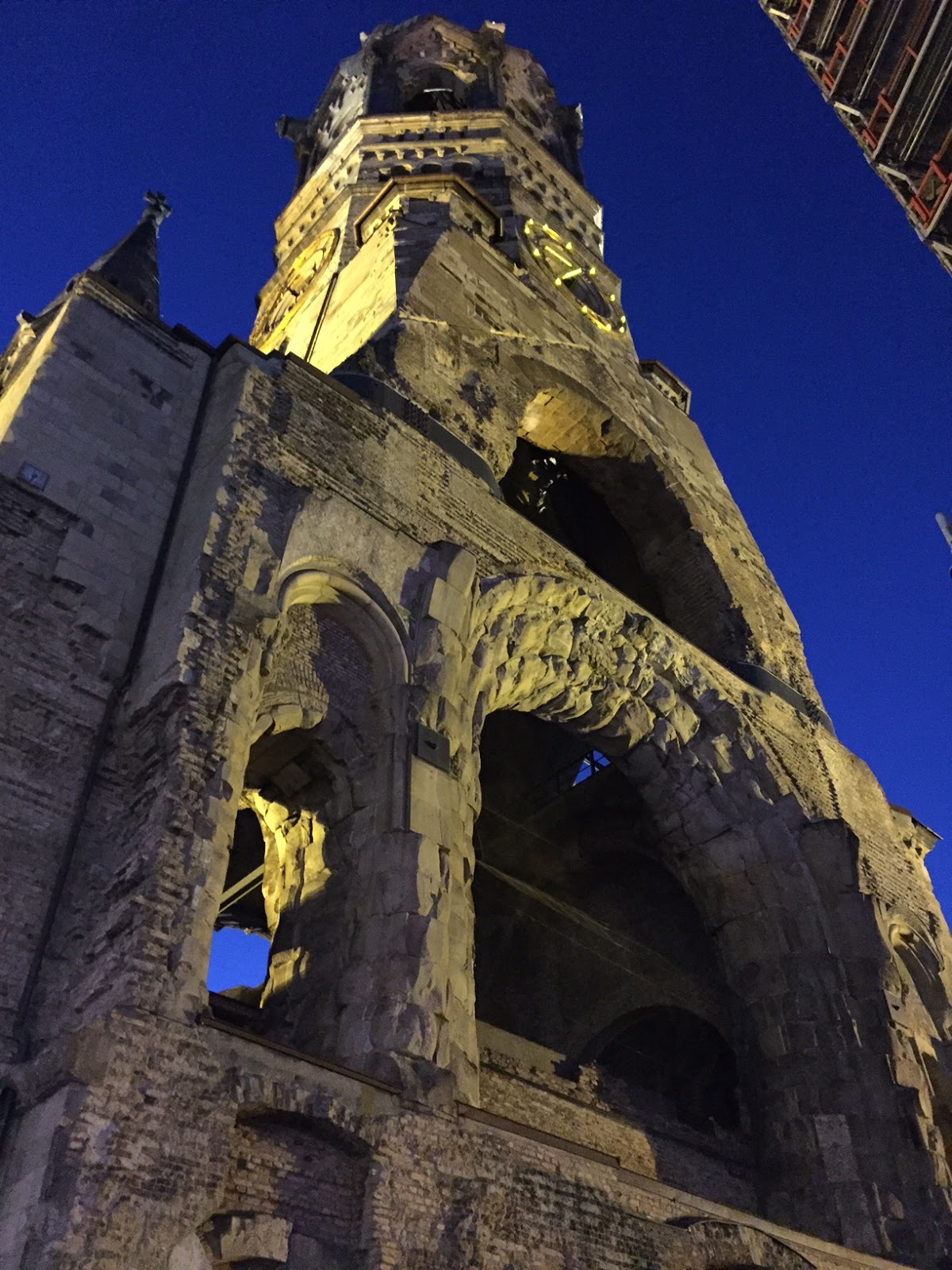
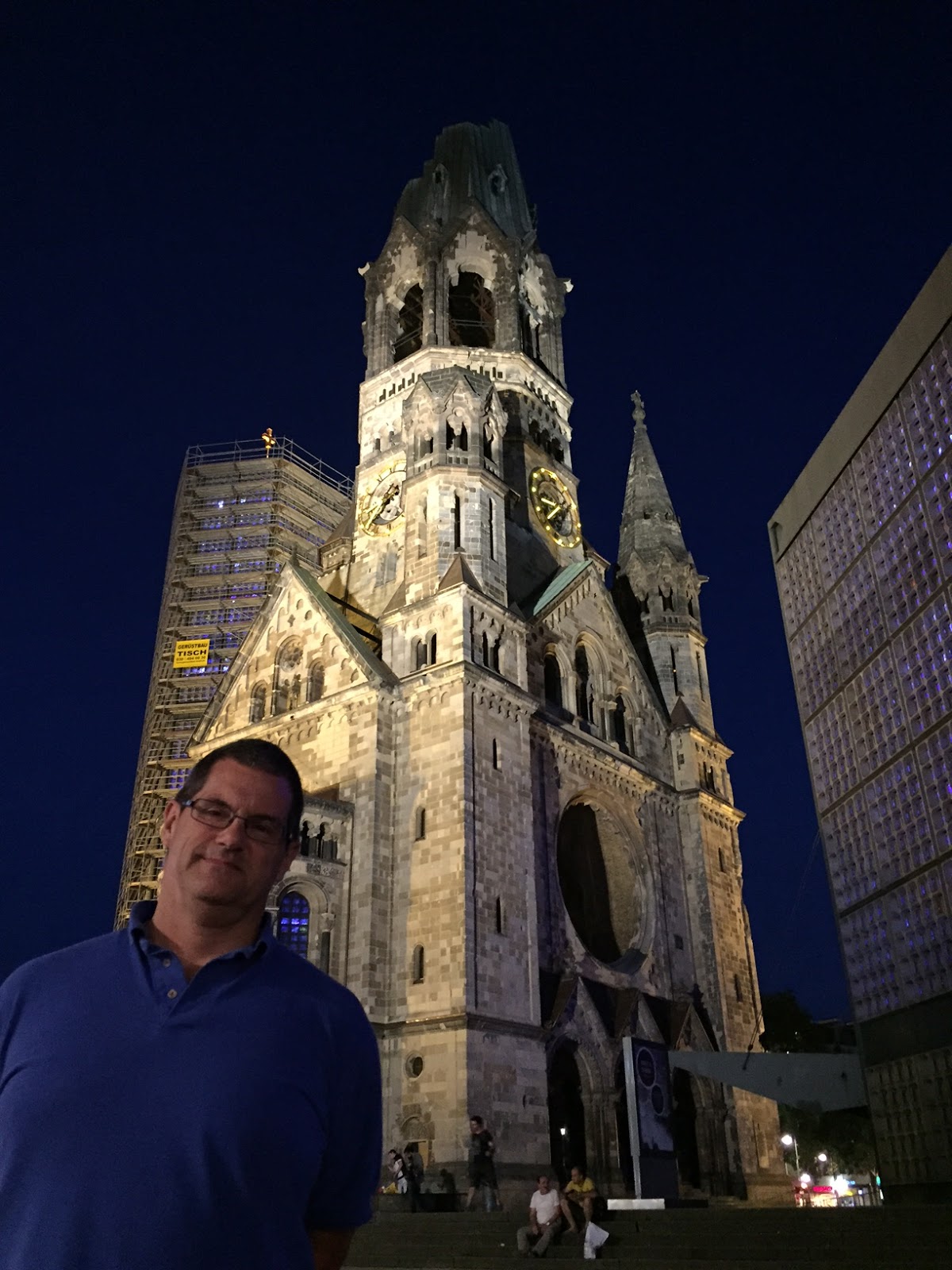
    We walked back to the hotel from there and checked out an area we hadn’t been in before, just kept seeing form a distance, including this church: Kaiser Wilhelm Memorial Church, circa 1890.
    With that, a decent bedtime coming. And good thing, too, because as our final day, we’ve packed tomorrow, but it will be a good one.
  • Day 9, Thu 9/1: Berlin, Part 1

    Day 9, Thu 9/1: Berlin, Part 1

    It’s not quite 5am on Friday morning as I start this. We got back to the room last night a little before 10pm, which is by far the latest we’ve been out the whole trip. The blog process is generally  2-3 hours – one hour for photo prep, another 1 or 2 for writing. – and I hate getting behind because it’s too hard to catch up. But it was a long day with lots of walking (11.43 miles and 40 floors according to Dan’s phone) and I just couldn’t think straight to do the writing. So after the photos were uploaded here I decided the writing would work better (for all of us!) if I did it over coffee in the morning. So here I am :) I slept a decent 5 hours and the room coffee ain’t bad for being instant. (Which is always the case here, by the way: instant, and surprisingly good.)

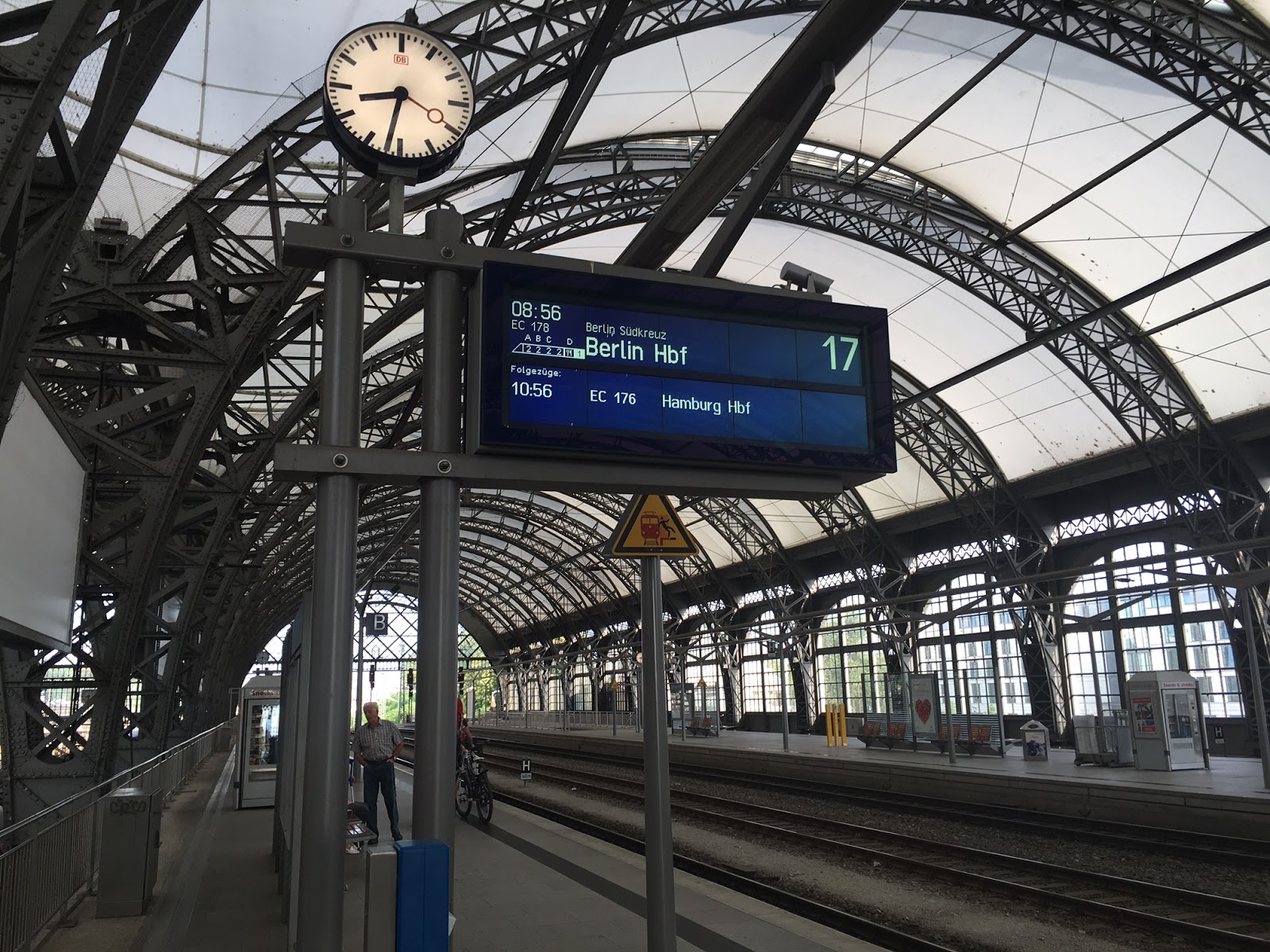
    We got an early start yesterday, but intentionally. Dan set the alarm for 5:45 so we could get one more spa round in, which opens at 6am. And we did. Made it to breakfast a little after 7 and out the door by 8:10 for an 8:56 train to Berlin from Dresden. This one was on time.
    The two hour ride was uneventful. We both slept a little. This train was more crowded, and there were 2 other women with us in a compartment for 6. So still comfortable.

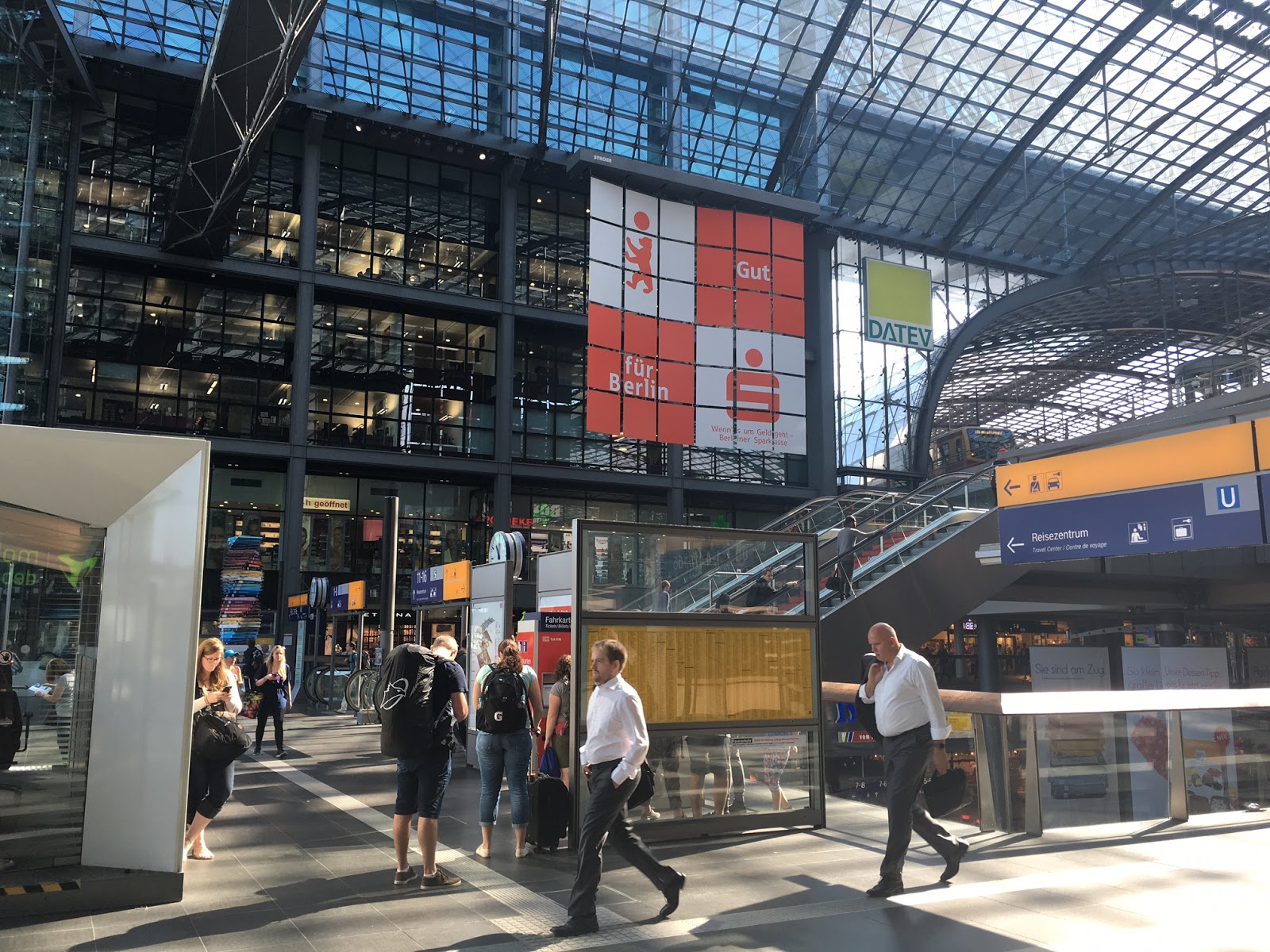
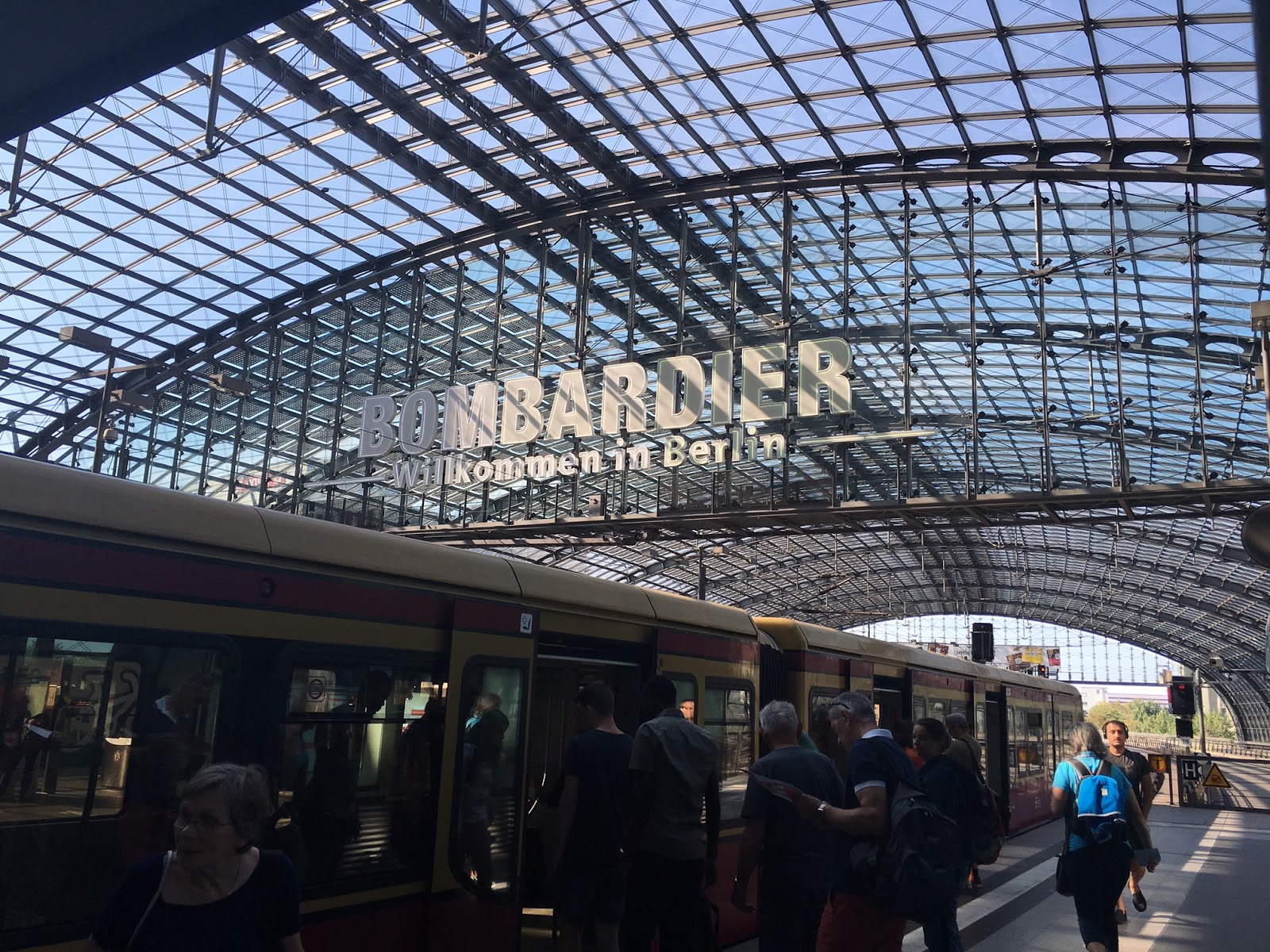
    If you’ve been traveling with us for awhile you know we love train stations. And the Berlin’s Hauptbahnhof (main train station) is huge! As soon as we stepped off the train we were like “this is going to be our kind of town.” We stopped at the visitors center and picked up public transportation passes which we can use unlimited for 4 days, and Dan added some extras to that for museums and such. Mostly we were interested in the transportation because we knew we’d be using it a lot, and much of what we would do (today especially) was free.

    And we had that feeling again as soon as we got off and started walking to our hotel. We like cities that have a lot of diversity, in people and neighborhoods, and like to see as much of it as we can. We especially like to taste neighborhoods that feel very lived in, as opposed to touristy areas. Neustadt in Dresden so far was the only one we’d done on this trip. Our hotel is out of the city center – there’s something going on in this town this weekend and we had trouble getting a room – but pretty close to 2 train stations so it will still be easy to get around. But the neighborhood is great so we’re really happy with it. Nothing touristy about it.

    This is a Hampton Inn, still part of the Hilton chain, but very basic. Honestly, we don’t really care that much about the rooms because we spend so little time here!

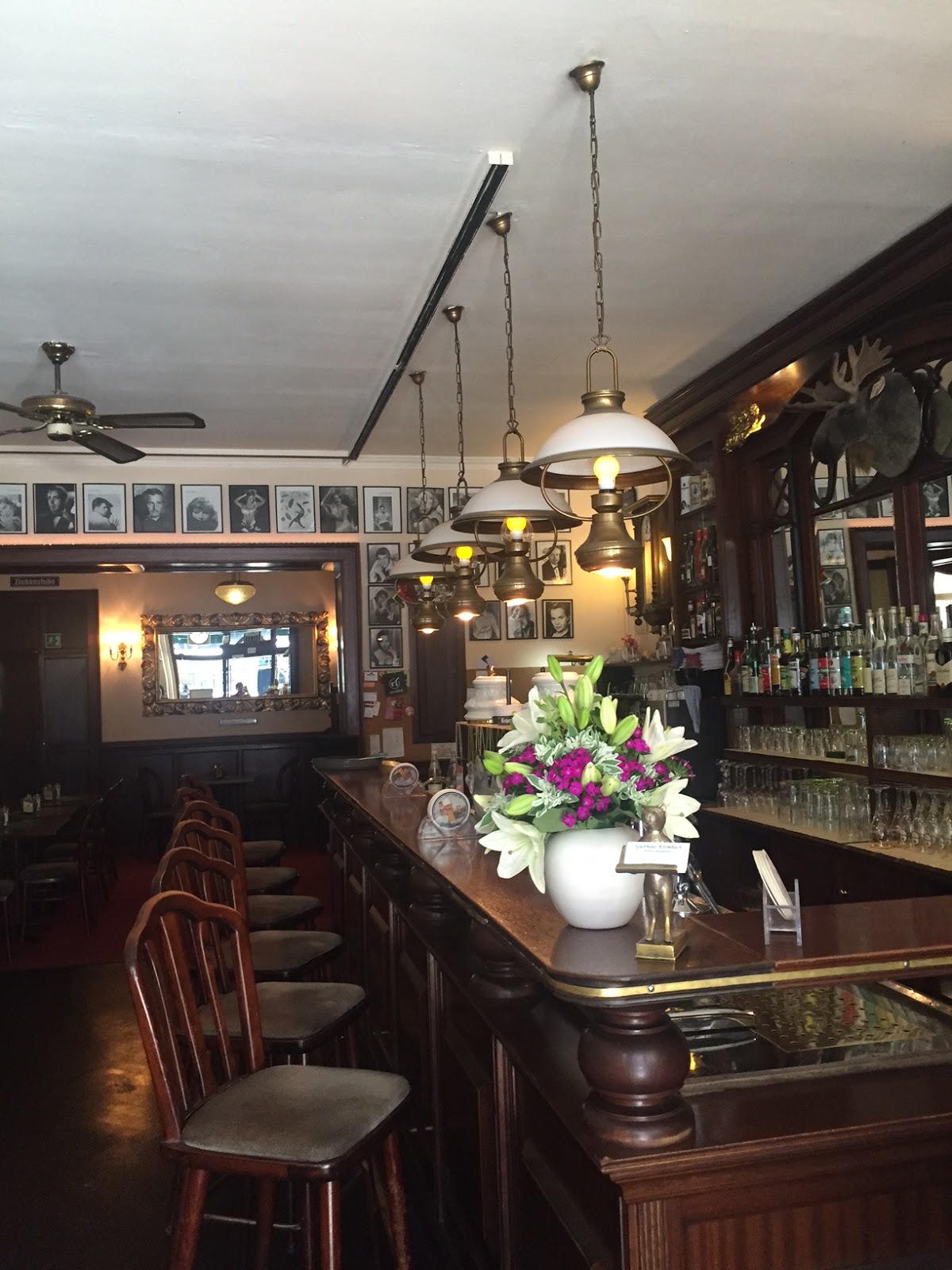
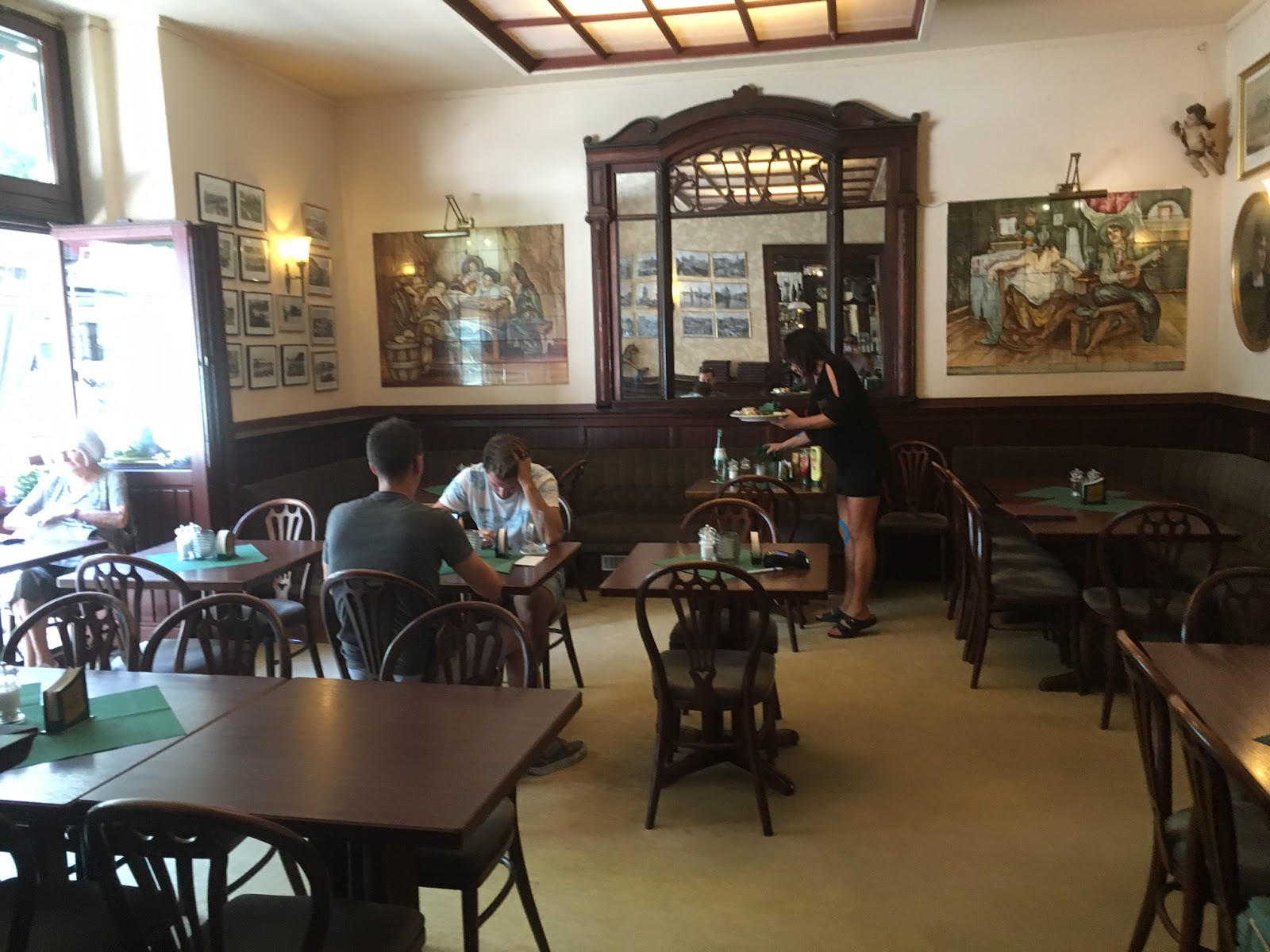
    We went in search of lunch and decided on a German place the hotel clerk had recommended, Gasthaus Krombach. It was #43 on TripAdvisors list of 6439 restaurants in Berlin so figured it couldn’t be too bad. And it wasn’t, but very German for sure.

    The restaurant as you walked in above. We took the one below as we were leaving, the waitress is clearing off our table.
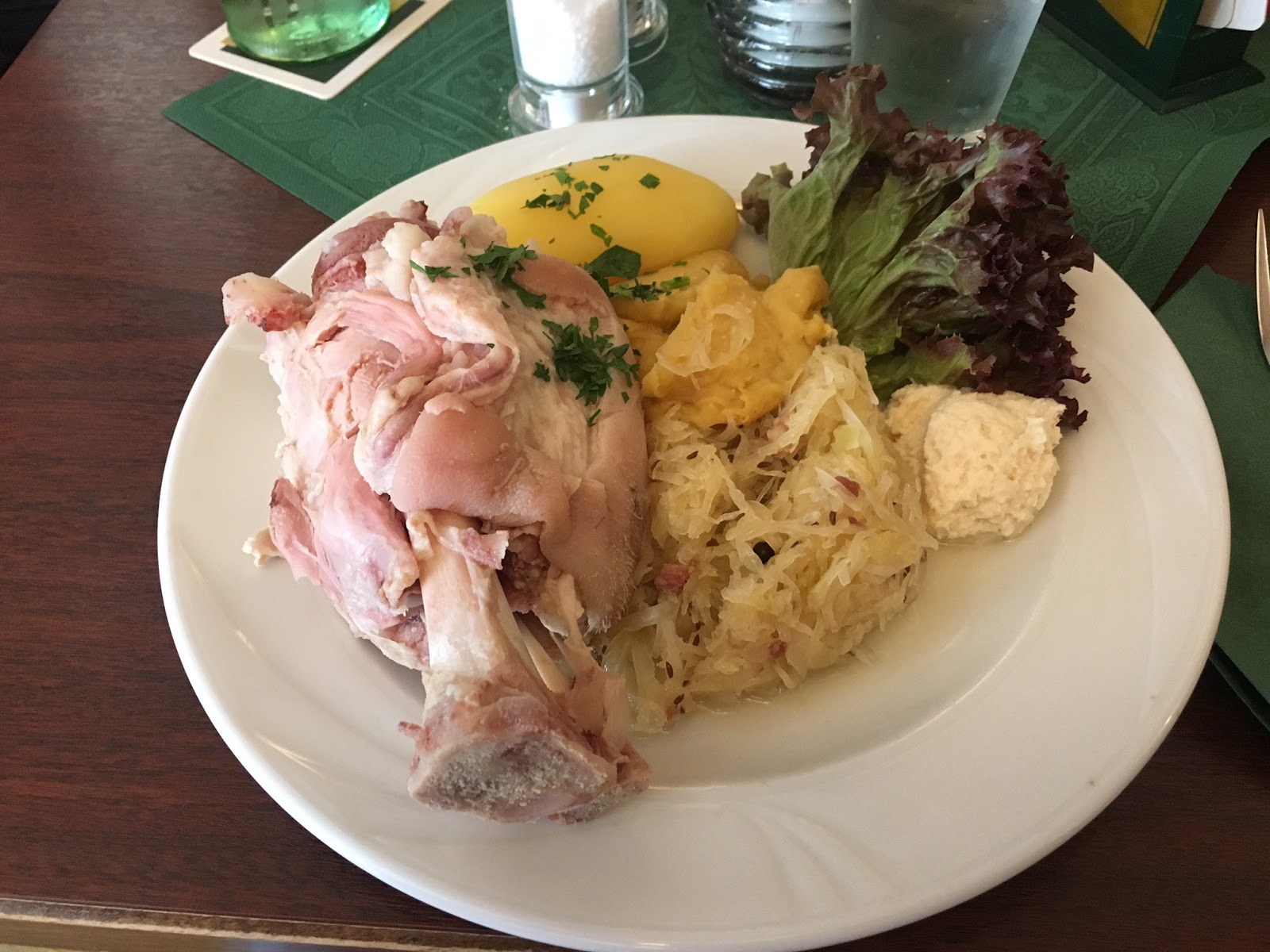
     This was probably the most unappetizing looking meal I’ve had, but it tasted good. Boiled pork knuckle – sort of like eating a turkey leg – with boiled potato, mashed yellow peas, sauerkraut, and a killer horseradish sauce I kept taking too much of and would get that burn.
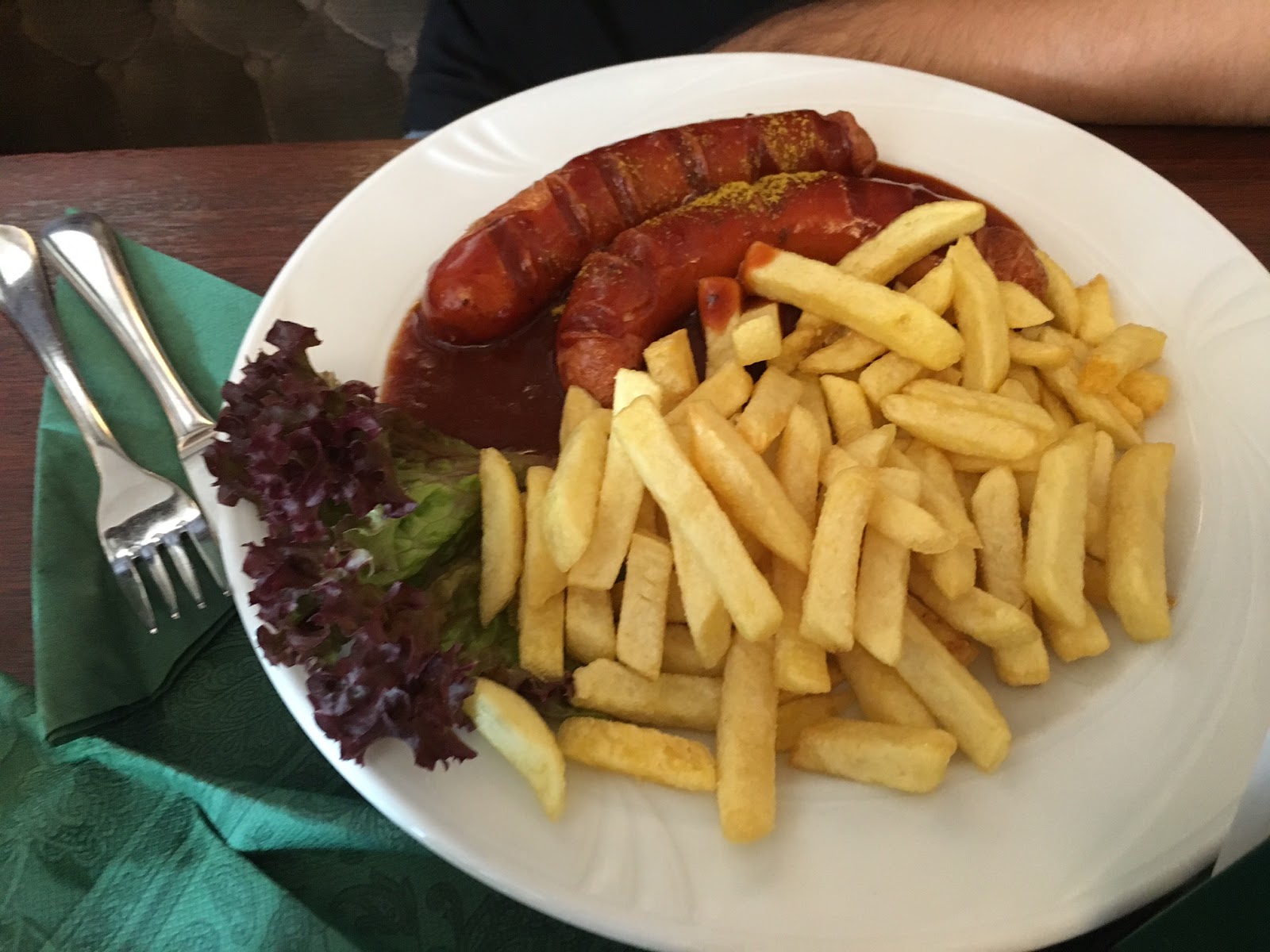
     Dan had a standard German staple: Currywurst and fries. Currywurst is a sausage with a sort of BBQ sauce and curry powder sprinkled on top.
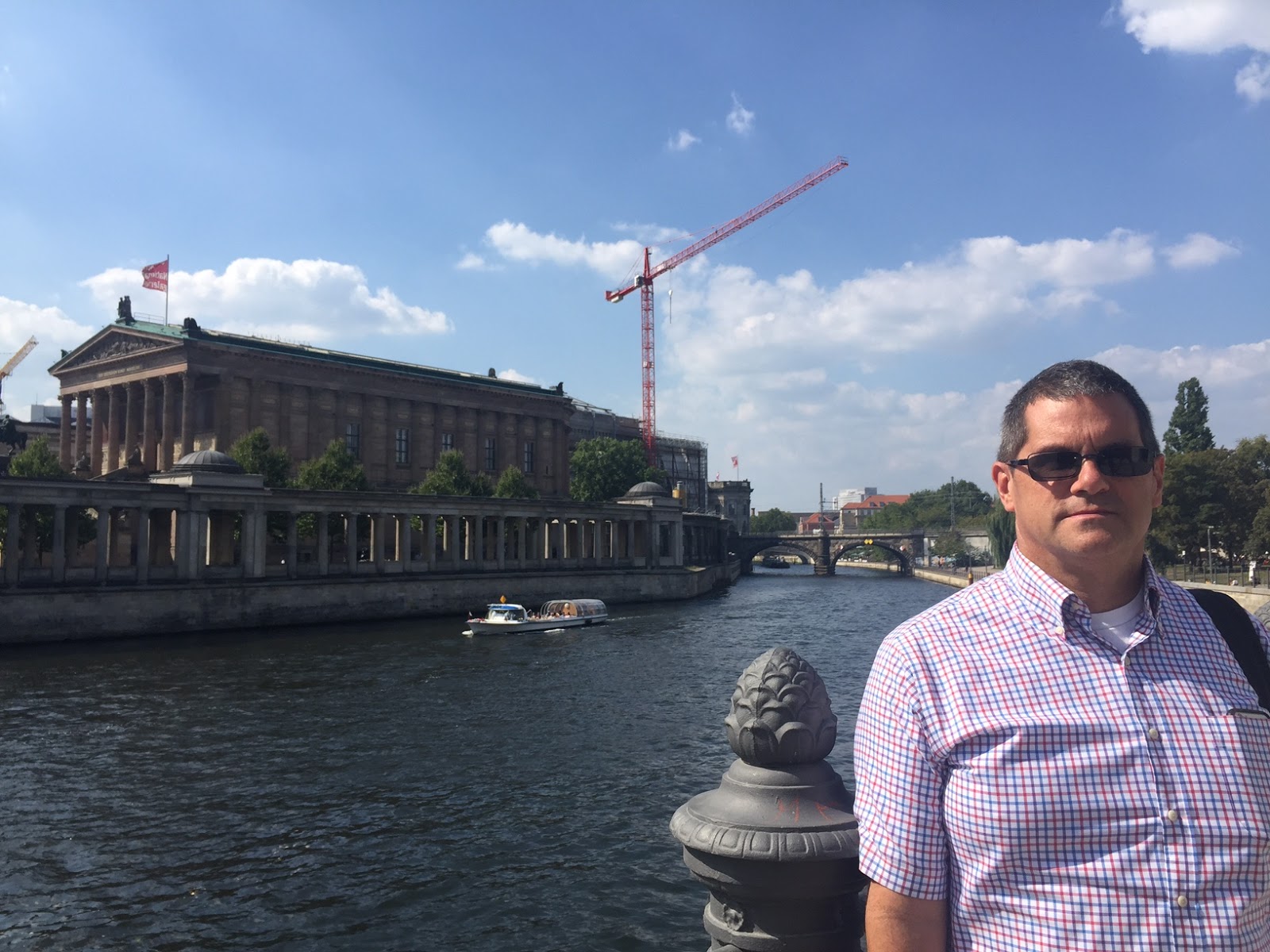
    After lunch we took the train towards the city center. Although we’re both getting a little museumed out, Berlin actually has a “Museum Island.” Ruh-roh. You know you’re in trouble if there’s an actual island full of them. We only did one of them today though.

    About to cross onto the island. You’ll probably see a lot of cranes over the next few days. There is a ton of construction going on in this town. Dan said there was even more when he was here in 2002, and it was on the “east” side where the post-Communist area was trying to catch up to the West Berlin side, which, while completely surrounded by the Communist state East Germany, actually belonged to the democratic state West Germany. That part of history is always very interesting to me for some reason.

    We decided to do Berliner Dom, the Berlin Cathedral, first. This was the view approaching it from the side. For some reason, probably the name, we had both assumed this was Catholic. Turns out it’s Lutheran, like the one in Dresden, which makes more sense. Also turns out it’s not a cathedral, in that it’s not the seat of a bishop. It’s just what it’s called. It’s official name is Evangelical Supreme Parish and Collegiate Church, a parish which dates back to 1451 and would have been Catholic then of course. It converted to Lutheran in 1538 by the ruler at the time, Joachim
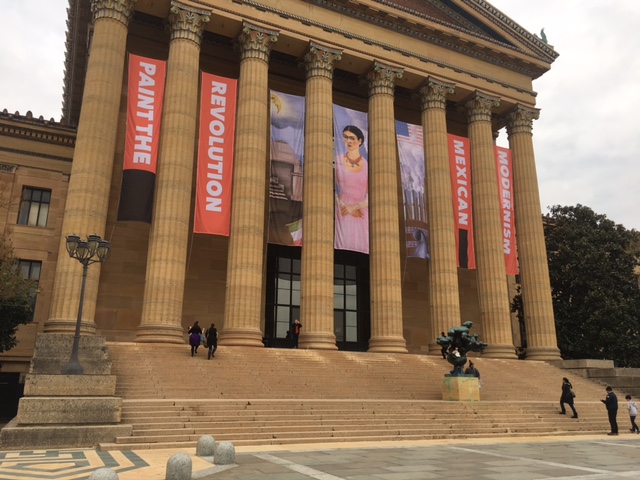
    The front view, taken from a large park across the street after we were done here. This church isn’t huge real estate wise – we’ve certainly been in a lot bigger – but it’s dome is huge and it’s very impressive inside and out. It was finished in 1905, and up until 1918, served as both a place of worship and a state site for public events. The Royal Palace was across the street and the Kaiser, Wilhelm II, who was also the head of the church, was very involved in its construction and used it a lot, including for his own birthday celebrations. Once he was out of power after 1918 and the end of WW1, it fell out of use publicly until the Nazis in the 30’s. Goering used it for a very public wedding in 1935. (And added a fun little photo below for emphasis.)

    Notice the guy in the left background, who was also the best man.

    It was damaged by bombs during WW2 and much of it sat unrepaired for awhile. Because of it’s association with governments the people were tired of, there wasn’t a ton of interest, therefore no funds, to bring it back. The parish continued on though. Long story short: West Germany ended up funding it’s repair in the 70’s-80’s. After the Wall fell,  people were committed to restoring it and it was re-inaugurated again in 1993.

     This is the same entrance as the one above.
     At this point I was still thinking it was Catholic. You don’t typically see the crucifixion like this in Protestant churches. (At least not the ones I’ve been in!)


     Martin Luther is the predominant figure left of the altar.
     This seriously cracked us up. All the way up the dome there were these lines like “still 180 steps to go!” and constant reminders of how physically demanding it was. The last line above we found hilarious. Did somebody die or something from physical exertion? The repeated emphasis was unusual.
    The Berlin TV Tower, finished in 1969. At 1207 feet, it’s the tallest structure in Germany, and 2nd tallest in the EU. (A radio tower in Riga, Latvia, is 2 feet taller.)
     The park we were in when we took the front shot of the church.
     A museum on the island we will not go into, but we liked the look of it.


    We headed to the Pergamon. As if it could read out minds, this museum focuses on what Dan has been wanting to see: civilizations from the Mesopotamia region, including now Turkey. There’s a lot of history there we know nothing about. The museum gets it’s name from a site discovered that was part of the Babylonian empire.

     The map of the areas covered.
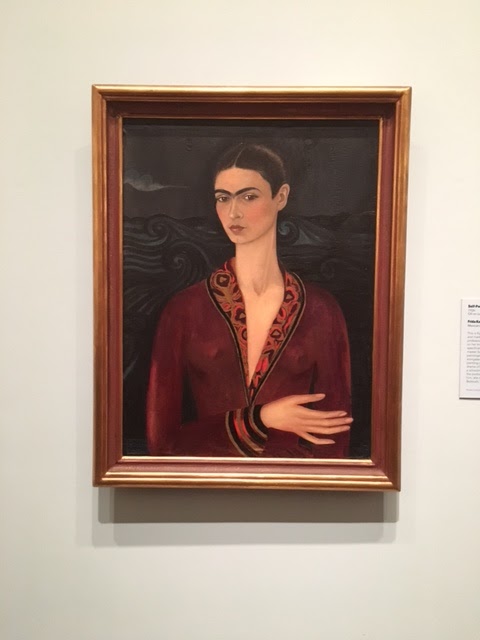
    The next 3 photos are from the Ishtar Gate, which has been reconstructed here in the museum to the degree it can be. It was built in 575 BCE in Babylon by Nebuchadnezzar.
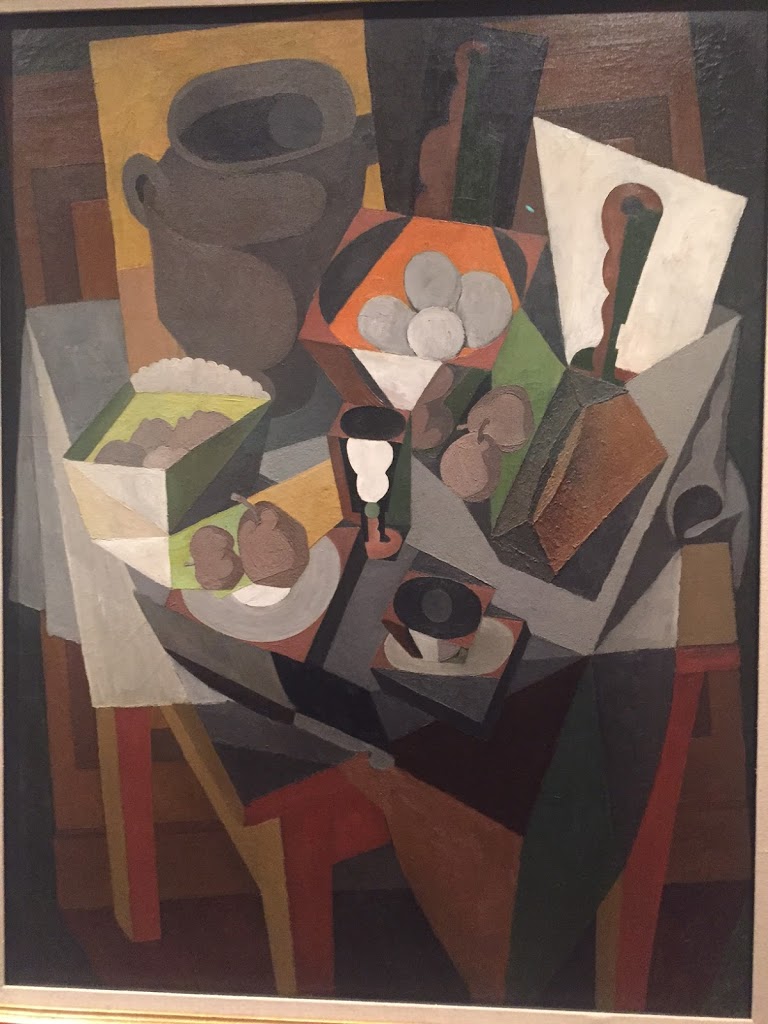


    The next several shots are all from a market square in Miletus, from what is currently Turkey, dating around 350 BCE.

    Mosaic flooring similar to the Roman stuff we’ve been, only this is several hundred years older.


     The reconstruction of these in this room was just kind of amazing.


    These next 3 are intended to be the rebuilding of the corridor that lead up to the gate of Ishtar, although these walls would have to be double the height to get it accurate.  In the 3rd photo you can see a model that shows what it might have looked like. We picked up the walls on the side matching the model; the Ishtar Gate in the background is hard to make out. But this was an impressive exhibit; we’d never seen anything like it.


     Looks amazing for being 3000 years old.


     This is a water basin, cut from a single basalt block.

    The next grouping of these came out of the Islamic exhibit. So from Arabia and Iraq, circa 700 AD.


     A palace wall.
     A very intricately decorated room.
    We left around 4:30 after just 75 minutes; were ready to be outside the rest of the day. We went in search of water and coffee, which we found at a train station not surprisingly, and decided where to go next.
    Ritter Sport is Dan’s favorite German chocolate. There’s a store here where you can design your own chocolate bar! We passed on that, but enjoyed looking around anyway. We will come back on Saturday and try out there restaurant.


     You can buy this in most grocery stores in the US, it’s just much cheaper here.
    Next was the holocaust memorial. These blocks are intended to create of sense of order that’s actually confusing (mission accomplished); some have also said it looks like a cemetery. We got there too late to go into the museum portion underneath all of this so just walked around. It was interesting being there as sunset approached, made for interesting shadows.
     They start at street level, get higher as you go in, and the ground turns into a valley. So suddenly you find yourself surrounded and you can’t see out, lose your sense of where you are.


    We had dinner after at a Thai vegetarian place. There are a lot of Vietnamese and Thai places here so decided we’d try one. This was vegetarian and it was very good.


     Dan had an eggplant dish and I had a simple vegetable hot plate dish, both with rice. Very satisfying, almost like a taste of home! We love Thai food and there’s a lot of good Thai food in Sacramento.


    This is Brandenburg gate, the most Berlin-y thing you could possibly see. Constructed during the reign of Frederick William II of Prussia, completed in 1791. Used for all sort of ceremonies, battles and demonstrations over the years, it was originally a gate used to collect taxes as merchants came in and out of the city. I loved some of the description provided about more recent events: “The thousand-year Reich proclaimed by the Nazis led to mass murder and a world war which ended 12 years later in catastrophic defeat.” and later: “The Brandenburg Gate took on a new significance after 13 August 1961 when work on began on building the Berlin Wall just a few meters away. The gate now became the symbol of the division of Berlin and the entire country. For 28 years it was completely inaccessible, being locked into the prohibited zone and death strip controlled by GDR border guards. the Berlin Wall fell in November 1989, however, and on 22 December 1989 Germany’s most prominent historical structure was reopened.” Nothing more I can say about that.

     This is the US Embassy, to my left from the photo above it.

    Next we went to the Reichstag. This is the German Parliamentary building. It was free, but you had to make an appointment to get in. We made ours a month ago, for 8:30pm. We got there around 8pm, left around 9pm, and there were still lots of people around. Everything about this was impressive and we’re very glad we did it.

     We took this on our way out. The dome at the top if what we got to tour. This is the #1 thing to do on TripAdvisor and we agreed.
     A viewing deck, taken as we were ascending the dome, it was still dusk then.
    We took this after, but it’s where we spent our time. It’s very well done, with ramps that lead you up and down, and an audio guide that plays automatically, describing things you’re seeing as you move about, stopping and starting based on where you are.
    On the right: mirrors that reflect sunlight into the plenary chamber below. On the left, a shade of shorts that follows the sun throughout the day to block glare. And below: a nice shot into the chamber with the chairs being reflected in the mirrors.


    A 30 meter hole in the top that allows creates passive ventilation. Dan was very impressed!
    The next several are all shots of the city from our walk on the deck.


     The Brandenburg Gate on the left.


     We went back to Brandenburg Gate on our way out to get a better photo at night.

    We took a bus back, which dropped us off at one of the train stations close to the hotel. We had seen this earlier in the day, just as Dan had said “I haven’t seen any Bayer signs.” They have pharmacies in Germany and we typically see them fairly regularly. Not 30 seconds later we came across this building, across the street from the train station.

    It was a good first day in Berlin. We are headed to breakfast soon, and after are spending the day in Potsdam, and will complete Berlin tomorrow.

  • Day 8, Wed 8/31: Dresden, Part 2

    Day 8, Wed 8/31: Dresden, Part 2

    It’s only 5:00 and we are done for the day, well sort of. We finished our agenda early and decided to continue with the “take it easy” theme we started the day with and return to the hotel and just relax a bit. So I’m getting an early start on the blog and Dan is continuing his watching of Penny Dreadful, a Netflix series he’s been watching the whole trip. We said we would go out again for a walk at night so we’ll see if that happens! As we were walking around the hotel on our way back in, we found a shortcut from the hotel to “the balcony of Europe” so it will be easy to do.

    Although we were up pretty early, we wanted a more relaxing day so took our time moving about and didn’t head downstairs until after 7. Breakfast was typical Hilton European – complete with pork-n-beans and mushrooms – and of course the normal variety of eggs, breads, fruits, deli meats, cheeses. Each location has some slight variations. Vienna had congee. Prague had 4 kinds of sausage. This one had eggs 6 ways: hard fried, over easy, sunny side up, scrambled, hard boiled, soft boiled.

    After breakfast we went into the “wellness” area. Dan worked out. I did rounds in the sauna, steam room and hot tub, where he joined me eventually. It was very relaxing. Almost too relaxing! I had trouble moving fast after that. But at some point vacation should be about relaxing, right?

    We left the hotel about 10:30. Yesterday we had purchased a “Welcome Dresden” card, which would get us into a number of museums. We had only picked three really that we would do and they were all on the card, so it made it worth it The Albertinum yesterday was one, so today would be the other two.

    Our first stop was Zwenger Palace. A string of 3 museums now, this used to be the public space for the Saxony court back in the day. Like this church was saw yesterday, this has been rebuilt from the ashes of destruction in the war. And actually much of the reconstruction is still going on. In the first museum in particular, only about half of it was open.

    Similar to the Kunst museum in Vienna, much of the collection here is from the Saxony Courts own Kunsthammer: collecting things to learn about and then reflect their understanding of the world in both art and science, because what they understand they can rule.


     This and the two paintings that follow are by an artist named Lucas Cranach the Younger, a German Renaissance painter whose work occupied much of this wing. Him and his father, oddly enough Lucas Cranach the Elder, both did several paintings of Adam and Eve; the father’s are more studied but we didn’t see any of his work here.
     Pygmies messing with a sleeping Hercules above; Hercules waking up below.


     Called “The Dentist,” we both went “ouch” when we saw it. The look on the guys face is awful.
     This is the Sistine Madonna by Raphael. Anything look familiar? Look at the bottom of it.
    You’ve probably seen these guys a million times and didn’t know where they came from. There are a couple of stories about their inspiration: one is they were the model’s children, and they would come and watch him paint and he painted them in just as they watched. The other is he was painting two kids looking wistfully into a bakery.
     If you read the Prague, Part 2, entry from this blog, you saw my musings on European streets I just like the look of. This was one of those streets in Haarlem, Netherlands, from our trip in 2013, with Grote Kerk (Great Church) in the background. Now look at the painting below, which we saw this morning in this exhibit.
     Apparently someone else liked the look of this street about 300 years ago, too.
     This was a nice area outside of one of the museum cafes. See the stairs in the back? We came down them later when we were walking around and found ourselves back here; it was the only way down from where we were.

    Next was the Math and Physical Science gallery. It displays a collection of scientific instruments at Dresden court that began around 1560. In particular, there were lots and lots of clocks. Mechanical clocks begin in the medieval period, when large clocks powered by falling weights were installed in the towers of town halls in churches. This collection runs from mid 1400s to mid 1800s.

     This was extremely intricate, and there was a visual aid that showed how the mechanics of how the pieces moved around and bobbed up and down when they did. Reminded me of the clock in Prague. Pretty ingenious stuff for the Middle Ages.
     They loved things that moved on their own. We saw a bunch of this stuff in Prague, called automatons.
     Yes, scales.


     Same clock above and below, just front and back. These things were amazing. Like the astronomical clock in Prague, it wasn’t just about time; they tracked the entire year including seasons and constellations.


    Believe it or not, a calculator. Each of the dials represents a place – tens, hundreds, thousands, etc. A stylus was used to turn each of the dials to enter numbers into the machine, and the sum appears in the windows at the top.


     This was all about telescopes and instruments that created heat from the sun.


     A thermometer!
     Every time we changed galleries, Dan took more photos of the courtyard.


     As we found our way to the final gallery, we discovered a path a level up that took you almost all around the court.


     The final gallery was porcelain. This is me going “you’re kidding, right?” Asian porcelain isn’t really our thing, but the exhibit kept going and kept changing.

    Meissen porcelain, named for the town it is made it just outside of Dresden, is the first European hard-paste porcelain made, starting in 1708.

     A porcelain replica made of an actual bouquet to a Saxon King by this daughter, 1749.

    We spent about 2.5 hours there then went in search of lunch. We first went to this place where Dan had made reservations for dinner for tonight, but at that point we’d already decided we weren’t going to go out but would just hang out in the lounge. So we tried going there for lunch but it didn’t open until 4pm. We ended up at a place close to Frauenkirche again. We typically have a rule about doing things this close to tourist attractions because they are usually not that good. But we had good luck yesterday and reasoned that it’s because almost all of the tourists here are German, so the restaurants are catering to their tastes.

    That’s Dan right of center. The table next to us were seated after and all 4 of them were smoking, which is the reason we typically don’t take advantage of outdoor seating in Europe. But the breeze was strong enough it was bearable.
     I had roast pheasant with stuffed with a chestnut dressing, shallots and polenta.
     Dan had sea bass (German, not Chilean; tastes more like trout), with rice and vegetables.
    This photo was taken from the church tower yesterday, but I realized as I was putting this together that we forgot to take an outside photo of where we went next, Residenzschloss (Royal Palace). See the building top left that also has a tower? That’s it. We went up there today, too; so you’ll see a photo from there looking pretty much to here. Like Zwenger, this has also been rebuilt and now houses several museums. We were here just over an hour so moved through them pretty quickly.
    They had an interesting exhibit of Turkish things from various interactions – both friendly and not – that the Saxons had with the Ottoman Empire over the centuries. We’d never seen stuff like this before and enjoyed it. We’ve been discussing Istanbul as one of our future trips so this gave us a little taste that we really liked.


     This tent was pretty cool; I liked how it looked on the other side below the best.


     Turkish armory above and below.

    The next gallery was a variety of treasures in gold, crystal, ivory, etc., that the court has collected over the years.  Dan took photos of his favorite pieces.


     For some reason he’s had Nebuchadnezzar on his mind, this piece represented a dream of his so it was impossible to resist.


    I’m leaving the explanation of this one in below because there’s no way to do it justice.


     The names of Saxon rulers were carved into the sails.
     Tiny ivory sailors climbing the nets on the ship in this one.


     Intricate golden coffee set made in Dresden around 1700.


    We both thought this was amazing. This is the court of a Grand Mogul from India, made in Dresden around 1705. The two photos below show the throne closer up, and then me beside it for perspective. It was the most detailed thing we’d seen all day.


    The Dresden Green Diamond is the most valuable of the jewels in the treasure at 41 carats. It is mounted with two other large diamonds, though a mere 19 and 6 carats, and 411 additional small and medium diamonds.

    We went up yet another tower from here and took photos from there.

     The guts of the clock in the tower.
    The church on the right is where we were yesterday.
    The Catholic church we couldn’t get into yesterday, and the Elbe River in the background.
    Same church, but went there after this today. Like the other buildings in the Centrum, this was also rebuilt from original material where possible, and based on original plans.


     And like the church yesterday, you can tell that all of the inside material is brand new.


     This is the pulpit, which is where the priest stands to deliver the sermon. I’ve only seen these is older European churches, but they are very common  here.
    A cute little row of restaurants lining the street that goes up from Bruhl’s Terrace into town, with our hotel on the right.
    ————————————————–
    We did go out again about 8:15pm. It’s now 9:30. We will do another round in the spa before bedtime and still be asleep by 11 hopefully. We’ll have an early morning again, catching a train to Berlin. Here are the photos we took of Dresden at night. We really do need to make a point to get out more at night, some of these are really pretty.
    At the beginning of “the balcony of Europe.” This started out with me being grossed out by a spider on the lamppost; Dan decided he liked it as a pose!
     By the Albertinum we visited yesterday.
     This is the back of Frauenkirche on the left, which is in the main square; and the Hilton logo bottom right. That’s how close are.
     The main hotel entrance with the Procession of Princes in the background and the tower of the Royal Palace behind that.
     Same shot just closer.
     Frauenkirche from the front.
    Opera House.
     Catholic church from the back and the dome of the Royal Palace.
    From the front.


     The top of those steps on the left is where Dan took the two shots above, and is sort of the start of the balcony of Europe, which he loved saying :)
    And that’s a wrap for Dresden.


  • Day 7, Tue 8/30: Dresden, Germany

    Day 7, Tue 8/30: Dresden, Germany

    [Wow, this internet is so much faster than the one in Prague!…actually the one in Vienna, too…]

    We set the alarm for 6am, packed up again, headed down for breakfast a little before 7, and were out the door about 7:40am.

    These were photos of our room in Prague that I took last night.

     They upgraded us to a suite, but it was just adjoining rooms where one of them was a living room. Nice enough to be sure, just an awkward layout. For as little time as we spend in our rooms, we don’t actually care about it that much. But Dan’s hotel’s status kicks in when they have the rooms available and they often upgrade without him asking.


     The view from our room, taken this morning. There was a decent sized tennis complex across the river. The river, by the way, is the Vitava.
     The Prague Hilton had this huge courtyard, with the rooms 8 floors up around it, to allow for more rooms with natural light I guess. That space there behind the staircase on the first floor is where we had breakfast. This was taken from a glass elevator that looked out into the courtyard.
    All that effort to make it to the train station on time and the train was 45 minutes late. Notice the “45 min” in the bottom right corner of the sign. We got there about 8:05 for an 8:27 train; they didn’t announce it was late until 8:21, and then it was only 5 minutes, which kept expanding. They finally announced the platform around 9:05, in the mean time we were just standing in front of the monitor in the station, watching the board. With about 100 others!
     The train wasn’t full; we had a compartment that sat 6 all to ourselves.
     Some pretty views from the train. It was a 2 hour ride to Dresden.


    We got to Dresden around 11:30am.  Why Dresden? It’s a good question. The primary thing we knew about it was it had been bombed to hell in WWII, and that they had done a nice job of reconstruction, especially since Germany was reunified. Dresden was in East Germany when they were split. We were originally only going to spend 1 night here but Dan’s colleagues at Bayer encouraged him not to rush it. There are a fair number of tourists here, but the vast majority of them are German. (Unlike in Prague and Vienna where we saw folks from all over the planet.)

    Dresden’s bombing became somewhat controversial after the fact, but at the time it was considered an important strategic target for the Allies. Dresden was the 7th largest city in Germany at the time. (Today, with a population of just over 1/2 a million, it’s #11.) It hadn’t been touched by the Allies despite being a major industrial, transportation and communication center, with lots of connections to other parts of Central Europe. Over 3 days in February of 1945, the Allies dropped 3900 bombs and incendiary devices, destroying 1600 acres and killing 22k-25k people. The Nazis propoganda machine blew that number up about 10x, and downplayed the importance of Dresden to Germany overall, which led to some of the controversy. After the war, Dresden became part of East Germany and was Communist until reunification.

    Dresden has been around for over 800 years and before Germany was unified in 1871, it was the seat of power for the Duchy of Saxony (Kingdom from 1806-1918), and Saxon royalty ruled here for many centuries.

    We walked to our hotel, about a mile. The entire way we hardly saw any traffic because there was a pedestrian mall that stretched essentially from the train station into the Centrum (downtown) and our hotel is right there in the center of the city. We can see the church below from one of our windows, because it’s at the end of the block.

    This is Frauenkirche, or Church of Our Lady. It’s the predominant building in the main square. That’s a statue of Martin Luther in the middle of the square, although in the photos above and below it looks like it may be right in front of the church. It’s not. Notice how small the people are by the church compared to those by the statue and you’ll see what I mean.


    This is almost the entire square and you get a better perspective of size, with the now small Martin Luther in the middle.

    This is of the back of the church. Notice the darker blocks here. And if you look again, and in the photos above, you’ll notice some dark blocks spread throughout the building in seemingly random places. Here’s the story:

    This church was destroyed in the bombing described above. After the war, it was left in ruins – literally, just as it was after being bombed – as a war memorial. And it sat that way for over 50 years. After reunification, they decided to have a go at rebuilding it, and used the original plans from 1720 which had been kept all this time. Where possible, they used actual material salvaged from the ruins. Hence the black blocks.
    Wild, eh?

    Here’s what was left of it after the bombing. The Martin Luther statue stood there all this time.

    Reconstruction started in 1994 and took 10 years.


     We, of course, took the option to go up, which you had to pay to do; the church itself was free.

    This hole here in the floor? The same hole in the middle of the dome 3 photos above.

    Dan having fun with the camera….

     Some pretty views of the town from above.
     See the awning in the shadows of the street towards the bottom of the photo? That’s our hotel.


     Martin Luther again from above. Those yellow tarps top left next to the red ones is where we ate lunch after. See the table below. (Although we sat at one farther in.)


     Dan kept saying “I can’t believe we’re eating at a burger joint in Germany” but he admitted more than once it was pretty good. He had an Italian burger – with Gorgonzola cheese among other things.
     Mine was French with Brie, and sweet potato fries. Both kinds of fries were delicious. The red sauce was a spicy something like you’d get with Asian appetizers. It was weird in that setting but worked well.
     Take note: Ketchup, and Fried Potato Sauce. Never get them confused. (And I love that the mayo bottle is bigger in a disgusting kinda way…)
     This is called the Procession of Princes and it literally outside out hotel door. It’s a mural painted on the wall of the royal palace showing all of the Saxon princes since around 1300. That’s not history I’m familiar with so didn’t recognize any of the names.


     This is a square around the Catholic church below, which we were going to visit, but we couldn’t figure out how to get in. The steps I’m on lead up to “the balcony of Europe.” (More on that later.) There was construction tape around the only entrance to the church we could see so something is going on. This was also destroyed in the war and reconstructed based on original plans.
    The full church, and that’s the opera house in the background.
     It was about 3:00 by this time and we went and checked into our room. They also upgraded us to a suite, although this is the real deal. We will be very comfortable. Too bad we don’t spend too much time in our room! The photo above is the first floor. There’s a half bath to your right.


     That’s where I’m sitting right now as I type :)
     We left about 3:30 to do the only museum we were going to today: The Albertinum, a nice little museum with a wide range of art (including a little modern…).
     Those stairs in the background also take you to the Balcony of Europe….
     This wasn’t a great museum, we were only there an hour. But there were a few pieces we liked. Especially this sculpture made of plywood.
     Dan thought she was whimsical.
     This was the huge entrance hall. You can see how crowded it was! Notice the baby on the floor on the far right just below center.
     Roman mosaic, probably around 200 AD.
     Dan likes it when we come across art of ancient civilizations that isn’t Egyptian, Greek or Roman. In this case, Assyrian. This stuff is about 2500 years old.


     Careful, we are entering the modern art arena. Dan thought this was whimsical as well. The upside down text is: No Rejection, No Annual Contract, No Credit Check.
     This was called Freedom.
    Dan couldn’t resist. Complements the black one from the Albertini in Vienna. (I keep wanting this museum – Albertinum – to be named after the same guy, Albert of Saxony, Maria Theresa’s son-in-law. But it was a different Albert of Saxony who was King about 100 years later. There was probably a relation there somehow, I just couldn’t track it.)
     This was a photo of Dresden after it was bombed. Dan ended up liking his reflection overlaid on it.

    We left the museum by the back door and took some steps up to Bruhl’s Terrace, AKA “The Balcony of Europe.” We thought that was an incredibly lofty nickname so kept making jokes about it, but it’s been used since the 19th century.  This was a pretty garden. You can barely see me standing on the other side if you look hard enough.

     It’s grainy because Dan used his zoom feature. This section by the river used to be the private gardens of the Count of Bruhl, hence the name.


     Elbe River.


    This is all still considered Bruhl’s Terrance.
     The Augustus Bridge is the oldest bridge in Dresden, built between 1907-1910. We crossed it to get to Neustadt below.
     This section of town was destroyed by a fire in 1685, and was referred to as “new town” when it was rebuilt. So not exactly new anymore, but it was adorable.


     Lots of shops and restaurants lined this park.
     There were several big fountains like this.
     We came into Neustadt to find a specific artsy area known as Kunstofpassage. On our way, we found ourselves going along this street that had a funky vibe that we really liked. Reminded us both of the strip on Telegraph in Berkeley. A pretty wide variety of ethnic food, including Italian of course, several Vietnamese, also Spanish and Turkish. And pot stores, despite weed still being illegal here. That image dead center is Mickey Mouse with pot leaves all around him.
    Lots of walkers and folks riding bikes. We love that.

    This is kind of blatant for weed not being legal.


     We found our destination.
     It was definitely funky, but we liked it.


     Gutters made into a water feature.
    This was opposite that, across the courtyard.
    We walked back to our hotel after that. We were pretty tired – walked over 11 miles – and had thought about getting a light dinner in the lounge and going out for dessert. We scratched the dessert part because we just didn’t want to go out again, despite getting back at about 7:15pm. The food in the lounge was good, we hung out there a bit while I prepped the photos and wrote some. (And thank god for high speed internet: So Much Faster than last night.) We came back to the room about 9pm, headed down to the spa area around 9:30 for sauna, hot tub and steam room. It’s now almost midnight and it’s bedtime. We have a full day in Dresden tomorrow, leaving for Berlin Thursday morning.
    PS: I don’t remember getting these notifications from TripAdvisor before this trip. Borders somewhere between cool and creepy….